
Blog Page 411

Emotions Over Investments: Buy Low Sell High

“Buy low, sell high.” It’s the golden rule of being a successful investor. You’ve heard this rule too many times, and you know it makes sense. Yet time and again, you find yourself doing the exact opposite. Most of us allow our emotions to play a big role the way we invest.

As we are unable to control our emotions we make mistakes, Emotions such as fear and greed. Fear of losing money holds back even those investors who have bright possibilities ahead of them. On the other hand, greed makes them make decisions that might make them lose more money they can make. Let’s discuss why these emotions come in between, and what we can do to stay away from such emotions.

Emotions Over Investments: Buy Low Sell High

Social burden

We are social animals and the social burden always is always present on our shoulders. A good house, a secure future for children, a comfortable lifestyle for spouse and parents, a smooth retired life, and the need for social status are the needs that make us greedy. The lack of any of the above may cause an inferiority complex or fear in us.

This inspires us to make the wrong decisions or wrong investments.

FOMO

Fear of missing out is an emotion that inspires you to make the wrong decision. If someone near to you is making more money in the market, you will feel that you are missing out and being left behind, so you jump in to invest, and at that time, stocks are already skyrocketing.

Confusion

The fear of losing everything and the greed of achieving everything create a conflict and confuse us at times of making investments. As we know Investment is all about putting the right amount of money into the right instruments at the right time. Let’s take a simple example.

 What do we do in the case of the stock market?

“If the stock market goes up we don’t buy because of fear it may crash, if the market goes up again we wait & don’t buy because of fear the market may crash.

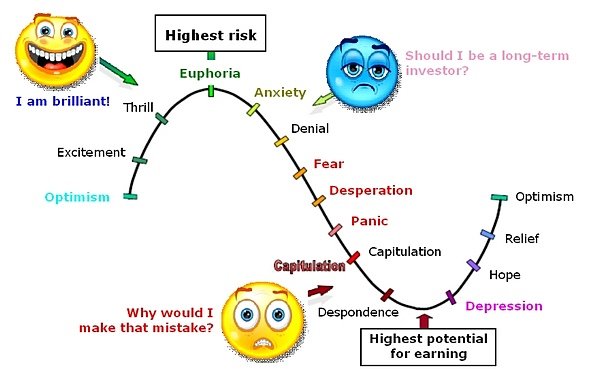
Instead of buying at low, we are waiting, and suddenly we find everybody is getting into the market like dot com companies, we lose control as we have emotion that we will be left behind and instead of buying at low we will end up buying at high. After some time, the market crashes, and instead of buying at low due to fear of losing we end up selling.”
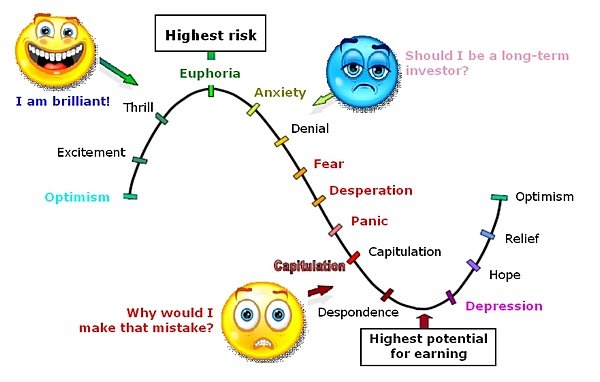
Market Cycle

So we do exactly the opposite which is foolishness caused by our emotions. Believe me, this emotion is the culprit for leaving us behind.

Burning Desires

Everyone wishes to have a luxurious car or a big bungalow as early as possible. These desires force us to invest in risky investments such as equities in the hope of getting higher returns quickly.

These shares may give returns that are higher than other instruments but if you make losses that are also terrible.

Overconfidence

Once you start trading in the stock market and a few of your trade get success, you will get confidence. But sometimes it may lead to overconfidence. You start taking bigger risk and ignoring warning or signal that may lead to losses.

Following Other People

Many people think that following a successful investor like “warren buffett” will help. However, you need to keep in mind that every individual has different risk-taking capabilities, goals, and wants. Investment done by others may not be the right investment for you.

A successful investor may be able to cope up with loss but you may not, which may cause strong disappointment and fear. You may take advice from professionals but blindly following anybody is not a good idea.

FAQs

How do emotions influence investment decisions?

Feelings like anxiety and desire frequently lead investors to make illogical investment choices. Fear may cause investors to sell quickly when the market is falling, while greed can lead to hasty purchases when the market is rising.

What is the significance of “buy low, sell high” in investing?

The basic concept of “buy low, sell high” stresses the importance of buying assets at a low price and then selling them when their value increases. The goal is to optimize profits by taking advantage of market inefficiencies.

How can investors overcome emotional biases?

Recognizing emotional biases is the first step for investors to overcome them, followed by implementing strategies like setting investment goals, diversifying portfolios, and maintaining a long-term view. Consulting with financial experts can also offer valuable counsel.

Why is buying low important for investors?

Purchasing assets at a lower cost enables investors to attain discounted prices and possibly achieve greater returns in the future with improving market conditions. It also diminishes the chances of paying too much for assets and enhances the safety buffer in investment choices.

What are some practical tips for selling high?

When trying to sell at a high price, investors should concentrate on recognizing assets that are overpriced by using fundamental analysis and market trends. Establishing precise exit criteria and adhering to a planned selling approach can prevent investors from making emotional decisions and successfully secure profits.


Why You Should Avoid Personal Loans

Personal loans can seem like an attractive option when you’re facing financial challenges or considering a major purchase. In today’s world income is limited but desires are endless. This desire often inspires us to take additional debt using credit cards or personal loans. personal loans can often lead to financial strain and should be approached with caution.

I advise you not to take any personal loan unless it is an extreme situation. Keep a personal loan as your last option to avail your immediate cash requirement.

Personal loans can be used for any purpose including medical expenses, marriage expenses, home improvement, purchasing household items or to pay your credit card debt. The best part is that you need not inform the bank about the purpose of taking a personal loan. In this way, personal loans are all-purpose loans.

In a home loan, car loan, or education loan you have to prove that you will be using this amount for said purpose only. A personal loan has one additional advantage the processing time of this loan is faster compared to any other loan. Most banks do not ask for any guarantor or any security deposit for this type of loan.

Due to this you might be thinking that this is the best loan option but believe me this is the worst loan option. Let’s discuss in detail why you should think of a personal loan as the last option.

personal loans

Why You Should Avoid Personal Loans

High-Interest Rates 

The interest rate charged by banks under personal loans is 14-18%.

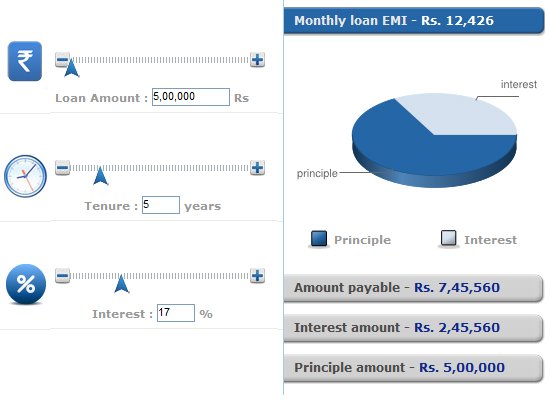
Let’s understand the facts by taking an example. Mr.X has an urgent need and he is taking a personal loan of 5,00,000 Rs/- an interest rate of 17% for 5 years. The effective EMI for this loan will be 12,426 Rs/-.

This loan will cost around 50% additional money as interest – 2, 45,560 Rs/-

Personal Loan Example

Personal Loan Example

This can result in significant interest charges over the life of the loan, making it more expensive in the long run.

Prepayment Penalty

Most lenders don’t allow part payment of loans. This means you end up paying the loan for the entire tenure of the loan. It can work out quite expensive since your initial installments go towards interest payments.  Some banks allow prepayment but they keep very high penalties for the prepayment of the loan.

Hidden Charges

Many banks keep certain hidden charges which make this loan more costly. Most of the borrowers forget to read the offer document/terms and conditions and may end up paying more.

Credit Score Impact

Obtaining a personal loan can harm your credit score, particularly if you already have a high debt-to-income ratio or a track record of tardy payments. Failing to make payments on time or defaulting on the loan can worsen your credit score.

Possibility of Entering a Cycle of Debt

Individuals who use personal loans to pay for their expenses could become stuck in a pattern of debt, continuously borrowing to fulfill their financial responsibilities. This could result in a negative cycle of mounting debt and financial strain.

It is usually advisable to stay away from debt but if you have a pressing need for cash & you can afford to repay it in a short period of time it is advisable to take a loan against assets like gold or property compared to a personal loan.

Lastly, decide if you can stay away from any loan. While this loan may be useful in certain instances like medical emergencies, it doesn’t make sense if you are using it on your vacations or any other fun-making expense.

FAQs

  1. Are personal loans ever a good idea?

    Personal loans can be a viable option in certain situations, such as consolidating high-interest debt or funding a necessary expense. However, it’s essential to carefully consider the terms and potential impact on your financial health.

  2. How can I qualify for a personal loan with favorable terms?

    To qualify for a personal loan with favorable terms, you’ll typically need a strong credit history, stable income, and a low debt-to-income ratio. Shopping around and comparing offers from multiple lenders can also help you secure the best possible terms.

  3. What should I do if I can’t afford to repay my personal loan?

    If you’re struggling to repay a personal loan, contact your lender immediately to discuss your options. They may be willing to work with you to modify your repayment plan or offer alternative solutions.

  4. What are the alternatives to personal loans for financing major purchases?

    Depending on your financial situation, alternatives to personal loans may include using savings, taking advantage of low-interest credit options, or exploring financing options offered by the seller, such as installment plans or store credit cards.

  5. How can I avoid falling into a cycle of debt with personal loans?

    To avoid falling into a cycle of debt, it’s essential to borrow responsibly and only take out loans for necessary expenses or investments. Additionally, focusing on building an emergency fund and improving your financial literacy can help you avoid relying on loans in the future.

What is required to be Successful in Business?

Many people dream of starting their own business but they never do so because they’re afraid of failing. It is known face that 9 out of 10 businesses fail in the first 5 years of starting the business.

So, the question that pops up in everyone’s mind is:-

Business Start

Success in business is a multifaceted endeavor that demands a combination of skills, strategies, and characteristics. From vision and goal setting to effective communication, building a strong team, and embracing innovation, there are several key elements that contribute to achieving success in the business world.

This may be due to a lack of experience, lack of cash, knowledge, or skills required to run the business.

So, let’s discuss in detail what is required to be successful in business.

successful in Business

What is required to be Successful in Business?

#1 The Mission

The most important thing for the business is its mission; many people start a business only to make money. Just to make money is not a strong mission. Money alone does not provide enough fire, drive, or desire to run the business.

One should have a strong and clear mission for the business, as the mission guides the actions of the organization, spells out its overall goal, provides a path, and helps in making decisions. It should provide “the framework or context within which the company’s strategies are formulated.

When a business gets big and it forgets its mission or the mission it was created for is no longer needed, the business begins to die.

#2 Leadership

You must have leadership qualities to run a business. A leader’s roles are a combination of visionary, cheerleader, and boss.

Business Leader

As a visionary, the leader must keep his or her focus on the corporate mission. As a cheerleader, he or she must inspire the team as it works together towards that mission as well as herald the successes along the way. As the boss, he or she must be able to take the tough calls regarding issues that distract the team from achieving the mission. The unique ability to take decisive action while maintaining focus on the ultimate mission is what defines a true leader.

With the right mission, team, and leader you are well on your way to building a strong business.

#3 Team

To succeed, a business must have the proper expertise in key areas. An individual may not have expertise in every area so he or she needs a group of people to formulate a successful business.

Team

Extraordinary team members with a good level of expertise will bring success to business. Choose the best team member to bring electrifying success.

#4 Cash Flow management

Cash flow management is a fundamental and essential skill if a person truly wants to be successful in the business. Cash flow is to a business what blood is to the human body. Nothing can impact a business more dramatically than not being able to make payroll at the end of the month.

Cash Flow

A good cash flow manager reviews his or her cash position daily, looking at cash sources and needs for the next week, month, and quarter. This allows him or her to plan for any large cash need before it becomes a cash crisis.

Effective cash flow management is critical for the success of any business, ensuring steady operations and growth. Leveraging expert accounting for SaaS companies can provide tailored insights into subscription revenue, churn, and recurring billing. This specialized expertise helps optimize cash flow, improve financial planning, and drive long-term profitability.

Business success often relies on smart financial management, and obtaining a free business credit report is key. It helps you monitor your company’s credit health, identify potential issues, and build credibility with lenders and partners.

Financial management is a continuous process many people lose sight of finance management when a business grows or becomes successful. This is a major cause of business failure. Proper finance management (and therefore expense management) is crucial to the ongoing success of any business.

#5 Communication management

One of the most important points for a successful business is communication management. The better you are at communication more and more people you will communicate to, thus increasing your chances of building more customer base.

Good Communicator

Most communication is directed towards external communication, but a business’s internal communication is also vitally important. Some examples of each are:

External Communication

  • Sales
  • Marketing
  • Customer service
  • To investors
  • Public relations

Internal Communication

  • Sharing wins and successes with your entire team
  • Regular meetings with employees
  • Regular communication with advisors
  • Human Resource Policies

Be a good communicator to be a good business man.

#6 People Management

Managing people effectively to release their full potential and enable them to succeed is the most important, and most difficult, job for a businessman. You must lead, motivate, inspire, and encourage them. Sometimes you will have to hire, fire, discipline, or evaluate employees.

Remember For any business, a major capital investment is an investment in people – ‘human capital’.

#7 System management

Every business, whether large or small, needs to have systems in place to enable it to conduct its day-to-day activities. Even a sole proprietor has to wear different hats to conduct his or her business. In essence, the sole proprietor is all systems in one.

For any business to grow, individuals must be accountable for each of the systems and a general owner / director must be in charge of making sure all the systems operate to their highest capacity.

The system required by every business:-

  • Daily office operation
  • Product development
  • Inventory
  • Order processing
  • Billing
  • Accounts
  • Marketing
  • Human Resources

#8 Legal management

In order to be successful in business one must know the legal aspects of the business. It is required to protect your business from legal matters which may happen.

Legal issues may surface in almost every facet of a business so you must know law or you must have experts to help you.

Some of the legal areas where you should focus on are:-

  • Consumer Law
  • Labor Law
  • Tax Law
  • Regulatory Compliance
  • Protecting Intellectual property

#9 Product Management 

The company’s product, which the customer ultimately buys from the business, is also an important aspect of a successful business. It could be a tangible item such as clothes or an intangible item such as consulting services.

Product management is to keep a close eye on the market (customer) and keep on modifying products as per customer needs. So product management is required by companies who need profit & success.

#10 Market

The success of your business depends on the market where you actually sell your product or services. If you are selling products where there is not enough demand (buyer) then you are trying to swim without water. So, market knowledge is equally important for the success of the business.

Conclusion

Success in business requires a holistic approach that encompasses vision, strategy, execution, and continuous improvement. By focusing on key elements such as vision and goal setting, effective communication, building a strong team, and fostering innovation, businesses can achieve sustainable growth and make a positive impact on society.

How to Become Wealthy? – Robert Kiyosaki Cashflow Quadrant

When it comes to wealth, people often struggle & spend their entire lives to become wealthy. Some of them can change the wheel of fortune and become wealthy while others don’t. In this post, we will suggest a proven way to become wealthy.

Many people believe that “Being rich is being wealthy” This is not true; being Rich is about how much money you possess at a specific moment in time.

Being Wealthy is about . . .

  • How much money do you keep?
  • How hard it work for you?
  • How much is left for future generations?

Being Wealthy is about exploding your Passive Income. (How long you can survive without ever having to go to work?).

  • A million-dollar question arises as to why only a few people are wealthy.
  • What do others have to do to become wealthy?

Let’s check out the views of the famous writer “Robert Kiyosaki “on this.

become wealthy

How to Become Wealthy? – Robert Kiyosaki Cashflow Quadrant

What The Wealthy Teach Their Kids About Money That The Poor And Middle Class Don’t.

We are a free country, not necessarily a fair country. We are all free to fail. We’re being taught to be “Good Employees.”  Process flow from the beginning of our childhood is:-

Go to school  –> Get good grades/results  –> Get a good “JOB” –> Work hard –> Maintain good credit

So we can consume lots of stuff. “JOB” for most means “Just Over Broke.”

This is a way to become “Wealthy?  –  NO

It is not your boss’ / employer’s job to make you wealthy or secure. Their job is to give you a paycheck. . . for work you have done & nothing more. You have to decide what you want to do with this money to become wealthy. The first thing you must learn is how to drive this money.

The biggest problem today is money drives most of us and we obey money.

  • Employers/Bosses
  • Landlords
  • Friends /Family

Probably it is because we are unable to drive money or maybe we are not smarter than our money?

If you want to be wealthy you have to be smarter than your money. You have to decide:-

Do you want to work for money? or do You want your money to work for you?

When money works for you, every rupee is your employee & you can decide how to take work from it. You have to manage the rupee so that every rupee works to bring you even more rupees while you’re asleep.

Yes, we are talking about the power of passive income. Passive income is income by Interest, dividends, real estate, rent, royalties, stock market, and annuities.

So it is not important that “What do you do?” but important is “What do you own?”

The key to becoming wealthy:-

  • Make investments that will bring passive income.
  • Know the difference between an ASSET and a LIABILITY, and only buy assets.
  • A True Asset will bring positive cash flow every month.
  • Live below your means, while constantly increasing your means. (Try to increase your active income)
  • Make your PASSIVE INCOME cover your Lifestyle Expenses forever.
  • Buy assets first, luxuries last.
  • If today you are unable to buy something ask yourself “How can I afford it?” This stimulates your creativity.

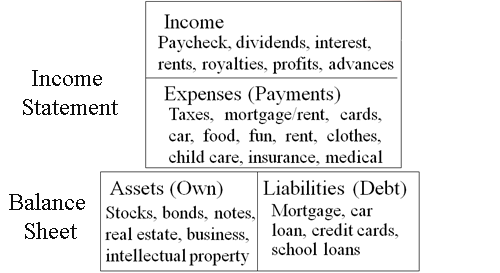
Sadly, most of us have been taught to read words and books, but not numbers and financial statements. Two key personal and business financial statements we all must be able to read.

  • The Income Statement shows the amount of money coming in and going out.
  • The Balance Sheet shows the balance of what you own and what you owe.

Income Balance

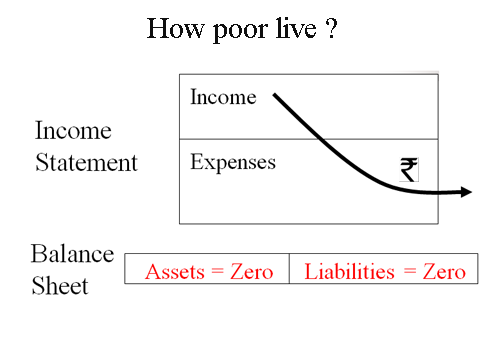
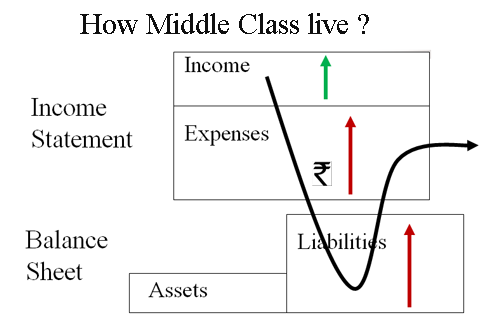
Let’s study the Income statements and balance sheets of the poor, middle-class, and wealthy people. Poor have small incomes and small expenses. Assets are zero and liabilities are zero.

Poor Live
The middle class has a stable income but they buy expenses and liabilities by thinking that they are buying assets. Expenses and liabilities are more and assets are less.

Middle Class Live

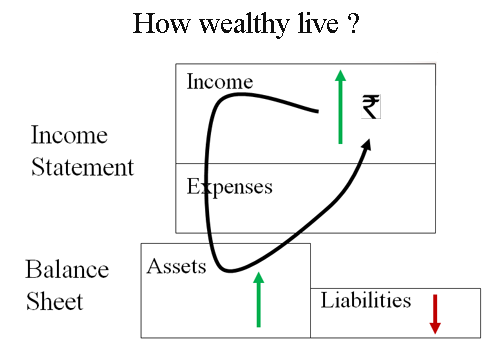
Now let’s take a look at how wealthy live. They usually take the income of the poor and middle class and buy assets that produce more income. Their assets produce passive income by which they again invest in assets to become wealthier. So to become wealthy you must invest in assets that are true assets and that will produce income for you.

Wealthy Live

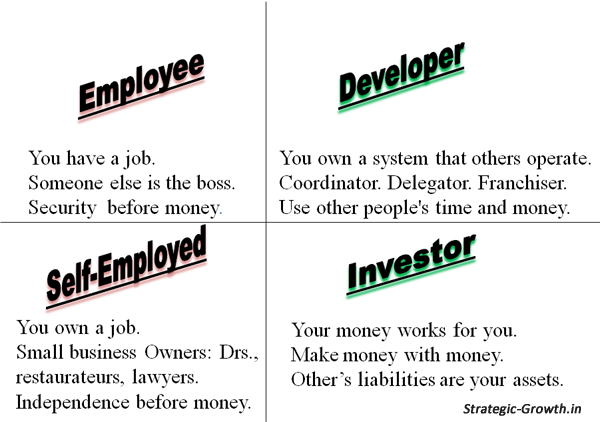
As per the Cash Flow Quadrant In the world, we have four types of people. Employees, Self-Employed, Developers, and Investor look at the following diagram.

Cash Flow

Understanding the Cashflow Quadrant is essential for individuals seeking financial success. It provides clarity on the various paths to wealth and helps individuals identify where they currently stand and where they aspire to be.

The E Quadrant: Employee

Characteristics of the E Quadrant

The E Quadrant comprises individuals who work for others and earn a fixed salary or wage. Employees typically exchange their time and labor for monetary compensation, often with limited control over their income and schedule.

Advantages and Limitations of Being an Employee

While being an Employee offers stability and certain benefits such as health insurance and retirement plans, it also comes with limitations. Employees have less autonomy and are subject to layoffs, salary caps, and the whims of employers.

The S Quadrant: Self-Employed

Characteristics of the S Quadrant

The S Quadrant consists of self-employed individuals who own their businesses or work as freelancers or independent contractors. They have greater control over their work and income compared to employees but often shoulder more responsibilities.

Pros and Cons of Being Self-Employed

Self-employed individuals enjoy autonomy and the potential for higher income, but they also face challenges such as irregular income, long hours, and the need to handle all aspects of their business.

The B Quadrant: Business Owner

Characteristics of the B Quadrant

The B Quadrant is inhabited by business owners who create systems and leverage the efforts of others to generate income. They focus on building scalable businesses that can operate independently of their direct involvement.

Benefits and Challenges of Being a Business Owner

Business owners enjoy the potential for unlimited income and the ability to create wealth through asset accumulation. However, they must navigate risks, manage employees, and adapt to market changes to succeed.

The I Quadrant: Investor

Overview of the I Quadrant

The I Quadrant represents investors who make money by putting their capital to work in various asset classes such as stocks, real estate, and businesses. Investors seek to generate passive income and grow their wealth over time.

Strategies for Becoming a Successful Investor

Successful investors employ strategies such as diversification, risk management, and long-term planning to achieve their financial goals. They continuously educate themselves and make informed decisions based on market trends and opportunities.

Transitioning Between Quadrants

Moving from the E or S Quadrants to the B or I Quadrants

Transitioning between quadrants requires a shift in mindset and approach to income generation. It often involves acquiring new skills, building networks, and taking calculated risks to pursue entrepreneurial ventures or investment opportunities.

Steps to Transition Effectively

Effective transition requires careful planning and execution. Individuals should assess their strengths, interests, and financial goals, and then develop a strategic roadmap to move toward the B or I Quadrants.

Building Wealth Through the Cashflow Quadrant

To build wealth using the Cashflow Quadrant, individuals must focus on leveraging assets and creating passive income streams. This involves investing in income-producing assets such as stocks, bonds, rental properties, and businesses that generate recurring revenue.

Conclusion

In conclusion, becoming wealthy is attainable for those willing to learn, adapt, and take action. By understanding and leveraging the principles of the Cashflow Quadrant, individuals can create multiple income streams, build assets, and achieve financial freedom.

FAQs

Is it possible to become wealthy without taking risks?

    • While risk-taking is often associated with wealth creation, there are ways to build wealth through conservative strategies such as disciplined saving and long-term investing.

Do I need a high income to become wealthy?

    • High income can accelerate wealth accumulation, but it’s not the sole determinant. Consistent saving, smart investing, and prudent financial management are equally important factors.

How long does it take to become wealthy?

    • The timeline for wealth accumulation varies depending on individual circumstances, goals, and strategies. However, achieving significant wealth typically requires time, patience, and diligent effort.

Can anyone become wealthy, or is it reserved for a select few?

    • Wealth is attainable for anyone willing to educate themselves, take calculated risks, and stay disciplined in their financial habits. It’s not reserved for a select few but rather accessible to those who are committed to their goals.

What role does financial education play in wealth creation?

    • Financial education is critical for making informed decisions about saving, investing, and managing money effectively. By improving financial literacy, individuals can navigate the complexities of wealth creation with confidence and competence.