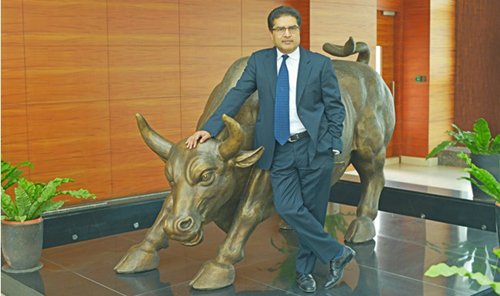
Raamdeo Agrawal, joint managing director of leading brokerage firm Motilal Oswal (MOSL) is back with the 21st wealth creation study report (2011-2016). This wealth creation study report gives information about top wealth creator and wealth destroyer stocks of last ten years. In all past 20 wealth creation studies, Raamdeo Agrawal has focused on what to buy? However, in 21st wealth creation report, he is also sharing information about how much to buy? Learning from the wealth creation report of Raamdeo Agrawal is given below.
21 Wealth Creation Study by Raamdeo Agrawal
How to make money from stock market?
Follow the steps given below in order to make decent money from the stock market.
The first step towards making money from the stock is set the goal for the investment and expected return. To simplified the concept Raamdeo Agrawal says when you plan to travel you decide destination where to go? Like Mumbai, Ahmadabad or somewhere else. Once your destination is decided you decide a mode of travel like a train, car, bus, or by plane. Your mode of travel decides the time for reaching a destination. Similarly in the stock market to earn a decent return (destination) it is important to select a right stock at right time (mode of travel).
Selection of stock –
The second step is a selection of stock. You must agree with Raamdeo Agrawal that a decent return can be given only by the company with the tiger concept (long term business opportunity) and tiger management available at a reasonable valuation. So, your task is to find out a company with the longevity of business and tiger management.
Raamdeo Agrawal gave an example of Pradhan Mantri Awas Yojana (housing for all by 2022 scheme). This scheme will bring a lot of business opportunity for housing finance and mortgage companies. So, you need to identify which company will gain maximum benefit from this scheme and likely to be become a leader in this market. In order to find out the leader, you need to look at the management of the company. The management of the company should have a competency, integrity, and passion towards business.
Once you identify right stock for the investment you should maximize the opportunity. Follow George Soros -“It is not important that how many times you win you may lose many more times but when you win how big you win?” When you have a tremendous conviction on a stock invest maximum amount.
The wealth creation report says that you should look at focused investment strategy and create a portfolio of only 10-15 stocks. Using a hypothetical example of 10 stocks, it explains how allocation could influence the performance of a portfolio. If funds allocated in different proportion return could be maximum or minimum.
Focused investing gives very good results. Rakesh Jhunjhunwala made it big because of focused investing in Titan, CRISIL and Lupin Stocks.
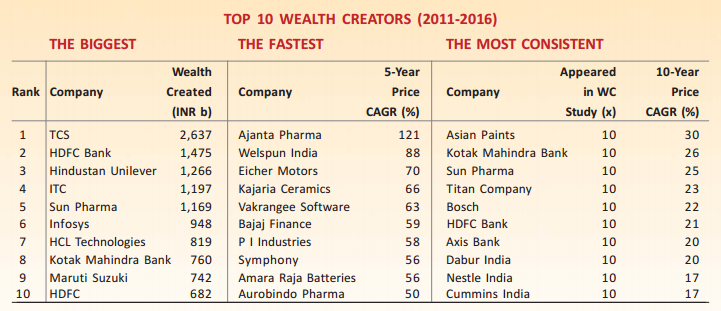
A biggest, fastest and most consistent wealth creator stocks as per 21st wealth creation report are given below.
Monitoring
Once you make the investment it is important to monitor your portfolio at a regular interval. It is suggested that you should monitor your portfolio quarterly. Make sure that your portfolio is giving you desired results or not make appropriate changes if required.
The core message from report is –
“Bet seldom, and only when the odds are strongly in your favor, but when you do, bet big, hold for the long term, and control your downside risk.”
Hope concept mention above will help you in making money from the stock market.
What is Virtual Credit Card (VCC)? How virtual credit card help cashless transaction? We are moving towards a cashless economy. It is claimed that cashless transactions are increasing in India. An increase in cashless transactions means an increase in the cybercrime and hacking attempt. A virtual Credit card is a secure cashless option that can protect you largely against hacking attempts or frauds. So, what is Virtual Credit Card? What are its benefits? How does virtual credit card work? In this post, I will provide complete details of Virtual Credit Card.
What is Virtual Credit Card (VCC)?
A virtual credit card is a replica of the real credit card that the user can generate online anytime whenever he/she wants to transact on any specific websites. VCC is a prepaid card that can be used only for the online transactions. A virtual credit card can be used only once and it expires automatically after 24 hours if not used. A virtual credit card is also called as a debit card as it does not give you any credit facility. VCC is the safest way to pay money online even if card information is compromised, the hacker cannot use the card beyond balance limit. In most of the cases, you need internet banking along with physical credit card to generate VCC.
It is a virtual card so you need not worry about theft or misuse.
It is a prepaid card where you can define your own limit.
A virtual credit card is one-time use card and it is self-destroying after 24 hours.
This card can be used only for online purchases.
No additional service charge applicable for using virtual credit cards.
Why should you use Virtual Credit Card?
The three compelling reasons for using a virtual credit card are given below.
Security
The biggest benefit of using a virtual credit card is security and peace of mind. You can simply avoid a credit card fraud by using VCC. This card can be used only once. Once CVV number of VCC is used it becomes invalid so, it eliminates the chance of misusing credit card information. This card is self-destroying and it expires automatically after 24 hours so usage period of this card is limited.
This card gives the flexibility to end user. It can be generated anytime using any amount starting from Rs.10 to Rs.50, 000.
Free
Virtual credit cards are free. In India bank don’t charge any money for making and usage of virtual cards.
Virtual Credit Cards provided by Banks
Kotak Netc@rd
You can generate Kotak Netc@rd by following the procedure given below.
Go to http://www.kotak.com/ and log on to Net Banking using your login ID (CRN) and password. Click on “netc@rd” tab post which you will receive an OTP at registered mobile number. Select the account from which you wish to draw funds for creating netc@rd and click OK to generate.
SBI Virtual Card
The process of generating SBI virtual card is given below.
Visit SBI Internet Banking https://www.onlinesbi.com/ and Login using internet banking user ID and password. Click on “e-card” tab and select “State Bank Virtual Card Option”. Select Account number and enter virtual card limit. After verification generate Virtual Card.
HDFC Bank Netsafe
The generation of HDFC Bank Netsafe virtual card is given below.
Visit Netsafe HDFC website. Accept terms and condition and enter your Credit card number and expiry date. On submission of detail, the system will ask you to generate a virtual card with a credit limit.
Virtual Credit Cards provided by Service Providers
FreeCharge Go MasterCard
Freecharge Go MasterCard is provided by freecharge. It is a free virtual card. It is powered by master card and Yes Bank. You can use this card across any online merchant.
Entropay Virtual Visa Card
Entropay is not based in India. Entropay offers free virtual visa cards. Entropay is open to anybody and is usable internationally. However, this product is not used in India.
Over to You –
From above discussion, it is clear that virtual credit card gives multiple benefits and it is best in terms of security, however, this card has certain limitations. You cannot use this card at a store or for telephonic purchase. This card cannot be used for the withdrawal of cash.
Looking at benefits I have decided to use a virtual credit card now onwards. What about you?
India’s financial ecosystem has been riding a digital wave for the past few years, and let’s be honest—it’s nothing short of revolutionary. Gone are the days when you needed to carry a fat wallet stuffed with cash, worry about change, or stand in long queues for payments. Today, cashless payment methods have taken center stage, making life faster, smoother, and more convenient.
Whether you’re buying groceries from the neighborhood kirana shop, booking a movie ticket, or paying your electricity bill, digital payments are now the default. What’s more, with government initiatives like Digital India and the rise of fintech startups, India has become one of the fastest adopters of cashless systems in the world.
But here’s the big question—what are the best cashless payment methods in India right now? With so many apps, cards, and platforms out there, it can be tricky to figure out which one’s worth your trust and time. That’s exactly what this guide is all about.
We’re going to break down the 10 best cashless payment methods in India for 2025, explaining how they work, why they matter, and where they shine. Plus, I’ll throw in some FAQs and a neat conclusion to help you wrap your head around the options.
Ready? Let’s dive right in!
10 Best Cashless Payment Methods
Cheque
The cheque is one of the oldest methods of cashless payment. It is a known method to everyone. In this method, you issue a cheque for the specific amount to someone else. The cheque gets deposited in the respective bank. Nowadays, many people even look for ways to make voided check online for easier transactions. The bank processes a payment through a clearing house.
The entire transaction done through a cheque gets recorded and there is a proof of payment. However, there are instances where cheque payments get dishonored due to signature mismatch or insufficient fund. In order to avoid such issue, you can use other cashless payment options.
UPI (Unified Payments Interface)
UPI has single-handedly redefined digital payments in India. Launched by the NPCI (National Payments Corporation of India), it’s now the go-to method for millions of Indians.
Why UPI stands out:
Ease of use: Just link your bank account, set a UPI PIN, and you’re ready to roll.
Instant transactions: Money transfers happen in seconds, 24/7—even on holidays.
Wide acceptance: From tea stalls to luxury stores, UPI is accepted almost everywhere.
Zero charges (mostly): Most banks don’t charge users for UPI transfers.
Popular UPI apps include PhonePe, Google Pay, Paytm, and BHIM. And with UPI Lite and UPI international, the system is evolving even further.
Mobile Wallets – Convenience in Your Pocket
While UPI may have stolen the spotlight, mobile wallets still have their charm. Apps like Paytm Wallet, Amazon Pay, and Mobikwik allow you to load money in advance and use it for payments.
Benefits of mobile wallets:
Great for small, everyday transactions.
Offers cashbacks, discounts, and loyalty rewards.
Secure payments without sharing bank details.
Works even when your bank server is down.
Mobile wallets are especially handy for metro rides, online shopping, and prepaid services.
Credit Cards – The Old but Gold Cashless Payment Method
Credit cards aren’t new, but they’re still one of the most powerful cashless payment methods in India. They allow you to spend first and pay later, often with attractive perks.
Why credit cards are popular:
Reward points and cashback: Every swipe counts.
Builds credit score: Useful for future loans.
Interest-free period: Usually 30–50 days.
Global acceptance: Works across countries.
From SBI and HDFC to ICICI and Axis Bank, almost every bank has multiple credit card options tailored for different lifestyles.
Debit Cards – Simple and Straightforward
Debit cards are probably the most straightforward cashless payment method. Unlike credit cards, they directly debit money from your bank account.
Key perks:
No debt worries: Spend only what you have.
Widely accepted: From ATMs to PoS machines, they work everywhere.
Even in rural India, debit cards paired with RuPay have boosted digital inclusion massively.
Internet Banking – The Classic Digital Route
Before UPI became a buzzword, internet banking was the backbone of cashless payments. Even today, many prefer it for larger, scheduled transactions.
Advantages of internet banking:
Ideal for NEFT, RTGS, and IMPS transfers.
Easy bill payments and fund transfers.
Safe and traceable.
Works well for businesses and corporates.
Though not as flashy as UPI, internet banking remains a reliable choice for people who like doing things the traditional way.
QR Code Payments – Scan, Pay, Done!
Walk into any shop today, and you’ll probably spot a QR code stuck near the billing counter. That’s because QR code-based cashless payments have exploded in popularity.
Why QR codes rock:
No extra hardware needed: Just a printout of a code.
Super quick: Scan with your phone, confirm, and done.
Secure: No need to share card or bank details.
Low-cost for merchants: Even small vendors can accept payments.
QR codes are the unsung heroes of India’s cashless revolution—especially for small businesses.
Aadhaar Enabled Payment System (AePS)
AePS is unique to India and is designed with inclusivity in mind. It allows people to make cashless payments using their Aadhaar number and biometric authentication.
Why AePS is important:
Enables financial access in rural and semi-urban areas.
No need for debit cards or smartphones.
Works through micro ATMs and banking correspondents.
Useful for government subsidies and welfare schemes.
AePS bridges the gap between modern banking and India’s vast unbanked population.
Prepaid Cards – Best for Controlled Spending
Prepaid cards are another versatile cashless payment method in India. Unlike debit or credit cards, these cards aren’t linked to your bank account. Instead, you load a specific amount and use them until the balance runs out.
Where prepaid cards work best:
Great for gifting (gift cards).
Ideal for corporate benefits and employee rewards.
Useful for budgeting personal expenses.
Accepted at most online and offline merchants.
Think of them as a smarter replacement for carrying physical cash.
Buy Now, Pay Later (BNPL) Services
BNPL is a relatively new player in the cashless payment scene but has gained massive traction among youngsters. Platforms like Simpl, ZestMoney, and LazyPay let you buy products and pay for them later in installments.
Why BNPL is trending:
Instant credit approval.
Zero or low interest.
Perfect for online shopping.
Flexible repayment options.
BNPL has become a hit during festive seasons, giving people the flexibility to shop without immediate financial strain.
Why Are Cashless Payments Growing So Fast in India?
It’s not just about convenience—there are deeper reasons behind the boom in cashless payment methods:
Government push through Digital India and demonetization.
Affordable smartphones and cheap data plans.
Increasing trust in digital systems.
Wider merchant acceptance.
Rewards and cashback culture.
Challenges of Cashless Payment in India
Of course, no system is perfect. While the future is bright, there are still some bumps along the way:
Cybersecurity risks and online fraud.
Dependence on internet connectivity.
Digital illiteracy in rural pockets.
Over-spending temptation with credit/BNPL.
But with stricter security measures and better awareness, these hurdles can be minimized.
FAQs
Q1. Which cashless payment method is the safest in India? UPI and credit cards with two-factor authentication are considered among the safest options.
Q2. Can I use cashless payments without internet? Yes! Options like AePS and offline UPI Lite work even without internet.
Q3. Do small shops accept cashless payments? Absolutely. Thanks to UPI and QR codes, even roadside vendors accept digital payments today.
Q4. Are there charges for using UPI? Most banks and apps don’t charge for UPI transactions, though a few may apply small fees beyond certain limits.
Q5. What’s the future of cashless payments in India? Expect more innovations like voice-based payments, AI-driven fraud detection, and wider adoption of NFC technology.
Conclusion
Cashless payment methods in India aren’t just about convenience anymore—they’ve become a way of life. From UPI’s unmatched dominance to the futuristic promise of NFC, India’s digital landscape is brimming with options.
The 10 best cashless payment methods in India we’ve explored show how far we’ve come—and how much more potential lies ahead. Whether you’re a tech-savvy urban dweller or a farmer in a rural village, there’s a cashless payment option tailored just for you.
So, the next time you’re about to pull out cash, pause for a second. With so many seamless alternatives at your fingertips, why not go digital? After all, the future of money in India is truly cashless.
Investment in good pharma stocks will turn out to be a lottery to the investor. This crystal clear message was given by Rakesh Jhunjhunwala India’s warren buffet at the beginning of the current financial year. It seems Rakesh Jhunjhunwala was right. Best Pharma Stocks has given a magnificent return in last one year. Moreover, investment in good pharma compaines for long term always pays good returns to the investors.
The pharma sector is performing well and it is expected that pharma stocks will give multifold returns in next five to seven years. So, it is recommended to inject a dose of pharma stocks in your portfolio. Before starting actual talk on best pharma stocks let’s find out why pharma stocks are good for the investment?
A major revenue of pharma companies comes in the US $ from export orders. The depreciating value of rupee gives export competitiveness to these companies.
A Pharma Companies enjoys dual markets Indian and International.
World-class research and development facilities of these companies give them a competitive edge over others.
The pharma companies work towards innovation and come out with new products. These new products lead to an increase in revenue and profit margin of these companies.
The best pharma stocks have given consistent returns to the investors in the past.
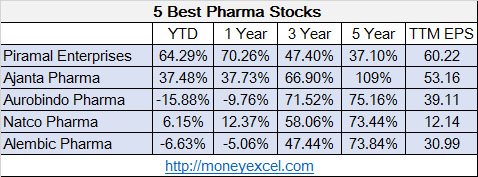
So, after understanding compelling reason for investing in pharma stocks, let’s take a look at the Top 5 Best Pharma Stocks for long term investment.
Piramal Enterprises is Flagship Company of Piramal Group. The company has a presence in the pharmaceutical, financial services, and information management sectors. The stock of Piramal Enterprise has given CAGR return of 70.26% in last one year. TTM EPS of this stock is very good. This stock has given a consistently good performance in the past.
2. Ajanta Pharma
Ajanta Pharma is most popular evergreen pharma stocks of pharma sector. Ajanta Pharma has given highest return to the investor in past five years. In last year this stock has given 37% return to the investor. This stock is expected to give better performance in future. You can invest in Ajanta Pharma.
3. Aurobindo Pharma
Aurobindo Pharma is leading pharma company. This year Aurobindo Pharma has given a negative return. However, in the long run, this stock has given very good returns to the investor. EPS and TTM EPS of the share are also good.
Natco Pharma is consistent performer stock since past 5 years. CAGR return of the stock this year is 12.37%. Natco has recently got final approval from USFDA for Armodafinil tablet. You can plan to invest in Natco Pharma for the long term.
5. Alembic Pharma
Alembic pharma is one of the oldest pharma companies of India. YTD return of Alembic Pharma is -6.6%. However, at long run, Alembic Pharma has generated a very good return to the investor. EPS and TTM EPS of the stock are good.
Do you think pharma stock will be a good bet for the future?
Have you made any investment in these pharma stocks?
Do share your query and questions in comment section.