
Blog Page 370

5 Best Investment Options in India for 2018

0

best investment options

Which are Best Investment Options in India for 2018? Where should I Invest money in the year 2018? Well, before getting answers to these questions let’s take a quick look at the year 2017. The year 2017 was a year of equity and cryptocurrency. BSE Sensex gave 28% returns to the investor in the year 2017. A Cryptocurrency was another disruption in the year 2017. Bitcoin turned out to be a real hero for many investors with a massive return of 5700% in 2017. In my opinion, stock market rally and upward movement in cryptocurrency are likely to continue in 2018. Keeping this in mind 5 Best Investment Options in India for 2018 are given below.

5 Best Investment Options in India for 2018

Stock Market
First best investment option for 2018 is stock market. One can generate a lot of wealth by investing in stock market provided investment is done in right stock at right time. There are many examples of Mutlibagger stocks like MRF, Caplin Point Laboratories, Infosys, TCS that have made investor wealthy over a long run. However, it is difficult to identify good stock for Investment. If you a skill to identify future multibagger stock for the investment you should invest in stock market.

Who should invest in Stock Market?
Knowledge and skill are must for stock market investment. If you have knowledge, skill and high-risk taking capacity you can plan to invest your money in stock market.

Also Read – 10 Best Short Term Investment Options

Mid Cap & Small Cap Mutual Funds
Mid Cap & Small Cap Mutual funds are one of the most profitable investment options in India. In last one year, few mid-cap & small-cap mutual funds have generated more than 50% return for the investor. You can opt for Systematic Investment Plan (SIP) or lump sum method for investment. It is better to select the direct mutual fund for investment. The direct mutual fund gives better return compare to normal mutual funds.

Who should invest in Mutual Fund?
If you want to balance risk and return mutual fund investment is for you. You can expect very good returns from mutual funds over a long run.

Cryptocurrency
Cryptocurrency is new investment option. This investment option is only for investors with a high-risk profile. If you are looking for quick gain on your investment you can invest in cryptocurrency bitcoin. However, it should be a very small percentage of your portfolio. The maximum cap on cryptocurrency should be 5% of your portfolio.

Who can invest in Cryptocurrency?
Cryptocurrency can be a bubble. The investor with high risk taking capacity can go for it. A risk-averse investor should stay away from this currency.

Must Read – Top 10 Long Term Investment Options in India

Peer 2 Peer Lending
Peer 2 Peer Lending is another best investment option in India. In this option, you need to lend money to individual or business through online services. You can expect 15-20% gain by lending money. However, it is risky investment option as a chance of losing money is high.

Who should invest in Peer 2 Peer Lending?
An investor with excessive cash and high risk taking capacity can opt for Peer 2 Peer lending option. You need to carry out due diligence before lending money to anyone.

PPF
PPF or Public Provident Fund is most popular investment option in India. PPF offers an interest rate of 7.6%. PPF investment also offers tax benefits under section 80C. The PPF matures in 15 years. You can withdraw money from PPF account after 6 years.

Who should invest in PPF?
PPF is particularly relevant for individuals with a low-risk appetite looking to save money over the long term for retirement planning or any other long-term financial goal. A high-risk investor can also invest in PPF to balance their portfolio.
Model Mutual Fund Portfolio for 2018

mutual fund portfolio

A Model Mutual Fund Portfolio means a perfect portfolio suitable for everyone. However, in the real life, there is nothing called as a perfect mutual fund portfolio. The reason is financial goals, risk profile and investment preferences of every individual are different. So, the portfolio building exercise includes multiple factors such as the age of investor, financial goal, risk profile, time horizon etc. Let’s try to understand the basic process of building a Mutual Fund Portfolio.

How to build a Mutual Fund Portfolio?

A step by step method used for building a mutual fund portfolio is given below.

  1. The first step in building a portfolio is defining a financial goal. Once you are done with defining your goal it becomes easy to build a portfolio.
  2. If your goals are short-term you can invest in fixed income investment. Fixed income investments are the best choice for short-term investment horizon. Here the meaning of short-term is less than 3 years.
  3. The next is deciding financial target and risk factor. If you can answer risk and returns precisely you have won the battle. E.g You can invest “X” amount every month and you will need “Y” amount after 3 years for your daughter’s marriage.
  4. Once you are through with this you need to start building your portfolio. As you have investment horizon and risk profile it will be easy for you to build the portfolio.
  5. You can either build a single common portfolio for your all financial goals or make an individual portfolio for individual financial goals. The second method would be difficult but surely give better results.

Also Read – How to Apply Loan against Mutual Funds for Financial Securities?

If you want to build your portfolio but don’t know which mutual fund scheme to select? Or you have already invested in a mutual fund but not sure if they are appropriate? Whatever be the case, I am herewith 3 model mutual fund portfolio for 2018.

These mutual fund portfolio should not be considered as a verdict for the investment. It is given here for the reference only. You can design your own portfolio on similar lines, based on financial goals, age, risk profile and other factors. Three types of portfolios are given Aggressive, Moderate and Conservative.

Model Mutual Fund Portfolio for 2018

Aggressive Profile

This type of mutual fund portfolio is best suited for the young individuals who have begun to earn money. They have very low or no financial obligation. The typical age group would be 20-35 Years. These type of investors are willing to take a risk for high return. They are not afraid of stock market uncertainties.

Recommended Post – MoneyWorks4me – Mutual Funds and Stock Decision Making Tool

The best-suited mix for these type of investor would be a small cap, mid cap funds along with multi-cap funds.

mutual fund portfolio aggressive profile

Moderate Profile 

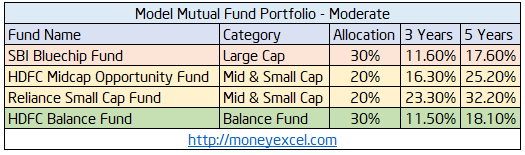
The moderate investors are slightly older. Typical age group would be 35-50 Years. They have financial responsibilities. However, they are willing to take some risk with finances. For moderate risk investor, a portfolio with the addition of large-cap and balanced mutual fund with optimum allocation will do.

mutual fund portfolio moderate risk profile

Conservative Profile 

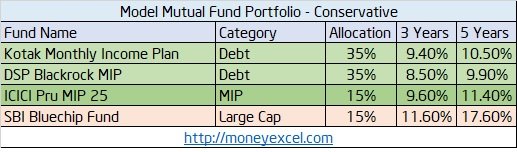
The conservative investors are a risk-averse investor. Protection of capital with small growth is their preliminary concerns. They are nearby retirement age typically above 50 years. They cannot afford the risk of the equity market. For these type of investors debt oriented schemes along with MIP are recommended mix. In addition to this small percentage of investment can be made in safe large-cap funds.

mutual fund portfolio

Note – Number of funds in your portfolio should not exceed certain limit. Ideal count would be 5-7. It will help in effective management and monitoring of the funds. The SIP amount in these funds depends purely on your financial goal and horizon.

Disclosure –  I have done SIP in SBI Magnum Multicap Fund & HDFC Balance Fund.

Do share your queries and comments.

Subscribe to our blog and get latest updates in your inbox.

Best Portfolio Management Services (PMS) in India

6


Portfolio Management Services (PMS) is a professional service offered by experts for the portfolio management. In this service, the Portfolio Manager manages client portfolio on their behalf. The prime objective of PMS is to help the client in getting the highest returns. Historically, some of the PMS has generated exorbitant wealth for the investors. E.g If you had invested Rs 25 Lakh in Porinju Veliyath’s Equity Intelligence PMS five years ago, your investment would be worth around Rs 1.25 crore today. What is Portfolio Management Services? What are the benefits of PMS? How does it work? Which are Best Portfolio Management Services (PMS) in India? Let’s try to get answers to these questions.

stock market portfolio management

What is Portfolio Management Services (PMS)?

In simple terms, portfolio management service is a service in which your equity portfolio is managed by the professional portfolio manager. The entire decision of buying or selling of stock is done by them on your behalf.  The portfolio manager possesses rich experience and is backed by a research team.

The portfolio manager charges fees in order to manage portfolio. This type of service is taken by High net worth individual or institutions. The minimum portfolio size for availing PMS services is 25 Lakh.

Porinju Veliyath Portfolio Holdings – Success Story of Porinju Veliyath

Types of Portfolio Management Services

In general, there are two types of PMS services namely Discretionary and Non-Discretionary.

Discretionary PMS – In Discretionary PMS, your portfolio is managed entirely by the portfolio manager. The decision about where to invest and at what time is at the discretion of Portfolio manager.

Non-Discretionary PMS – In Non-Discretionary PMS, your portfolio is partially managed by the portfolio manager. Your portfolio manager advice you about buy and sell activities. The execution of trade take place after taking consent from you.

In India, most of the PMS providers offers Discretionary services.

How PMS works?

Once you opt for the services offered by PMS, a dedicated portfolio manager shall be allocated to you. You need to make payment by cheque and transfer your existing shares to the PMS account. You need to sign portfolio management agreement and demat account opening form. There will be separate demat account once you opt for PMS. Apart from this, you need to submit PAN card, Aadhaar card and residence proof.

A portfolio manager showcases a model portfolio based on your risk profile and financial goal. Based on your agreement investments take place. A portfolio manager makes changes to your portfolio based on market condition and risk profile. This is to ensure maximum gain from the invested money. You will get regular updates about the performance of your portfolio.

Technical Analysis or Fundamental Analysis – Which is better?

What are the benefits of PMS?

  • PMS is managed by a qualified and experienced portfolio manager. So, you are likely to get superior returns by adopting PMS.
  • A stock portfolio backed by a high level of investment expertise and research.
  • Personalization and customization based on the risk profile of the investor.
  • Strong and Active Risk management.
  • Portfolio Manager is directly accountable to the client, a client can seek justification especially in case of discretionary services.
  • The complete transparency is another benefit of PMS. The client will be updated time to time about the performance of the portfolio.

Best Portfolio Management Services (PMS) in India

1)    Porinju Veliyath Equity Intelligence PMS

Equity Intelligence PMS is claimed to be Best Portfolio Management Service Provider in India.

Equity Intelligence was incorporated in 2002. It is backed by Investment guru Porinju Veliyath. It is SEBI registered portfolio management firm with a track record of providing a very good return to the investor.

It is claimed that since inception EQ PMS has generated 32.76% return for the investor. This year in FY2017 EQ PMS has generated 46.98% return.

The minimum Investment required for this PMS is Rs.50 Lakh. Earlier it was Rs.25 Lakh but in order to maintain quality and to reduce rush this amount is increased to Rs.50 lakh. The fees charged by EQ PMS is 2% per annum charged quarterly @0.5% on average NAV and 10% share of the returns above 10% per annum.

2)    Motilal Oswal Next Trillion Dollar Opportunity

The second Best PMS on the list is Motilal Oswal Next Trillon Dollar Opportunity (NTDOP). Motilal Oswal PMS was established way back in 2003. In last five years this PMS has generated 31.5% return for the investor. It is backed by dedicated team of experts including Raamdeo Agrawal.

The minimum investment required for Motilal Oswal Next Trillion Dollar Opportunity is 25 Lakh. You can top up this plan with additional amount 5 Lakh. The fees for this PMS is variable and based on the performance of portfolio.

NRI can also invest in this PMS services.

5 Best Demat Account in India for New Investors

3)    ASK India Select

ASK India Select is third best portfolio management service in India. ASK India is backed by team of experts. ASK India select has generated 26.4% return in last five years.

The minimum investment required for ASK India select PMS is 5 Lakh. You can increase this investment any time. The fixed fees for this PMS is 2.5% to 3.50%. In addition to this, client needs to pay brokerage amount. Apart from fixed fees additional variable component of performance based fees is also involved. Overall it is a good choice for investment.

Points to consider while selecting PMS in India

You should consider following points while selecting PMS for the investment.

  • First thing you need to consider is Investment Horizon. Your horizon can be short term, long term or medium term.
  • Portfolio Strategy and performance is another important point to consider. A portfolio should beat the benchmark.
  • Minimum investment also matters. Some PMS offers services with minimum investment amount of Rs.50 lakh. Higher the amount means higher the risk.
  • Entry and exit load charged by PMS is another important factor one should consider.
  • Some PMS has Lock-in period. You should stay away from such PMS.
  • Fees charged by the PMS is another important point one should consider before making any investment.

Should you Opt for PMS?

Portfolio Management Services are recommended only for High Net worth individual with high risk taking capacity. This service is not recommended for the normal investor. If you have the capacity to invest in the stock market, but you are lacking with skill and time PMS is for you.

Note – The selection of Best Portfolio Management services given above is based on user feedback and experience. I have not availed any services from above PMS. You are requested to carryout own due diligence before making investment in any PMS.

Happy Investing!

How to Verify Aadhaar & PAN at EPF UAN Website?

verify aadhaar

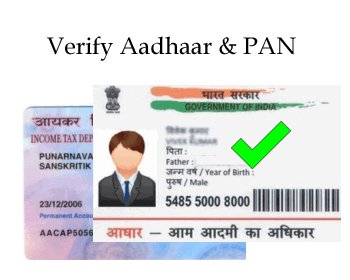
Once you link your Aadhaar and PAN with EPF account, you need to digitally verify Aadhaar & PAN at EPF UAN website. As per EPF UAN website, digitally verification of KYC such as Aadhaar & PAN is mandatory for availing EPF services. In this post, we will take a look at the complete process of How to Verify Aadhaar & PAN at EPF UAN Website? We will also take a look at online verification status of KYC.

EPF UAN Passbook Download Portal Facility – New Interface

How to Verify Aadhaar & PAN at EPF UAN Website?

The steps for online verification of Aadhaar and PAN at EPF UAN website is given below.

  • Visit Unified Member Portal – https://unifiedportal-mem.epfindia.gov.in/memberinterface/
  • You will be prompted for UAN Login and Password. After Entering UAN and Password enter Captcha text and press Sign In button.
  • After successful authentication, you will be taken to the page where it will show your member profile, UAN Card, and Account setting section.
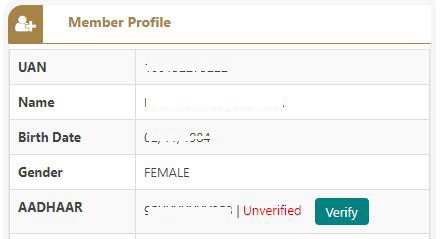
  • Under Member Profile, you will be able to see the section of AADHAAR and PAN.
  • If AADHAAR and PAN are not verified it will show Unverified text with red color beside Aadhaar and PAN number.

Verify Aadhaar

  • Along with that, it will also display “Verify” button.
  • For Aadhaar verification press Verify button beside Unverified text in Aadhaar Section. Now the system will verify your Aadhaar number with UIDAI database. You will see message box with Verifying text.

verify PAN

  • On successful UIDAI authentication status is updated to Verified with UIDAI. In case of mismatch in Name, DOB or Gender it will display a warning message.
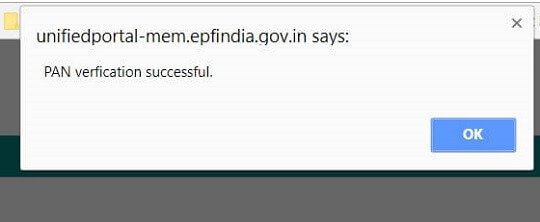
  • For PAN Verification press Verify button beside Unverified text in PAN Section. Now the system will verify your PAN number with Income tax database. On successful verification it will say PAN Verification Successful and status will be changed to Verified.

Online EPF withdrawal Claim Submission Process

PAN Verification

Online Verification Status of KYC

KYC means Know Your Customer. It is a process to know detail about Customer.

To check Online Verification Status of KYC, login to UAN Portal and go to Manage > KYC. In this section, you will find KYC related information. You can also see a section for KYC Pending for Approval and Digitally Approved KYC Section.

The last column under Digitally Approved KYC section is Online Verification Status. The status under both PAN and Aadhaar should appear as Verified.

EPF withdrawal for buying house and paying EMI – New EPFO rule

verification status

Under Digitally Approved KYC Section you should have minimum following documents approved for KYC.

  • Bank Details
  • Aadhaar
  • PAN- Mandatory if you do withdrawal before 5 years of EPF contribution as TDS is deducted.

If you find missing information in this section you can add it using Add KYC section. Once you are done with adding detail press Save Button. Now this detail will appear in Pending KYC Section. You have to wait for the employer to approve the KYC details.

After approval by your employer, these documents appear in Digitally Approved KYC as shown in the image below.

I hope the information given here for the online Verification of Aadhaar & PAN will help you in the completion of online verification. In case you have any query feel free to post it in the comment section.