Blog Page 371

Financial Planning Your Basic Need

”Financial

Although financial planning is basic need today many people yet do not understand anything about financial planning. When we ask for monthly income of people visiting us 100% people answer it promptly but if we ask them how much percent they invest on yearly basis, 90 people out of 100 is unable to answer it.

If we make balance sheet of our life considering average life span of 70 years we start our education life from 3 years and we continue it till 24 year. Once our education life is over we enter in professional life where we start earning money. From 24 years to our retirement age 60 years we try earning maximum money either by doing job or by business. So on and average person spends 35 years of his/her life in earning money.

Half of our life span is dedicated for earning money. We work very hard to earn money but we hardly plan anything for this hard earned money. Most of people spend and invest money randomly without any planning.

Earning more money is not in everyone’s hand but planning of this earned money is in our hand.  How much to percentage we should spend and how much percentage we should invest in which asset class we should decide it wisely.

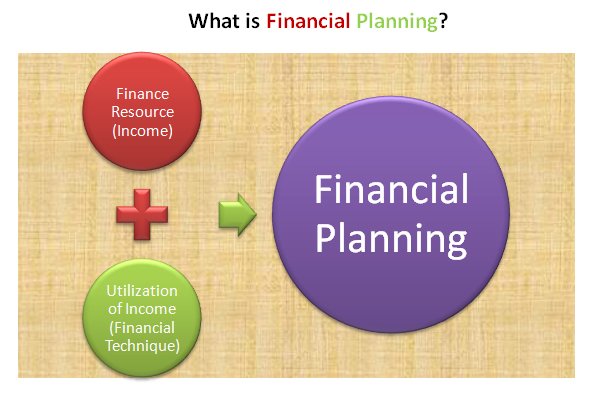
So utilization of this income (financial resource) for investment using correct financial technique is called as Financial Planning. Financial planning is basic need today.

”What

Yet 70 out 100 persons still spend money without any planning or follow other people blindly when it comes to investments. When they need more money they end up taking personal loans and later stage they find them inside deep debt.

Not only that 75 out of 100 people spend more money than their earning. They are simply not aware that how much money they need for spending every month.

So ultimately you should understand that if earning is not in your hand other two Spending and Planning is in your hand only. If you don’t control E(earning) S(spending) & P(planning) in your life than at the end your position will be like “Khaya Piya Kuch Nahi Glass Toda Bara Anna”.

So if you have not planned anything yet, start planning now before it’s too late.

Tips for getting higher returns from share trading

Share Trading

How many times have you bought a stock on someone’s advice to make a quick buck and waited for months, may be years, to just recover your cost? Share trading, experts warn, is a risky game. However, it’s possible to play it smartly and make a quick buck as well, they say.

“The main attraction of trading is that people feel they can make quick money. But there are no free lunches. Trading requires a lot of discipline.”

While traders do make as well as lose money, whether this activity suits you depends on your financial position.

TYPES OF TRADES

You can trade in shares and commodities. However, in India, retail investors mainly trade in stock futures and options due to sheer volumes. Trading means buying and selling a stock the same day or holding it for just 2-3 days. The former is called intra-day trade. The latter is called swing trade. Positional trade generally involves taking a longer position and holding a stock for 2-3 weeks.

MAKING MONEY

Profits depend on risk appetite & risk management, how much money you invest and how many of your trades turn out to be profitable. You can make 3-4% in a day or even lose money

It also depends on how much capital is available with you, how many opportunities you can explore and your knowledge of technical analysis.

SKILL SETS

While any recipient of the so-called ‘hot tip’ can trade, making money consistently is possible only when you have sufficient knowledge of the markets and skills for technical analysis, which is the science of forecasting prices based on historical data.

The software for technical analysis is available on the internet for free, but with limited features. Professional software capable of highly detailed analysis comes at a price. One should either have knowledge of technical analysis and the market or should have good technical consultant to help him.

Stock exchanges, such as the Bombay Stock Exchange and the National Stock Exchange, offer courses in technical analysis. Another institution which offers such courses is Online Trading Academy. “People should trade only if they can take risk, control emotions, set targets and book profit/loss at the target point.

TRADING TIPS

While one can get many trading tips, their execution is important. It’s a battle of emotions. Trading is simple, but not easy. You have to be disciplined.

The importance of discipline in share trading cannot be obver stressed. That is because in most cases, when people are making money, greed makes them wait for more, and so they don’t book profits. When prices fall, fear makes them sell fast. These situations can be avoided if they know when to book profit/loss.

If losses are not a restraint and the market’s roller-coaster movements give you a high, here are a few habits and skills that can help you stay on the right track. These are useful for day traders as well as positional traders.

Skillset required for trading is as follows:-

Discipline:

The key to success is a stop-loss order. Stop loss helps a trader sell a stock when it slides to a certain price. Suppose you buy shares of company A at Rs 50 and set a stop loss at Rs 45. When the price falls to Rs 45, the shares will be sold automatically. This means you have limited your loss to Rs 5. While entering a trade, you should be clear about how much loss you are willing to accept.

Skill:

Trading is a skill, “You have to learn what not to do along with what you should do. You should also know how to spot amateurs and trap them and how to take positions. Also, you should be quick to get in and very quick to get out” .A lot of amateurs in the market buy at a wrong point. A skilled trader identifies such people and takes an opposite position to trap them.

Planning: One should identify a few stocks and focus on them.

Minimum capital:

Only those with a capital of at least Rs 1 lakh can trade for a meaningful gain. However, this capital should not be borrowed and should not be part of your core savings. People can also trade with less, but volumes are important. So, a certain minimum capital is a must.

Price movement:

What should you do with a share which has high volumes but not much price movement? You should prefer shares with a minimum price movement of Rs 10. This means the average difference between a stock’s intra-day high and intra-day low should be at least Rs 10.

Volatility:

Any stock with a positive beta of 1 or above is good. A beta of 1 means the stock will move in line with the market. If the market falls 2%, the stock will also fall 2%. “One can look at a maximum beta of 2 or 2.5, not more than that”. One can find a stock’s beta in the trading software.

Supply-Demand:

One has to know the supply and demand of individual stocks. If the number of shares up for sale is more, one should not buy the stock, and vice versa. To know if the sell quantity is more or the buy quantity is more, one cannot rely on the bid and ask numbers available on the screen. Only a technical analysis can help identify the supply and demand in individual stocks.

News Flow: Never trade on news which is out in the market. It takes a few minutes for a stock price to adjust to any news.

Average out:

When the price of a stock starts falling, people buy more to average out. In trading, it’s a strict ‘No’. “As a professional trader, I would never average out. It’s a losing trade. The trade is going bad. I would rather wait for the right time to enter again.”
Do you think you can immediately start trading with all these tips? The answer is “NO”. One needs to develop a few skills, including the ability to understand technical analysis. “Trading is a simple process, but not easy.,”

At last I would like to say that:-

“Markets are the places where two types of people meet up in the morning: those with experience and those with money. Towards the end of the day, they exchange their assets and go home.”

In future articles we will discuss in detail how one can trade using some charts and technical analysis.

Health Insurance Plan Features Comparision

Health Insurance Plan Features – Good health is the most valuable asset that we have. Still, nowadays with increasing levels of stress, negligible physical activity, and changing lifestyles, our vulnerability to diseases is increasing at an alarming pace.

The cost of healthcare is rising every day indirect costs are more than the cost of your treatment, like – hospital room rent, nursing expenses, post-discharge expenses, recuperating expenses, ambulatory charges, etc account for a major part of the overall cost incurred. Lack of sufficient savings or a suitable health policy may force you to compromise on the quality of medical treatment.

Health insurance is a must as it saves money and covers unexpected calamities. Life is unpredictable, insurance can make it safe and secure from bearing huge losses.

Best Health Insurance Plans in India 2024

Despite of the fact that it is extremely important to purchase health insurance still 30% of the Indian population doesn’t have health insurance policies. This is as per NITI Aayog report of 2021. The major chunk of 70% people that are covered with health insurance rely on the health insurance coverage given by their employer. In case of job loss, they are outside of coverage of health insurance. Not only that most people do not purchase job loss cover policy. Although you are covered by a health insurance policy under the employee scheme you should still purchase a separate health insurance policy.

comparison Health Insurance Policy

Health Insurance in India is highly affordable it can be purchased with a click of a button. This policy carries the assurance and freedom from insecurities that threaten life now and then.

If you are planning to purchase health insurance you should compare health insurance policies to get the best deal.

Here are important factors to compare while purchasing a health insurance policy including actual plan comparison.

Health Insurance Plan Features Comparision

Features that you should compare while buying health insurance policy online and offline are given below.

Premium

You should compare health insurance policy premiums offered by various insurance companies. The premium of the policy should be lower. However, the premium is not the only factor for consideration.

Coverage Amount

The coverage amount, or sum insured, is the maximum amount that the insurance company will pay for the policyholder’s medical expenses. It’s crucial to choose an adequate coverage amount that can cover potential medical costs.

Cashless Facility

A cashless facility is a must nowadays. You should consider a plan that offers a cashless facility. Insurers have tie-ups with hospitals where policyholders can avail of cashless treatment, meaning the insurer settles the bills directly with the hospital.

Pre and Post Hospitalization Coverage

Most of the time we end up doing additional expenses after hospitalization. This means you should purchase the plan that offers post-hospitalization coverage. This typically includes diagnostic tests, consultations, and medications.

  • Pre-Hospitalization: Usually covered for 30 to 60 days before hospitalization.
  • Post-Hospitalization: Coverage extends for 60 to 90 days after discharge.

Waiting Period

In the case of pre-existing diseases, coverage is not provided from day one. This is why health insurance plans come with a waiting period instead of offering coverage from day 1. During this waiting period, no claims are admissible. Hence, you should choose a health insurance policy with a minimum waiting period.

Network Hospitals

Availing treatment at network hospitals is very convenient as they allow cashless treatment to the insured. This is why you should check the number of network hospitals an insurance company has. It is recommended to choose an insurance company that has a high number of network hospitals.

Add-on Benefits

Add-ons are additional benefits that you can include in your health insurance policy, for extensive coverage. You can choose them voluntarily by paying an extra premium at the time of policy purchase.

Day Care Procedures

Modern health insurance plans cover daycare procedures that do not require 24-hour hospitalization. This includes treatments like cataract surgery, chemotherapy, and dialysis. Look for plans that cover a broad range of daycare treatments.

No Claim Bonus 

No Claim Bonus is given by the insurers for every claim-free year. It can be in the form of a higher sum insured without an increase in the premium or a discount on the premium. Check the percentage increase in the sum assured. 

Co-Payment

Co-Payment is the percentage of the claim amount you need to pay from your pocket, while deductibles are the fixed amount you pay before the insurer starts paying.

Room Rent Limit 

Many plans have room rent limits and ICU Charges that determine the daily allowance for room and intensive care unit charges during hospitalization. Opt for the plan that has no room rent limit or higher room rent.

Maternity and Newborn Coverage

Some health insurance plans provide maternity and newborn coverage, that includes expenses related to childbirth and newborn care. Few plans come with a waiting period for maternity benefits.

Annual Health Checkup

Many health insurance plans offer annual health check-ups as a part of their coverage. Regular health check-ups help in early detection and management of potential health issues.

Benefits of Health Insurance

Financial Security

Health insurance provides financial security by covering high medical costs. It ensures that individuals can access necessary medical care without depleting their savings.

Access to Quality Healthcare

With health insurance, policyholders can access quality healthcare services, including consultations with specialists, advanced medical treatments, and hospitalization.

Cashless Treatment

Most health insurance plans offer cashless treatment at network hospitals, where the insurer directly settles the medical bills with the hospital. This eliminates the need for policyholders to arrange funds during emergencies.

Tax Benefits

Under Section 80D of the Income Tax Act, health insurance premiums are eligible for tax deductions, providing financial benefits to policyholders.

Additional Benefits

Health insurance plans often come with additional benefits such as ambulance charges, alternative treatments (like Ayurveda, Yoga, Naturopathy, Unani, Siddha, and Homeopathy), and wellness programs.

Challenges in Choosing the Right Plan

Complex Terminologies

The insurance industry is filled with complex terminologies that can be confusing for consumers. Understanding terms like sum insured, co-payment, and deductible is crucial for making informed decisions.

Hidden Clauses

Insurance policies often contain hidden clauses that can affect the claim process. It’s essential to read the policy documents carefully to understand all terms and conditions.

Premium Increases with Age

As individuals age, the risk of health issues increases, leading to higher premiums. Planning for these increases is important to maintain continuous coverage.

Selecting Adequate Coverage

Choosing the right coverage amount can be challenging. It’s important to assess personal and family health needs, potential medical costs, and financial capacity.

Claim Settlement Process

The claim settlement process can be cumbersome and time-consuming. It’s important to choose an insurer with a high claim settlement ratio and a smooth claim process.

Conclusion

Selecting the best health insurance plan in India requires careful consideration of various factors such as coverage, premiums, hospital network, and additional benefits. By understanding your needs and comparing different plans, you can make an informed decision that provides comprehensive protection for you and your family. Invest time in researching and choose a plan that not only fits your budget but also ensures peace of mind in times of medical emergencies.


Term Insurance Plans Comparison- How to Select a Term Plan?

Term Insurance Plans – Let me start this post with the famous saying of Michael J Fox – “Family is not an important thing, it’s everything”. So, if you care for your family, you should buy an insurance policy (term plan). A term plan provides financial assistance in case of an unfrozen event.

Term insurance policies are very popular nowadays. Premium rates of such policies are very low, companies are advertising term plans in a big way.

Financial planners also recommend that a term plan is best for insurance, as it covers high risk at a low price. The premium of the term plan is the lowest compared to ULIP, endowment, or money-back plan. Term plan policy is purely for risk cover.

Term Plan Comparison India

What is a Term Insurance Plan?

Term Insurance Plan is a pure life insurance policy. Term Insurance means an agreement between the insurer and the policyholder. In this policy, the insurer will pay the fixed sum assured to the nominee on the death of the policyholder. If the policyholder survives the policy term, the insurer will not pay anything.

In a few term plans, the policyholder can select how death benefit will be paid to the nominee. The payment could be either lump sum or monthly.

What are the Benefits of a Term Insurance Plan?

There are multiple benefits of Term Insurance Policies. Details are given below.

  • A term insurance policy provides higher-risk coverage at a lower premium.
  • Your nominee will get a lump sum amount in the event of sudden death.
  • You can opt for an additional sum assured benefit in case of accidental death.
  • Term insurance plan takes care of the family in case of disability or critical illness.
  • One can get a lump sum amount if diagnosed with a critical illness.
  • You can avail of tax benefits for the paid premium amount.
  • If opted, one can get supplementary income in case of loss of income due to accidental disability or illness.
  • An online option is available. It can be purchased easily without the help of an agent.

Why Term Plan?

You might be wondering, “Why would I go for a term plan instead of other types of insurance?” Here are a few reasons:

  • Affordability – Term plans typically offer higher coverage at lower premiums compared to whole-life policies.
  • Simplicity – These plans are easy to understand without complicated investment components.
  • Flexibility – You can choose the term length based on your financial goals and needs.

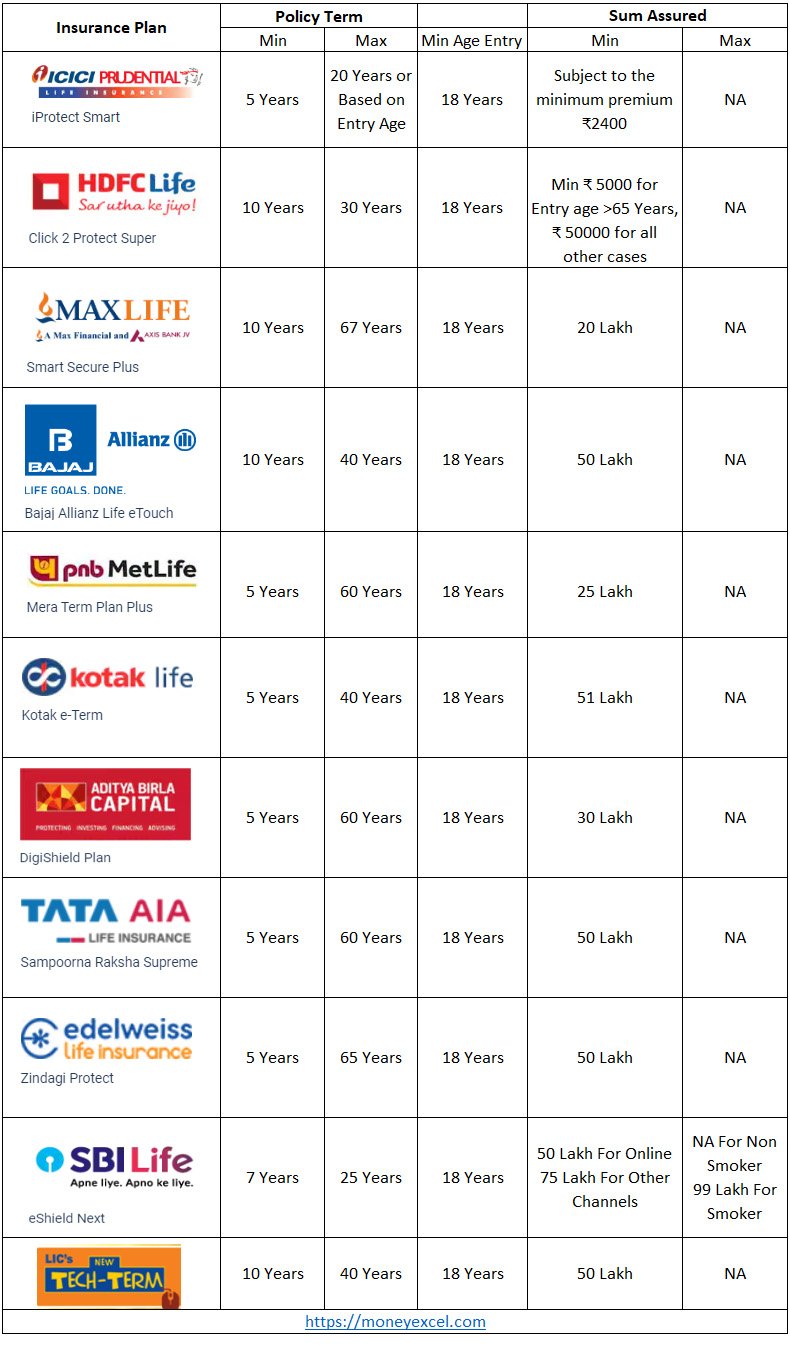
There are many term insurance plans in India, but all of them have different features and premium rates which confuses a prospective customer to choose the best term insurance plan. Look at the following comparison chart and Important features before purchasing the term plan.

How to Select Term Plan – Step-by-Step Guide

#1 Evaluate Your Financial Needs

Take a look at your financial situation. Ask the following questions to yourself.

  • How much coverage do I need?
  • What loans and liabilities do I have?
  • What future expenses should I consider (kids’ education, marriage, retirement, etc.)?

Making a financial plan will assist in calculating the required coverage amount. Being underinsured could put your family in a tough spot, while over-insuring might be a pointless expense.

#2 Determine the Policy Term

The next step is to decide policy term means for how much period you need insurance coverage. The term should ideally include the time when you have the most financial responsibilities.  

  • 20-30 Years: If you have young children, a mortgage, or are far from retirement.
  • 10-20 Years: If your kids are older and you’re closer to paying off significant debts.
  • 5-10 Years: If you’re nearing retirement and just need a little extra coverage.

#3 Compare Different Plans

Now you need to find out and compare various plans to see which plan is suitable for your needs. You should at least look at the following features while deciding.

  • Premium – Ensure the premiums fit within your budget without compromising on coverage.
  • Riders and Add-ons – Some insurers offer additional benefits like critical illness coverage, accidental death benefits, etc.
  • Claim Settlement Ratio – This indicates the reliability of the insurer in settling claims. Higher ratios are generally better.
  • Unique Feature – Any Unique feature provided by a plan that is of your need.

#4 Check the Reputation of the Insurer

You should find out or research about the reputation of the insurer. You can look at the following –

  • Customer Reviews  – Check online reviews for insights from existing customers.
  • Financial Strength – Look at the company’s financial ratings to ensure they’re capable of paying out claims.

#5 Understand Terms

You should understand policy terms and exclusions. Some common things to look at –

  • Suicide Clause – Most policies won’t pay out if the insured commits suicide within the first couple of years.
  • Claim Settlement – You should take a look at the claim settlement and its history.

#6 Seek Professional Advice

Seek professional advice. It is a fact that If you are uncertain, seek advice from a financial consultant. They have the ability to offer customized guidance tailored to your specific circumstances and assist you in understanding the intricacies of choosing a term plan.

Top 6 Best Online Term Insurance Plans in India

Term Plan – Comparison

Term Insurance Plans Comparison - Moneyexcel

Key Features of Various Term Plans

ICICI – iProtect Smart

  • ICICI iProtect Smart plan is available in four different options Life, Life Plus, Life Health & All-in-One.
  • ICICI Pru iProtect Smart Offers the facility of Life stage protection (increase in coverage) without any medical.
  • Accidental Death coverage is offered in Life Plus and All-in-One Plan Only.
  • 34 Critical illness is available in Life Health & All-in-One Plan.

HDFC Click 2 Protect Super

  • HDFC Click 2 Protect Super plan is offered in three different options Life Plus, Increasing Coverage + Terminal Illness Coverage & Decreasing Life Cover options.
  • Accidental Disability, Critical Illness, and Health Rider Options.
  • Option to choose increasing Death Benefit up to 200% under Life option.
  • Option to vary your Death Benefit according to your need under the Life Goal option.

Max Life Smart Secure Plus

  • Max Life Smart Secure Plus offers Life Cover and  Increasing Life Cover options up to 200%.
  • Max Life Smart Secure Plus comes with death benefits, including a cover for terminal illness and an exit value.
  • This plan provides optional benefits such as premium breaks, joint life cover, additional payout on accidental death

Bajaj Allianz Life eTouch

  • Bajaj Allianz Life eTouch offers a shield for your life to cover death, terminal illness & disability.
  • This plan offers flexibility to pay premiums throughout the policy term.
  • Bajaj Allianz Life eTouch provides a unique feature of Premium Holiday. This means you can skip your premium during the policy term for 1, 2, or 3 years.
  • Bajaj Allianz Life eTouch is available in three different policy options Life Shield, Life Shield Plus, and Life Shield ROP.

PNB MetLife Mera Term Plan Plus

  • PNB MetLife Mera Term Plan Plus is available in three different variants Life, Life Plus (Terminal Illness Benefit, Premium Waiver Benefit) & Life Plus Health.
  • PNB MetLife Mera Term Plan Plus offers an Additional Spouse Coverage Option.
  • This plan also offers step-up benefits, life stage benefits, and child education support options.

Kotak Life – Kotak e-Term

  • Kotak e-Term offers 3 plan options Life, Life Plus, and Life Secure Options.
  • Kotak e-Term comes with 3 payout options Immediate Payout, Level Recurring Payout & Increasing Recurring Payout.
  • This plan comes with a Step-Up option to increase coverage of future life-stage events.
  • You can purchase additional riders of Permanent Disability & Kotak Critical Illness Plus with the Kotak e-Term Plan.

Aditya Birla Capital – DigiShield Plan

  • Aditya Birla Capital – DigiShield Plan is a customized term plan with 10 plan options.
  • DigiShield Plan offers flexible death benefit payout options – as a lump sum, monthly income, or a combination of both.
  • This plan offers the option to cover your Spouse under the same Policy with Joint Life Protection.
  • DigiShield Plan comes with an Inbuilt Terminal Illness Benefit and Accelerated Critical Illness cover for 42 specified Critical Illnesses, on payment of an additional premium.

Tata AIA – Sampoorna Raksha Supreme

  • Tata AIA – Sampoorna Raksha Supreme offers multiple plan options Life, Life Plus, Life Income, and Credit Protect
  • In this plan, you can increase your life cover at important life milestones.
  • This plan comes with a range of rider options, you can be covered against critical illness, accidental death, etc.
  • This plan allows you to select a payout option.

edelweiss – Zindgi Protect

  • edelweiss – Zindgi Protect offers Life Cover and Return of Premium options.
  • You can add the Better Half Benefit or Future Protect Benefit by paying an extra premium.
  • edelweiss Zindgi Protect provides a premium break facility by paying an extra premium
  • This plan offers different payout selection options.

SBI Life – eShiled Next

  • SBI Life – eShiled Next offers three plan options life cover, increasing cover, and level cover.
  • You can customize this plan with a death benefit payment mode and a better half benefit option.
  • Terminal illness benefit is offered under the eShield Next Plan.
  • Additional Rider options are available under this plan.

LIC – New Tech Term Plan

  • LIC New Tech Term Plan is an Individual Pure Risk Premium Life Insurance plan with the option of level sum assured and increasing sum assured.
  • This plan is offered with differential premium rates for smokers and non-smokers.
  • You can opt for Accident Benefit Rider with LIC New Tech Term plan.
  • LIC New Tech Term plan is an online term assurance plan. This means you can purchase this plan online only.

Tips For Buying Term Insurance Policy

  • Go for an Online Term Plan instead of an Offline plan. Online term plans are much cheaper as no middleman agent is involved in between.
  • Claim settlement is one of the leading indicators don’t rely too much on the claim settlement ratio.
  • Fill up the complete details given in the form without hiding anything. Never allow someone to fill out the proposal form.
  • I would not advise going for any type of rider while buying a term plan.
  • Review your insurance requirements regularly and make changes to growing needs.

Over to you –

Looking at the above term insurance comparison you must have got fair idea about various term plans. So, Which term plan do you have currently? If you are planning to buy one, and seeking guidelines get in touch with us at contact@moneyexcel.com.