
Blog Page 277

Aadhaar PVC – How to get Aadhaar Smart Card?

Aadhaar PVC smart card can be ordered online on the UIDAI portal. Aadhaar PVC card comes with a photograph, QR Code, and hologram.

As we know that the normal Aadhaar card is issued in paper format. Many people carry Aadhaar card letter or they cut issued card by scissors. The letter format & cut Aadhaar card is difficult to carry in the wallet like a credit card or debit card. Most of the paper format card develop a crease or become dirty over a period of time.

To improve the quality of the Aadhaar card, UIDAI has launched a PVC based smart card. It is of credit card size which can be easily carried in the wallet. Aadhaar PVC is not free. You need to pay Rs.50 to get smart card Aadhaar PVC. Step by step process to order Aadhaar PVC card is given below.
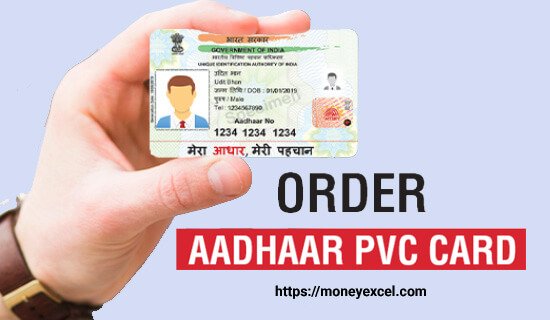
Aadhaar PVC Card

How to order online Aadhaar PVC card?

Step 1 – Visit UIDAI portal. Click on My Aadhaar and go to sub menu – Order Aadhaar PVC Card.

Step 2 – Enter 12 Digit Aadhaar Number or 16 Digit Virtual ID or 28 Digit EID. Enter the security code and click on the Send OTP. You will receive OTP on the registered mobile number. Enter the OTP and click on Submit.

Step 3 – On the next page, you will be able to see your Aadhaar data – Name, Date of Birth, Gender, Address, and your photograph.

Step 4 – In case you find data given on the screen is incorrect/missing/out-dated you need to get your Aaddhar Updated.

Smart Card Aadhaar

Step 5 – Click on the Make Payment button. You will be taken to the payment page. Here you need to make a payment of Rs.50. There are multiple payment options such as credit card/debit card, net banking, UPI, etc.

Step 6 – Select the payment option and make a payment of Rs.50. Once you make a payment your application for the Smart card is submitted. You can download the payment Receipt for reference.  System generated SRN (Service Request Number) will be displayed on the screen.

Step -7 – The time required to deliver Aadhaar is 15 days. You can track your Smart Card Aadhaar application by SRN. You need to go to My Aadhaar >> Check Aadhaar PVC Card Status in order to know application status.

Also Read – How to Update Address in Aadhaar Card Online?

Types of Aadhaar Cards

Four types of Aadhaar Cards are issued by UIDAI.

#1 Aadhaar Letter

Paper-based laminated letter with secure QR Code with Issue Date and Print Date. This letter is sent to resident free of cost by ordinary post. In case this letter is lost you can order it again by paying Rs.50 for reprinting.

#2 eAadhaar

eAadhaar is the electronic form of Aadhaar, digitally signed by UIDAI, having QR code for offline verification with Issue Date and Download Date. Resident can easily download eAadhaar/masked eAadhaar from UIDAI’s official website using registered mobile number.

#3 mAadhaar

mAadhaar is digital form of Aadhaar which can be installed on mobile device. You need mAadhaar app. This app is available on Google Play as well as iOS store for downloading.

#4 Aadhaar PVC Card

Aadhaar PVC is newly issued credit card size PVC card. This card is digitally signed and contains demographic details, photograph, hallmark and multiple security features. You need to pay Rs.50 in order to get PVC card of Aadhaar.

Security Features of Aadhaar PVC Card

This card contains security features like:

  • Secure QR Code
  • Hologram
  • Micro text
  • Ghost image
  • Issue Date & Print Date
  • Guilloche Pattern
  • Embossed Aadhaar Logo

FAQ about PVC Aadhaar Card

How much money I need to pay to get Smart Aadhaar Card?

You need to pay Rs.50 in order to get Smart Aadhaar card. This card can be ordered online as well as offline at enrollment center.

Which modes are available for the payment?

As of now Credit Card, Debit Card, UPI and Net Banking options are available as the payment mode.

How many days it will take to deliver the PVC Aadahar card after raising request?

The PVC based Aadhaar card is delivered roughly in the 15 days from the date of ordering.

Why I should opt for PVC Aadhaar Smart Card?

You should opt for PVC Aadhaar Smart Card because this card contains lot of security features. It is credit card size card which is easy to carry in wallet. As this card is made up from PVC material life span of this card is long.

Over to you

Have you ordered PVC Aadhaar Smart Card? Do you think it is worth to order this card?

Share your experience in the comment section.

Thanks for reading the post.

Please share this post with your friends on Facebook & WhatsApp Groups.

EMI Loan Moratorium – Interest Waiver Cashback from Bank

0

You must be aware that the government has announced a loan moratorium from 1st March 2020 to 31st August 2020. Loan Moratorium was announced amid the Covid-19 pandemic. The government has announced major relief to all borrowers which is interest waiver or cashback benefit. This benefit applies to all borrowers irrespective of those who have opted for loan moratorium or not.

This benefit is given to all individual borrowers and small businesses with a loan amount of up to 2 Cr. The entire interest for six months would be waived off. If the borrower has already made a payment cashback will be issued for the interest amount. The benefit is announced by the finance ministry considering the fact extreme hardship is faced by the people due to the Corona pandemic.

Let’s look at the detail of the Interest waiver and cashback benefit announced by the government of India.

Loan Moratorium Interest Waiver

Interest Waiver & Cashback Scheme – Mar 2020 to Aug 2020

This scheme shall be called “Scheme for grant of ex-gratia payment of difference between compound interest and simple interest for six months to borrowers in specified loan accounts.

The said benefit applies to the loans below 2 Cr across the following loan categories. Any borrower whose aggregate of all loan amount is above 2Cr will not be eligible for this scheme.

  1. MSME Loans
  2. Education Loans
  3. Home Loans
  4. Automobile Loans
  5. Personal & Professional Loans
  6. Consumer Durable Loans
  7. Credit Card Dues
  8. Consumption Loans

The lending institute should be a public sector bank, banking company, co-operative banks, regional, rural banks, All India Financial Institution, non-banking finance institution, housing finance company, or microfinance institution.

Key Features of Interest Waiver Cashback Scheme

  • The scheme will credit the difference between compound interest and simple interest for a period of six months.
  • The interest rate applicable will be as per loan agreement in case of home loan, education loan, automobile, personal and consumption loans. The interest rate would be as per Feb,2020. Incase rate of interest is changed thereafter; it shall not be considered for computation.
  • The credit card dues interest rate would be as per weighted average lending rate for the transactions financed on EMI basis. Penalty or penalty interest rate would not be considered.
  • For cash credit, simple interest would be calculated on daily basis as on Feb, 2020. Compound interest rate would be calculated on monthly basis.
  • The lender will credit the difference between compound interest and simple interest by 5th November,2020.
  • Grievance redressal mechanism for the entire process would be established. The responsibility is centrally assigned to SBI.
  • Lending institute needs to claim reimbursement at the central government. The claim to be lodge latest by 15th December, 2020. The claim is subject to audit.

Calculations

The benefit is applicable to all loan borrower irrespective of borrower had fully availed, partially availed or not availed moratorium facility.

Let’s try to understand this by example.

Suppose borrower has taken a home loan of 50 Lakh. The simple interest on the loan amount would be 4 Lakh per annum considering 8% interest rate.

The six monthly simple interest would be 2 Lakh and outstanding with compound interest would be Rs.212425. So, total benefit in this case would be Rs.12425.

Simple interest amount from above 2 Lakh would be paid by borrower. Rs.12425 Compound interest would be paid by the government.

Take away

It is a welcome step by the government. This step would help borrowers in the bad times especially to new borrower where interest burden is more compared to principal component. In the moratorium, the government has deferred payment of EMI for six months. This means borrowers were liable to pay interest and interest on interest. However, now only interest amount to be paid compounding interest will be paid by the customer. The liability is slightly reduced for the customers.

Thanks for reading this post. Get a similar post in your inbox at regular intervals by subscribing to my blog.    

Credit Card EMI Offer – Should you opt?

Credit Card EMI is a facility that allows you to purchase big items on EMI. You need not spend the entire amount from your pocket in a single go. The entire amount will be divided into equated monthly installments and paid on a monthly basis. You require a credit card to opt for this facility.

Festival season has started and many companies are offering credit card EMI facilities. So, if you are facing a cash crunch you can opt for this facility. Recently when I was planning to purchase a refrigerator, I came across a similar offer in Samsung Double Door Refrigerator. The offer was to opt for Credit Card EMI and get a cashback of 10% after 90 days. In the first instance, it seems to be a lucrative offer. But I decided to do calculations before opting for this offer. When I did the calculation the actual picture was cleared.

When you opt for Credit Card EMI offer you need to pay the interest rate on the amount borrowed. In my case, it was 13.99% – per annum. So, with the principal and interest amount the amount comes out to be higher. However, with a cashback offer of 10%, it was a beneficial affair.

After going through this purchase experience I decided to share my story and credit card EMI calculation with you. The main objective is to help you in making an informed decision while buying a product with an EMI option.

Credit Card EMI Option

What is Credit Card EMI?

Credit Card EMI means converting the entire bill into EMI. This option is available on selected purchases for a limited period only. It is one type of loan offered on large value purchases. This loan needs to be paid in EMI. The credit card EMI contains both the principal and the interest component.

  • In case you decide to opt for this scheme, the credit card EMI option to be selected by the retailer while swiping the card on the POS.
  • At the same time, you need to make choice about EMI tenure. You can opt for 3 months, 6 months, 9 months, 12 months, or 24 months EMI options.
  • The rate of interest in this option is usually lower than the credit card interest rate. It will be decided by the credit card company.
  • Once you have opted for this facility, your credit limit will be reduced by the bill amount. Every month you need to pay EMI.
  • Prepayment or closure facility is not given in most of the cases. In some cases, you need to pay processing fees also.

These types of schemes are offered in collaboration with the vendor or merchant.

Also Read – What is Pre EMI? – Pre EMI vs Full EMI Difference

Types of EMI Offered by Banks

Three types of EMI facilities are offered by credit card companies. Zero Interest rate EMI, low interest rate EMI, and Credit card EMI with cashback. In Zero Interest rate EMI, no interest is applicable. On Low-interest rate EMI, the applicable interest rate is lower compared to credit card interest rates.

#1 Zero Rate EMI

Zero Rate EMI is an option where the loan is offered with a zero rate of interest. In this option, the credit card company does not charge anything extra and does not earn anything from you. This option is given to selected customers only. It is advisable to go for the Zero Rate EMI option.

#2 Low-Interest rate EMI

Low-Interest rate EMI option is offered with a lower rate of interest. The interest rate range in this option is from 13% to 22% per year which is lower compared to credit card interest. You can not make a pre-payment in this case. If you do prepayment you need to pay an additional penalty.

#3 Credit card EMI with Cashback

Under this option credit card EMI facility is offered at a lower interest rate. Along with EMI, you will get a cashback facility. The cashback amount is offered by the respective merchant or manufacturer and not by the bank or credit card company. Cashback will be credited after 90 days of doing the transaction.

Credit Card EMI facility – Calculation

Let’s take an example and do a calculation for the Credit Card EMI facility. Mr. Suresh holds an ICICI Coral Credit card with a credit limit of 1.25 Lakh. He has a requirement to purchase a Smart TV. He opts for Smart TV with a Credit card EMI Facility with 6 6-month EMI option. TV cost is Rs.49000. On the other hand, Mr.Ramesh does not hold any credit card. He also makes a purchase of the same Smart TV by making a one-time payment using a debit card. Another person Mr.Mahesh also holds a credit card and he opts for a credit card EMI with a cashback facility of 15% on the same TV.

Calculation –

Credit Card EMI (Suresh) Debit Card (Ramesh) Credit Card EMI with Cashback (Mahesh)
TV Cost 48331 48331 48331
Interest rate  (13.99%) 3380 Nil 3380
Swipe Charges 858 Nil 858
Total 52569 48331 52569
Cashback Nil Nil 7249.65
Total Payout 52569 48331 45319.35

From the above calculation, we can clearly say that the debit card option or EMI with Cashback option is beneficial.

Pros

  • No need to pay money upfront. It will be a deferred payment.
  • Zero Cost EMI option is available for the customers.
  • The rate of interest is lower compared to credit card interest.

Cons

  • You need to pay the principal and interest amount.
  • A credit limit will not be reduced until the time you pay your dues.
  • In some cases, you need to pay processing costs or swipe charges.

What you should check before opting for the EMI option in a Credit card?

Interest Rate

You need to check for the applicable interest rate. The rate of interest should be low. If required go for low tenure 3 months for 6 months.

Swipe Charges

Another point to check is swipe charges. The swipe charge or processing fee should be NIL or as low as possible.

Prepayment Facility

The credit card company should provide a prepayment facility for this option. Pre-closure charges should be low or NIL.

Is it advisable to opt for a Credit Card EMI Facility?

The answer to this question is purely based on your financial condition and the offer on hand. If you are not in a position to pay upfront money but you have future visibility that you will get money at regular intervals you can go for this facility. Another reason for opting for this facility could be a discount offer or Cashback.

Note – If you opt for this facility make sure that you clear your dues on time.

Once in a while opting for this facility is ok but it should not become a habit while buying any big-ticket items.

Saral Jeevan Bima – New Term Insurance Guideline by IRDAI

Saral Jeevan Bima Term Insurance Plan


Saral Jeevan Bima – Term Insurance – Term Plan is a widely accepted product. However, terms and conditions of the term plan offered by different insurance companies are different. Every company was introducing innovative products with different features, options, and riders.

Different term plans with different features are creating confusion among customers. It is extremely difficult for the customer to compare policy features and take a buying decision.

To help customers IRDAI has issued a new guideline for the term insurance policy. This guideline is for standardizing terms and conditions of the term plan. It will be called Saral Jeevan Bima. Saral Jeevan Bima will be a standard term plan with simple features and standard terms and conditions.

It is a welcome step by IRDAI. This step will make the life of the customer easier. It will enhance trust between the insurance company and its customers. This step will also help in preventing the mis-selling of insurance policies. Before this IRDAI has released a guideline for standardizing terms and conditions for health insurance policies – Arogya Sanjivani.

Here is detail guideline announced by IRDAI for standard term insurance – Saral Jeevan Bima.

Saral Jeevan Bima – New Term Insurance Guideline by IRDAI

The standard term insurance plan shall be called “Saral Jeevan Bima”. All insurance policies will prefix Saral Jeevan Bima before the product name.

It will be a non-linked and non-participating pure term plan which will cover the risk of individual life. No additional saving or investment component will be attached to this plan. This term plan guarantees payment of sum assured to the nominee, incase policy holder’s die during the policy term.

Only specific riders can be offered. No additional benefits, options, variants shall be offered to the policyholder. No exclusion is allowed under this policy except suicide exclusion. This policy shall be offered to individuals without any restrictions on gender, place of residence, travel, occupation or educational qualifications.

The terms and conditions document of Saral Jeevan Bima would be standard. Key Features and other parameters of this plan as per IRDAI guidelines are given below.

Sr. No. Description Features
1 Entry Age 18 years to 65 years
2 Policy Term 5 years to 40 years
3 Maximum Maturity Age 70 years
4 Sum Assured


 Minimum 5 Lakh to Maximum 25 Lakh*

(SA would be allowed only in the multiple of Rs.50000)

*Insurers have the option of offering Sum Assured beyond 25 Lakh under Saral Jeevan Bima with all other terms and conditions remaining the same.

5 Premium Payment Options Single Premium – Lump sum

Regular Premium – Monthly, Half Yearly & Yearly

Limited Premium Term for 5 years and 10 years

6 Death Benefit For Regular & Limited Premium Payment policies: Highest of:

–       10 times of annualized premium;

–       105% of all the premiums paid as on the date of death;

–       Absolute amount assured to be paid on death.

For Single premium policies: Higher of:

–       125% of single premium;

–       absolute amount assured to be paid on death.

7 Maturity Benefit None
8 Exclusions Only suicide clause
9 Waiting period 45 days from the date of commencement of risk. In case of revival of Policy, the Waiting Period shall not be applicable.

The following words shall be prominently displayed in BOLD, on the welcome letter of Policy Document as well as on the first page of Sales Literature.

“This Policy will cover death due to accident only during the waiting period of 45 days from the date of commencement of risk.

In case of death of the life assured other than due to accident during the waiting period, an amount equal to 100% of all premiums received excluding taxes, if any, shall be paid and the Sum Assured shall not be paid.”

10 Surrender Value Surrender Value is not applicable under this Policy.
11 Policy Cancellation Value Policy Cancellation Value shall be payable:

–      Upon the Policyholder applying for the same before the stipulated date of maturity in case of Single Premium Policy;

–      Upon the Policyholder applying for the same before the stipulated date of maturity or at the end of revival period if the policy is not revived, in case of Limited Premium Payment Policies.

The amount payable shall be calculated differently in single premium and limited premium policy. For regular premium policy no cancellation value shall be payable.

12 Loan No loan will be offered against the policy
13 Optional Riders Accident Benefit and Permanent Disability Benefit Riders

The policy guideline suggested above for the term plan Saral Jeevan Bima shall be applicable from 1st January, 2021.

Take Away

It is a very good step by IRDAI. This step is likely to give the following benefits.

  • As the terms and conditions of a term plan are standard, it is likely to increase term insurance adoption across India.
  • The policy premium of this plan will be low as sum assured under this policy is restricted to 25 Lakh.
  • As it is an affordable policy lower-income group will also purchase Saral Jeevan Bima.
  • Suggested Features and Benefits of this policy is really Saral (Simple) and easy to understand.
  • As it is a standard product and governed by the guideline of IRDAI, the chance of mis-selling and disputes at the time of claim settlement will be low.

Thanks for reading this post, if you liked this post, share it with your friends and relatives on WhatsApp & Facebook. Post your queries in the comment section. I will surely try to answer it.