

If you’ve been following the Indian investment world closely, you’ve probably heard the term “SIF” coming up more and more these days. And there’s a good reason for that. Specialized Investment Funds — or SIFs — are quietly reshaping the way serious investors in India think about growing and protecting their money.
This article breaks down everything about SIFs in plain language: what they are, how they work, the top funds available in 2026, and whether they’re right for you.
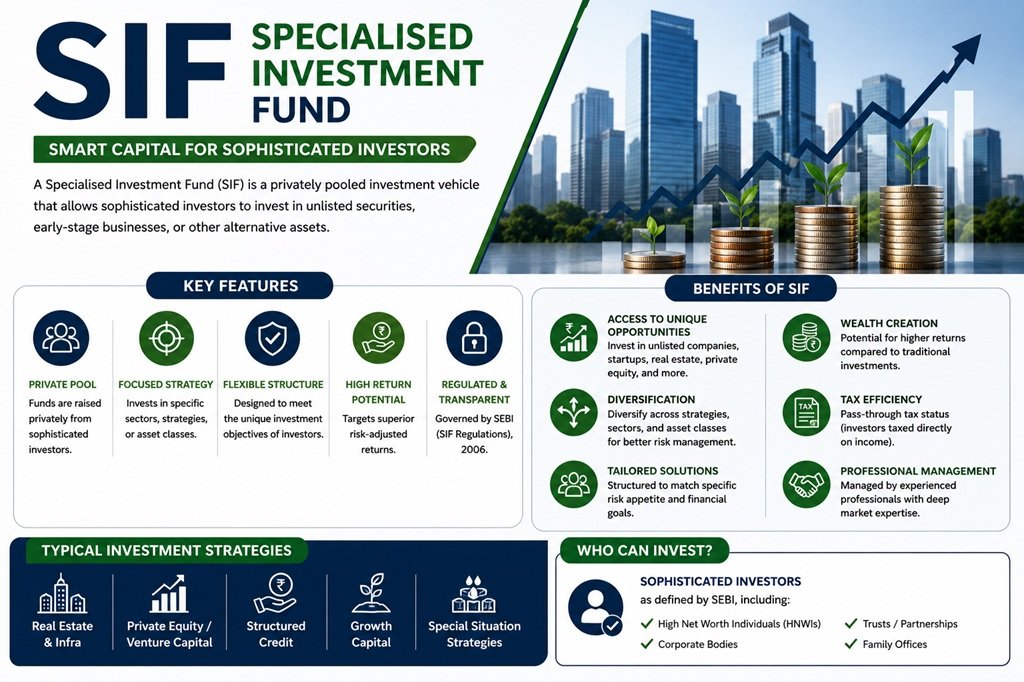
SIF – Specialized Investment Funds
Think of a SIF as a smarter, more flexible cousin of the traditional mutual fund. SEBI (Securities and Exchange Board of India) formally introduced the SIF structure in 2026 to fill a gap that existed between regular mutual funds on one end and high-ticket investment options like PMS (Portfolio Management Services) and AIFs (Alternative Investment Funds) on the other.
Here’s the key difference: regular mutual funds can only “go long” — meaning they can only buy stocks or bonds hoping prices will rise. SIFs, on the other hand, can also “go short” — meaning they can actually bet against certain stocks using derivatives when prices are expected to fall. This ability to play both sides of the market is a game-changer.
In simpler terms, imagine you’re playing cricket. A traditional mutual fund only bowls. A SIF both bowls and bats — it can take offensive and defensive positions depending on the situation.
SIFs are designed for experienced investors who want the tax and operational convenience of mutual funds but also want access to the kind of complex strategies previously available only to ultra-high-net-worth individuals through PMS or AIF.
How SIFs Differ from Regular Mutual Funds
Before diving into specific funds, it helps to understand what makes SIFs genuinely different.
Strategy flexibility: Regular mutual funds are limited to buying assets (going long). SIFs can take short positions, use derivatives for hedging, and rotate across sectors or asset classes actively.
Market adaptability: In a falling market, a regular mutual fund almost always loses value. A well-managed SIF can neutralize some of that damage or even profit from it, because it can hold short positions that gain value when prices drop.
Minimum investment: Both SIFs and some premium mutual fund categories require meaningful capital. Most SIFs ask for a minimum of around ₹10 lakh per investor, which means they’re not for everyone.
Complexity: SIF strategies involve derivatives, sector rotation, and hedging — concepts that require a certain level of financial literacy to understand and evaluate.
Taxation: SIFs are structured to benefit from mutual fund-style taxation rules, which can be more investor-friendly than PMS or AIF taxation depending on the fund’s equity exposure.
Top SIF Funds in India 2026
Here’s a look at the most notable SIF funds launched or available in India as of 2026.
SBI Magnum SIF – Hybrid Long Short Fund
SBI Mutual Fund is one of India’s largest and most trusted fund houses, and its entry into the SIF space through the Magnum SIF – Hybrid Long Short Fund is significant. The fund follows a hybrid strategy, meaning it invests in both equity and debt instruments, while also having the flexibility to take short positions through derivatives.
The goal is to deliver solid risk-adjusted returns across market cycles — whether the market is going up, going down, or moving sideways. Assets are spread across equities, fixed-income securities, derivatives, REITs, and InvITs, which adds another layer of diversification.
Who should consider it: Investors who already have a large portfolio and want a professionally managed fund that can protect against downside risks while still participating in market upswings.
Minimum investment: Around ₹10 lakh
Strategy: Equity + Debt + Derivatives with short position capability
Taxation: Equity taxation rules apply when equity exposure exceeds 65%
Quant Equity Long Short Fund
Quant Mutual Fund has built a reputation for using data-driven, quantitative models in fund management, and their Equity Long Short Fund brings that approach into the SIF space.
This fund focuses specifically on stocks outside the top 100 companies by market cap — meaning it hunts for opportunities in the mid-cap and small-cap universe, which is often where the most undervalued and overlooked gems are found. The strategy involves building a strong long position in selected equities while also maintaining a limited short position to cushion against market downturns.
What makes this fund particularly interesting is that it brings something traditional mutual funds never could — the ability to actually use derivatives and short positions as a built-in risk management tool, not just a speculative one.
Who should consider it: Investors comfortable with mid- and small-cap volatility who want a more active strategy that goes beyond just buying and holding.
Minimum investment: Around ₹10 lakh
Strategy: Long positions in mid/small-cap stocks with limited short exposure via derivatives
Taxation: Eligible for mutual fund-like tax treatment under the SIF framework
Quant Hybrid Long Short Fund
Also from Quant Mutual Fund, this is the hybrid version of their SIF offering. Unlike the equity-only long short fund, this one invests across both equity and debt, offering a more balanced risk profile.
It was launched through an NFO (New Fund Offer) on September 25, 2026, and follows a disciplined allocation strategy: equity between 25–75%, debt between 25–75%, and short derivative positions up to 25%. This flexibility allows the fund manager to tilt towards equity in bullish conditions and towards debt when markets look uncertain.
The objective is dual: generate capital appreciation over time while also producing regular income, all while keeping risk balanced through active short positions.
Who should consider it: Investors who want exposure to both equity growth and debt stability within a single fund, with built-in downside protection.
Minimum investment: Around ₹10 lakh
Strategy: Equity (25–75%) + Debt (25–75%) + Short Derivatives (0–25%)
NFO Date: September 25, 2026
Altiva Hybrid Long Short Fund (Edelweiss Mutual Fund)
Edelweiss Mutual Fund launched its SIF offerings under a dedicated platform called Altiva. The Altiva Hybrid Long Short Fund is one of the most comprehensive products in this space.
What sets this fund apart is its all-weather approach. It combines equity investing, fixed-income instruments, arbitrage opportunities, special situation investments, and derivative hedging into a single portfolio. The idea is to have something working in your favour no matter what the market is doing — if equities are struggling, the arbitrage or fixed-income sleeve picks up the slack.
Special situation investing refers to opportunities arising from events like mergers, spin-offs, restructurings, or regulatory changes — these are areas where disciplined analysis can find mispricings that the broader market hasn’t yet recognized.
Who should consider it: Investors looking for a true all-weather investment that balances growth, income, and protection.
Minimum investment: Around ₹10 lakh
Strategy: Equity + Fixed-income + Arbitrage + Special situations + Derivatives
AMC: Edelweiss Mutual Fund (under the Altiva SIF platform)
Edelweiss Altiva SIF – Multi Asset Hybrid Fund
This is the broadest offering in the Edelweiss Altiva SIF lineup. Rather than focusing primarily on equity or debt, it actively invests across multiple asset classes — equities, bonds, arbitrage positions, derivatives, and potentially commodities or other instruments.
Multi-asset investing is a time-tested approach to managing volatility. Different assets tend to behave differently during the same market conditions. When equity markets fall, bonds often rise. When both struggle, commodities like gold might hold steady. By actively managing allocations across all these, the fund aims to deliver stable and consistent returns regardless of what any single asset class is doing.
Who should consider it: Investors who prefer genuine diversification across asset classes and want a single fund that does the allocation work for them.
Minimum investment: Around ₹10 lakh
Strategy: Active multi-asset allocation across equity, debt, arbitrage, and derivatives
Types of SIF Strategies Explained Simply
SIFs don’t all follow the same playbook. Here’s a quick guide to the main strategy types you’ll encounter.
Equity Long Short: Most of the money goes into equities (minimum 80%), with a small allocation to short derivatives (up to 25%). Works best when there’s market uncertainty — the short positions act like insurance against falling prices.
Hybrid / Multi-Asset Long Short: Splits money between equity and debt (minimum 25% each), with optional short exposure. This is the most balanced approach and suits investors who don’t want all their risk in one place.
Sector-Rotation / Thematic: Focuses on a limited number of sectors (usually up to four) and actively moves money between them based on which sectors look promising or risky at any given time. Can also take short positions on sectors heading into trouble.
Quant-Driven / SMID-Focused: Uses automated quantitative models to find opportunities in small and mid-cap companies. Higher potential returns, but also higher volatility. Best for aggressive, long-term investors with a high risk tolerance.
Is a SIF Right for You?
SIFs are genuinely exciting products — but they’re not for everyone. Here’s a simple way to think about it.
SIFs are a good fit if you:
- Already have a mature investment portfolio worth at least ₹20–30 lakh or more
- Have some experience with mutual funds and understand basic risk concepts
- Want downside protection in volatile markets, not just maximum returns
- Can commit at least ₹10 lakh to a single investment
- Are patient and thinking in terms of 3–5 year horizons
SIFs are probably not right for you if you:
- Are just starting your investment journey
- Need your money back in less than a year
- Are uncomfortable with the idea of derivatives or short selling
- Don’t have enough surplus capital to absorb potential short-term volatility
Things to Check Before Investing
Look at the fund house’s track record. SIFs are a new category, so there’s limited history. But you can assess the AMC’s broader reputation — how have they performed across other fund categories? Do they have experienced fund managers who’ve handled derivatives or multi-asset strategies before?
Understand the actual strategy. Don’t invest in a SIF just because it sounds sophisticated. Ask: What exactly does this fund buy? When does it go short? What conditions trigger a change in strategy? If you can’t get a clear answer, wait.
Read the scheme document carefully. Pay attention to minimum investment amounts, any lock-in periods, redemption conditions, and expense ratios. Some SIF schemes may have exit loads or limited liquidity windows.
Get the taxation picture right. If a SIF has over 65% equity exposure, it may qualify for equity fund taxation (favourable long-term capital gains rate). If the equity exposure is lower, debt fund taxation rules could apply. This can significantly affect your actual post-tax returns.
Treat SIFs as a portion of your portfolio. Even experienced investors shouldn’t put everything into a SIF. A reasonable approach might be to allocate 15–25% of your overall portfolio to SIFs as a diversifying, risk-managing layer, while keeping the rest in traditional equity funds, debt funds, or direct stocks.
Conclusion
SIFs represent a maturation of India’s investment ecosystem. For years, sophisticated strategies like long-short equity and multi-asset allocation with derivatives were available only to those who could afford PMS minimums of ₹50 lakh or AIF commitments of ₹1 crore. The SIF structure brings these approaches within reach of a broader (though still serious) investor base.
That said, “accessible” doesn’t mean “simple.” SIFs carry real risks — including the risk of poor strategy execution, derivative losses, and higher expense ratios compared to passive funds. The value of a SIF depends enormously on the quality of the fund management team.
The investors who will benefit most from SIFs are those who approach them with clear goals, realistic expectations, and a genuine understanding of what they’re buying into. Used wisely, a well-chosen SIF can meaningfully strengthen a portfolio’s ability to weather uncertainty and deliver more consistent results across market cycles.
Frequently Asked Questions
Q: What does SIF stand for?
SIF stands for Specialized Investment Fund — a category introduced by SEBI in 2026 that allows fund managers to use advanced strategies including long-short positions and derivatives.
Q: Can a beginner invest in SIFs?
Not ideally. SIFs involve complex strategies and require a minimum investment of around ₹10 lakh. They’re better suited for experienced investors with an existing portfolio.
Q: Are SIF returns guaranteed?
No. SIFs are market-linked products. Their value can go up or down. The strategies aim to manage risk better than traditional funds, but they don’t guarantee returns.
Q: How are SIFs taxed?
It depends on the fund’s equity exposure. Funds with more than 65% equity may qualify for equity fund taxation rules (with lower long-term capital gains rates). Always consult a tax advisor for your specific situation.
Q: How much should I invest in a SIF?
Most SIFs require a minimum of ₹10 lakh. However, how much of your total portfolio you allocate depends on your risk appetite and investment goals. A financial advisor can help determine the right allocation for you.

 in India for 2026, including portfolio strategies, growth potential, and market outlook.)