

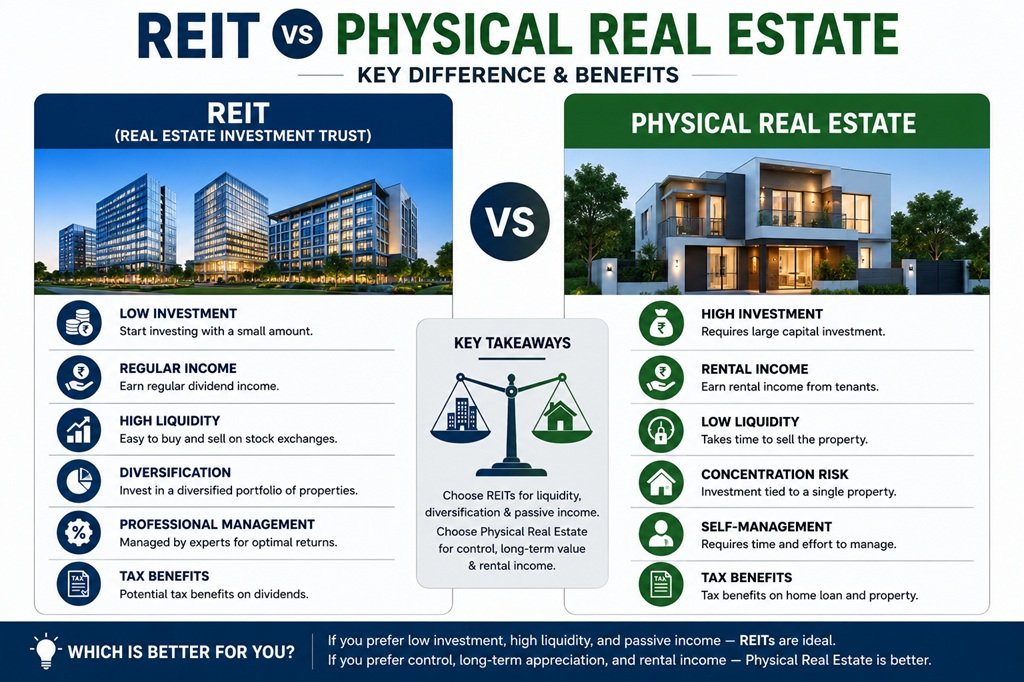
REIT is becoming an alternative to real estate investments. For any investor, investing in real estate comes with a big capital requirement and risk tolerance. REITs provide a solution to this problem. Now investors can invest in real estate via REIT, which gives the advantage of investing in real estate without owning property.
In this post, we will take a look at difference between REIT and physical real estate.
What is a REIT?
REIT stands for real estate investment trust. REIT invest in the income-generating real estate projects such as offices, hotels, retail and other commercial real estate properties.
The main purpose of a REIT is that there could be earning of income from rents and interest through the acquisition and management of commercial properties. It is required by law for REITs to pay at least 90% of their net distributable cash flow as dividends to their investors.
REIT are listed on the stock exchanges similar to the shares of other companies. REIT allows fractional investment in the real estate projects and provide benefits of potential dividend income along with potential capital appreciation.
Types of REITs
Based on features and benefits, REITs can be classified into multiple types. The following categorisation is based on the kind of investments made by REITs:
Equity REITs – One of the most preferred types of REITs, equity REITs manage income-generating commercial properties and provide a source of fixed income potential to their shareholders through their rentals. These commercial real estate properties include apartments, shopping complexes, hospitals, and offices.
Mortgage REITs – REITs that invest in mortgages and mortgage-backed securities are called mortgage REITs, or mREITs. Generating income through interest payments, mortgage REITs are said to have lower risk than equity REITs but also come with a lower return potential.
Hybrid REITs – REITs that invest in a combination of commercial properties as well as mortgages are called hybrid REITs and potentially offer shareholders a diversified mix of rental income as well as interest income.
Based on the accessibility of REITs, they can be categorized into the following.
Publicly traded REITs – These REITs are listed on the public stock exchange and thus ensure liquidity and transparency.
Private REITs – Offering higher levels of control, privately traded REITs are generally available only to a certain list of accredited investors. Since they are not publicly traded on the stock exchange, they have a lower level of liquidity.
Public non-traded REITs – While these REITs are not listed on the public stock exchange, they are registered under regulatory bodies and thus are said to provide higher relative stability than private REITs.
Private REITs – Private REITs provide a high degree of control and are normally accessible only by an approved group of investors. As these REITs do not trade on any stock exchanges, they lack the liquidity that other kinds of REITs possess.
Public non-traded REITs – Public non-traded REITs are registered and therefore more stable than private REITs, even though they do not trade on the public stock exchange.
Note: In India, all REITs approved by SEBI are publicly traded. There is no concept of private or public non-traded REITs within the context of Indian regulations.
What is a real estate fund?
A real estate fund is a sectoral mutual fund that invests in companies associated with real estate or in real estate-oriented instruments such as REITs. Similar to other mutual funds, real estate funds are professionally managed by a fund manager who aims to leverage their analysis and industry outlook to generate potential returns.
Difference between REIT and real estate fund
The following could be considered as the prime distinctions between a real estate fund and a REIT:
Structure of investment – While REITs comprise a trust and invest directly in commercial properties and mortgages, real estate funds are a form of a mutual fund that invests in the stock of companies operating in the real estate market or REITs.
Income Generation – REITs earn from the rental income and interest earned on mortgages and thus, can generate value for shareholders. Moreover, the potential value generation in the case of REITs can also come from the potential increase in the value of the properties. Real estate funds earn by way of dividends earned by appreciation in the stock value.
Liquidity – Being tradable like other stocks on the stock exchange, REITs are very liquid in nature. Conversely, real estate funds are not tradable like other stocks and thus, are less liquid.
Risk diversification – Real estate funds diversify their money among many companies operating in the real estate sector while REITs too generate diversified income streams. However, REITs have a risk of concentration of funds due to the long-term and geographic nature of the investments made.
Features and benefits of REITs
Liquidity: Due to the fact that they are tradeable on the stock exchange, these investments are highly liquid. Diversification: An investor can get diverse commercial properties from industrial to residential in REITs.
Fixed Income: Out of 90% of their total income, including rents and interests, is paid back to the shareholders by the REITs.
Tax concessions: When REITs meet certain investment standards, they can choose to adopt a concessional taxation model, thus benefiting their investors.
Accessibility: Investors in REITs become partial owners of commercial properties, thus lowering the entry barrier to such an investment.
Expert Management: Property investment, management, and operations decisions in REITs are made by professionals from the real estate sector. Inflation Hedge: Investing in REITs might act as protection against inflation.
Inflation hedge – Investment in real estate funds might help in outpacing inflation.
Which is better, REITs or real estate mutual funds?
In fact, both types of financial investments, including REITs and real estate funds, possess their own distinctive characteristics. On the one hand, REITs allow their investors to have partial ownership of physical property and offer steady sources of earning for them, while real estate funds are associated with gaining profits through the potential growth in value of stocks belonging to real estate firms. Both financial instruments have differences in terms of liquidity, access, taxation policies, and investors’ strategies.
Conclusion
It would be appropriate for each investor to ensure that their investments are made according to the financial objective and other elements such as the level of risk and funding available. As real estate is deemed to be vital in the Indian economy, then investment instruments such as REITs and real estate funds enable one to join this system with minimal entry risks and cost.
FAQs:
What kind of returns do REITs produce?
REITs generate rental income from their owned and managed commercial properties and interest income from mortgages and mortgage-backed debt financing.
Is REIT different from REMF?
Yes. REITs, or real estate investment trusts, directly own and operate income-generating real estate, whereas REMFs, or real estate mutual funds, allocate investor money in a portfolio of stocks that deal in real estate.
How do I start investing in a real estate fund?
Investors may start investing in real estate mutual funds through brokerage platforms and buy or sell funds listed on public exchanges using a demat account.
Are REITs better than physical real estate?
It depends on the investor’s financial objectives as well as other factors such as risk appetite, expertise, availability of capital, and personal preferences. REITs allow investors to get exposed to the real estate market with limited capital.

