

NPS – The Pension Fund Regulatory and Development Authority (PFRDA) has officially launched the NPS Swasthya Pension Scheme. It is health care scheme for retirement where NPS subscribers can have a dedicated health-linked pension account to pay for out-patient visits, hospital stays, and other qualifying medical expenses.
Remember it is not health insurance. It is your own saving for your own health in the separate account. You can save money via NPS Swasthya and use it in the future when you actually needs it. Think of it as the pension world finally growing up and acknowledging that healthcare costs are just as real as retirement costs.
In this article, we will look at everything about NPS Swasthya Pension Scheme Eligibility, contributions, withdrawals, and exit criteria.
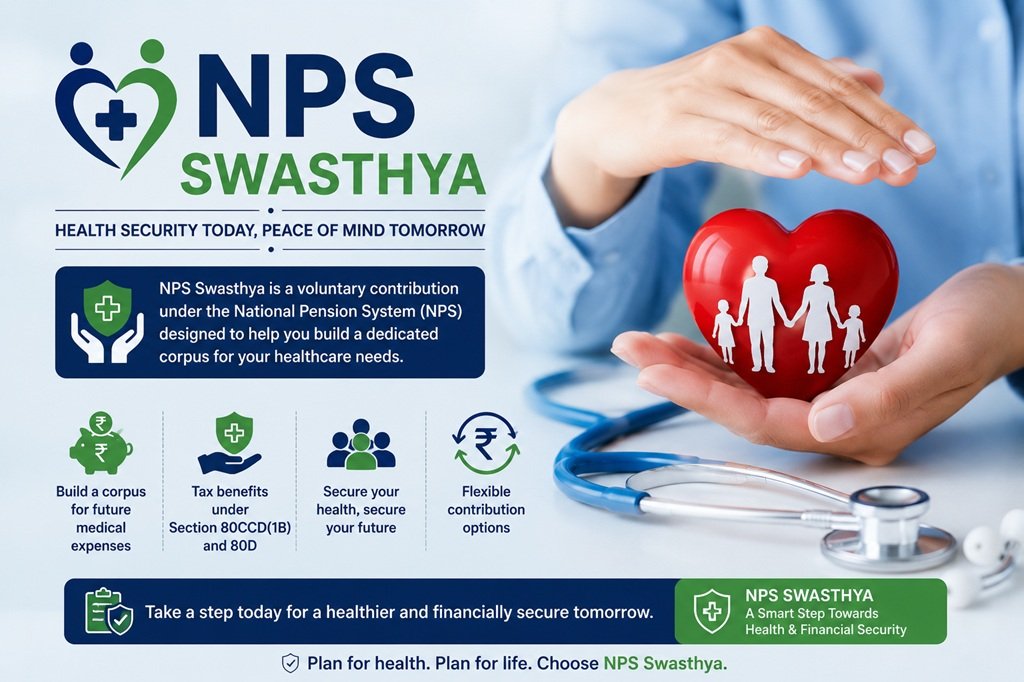
What Exactly Is the NPS Swasthya Pension Scheme?
At its core, the NPS Swasthya Pension Scheme (also called NSPS) is a health-linked, contributory pension product introduced under the National Pension System’s Multiple Scheme Framework (MSF). It operates as a sector-specific scheme — meaning it’s separate from your regular NPS account but tied to the same overall NPS architecture.
PFRDA launched it as a Proof of Concept (PoC), which basically means it’s running as a pilot for now, in a controlled environment under the Regulatory Sandbox Framework. The idea is to test whether mixing pension savings with healthcare benefits actually works on the ground before rolling it out to the entire country. Smart move, honestly.
The scheme came about after PFRDA examined the feasibility of integrating health-related benefit mechanisms with the existing NPS architecture. And what they found was encouraging enough to move forward with a limited launch.
Here’s the big picture in simple terms:
- You open a dedicated NPS Swasthya account alongside your regular NPS account.
- You contribute money into it voluntarily.
- When you face medical expenses — whether it’s a doctor visit or a major surgery — you can withdraw from this dedicated account.
- Payments go directly to hospitals or health administrators, not into your pocket.
- Any leftover money after your medical bill is settled goes back to your regular NPS account.
It’s clean, it’s structured, and it fills a gap that has been gaping for far too long.
Eligibility Criteria for NPS Swasthya
One of the most refreshing things about the NPS Swasthya Pension Scheme is that it isn’t buried under layers of complicated eligibility rules. Here’s the straightforward breakdown:
Basic Eligibility
- Any Indian citizen — resident or non-resident — is eligible to join.
- You must already have a Common Scheme Account under the regular NPS. If you don’t have one, you’ll need to open one first.
- Participation is completely voluntary. Nobody’s forcing your hand here.
- Standard KYC (Know Your Customer) documentation is required, but the process is streamlined.
The Age-Based Transfer Rule
Here’s where it gets a little more specific — and a bit more interesting:
- If you’re above 40 years of age and you’re a non-government sector subscriber, you’re allowed to transfer up to 30% of your own contributions from your existing Common NPS Account into the NPS Swasthya account.
- This is a one-time flexibility option designed especially for those who already have a decent corpus built up and want to earmark a chunk of it for health needs.
Who’s Left Out of the Transfer Option?
This is important: government sector employees and those in government-owned corporates are currently excluded from the 30% corpus transfer option. They can still open an NPS Swasthya account and contribute fresh money into it, but they can’t move existing NPS funds into the Swasthya account under the current pilot rules.
It’s a limitation worth knowing upfront, especially if you’re a central or state government employee who was hoping to redirect an existing corpus.
How Contributions Work Under NPS Swasthya
The contribution structure under the NPS Swasthya Pension Scheme is refreshingly flexible — there’s no rigid monthly amount you’re forced to commit to.
Key Contribution Facts
- Minimum initial contribution: ₹25,000 to open the account and become eligible for scheme benefits. The moment you make this contribution, you’re in.
- Subsequent contributions: You can contribute any amount of your choice, as and when you like, in line with existing NPS guidelines for the non-government sector.
- Investment of funds: Whatever you contribute is invested by empanelled Pension Funds under the Multiple Scheme Framework (MSF) guidelines — so your money isn’t just sitting idle. It’s working for you.
- No mandatory monthly commitment: Unlike some insurance products that demand a fixed premium, NPS Swasthya gives you the freedom to contribute on your own terms.
One thing to keep in mind: the scheme is contributory, meaning you’re building your own health fund. The government isn’t topping it up. This is your money being managed wisely for your future medical needs.
How Withdrawals Work
Alright, this is the part most people are curious about — what happens when you actually need to use the money? The NPS Swasthya Pension Scheme has clear, well-defined rules for withdrawals, and they’re designed to be genuinely useful rather than bureaucratically frustrating.
Partial Withdrawals for Medical Expenses
- Subscribers are allowed to make partial withdrawals from their NPS Swasthya account to cover both outpatient (OPD) and inpatient (hospitalisation) medical expenses.
- At any given time, you can withdraw up to 25% of your own contributions made to the scheme. Note that this is your contributions, not the total corpus (which might include investment gains).
- No limit on the number of withdrawals — you can make multiple withdrawals as medical needs arise. No waiting periods between withdrawals either, which is a huge relief compared to the rigid rules of standard NPS.
- One condition for the very first withdrawal: You need to have accumulated at least ₹50,000 in your NPS Swasthya account before you can make your first withdrawal. Think of it as the scheme ensuring there’s a meaningful corpus before any outflow begins.
Where Does the Money Actually Go?
Here’s the safeguard that keeps the system honest: withdrawn funds are paid directly to hospitals, Health Benefit Administrators (HBAs), or Third Party Administrators (TPAs). The money doesn’t pass through your personal bank account — it goes straight to the medical service provider based on valid claims and supporting invoices.
Any amount left over after the medical bill is settled? It’s automatically transferred back to your regular NPS Common Scheme Account. Nothing is wasted.
Exit Rules and Premature Withdrawal: What Happens in Extreme Situations?
Medical emergencies don’t always play by the rules of a standard 25% withdrawal cap. What if your hospital bill is enormous — far more than what a partial withdrawal can cover?
The NPS Swasthya Pension Scheme has thought about this too.
Premature Exit for Serious Inpatient Treatment
If you’re facing an inpatient hospitalisation where the medical expenses in a single instance exceed 70% of the total corpus in your NPS Swasthya account, you’re permitted to take a premature exit with 100% lump sum withdrawal — regardless of how large or small your corpus is.
Let that sink in. If your medical bill is big enough relative to what’s in your Swasthya account, you can pull everything out at once. No arguments, no lengthy approvals — the scheme understands that a health crisis isn’t the time for bureaucratic red tape.
This exit, like regular withdrawals, is still paid directly to the HBA or TPA. And again, any surplus after settling the medical bill goes back to your regular NPS account.
Regular Exit Provisions
For exits that don’t fall into the emergency medical category, the standard NPS exit rules apply:
- The accumulated amount in the NPS Swasthya account is first transferred to your Common Scheme Account.
- From there, normal and premature exit rules applicable to the All Citizens Model under NPS kick in.
- This ensures your retirement savings are still protected even if you stop contributing to the Swasthya account.
What If the Pilot Scheme Is Discontinued?
Since this is running as a Proof of Concept with a limited duration, there’s always the possibility it doesn’t get a permanent rollout. In that case, PFRDA has already clarified: subscribers can shift their accumulated NPS Swasthya funds back to their regular NPS account, following standard NPS exit rules. You won’t be left hanging.
The Role of Health Benefit Administrators (HBAs) and TPAs
You might be wondering — who exactly validates these medical claims and makes sure the money reaches the right place?
That’s where Health Benefit Administrators (HBAs) and Third Party Administrators (TPAs) come in. These are authorised intermediaries empanelled under the scheme who:
- Verify medical claims and supporting invoices
- Process withdrawal requests
- Remit payments directly to hospitals or healthcare providers
- Manage any surplus after medical expense settlement
Pension Funds running the NPS Swasthya Pension Scheme can also collaborate with FinTech firms and health service providers to make the entire process smoother and more digital. The goal is a seamless, paperless experience — which is something India’s healthcare payment landscape desperately needs.
Insurance Top-Ups: An Added Layer of Protection
Here’s a feature that doesn’t get enough attention: the NPS Swasthya Pension Scheme also allows for insurance top-ups. If a subscriber opts for health insurance coverage as part of the scheme, the insurance premiums are deducted directly from the NPS Swasthya account as a partial withdrawal.
This is a clever integration. Instead of juggling a separate insurance policy and a pension account, subscribers can essentially have their health insurance premiums funded through their dedicated Swasthya corpus. It adds a layer of protection beyond just direct medical expense withdrawals.
NPS Swasthya vs. Regular Health Insurance: What’s the Difference?
People sometimes ask — why not just buy a health insurance policy? It’s a fair question, and the answer is that NPS Swasthya isn’t really competing with health insurance. It’s complementing it.
Here’s a quick comparison to put things in perspective:
| Feature | NPS Swasthya Pension Scheme | Regular Health Insurance |
| Nature | Self-funded savings | Premium-based coverage |
| Corpus ownership | Your money, invested | Premiums don’t accumulate |
| Withdrawal flexibility | Multiple, no waiting period | Claim-based, subject to policy terms |
| Tax implications | Under NPS framework | Section 80D deductions |
| Coverage scope | OPD + inpatient | Varies by policy |
| Investment growth | Yes, through Pension Funds | No |
| Government involvement | PFRDA regulated | IRDAI regulated |
Think of NPS Swasthya as your health savings cushion, and health insurance as your health expense safety net. Together, they’re a genuinely powerful combination.
Why the NPS Swasthya Pension Scheme Matters for India
To truly appreciate why this scheme is a big deal, you’ve got to understand the healthcare cost landscape in India. Out-of-pocket medical expenses are among the highest in Asia. Families regularly deplete their life savings during medical emergencies. And for those who’re self-employed or in the informal sector — there’s often nothing between them and a financial catastrophe.
NPS Swasthya addresses this in a way that’s sustainable because it doesn’t depend on government funding per patient. It depends on individual savings, wisely invested and thoughtfully protected. It’s self-reliant healthcare planning — and that’s something India badly needs to normalise.
The scheme also demonstrates PFRDA’s growing willingness to innovate within the pension ecosystem. The fact that they’re willing to relax certain withdrawal regulations specifically for healthcare purposes shows a regulatory body that’s listening to what citizens actually need.
Who Should Seriously Consider Joining NPS Swasthya?
Not everyone will find equal value in this scheme. But certain groups would be wise to give it serious thought:
- Self-employed professionals — doctors, lawyers, consultants, freelancers who don’t have employer-sponsored health benefits.
- Gig economy workers — delivery partners, independent contractors, content creators who often have zero safety net.
- Private sector employees over 40 — especially those who already have a decent NPS corpus and can make the 30% transfer.
- Senior family members — if you’re planning retirement finances for ageing parents, this could be a structured way to earmark healthcare funds.
- Anyone with a family history of serious illness — because planning for predictable risk is just smart financial hygiene.
If you’re already contributing to NPS and healthcare costs keep you up at night, the NPS Swasthya Pension Scheme is probably worth exploring right now.
Frequently Asked Questions (FAQs)
Is the NPS Swasthya Pension Scheme available to government employees?
Yes, government employees can open an account and contribute fresh funds. However, they’re currently excluded from the option to transfer 30% of their existing NPS corpus into the Swasthya account. That transfer benefit is currently limited to private/non-government sector subscribers above 40 years.
What’s the minimum amount needed to open an NPS Swasthya account?
You’ll need to make an initial contribution of ₹25,000. Once you do that, you’re immediately eligible for scheme benefits.
Can I make unlimited withdrawals from the NPS Swasthya account?
There’s no restriction on the number of withdrawals, but each withdrawal is limited to 25% of your own contributions at any given time. Also, your first withdrawal can only happen after your corpus reaches ₹50,000.
Does the money from withdrawals come to my bank account?
No. Funds are paid directly to hospitals, Health Benefit Administrators (HBAs), or Third Party Administrators (TPAs). Any unused amount after settling the bill is returned to your regular NPS Common Scheme Account.
What happens if my hospital bill is more than what I can withdraw?
If the medical expenses in a single inpatient instance exceed 70% of your total NPS Swasthya corpus, you’re allowed to exit the scheme with a 100% lump sum payout — regardless of the corpus size. This is the premature exit provision for serious medical emergencies.
Is NPS Swasthya a replacement for health insurance?
Absolutely not. It’s meant to complement your existing health coverage, not replace it. Think of it as a dedicated healthcare savings buffer that works alongside your insurance policy.
What if PFRDA discontinues this scheme?
Since it’s running as a pilot (Proof of Concept), there’s a possibility it may not become permanent. If discontinued, you can transfer your accumulated NPS Swasthya funds back to your regular NPS Common Scheme Account under standard exit rules.
Who are Health Benefit Administrators (HBAs)?
These are authorised intermediaries appointed under the scheme to verify medical claims, process withdrawal requests, and ensure that payments go directly to healthcare providers. Pension Funds may also collaborate with FinTech companies and TPAs for this purpose.
Can NRIs join the NPS Swasthya scheme?
Yes, the scheme is open to both resident and non-resident Indian citizens, provided they hold or open a Common NPS Account and meet KYC requirements.
How is the money in the NPS Swasthya account invested?
Your contributions are invested by empanelled Pension Funds under the Multiple Scheme Framework (MSF) guidelines — the same way your regular NPS corpus is managed. So your health savings are also growing over time.
Conclusion
The NPS Swasthya Pension Scheme is one of those rare policy moves that actually makes you think — why didn’t we do this sooner? India has had pension reform, and India has had health scheme reform. But weaving them together, thoughtfully and systematically? That’s new territory, and PFRDA deserves credit for taking the plunge.
Of course, it’s still a pilot, and a few rough edges remain — most notably the exclusion of government employees from the corpus transfer benefit. But as a concept, NPS Swasthya is genuinely promising. It’s practical, it’s flexible, and it addresses a real problem that millions of Indians face every single year.
If you’re already an NPS subscriber, this is the perfect time to seriously consider adding an NPS Swasthya layer to your financial planning. And if you’re not yet part of the NPS ecosystem at all, this might just be the nudge you needed. Medical expenses don’t send appointment reminders — but with NPS Swasthya, at least your financial preparedness can stay one step ahead.

