

Credit card is easy money. You can just swipe it and purchase whatever you want. But credit card can come with credit card debt. Credit card debt in India has been quietly exploding. With easy EMI options, “no-cost” offers, and cashback rewards dangled in front of us at every checkout counter, millions of Indians are finding themselves buried under interest rates that can go as high as 42% per year.
But here’s the good news — this is a problem you can absolutely solve. Whether you owe ₹20,000 or ₹2,00,000, there’s a clear path forward. And not only can you wipe out that credit card debt, you can come out the other side with a credit score that would make a banker smile.
This article helps you in understanding how credit card debt actually works in India, to the smartest payoff strategies, to the step-by-step actions that will boost your CIBIL score over time. Let’s get into it.
What Is Credit Card Debt?
When you use a credit card and don’t pay the full amount by the due date, the remaining balance starts collecting interest. This isn’t simple interest — it’s revolving interest, which compounds monthly. Indian banks typically charge between 2.5% to 3.5% per month, which translates to a jaw-dropping 30% to 42% annually.
To put that in perspective: if you carry a balance of ₹1,00,000 on your credit card for a full year paying only the minimum due, you could end up paying back nearly ₹1,40,000 or more. You’re essentially paying for the same thing almost twice.
What makes credit card debt especially sneaky is the minimum payment trap. Banks set minimum payments low on purpose — often just 5% of your total outstanding. Paying only the minimum feels manageable, but it keeps you on the hook for years. The bank’s happy. Your wallet? Not so much.
Here’s what else most people don’t realize:
- Late payment fees can range from ₹500 to ₹1,300 per month
- Cash advance fees on credit cards are usually 2.5%-3% of the amount withdrawn, plus interest from day one
- Over-limit charges kick in the moment you exceed your credit limit
- Missing payments directly damages your CIBIL score, making future loans expensive or outright impossible
Understanding all this isn’t meant to scare you — it’s meant to fuel your urgency. Once you see credit card debt for what it is, it becomes much easier to fight back.
Step 1: Find out the exact number
The very first thing you’ve got to do — and this is the step most people skip — is get a crystal-clear picture of exactly what you owe.
Pull out every credit card statement you have. Yes, all of them. Create a simple list with:
- Card name and bank
- Total outstanding balance
- Interest rate (monthly and annual)
- Minimum payment due
- Due date
This isn’t fun. In fact, it might be downright uncomfortable. But you can’t fight what you can’t see. Think of it like turning on the lights when you hear a noise in the dark — the reality is almost always less terrifying once it’s visible.
If you’ve got multiple cards, add up all the balances. That total number is your enemy. Write it down. Circle it. That’s what you’re going after.
Step 2: Stop excessive spending
Before you start paying down your credit card debt, you need to stop making it worse.
Cut the spending on credit cards. This doesn’t necessarily mean scissors-to-the-card drama (though some people find that weirdly satisfying). It means making a firm decision: no new charges on any credit card until your debt is under control.
Switch to using your debit card or cash for daily expenses. If you’re worried about losing rewards points, don’t — no reward program in the world gives back 36% annually. The math simply doesn’t work in your favour when you’re carrying a balance.
Also, cancel subscriptions or auto-charges that are billed to your credit cards, and link them to your bank account instead. The fewer ways your credit card balance can grow, the better.
Step 3: Build a Budget
“Budget” is one of those words that sounds boring but is actually your most powerful weapon against credit card debt.
Here’s a dead-simple approach called the 50-30-20 rule, adapted for the debt-payoff phase:
- 50% of income → Essentials (rent, groceries, utilities, transport)
- 20% of income → Debt repayment (this goes UP during the payoff phase)
- 30% of income → Everything else (eating out, entertainment, shopping)
During your debt-crushing phase, you want to flip those last two percentages if at all possible. The more money you can throw at your credit card debt, the faster it disappears — and the less interest you pay overall.
Track every rupee for at least one month using a free app like Walnut, Money Manager, or even a simple Excel sheet. You’ll almost always find “leaks” — small, automatic spends that add up surprisingly fast.
Step 4: Choose Your Payoff Strategy
This is where things get interesting. There are two main strategies to pay off credit card debt, and both work. The right one depends on your personality.
The Avalanche Method (The Smart Way)
With the avalanche method, you list all your debts from highest interest rate to lowest. You pay the minimum on everything, but throw all your extra money at the highest-interest card first.
Once that card’s paid off, you roll that entire payment amount into attacking the next card. Like a snowball rolling downhill — except it’s an avalanche.
Why it works: You pay the least amount of total interest. Mathematically, it’s the most efficient approach.
The downside: It can take a while to see progress if your highest-interest card also has the biggest balance. This can feel discouraging.
The Snowball Method (The Motivating Way)
With the snowball method, you list debts from smallest balance to largest, regardless of interest rate. You attack the smallest balance first.
Knock that one out, feel the win, then move to the next. Each payoff gives you momentum.
Why it works: Psychology. Humans are wired to need small victories. Completing debts one by one keeps you motivated.
The downside: You might pay slightly more in total interest compared to the avalanche method.
Which should you choose? If you’re disciplined and numbers-driven, go avalanche. If you’ve tried paying off debt before and quit halfway, go snowball. The best strategy is the one you’ll actually stick to.
Step 5: Negotiate With Your Bank
Here’s a trick that most Indians don’t know: you can negotiate with your credit card issuer.
If your credit card debt has become unmanageable, call your bank’s customer care and ask about:
- Restructuring your debt into a fixed EMI at a lower interest rate
- A temporary hardship plan if you’ve faced a job loss or medical emergency
- A one-time settlement (though this impacts your CIBIL score, it can be a last resort)
- Waiver of late fees or penalties — especially if you’ve been a long-standing customer
Banks generally prefer getting paid something over not getting paid at all. They’re often more willing to work with you than you’d expect. Be polite, be honest, and ask directly.
Step 6: Explore Balance Transfer Options
A balance transfer means moving your credit card debt from a high-interest card to one that offers a lower interest rate — sometimes even 0% for an introductory period.
Several Indian banks offer balance transfer facilities. HDFC, ICICI, SBI, and Axis Bank all have versions of this feature.
Here’s what to look out for:
- Processing fee: Usually 1-2% of the transferred amount
- Introductory period: Often 3-6 months at 0% or low interest
- What happens after: The rate jumps back up, sometimes higher than before
A balance transfer makes sense if you’re confident you can pay off a large chunk (or all) of the balance during the low-interest window. If you just transfer and keep spending, you’ve made your situation worse.
Step 7: Find Extra Money for Credit Card Debt
Cutting expenses helps. But earning more can be a total game-changer.
Some practical ideas that actually work for Indians:
- Freelance on weekends — writing, graphic design, tutoring, data entry
- Sell things you don’t use — OLX and Facebook Marketplace are full of buyers
- Rent out a room or parking space if you have one available
- Use cashback and reward points — redeem them for statement credits or bill payments
- Ask for a raise or side project at work — the worst they can say is no
- Drive for Ola or Uber on evenings or weekends
Even an extra ₹5,000-₹10,000 a month can dramatically shorten the time it takes to eliminate your credit card debt.
How to Build a Good Credit Score in India
Now let’s talk about the other side of this equation — your CIBIL score.
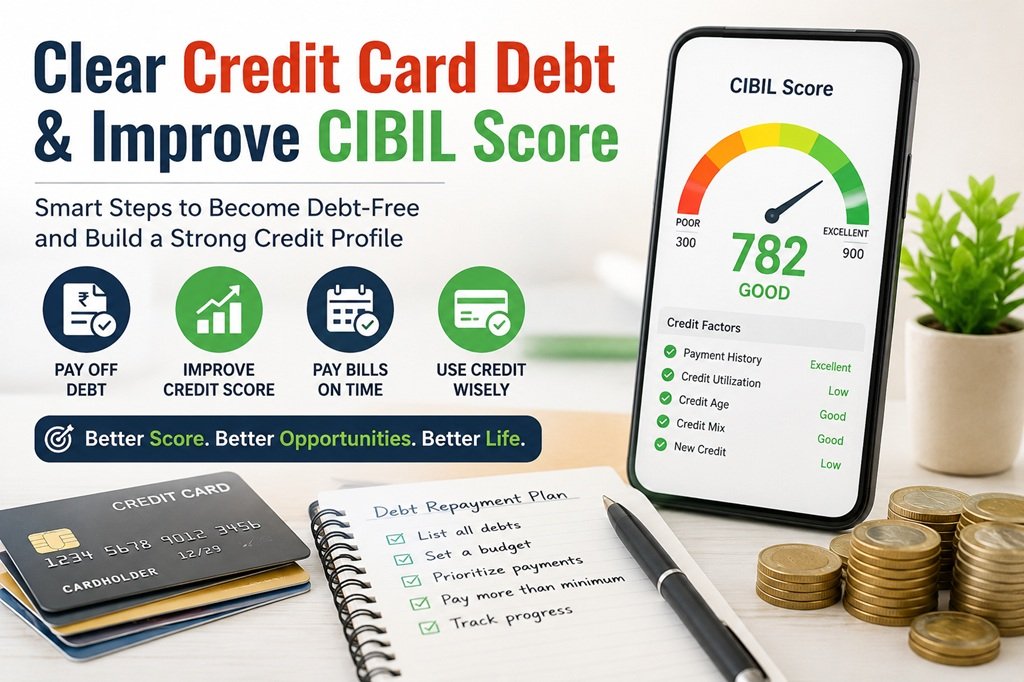
Your CIBIL score ranges from 300 to 900. Anything above 750 is considered excellent, while anything below 650 makes lenders nervous. Your score determines whether you get loans, at what interest rate, and how much.
Paying off credit card debt is one of the biggest things you can do for your score. But there’s more to it.
Understand What Makes Up Your Credit Score
Here’s roughly how Indian credit bureaus calculate your score:
| Factor | Weightage |
| Payment history | ~35% |
| Credit utilization ratio | ~30% |
| Length of credit history | ~15% |
| Credit mix | ~10% |
| New credit inquiries | ~10% |
Keep Your Credit Utilization Low
Your credit utilization ratio is the percentage of your available credit that you’re using. If your total credit limit is ₹1,00,000 and your balance is ₹70,000, your utilization is 70% — and that’s considered very high.
Aim to keep it below 30%, ideally below 10% for the best score impact. This single factor accounts for about 30% of your score.
As you pay down your credit card debt, your utilization ratio drops automatically — which means your score should start climbing. It’s a beautiful cycle.
Never Miss a Payment
Payment history is the single biggest factor in your credit score. One missed payment can knock 50-100 points off your score and stay on your report for years.
Set up auto-pay for the minimum amount on all cards, just as a safety net. Then manually pay more on top of that whenever you can.
Don’t Close Old Cards (Usually)
It’s tempting to cut up and cancel cards you’ve paid off. But closing old accounts actually shortens your credit history and can increase your utilization ratio — both of which hurt your score.
Keep old cards open, use them occasionally for small purchases, and pay them off immediately. This keeps the account active and your history long.
Limit Hard Inquiries
Every time you apply for a new credit card or loan, the lender does a hard inquiry on your credit report. Too many inquiries in a short period signals desperation to lenders and dings your score.
Don’t apply for new credit unless you truly need it. And when you do shop around for loans, try to do it within a short window (a few weeks) so multiple inquiries count as just one.
Check Your CIBIL Report Regularly
Get your free annual CIBIL report at cibil.com and check it carefully for errors. Mistakes — like incorrect outstanding balances, duplicate accounts, or payments wrongly marked as missed — are more common than you’d think, and they can drag down your score unfairly.
If you find an error, raise a dispute with CIBIL directly. It can take a few weeks, but getting inaccuracies removed can give your score a meaningful lift.
Common Mistakes to Avoid When Tackling Credit Card Debt
Let’s call out some classic blunders so you don’t make them:
- Paying only the minimum due every month — This keeps you in debt for years and costs a fortune in interest.
- Using one card to pay off another — Cash advances have brutal fees and no grace period.
- Ignoring the problem and hoping it goes away — Credit card debt doesn’t disappear on its own. In fact, it multiplies.
- Closing multiple old accounts at once — This can cause a sudden drop in your credit score.
- Taking a personal loan to pay off debt without changing habits — If the spending habits don’t change, you’ll end up with both loan repayments AND new credit card debt.
Conclusion
Here’s the thing about credit card debt in India — it didn’t build up overnight, and it won’t disappear overnight either. But every single payment you make above the minimum, every rupee you redirect toward your balance, every month you resist adding to the pile? That’s real progress.
The roadmap is clear:
- Face your numbers honestly
- Stop adding to your debt
- Build a realistic budget
- Pick a payoff strategy and commit
- Explore every tool available — negotiations, balance transfers, side income
- Simultaneously build your credit score with smart habits
Don’t wait for the “perfect moment” to start. There isn’t one. The best time to crush your credit card debt was yesterday. The second-best time is right now.

