

BTST is the perfect way to buy and sell stocks without committing to a whole day. If you see a stock fly at close and want to be able to hold onto it until tomorrow, but don’t have time to wait any longer than that, then BTST trading is just what you’re looking for!
This guide will explain everything you need to know about BTST trading including; what it is, how it works, examples of BTST trades, BTST trading strategies, fees and charges associated with BTST trading and the most important thing, the risks of BTST trading.
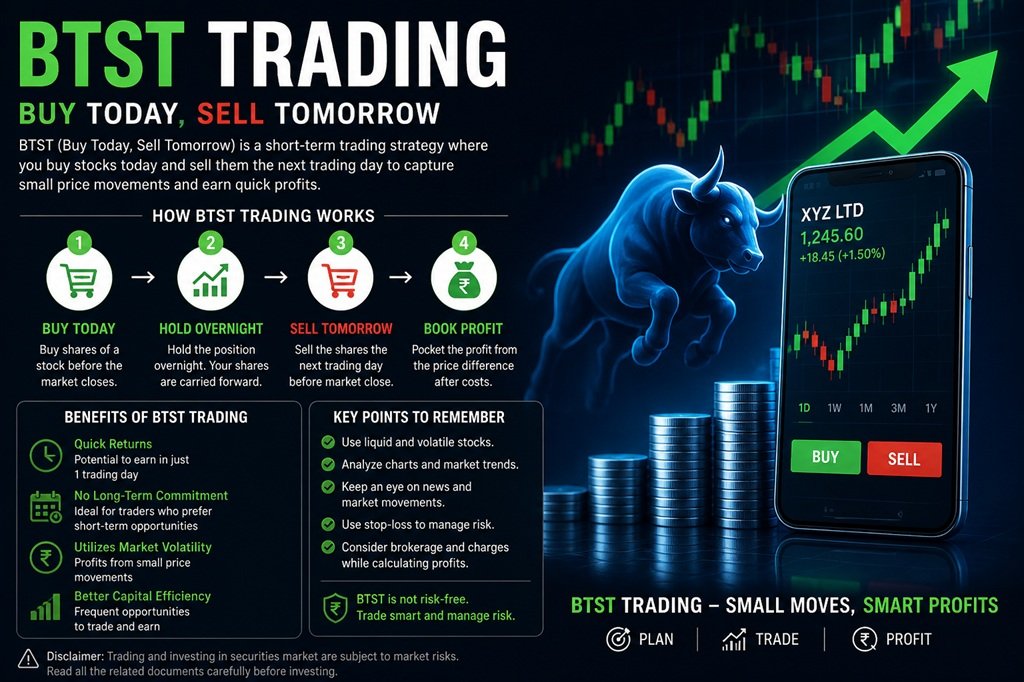
What Does BTST Mean?
BTST stands for Buy Today, Sell Tomorrow. The name says it all.
In BTST trading, you buy shares during today’s trading session and sell them the very next trading day — before those shares are even officially added to your demat account. Yes, you are selling shares that haven’t technically “arrived” yet. This is possible because India’s stock market runs on a T+1 settlement system, where a trade settles (is finalized) one business day after the trade date. Your broker bridges this gap for you.
To understand why this is useful, think about the space between intraday trading (buy and sell on the same day) and delivery trading (buy and hold for days, weeks, or longer). BTST sits in the middle — you hold the stock for just one night to catch any price jump the following morning.
A Real-Life Example
Say it’s 3 PM on a Tuesday. You notice that Reliance Industries is trading near its day’s high with unusually strong volumes. After market hours, the company is expected to announce its quarterly earnings. You feel confident the results will be good.
So you buy 50 shares of Reliance at ₹1,400 each, spending ₹70,000.
Results come in after 6 PM. They are excellent — better than most analysts expected. Global markets also trend positive overnight.
Wednesday morning, Reliance opens at ₹1,500 — a gap-up of ₹100 per share. You sell all 50 shares at ₹1,500, making a gross profit of ₹5,000 in roughly 18 hours.
That is BTST in action.
How BTST Trading Actually Works: Step by Step
Understanding the mechanics helps you avoid costly mistakes.
Step 1 — You Buy Shares (Day 1, usually between 2:30 PM – 3:30 PM) You place a buy order using the CNC (Cash and Carry) product type, or your broker’s specific BTST option. The capital gets blocked in your account. Ideally, you are buying near the end of the session, after the day’s trend is clearly established.
Step 2 — You Hold Overnight The shares are in the settlement pipeline. They are not yet credited to your demat account, but your broker knows they are coming. You monitor any overnight news — global markets, company announcements, economic data.
Step 3 — You Sell the Next Morning (Day 2) When the market opens at 9:15 AM, you assess the situation. If the stock has gapped up as expected, you sell and take your profit. If it has gapped down, you cut your losses quickly. The shares that were being delivered from Day 1’s purchase are matched against your sell order by the broker.
Step 4 — Settlement Completes (Day 3) The complete settlement cycle wraps up, your net profit or loss is reflected in your account, and the position is closed.
The T+1 Settlement Cycle
India moved to a T+1 (trade plus one day) settlement cycle, which means shares bought on Monday are credited to your demat on Tuesday. BTST exploits this window — you sell on Tuesday before the shares even formally land, and your broker handles the delivery matching behind the scenes.
BTST vs Intraday vs Delivery
Here’s a simple breakdown to see where BTST fits in your trading toolkit:
| What You Want | Use This |
| Profit within the same day, no overnight risk | Intraday |
| Hold overnight to catch next-day momentum | BTST |
| Invest for days, weeks, or longer | Delivery |
Key differences:
- Risk level: Intraday has zero overnight risk but requires constant monitoring. BTST carries one night of gap risk. Delivery carries multiple nights.
- Capital required: Intraday allows leverage, so less upfront money is needed. BTST typically requires 40–100% of the trade value upfront (as per SEBI rules). Delivery requires the full amount.
- STT (Securities Transaction Tax): In intraday, STT applies only on the sell side at 0.025%. In BTST, if the broker treats it as delivery, STT is charged at 0.1% on both buy and sell sides.
- Demat charges: Delivery trades attract DP (Depository Participant) charges when you sell. BTST trades are often exempt since shares may not formally enter your demat.
A Detailed BTST Trade Example with Actual Numbers
Let’s walk through a real scenario so the profit/loss formula makes sense.
Situation: You buy 100 shares of Company ABC at ₹500 each on Monday afternoon. Total cost: 100 × ₹500 = ₹50,000
Overnight trigger: Company ABC announces a new government contract after market hours.
Tuesday morning: The stock opens at ₹535. You sell all 100 shares. Sell value: 100 × ₹535 = ₹53,500
Gross Profit: ₹53,500 – ₹50,000 = ₹3,500
Charges (approximate):
- STT on buy (0.1%): ₹50
- STT on sell (0.1%): ₹53.50
- Exchange charges (NSE, ~0.00297%): ₹15
- Brokerage (flat ₹20 per order, two orders): ₹40
- GST (18% on brokerage + exchange charges): ₹10
- Total charges: ~₹170
Net Profit: ₹3,500 – ₹170 = ₹3,330
Formula to remember:
Profit/Loss = (Sell Price – Buy Price) × Number of Shares – All Charges
All the Charges You Need to Know
BTST isn’t free. Here’s every cost to factor in before you trade:
Securities Transaction Tax (STT): If treated as delivery, 0.1% is charged on both the buy and the sell leg. This is mandatory and non-negotiable.
Brokerage: Discount brokers typically charge a flat fee (around ₹20 per executed order). Full-service brokers may charge 0.1% to 0.5% of turnover.
Exchange Transaction Charges: On the NSE, approximately ₹2.97 per lakh of turnover (as of October 2024 revised rates). BSE is slightly different.
GST: 18% on the sum of brokerage and exchange charges.
SEBI Turnover Fees: A small regulatory charge on all transactions.
DP (Depository Participant) Charges: Usually around ₹13–₹13.50 plus 18% GST per ISIN per day. May apply if shares are formally credited before you sell.
Stamp Duty: Charged on the buy side; varies by state.
Auction Penalty: If the original seller fails to deliver their shares to the exchange on time, you may face an auction penalty of up to 20% of the shortfall value. This is one of the biggest hidden risks of BTST.
SEBI Upfront Margin Rule (from September 2020): You must maintain 100% of the trade value as margin. If you fall short, a penalty of 0.5% to 1% per day applies on the shortfall amount.
Who Should Use BTST Trading?
BTST is not for everyone. It works best for:
Short-term active traders who want to capture momentum over one night without committing to a multi-day swing trade.
Technically aware traders who can read charts, identify breakouts, and interpret volume signals near the market close.
People with a higher risk appetite who can emotionally and financially handle waking up to a gap-down opening.
Market watchers who track global market movements, corporate earnings calendars, and news flow that impacts Indian stocks.
If you are just starting out or prefer passive investing, BTST may be too hands-on for your style.
Smart BTST Strategies That Actually Work
The Breakout Strategy
Look at 15-minute or 30-minute candlestick charts in the final hour of trading. Stocks that break above a key resistance level with above-average volume are prime BTST candidates. The logic is simple: if buyers push a stock to a new high with strong volume just before close, there is a good chance that momentum carries into the next morning.
Buy Before a Major Announcement
Corporate events like quarterly results, merger announcements, or large order wins often cause stocks to gap up or down the next morning. If your research suggests a positive outcome, entering just before market close is a classic BTST move. Be cautious though — if you’re wrong, the gap can go the other way.
Ride the Sectoral Wave
Sometimes an entire sector gets good news — a policy announcement, export data, or a global commodity price move. If you see the banking sector, IT sector, or pharma stocks moving strongly in the last 30 minutes, picking a liquid large-cap within that sector for BTST can work well.
Always Set a Stop-Loss
This is not optional. Before you go to sleep, set a Good-Till-Triggered (GTT) stop-loss order. If the stock opens below your stop price, the order exits automatically. You do not want to be emotionally deciding at 9:15 AM when the market is gapping down fast.
Use Technical Indicators for Confirmation
- RSI above 60–65: Suggests the stock has solid bullish momentum.
- Price above VWAP in the last hour: Indicates that buyers dominate.
- Volume 1.5x–2x the 10-day average: Confirms the move is genuine, not a thin-market blip.
How to Pick the Right Stocks for BTST
Not every stock is BTST-worthy. Here are the filters to apply:
High liquidity is non-negotiable. Stick to Nifty 50 or Nifty 500 stocks with daily volumes of at least 5–10 lakh shares. Low-volume stocks may not have enough buyers the next morning, leaving you trapped.
Closing near the day’s high. A stock that closes at or near its intraday high suggests buyers were in control till the very end — a positive signal for the next morning.
Clear news or event catalyst. Earnings, contracts, regulatory approvals, or global tailwinds give the move a reason to continue overnight.
Bullish overall market. Individual stock BTST trades work much better when Nifty is trending up. In a weak market, even strong individual stocks can get dragged down.
Stocks to Strictly Avoid for BTST
Penny stocks and illiquid stocks: These are a disaster waiting to happen. Low volumes mean you may not find a buyer the next morning. You risk being stuck or facing a lower circuit.
Stocks already up 5%+ on the day: Most of the move has already happened. Profit-booking the next morning is highly likely, and you may end up on the wrong side of it.
T2T (Trade-to-Trade) stocks: BTST is not permitted for T2T category stocks, as they require compulsory delivery. Your broker will typically block this.
Stocks under GSM or ASM surveillance: These have heightened volatility and trading restrictions. The risk is disproportionate to any potential reward.
Stocks with a negative event overnight: If a company has a board meeting, court hearing, or regulatory scrutiny expected overnight, stay away. The downside surprise potential is high.
Advantages of BTST Trading
Quick profit potential: You can earn in just 18–24 hours what might take days with regular delivery trading, if a strong catalyst plays out.
Less stressful than intraday: You don’t need to stare at your screen all day. You enter near close, set your GTT orders, and check back in the morning.
Capitalise on after-market news: Major announcements often come after 4 PM, when markets are closed. BTST lets you position yourself before the news breaks rather than reacting to it the next morning.
Efficient use of capital: You can potentially avoid full DP debit charges and certain demat costs, since the shares may not formally enter your account before you sell.
Flexibility: Works well for people who have day jobs but follow markets actively in the evenings and early mornings.
Risks You Must Take Seriously
Auction risk (short delivery): This is the biggest BTST-specific risk. If the person who sold you shares on Day 1 fails to deliver them on time, you cannot complete your sell on Day 2. The exchange then runs an auction to procure those shares. You may face an auction penalty — sometimes up to 20% of the value of the shortfall. This is entirely outside your control.
Gap-down overnight: Bad news doesn’t announce itself in advance. A geopolitical event, a global market crash, a company scandal — any of these can cause your stock to open 5–10% lower the next morning. Your entire expected profit can turn into a loss.
Liquidity risk: Even large-cap stocks can sometimes hit a lower circuit on surprise bad news, leaving you unable to sell at all.
Higher trading costs: If you trade BTST frequently, the charges on both buy and sell legs (especially if treated as delivery) add up fast. Small position sizes can easily end up being eaten by fees.
Margin shortfall penalties: SEBI requires full margin to be maintained. If your account drops below the threshold, penalties kick in even if the trade was not your fault.
When to Use BTST and When to Step Back
Use BTST when:
- A high-volume stock breaks out near resistance in the last 15–30 minutes
- You have a strong, research-backed reason to expect positive overnight news
- The broader market is in an uptrend
- You are trading only liquid, large-cap stocks
- You have stop-loss orders ready to go before you sleep
Avoid BTST when:
- Markets are highly uncertain — elections, RBI policy days, global crises
- You are looking at penny or illiquid stocks
- A stock already made a big move earlier in the day
- You don’t have the time or tools to set stop-loss orders
- You are investing more than you can afford to lose overnight
Final Thoughts
BTST trading is a powerful short-term tool — but it is not a magic formula. It rewards traders who do their homework: studying charts, tracking news flow, checking volumes, and most importantly, respecting risk management.
Think of BTST like boarding a last train. If you’ve checked that the train is running on time, the weather is clear, and you have your ticket ready — the journey can be smooth and fast. But if you board blindly without checking any of these, you might find yourself stuck midway.
Start small, practice with liquid large-cap stocks, always set a stop-loss, and never put all your capital into a single BTST position. Over time, as you develop a feel for when conditions are right, BTST can become a reliable part of your short-term trading strategy.
Disclaimer: This article is for educational purposes only and does not constitute investment advice. All trading in the stock market involves risk. Please do your own research and consult a registered financial advisor before making any investment decisions.

