
Blog Page 89

APAAR ID Card – Registration, Benefits, How To Download

0

The Government of India and the Ministry of Education introduced the APAAR ID card according to the National Education Policy (NEP) 2020 to generate unique ID numbers for school students throughout India.

The APAAR ID, referred to as the ‘One Nation One Student ID Card’, will be advantageous for all students since their entire academic information, including achievements, degrees, scholarships, and other credits, will be digitally linked to the APAAR ID.

APAAR ID Register Download

What is the APAAR ID Card?

The APAAR ID Card is a distinctive identification system launched by the Indian government to consolidate student records and academic information within a cohesive structure. It functions as an Academic Bank of Credits (ABC) ID, assisting students in keeping a digital log of their academic achievements.

APAAR represents “Automated Permanent Academic Account Registry.” This project seeks to improve the accessibility, transparency, and efficiency of education in India.

The APAAR ID card is a permanent identification number that monitors students’ educational progress and accomplishments, facilitating transfers between schools. The schools and universities will provide this card to every student registered from pre-primary through higher education. The APAAR card will be an enhancement to the students’ currently available Aadhaar ID.

The APAAR card can be downloaded by the students after completing the APAAR Card registration process. The APAAR card will feature the distinctive 12-digit APAAR number, a unique ID, through which students can access various benefits and easily store their academic records.

The One Nation One Student ID Card will additionally be connected to the children’s Aadhaar card number. The APAAR ID represents an important advancement in creating a structured and accessible scholarly experience for students.

What is EPIC Number? How To Download Voter ID Card?

Key Features of the APAAR ID Card

  • A lifelong academic ID for students
  • Helps track academic credits and achievements
  • Enables smooth transitions between schools, colleges, and universities
  • Digital record-keeping for education-related activities

Who is Eligible for an APAAR ID?

Any student enrolled in an educational institution in India, from primary school to higher education, is eligible for an APAAR ID. It applies to –

  • School students (Class 1 to 12)
  • College and university students
  • Vocational and skill development learners

APAAR ID Consent Form

Educational institutions can enroll their students’ names for APAAR ID cards solely after receiving approval from the parents. The approval of parents whose kids are going to apply for the APAAR ID card is essential because the APAAR ID card will include personal information about the children, including blood group, weight, height, and more.

Schools may offer the APAAR ID consent form to parents who consent to request an APAAR ID card for their kids. Parents may also obtain the form from the official website, complete it, and send it to the schools. The document will serve as a consent letter from the parents. Parents can choose to revoke their consent at any moment.

How to Fill APAAR ID Consent Form?

Below is the process for filling out the APAAR ID consent form:

  • Parents must visit the APAAR website.
  • Scroll down and click on ‘Resources’.
  • Click on the download icon against the ‘APAAR Parental Consent Form (English)’ 
  • Fill out the required details on the form and submit it to the school.

How to Register for an APAAR ID?

Step 1: Visit the Official Portal

Go to the official APAAR ID registration website or check with your educational institution.

Step 2: Provide Required Details

Enter the necessary information such as:

  • Student’s name
  • Date of birth
  • Aadhar number (if applicable)
  • School or college details

Step 3: Verification Process

Once you submit the details, the system verifies your credentials. This may involve OTP authentication via the registered mobile number.

Step 4: Generation of APAAR ID

After verification, a unique APAAR ID is created, and you can download the digital APAAR ID card.

How to Download APAAR ID Card?

Step 1: Log in to the APAAR Portal

Visit the official website abc.gov.in and enter your registered details.

Step 2: Navigate to the Download Section

Once Login, Find the option to download your APAAR ID card in PDF format.

Step 3: Save or Print the ID

Your APAAR ID is displayed on the Screen. You can download it. After downloading, you can save a digital copy or take a printout for future reference.

Benefits of APAAR ID Card

Digital Academic Record

No more lost mark sheets! The APAAR ID stores academic records digitally, making them accessible anytime, anywhere.

Easy School and College Transfers

Moving to a new institution? APAAR simplifies the process by maintaining a centralized record of academic credits and certificates.

Integration with ABC (Academic Bank of Credits)

The ID is linked to the Academic Bank of Credits (ABC), helping students accumulate and transfer credits across institutions seamlessly.

Reduces Paperwork

Forget the hassle of carrying physical documents. APAAR minimizes paperwork by offering digital storage of academic credentials.

All details regarding a student can be accessed through the APAAR card. It includes details like the student’s name, address, birth date, gender, photo, sports participation, education loans, scholarships, awards, and more.

Improves Transparency in Education

The government and institutions can track academic progress more efficiently, ensuring transparency and preventing fraudulent documentation.

It will electronically centralize academic information, encompassing scholarships, degrees, accolades, and other student credits.

Student Data Storing and Tracking at Single Place

The APAAR ID card will centrally digitize student information, including academic results, examination scores, report cards, health records, and extracurricular accomplishments like Olympiad rankings and specialized skill training.

The APAAR number will monitor the academic histories of students across all age categories, encompassing school, degree college, junior college, and postgraduate studies.

Credit Score

The credit score assigned to students via APAAR ID can be utilized for their higher studies or for university entrance examinations.

Security and Privacy Concerns

Since the APAAR ID is linked with academic credentials, security measures are in place to protect students’ data. Institutions ensure that:

  • Data is encrypted and securely stored.
  • Only authorized personnel can access student records.
  • Privacy laws are followed to prevent misuse of personal information.

How Does APAAR ID Help in Future Studies and Careers?

1. Streamlined Higher Education Admissions

Universities can access academic records directly, simplifying the admission process.

2. Simplifies Scholarship Applications

Many scholarships and government benefits might be linked to APAAR, making applications smoother.

3. Easier Job Applications

Employers and institutions can verify educational qualifications without requiring physical documents.

4. Global Recognition

APAAR may later integrate with international education systems, making global academic transitions easier.

Common Challenges and Solutions

1. Technical Glitches

Some students face issues during registration due to server errors. Ensure a stable internet connection and try at non-peak hours.

2. Verification Delays

If your verification takes longer than expected, contact your educational institution for assistance.

3. Forgotten Login Credentials

Use the “Forgot Password” option on the portal or contact support for help retrieving your account.

Future of APAAR ID in India

The APAAR ID system is set to revolutionize academic record-keeping in India. In the coming years, we can expect:

  • Full integration with the National Education Policy (NEP 2020).
  • Increased adoption by universities and employers.
  • Potential international collaboration for global education recognition.

Final Thoughts

The APAAR ID card is a game-changer for students, institutions, and employers. It ensures academic credentials are secure, accessible, and transferable, making life easier for students pursuing education in India. If you haven’t registered yet, now is the time to do so and enjoy the benefits of this digital academic revolution!

Frequently Asked Questions (FAQs)

Is the APAAR ID Card Mandatory?

As of now, it is not compulsory but highly recommended. The government encourages students to register to avail of its benefits and future integration with the education system.

Can I register for an APAAR ID without an Aadhar number?

Yes, but having an Aadhar-linked APAAR ID offers additional benefits like seamless verification and integration with government portals.

Is the APAAR ID valid for life?

Yes, the APAAR ID is a lifelong academic identity that remains with the student throughout their education and career.

Can I update my details in the APAAR ID?

Yes, students can update their details by logging into the portal and making necessary changes with proper verification.

Does APAAR replace traditional mark sheets?

Not entirely. While APAAR digitizes records, mark sheets will still be issued by educational institutions.

What should I do if I lose access to my APAAR ID?

You can recover your APAAR ID by visiting the official portal, using the recovery options, or contacting your institution for assistance.

e-Shram Card – How to Download?

The Government of India launched the e-Shram scheme to offer social security to employees in unorganized sectors. The government introduced the e-Shram portal for workers in informal sectors as well. The aim of the e-Shram portal is to gather a database of unorganised workers in order to offer them advantages from different government initiatives.

An individual employed in an unorganized sector should register for a Shramik card or an e-Shram card. With the e-Shram card, workers and laborers in unorganized sectors can access numerous benefits, including a pension post-60 years, death insurance, financial support during incapacity, and more. The aim of the e-Shram card is to enable unorganized workers to access all the new government schemes and services via the e-Shram portal.

e-sharm card download online

What is an e-Shram Card?

The e-Shram Card is a unique identification card issued by the Indian government for unorganized sector workers. It includes a Universal Account Number (UAN) and provides access to various government welfare schemes.

Who is Eligible for an e-Shram Card?

To apply for an e-Shram Card, you must:

  • Be an unorganized worker (e.g., laborers, street vendors, construction workers, agricultural workers, etc.).
  • Be aged between 16-59 years.
  • Not be a taxpayer (shouldn’t be paying income tax).
  • Not be a member of EPFO or ESIC.

e-Shram Card Details

Scheme name e-Shram Card
Launched by Ministry of Labor and Employment
Start date August 2021
Beneficiaries Unorganised sector workers
Pension benefits Rs.3,000 per month
Insurance benefits Death insurance of Rs.2 lakh Rs.1 lakh for partial handicap
Age limits 16-59 years
Official website https://eshram.gov.in/
Helpline number 14434

What is the Unorganised Sector?

The unorganized sector consists of establishments or units involved in providing services, goods, or manufacturing and employs fewer than ten workers. These units are not included in the ESIC and EPFO. Any employee engaged in the unorganized sector is regarded as an unorganized worker. An individual who is not affiliated with ESIC or EPFO and works from home or is self-employed is referred to as an unorganized worker.

e-Shram Card Registration: How to Apply Online?

The e-Shram card application can be submitted via the CSC (Common Service Centre) or the e-Shram website. Qualified individuals can go to the closest CSC center and apply for the e-Shram card. They can find the closest CSC centre on the e-Shram Portal by inputting the state and district to apply for the e-Shram card.

The method of submitting the application to acquire the e-Shram card online is outlined as follows.

Step 1 – Visit the e-Shram portal (Self-registration page).

e-Sharm Card Apply

Step 2 – Input the mobile number linked to Aadhaar and the captcha code, then press the ‘Send OTP’ button.

Step 3 – Input your Aadhaar number, check the terms and conditions box, and input the OTP received on your mobile. Press the ‘Validate’ button.

Step 4 – Confirm the personal details that appear on the screen.

Step 5 – Provide the necessary information, including your address, educational background, etc.

Step 6 – Choose the skill title, type of industry, and work category.

Step 7 –  Enter the bank details and select the self-declaration.

Step 8 Select the ‘Preview’ option to check the entered information and then click on the ‘Submit’ button.

Step 9  An OTP will be sent to the mobile number. Enter the OTP and click on the ‘Verify’ button. 

Step 10 The e-Shram card is created and shown on the display. The e-Sharm Card can be downloaded from here.

Documents Required for e-Shram Card

  • Aadhaar card.
  • The mobile number linked with the Aadhaar card.
  • Bank account.

How to Download e-Shram Card?

After filing the application to obtain the e-Shram card, follow the below process to download the e-Shram card:

  1. Visit the e-Shram portal. 
  2. Press the ‘Already Registered’ tab and choose the ‘Update Profile Using UAN’ option.
  3. Input the UAN number, date of birth, captcha code, and press the ‘Generate OTP’ button.
  4. Input the OTP sent to your mobile number and press the ‘Validate’ button.
  5. Verify the personal information shown on the display.
  6. Select the ‘Preview’ option to check the information provided, and then click the ‘Submit’ button.
  7. A mobile number will receive an OTP. Input the OTP and press the ‘Verify’ button. 
  8. The e-Shram card is generated and displayed on the screen.
  9. The e-Shram card can also be downloaded by clicking on the download option.

e-Shram Card Payment Status: How to Check Balance in e-Shram Card?

  1. Visit the e-Shram portal.
  2. Click on the ‘E Shram Card Payment List’ link.
  3. Enter the e-Shram card number, UAN number, or Aadhar Card and click on the ‘Submit’ button.
  4. You can see the e-Shram payment status.

Benefits of an e-Shram Card

The unorganised worker having an e-Shram card will get the following benefits –

  • A pension of Rs.3,000 per month after attaining 60 years.
  • Beneficiaries will receive a 12-digit UAN number valid throughout India.

Accidental Insurance Coverage

  • Workers get ₹2 lakh insurance under the Pradhan Mantri Suraksha Bima Yojana (PMSBY).
  • In case of partial disability, ₹1 lakh is provided.

Access to Social Security Schemes

  • The government integrates various welfare schemes like Pensions, Maternity Benefits, and Housing Assistance under one platform.

Financial Assistance During Emergencies

  • During times like COVID-19, the government may offer direct benefit transfers (DBT) to workers.

Job Assistance and Skill Development

  • e-Shram Cardholders may receive training programs and employment opportunities in their respective fields.

Integration with Other Schemes and Portals

While the e-Shram card facilitates access to various government schemes, workers must enroll separately in schemes like PM-SYM to receive pension benefits.

  • Pradhan Mantri Shram Yogi Maandhan (PM-SYM) – The PM-SYM pension scheme is now linked with the e-Shram portal. Workers aged 18-40 who are unorganized can register using their Universal Account Number (UAN). Under PM-SYM, recipients receive a monthly pension of ₹3,000 upon reaching 60 years of age. The government covers 50% of the contribution while the worker pays the rest.
  • National Career Service (NCS) – Registered employees can utilize the NCS portal with their UAN to discover job prospects. This integration improves job opportunities in the unorganized sector.
  • Skill India Digital Portal – e-Shram is connected to the Skill India Digital platform, offering workers chances for skill development and apprenticeship programs.

Common Issues & Solutions

1. OTP Not Received?

  • Ensure your mobile number is linked to Aadhaar.
  • Wait for a few minutes and try again.

2. Details Not Matching?

  • Double-check the Aadhaar details you entered.
  • If incorrect, update your Aadhaar details first before registering.

3. Payment Not Received?

  • Check if your bank details are correctly entered.
  • Contact your local labor office for assistance.

Conclusion

The e-Shram Card is a revolutionary step toward securing unorganized sector workers in India. From financial assistance to social security benefits, it’s a must-have for workers looking to improve their economic stability. If you haven’t applied yet, register today and secure your future!

FAQs

1. Is the e-Shram Card free of cost?

Yes, registering and downloading the e-Shram Card is completely free.

2. Can I update my details on the e-Shram portal?

Yes, you can log in and update your details whenever necessary.

3. How long does it take to receive the e-Shram Card?

You can download it immediately after successful registration.

4. Is there any age limit to apply for an e-Shram Card?

Yes, only workers between 16 to 59 years are eligible.

5. Can I use the e-Shram Card for bank loans?

While it’s not a loan card, having an e-Shram Card may help in availing financial assistance from government schemes.

In case of issue, you can contact e-Shram card helpline toll-free number (From Monday to Sunday) – 14434 , e-Shram email ID – eshramcare-mole@gov.in 

How Employers Can Address Expense Fraud

Your employee’s expenses from the latest business trip are not adding up. You’re suspicious that they made several unauthorized purchases right under your nose. If your suspicions are correct, your employee committed expense fraud.

expense fraud

What Is Expense Fraud?

 Expense fraud is when an employee falsifies a business expense. In some cases, the employee will commit this fraud accidentally, either by submitting invoicing errors or making purchases that they were unaware the business wouldn’t authorize (for example, a meal while traveling). In other cases, the fraud is intentional, and the employee has committed it for their personal gain.

These are some examples of expense fraud:

1. Unauthorized Travel Expenses

The employee uses company funds for unnecessary expenses while traveling on business. An unnecessary expense could be a first-class ticket upgrade or a premium hotel stay. Some employees may even use company funds for trips that were not done expressly for business purposes, like a personal vacation.

2. Unauthorized Personal Expenses

The employee tries to get the company to foot the bill for personal expenses by claiming they are business-related expenses. This could be paying for meals under the guise of “business lunches” or personal tech as “business equipment.”

3. Falsified Receipts and Invoices

When an employee submits reimbursement claims for purchases using altered receipts, fake invoices or overblown costs so that they receive more money from the company.

4. Duplicate Reimbursements

An employee submits the same expense multiple times in order to receive more reimbursement than necessary.

How Can You Respond to Expense Fraud?

Employers that suspect expense fraud shouldn’t accuse an employee of bad actions right away. It’s never a good idea to accuse an employee of ill intent without clear proof. Not only will that damage the relationship that your company has with this employee, but it can also damage the relationship with other employees in the building. Negative accusations will upset the entire staff’s morale.

So, what can you do if you suspect expense fraud? Don’t make any hasty decisions. Start by conducting an investigation into the matter.

The investigation should involve discussing the problem with the employee. Talking to the employee will help you determine whether they made an honest mistake or an intentional act of fraud. It’s important to consult an HR expert during this process to make sure that you are complying with company procedures and labor laws.

Employment Consequences

If fraud is discovered, but you believe the fraud to be accidental or minor, you can choose to keep the employee on staff. You may want to provide disciplinary actions like writing them up with a warning, putting them on probation or suspending them temporarily.

If the fraud is deliberate and severe (either the monetary amount is very high or there is a repeated pattern of expense fraud), then you may want to consider termination as an appropriate response.

Legal Consequences

When the fraud is deliberate and severe, employers may also want to consider taking legal action against the employee. You can file a civil lawsuit for breach of contract or fraud. If a judge sides with your case, the employee (likely ex-employee at this stage) may be court-ordered to repay the fraudulent expenses.

Recouping Lost Expenses

Disciplining an employee for expense fraud will not bring the money back. So, how can you get the lost funds back into your accounts?

The first thing that you should do is set up a repayment plan with the help of your employee. You cannot automatically deduct wages from an employee’s paycheck in order to recoup the losses. You will need an employee’s consent to make paycheck deductions. So, make a documented repayment plan with the employee to get the funds back in a reasonable timeframe.

If the employee has been terminated, you can turn to a professional debt collection agency for help. Look for a debt collection agency that offers employee debt recovery services. The agency can contact your ex-employee and set up a reasonable payment plan so that you can recoup your losses.

A debt collection agency can also enforce court-ordered repayments. So, if you win your legal battle against an ex-employee, a debt collection agency can collect those payments for you.

How a Professional Debt Collection Agency Can Help

Debt collection is a delicate process. It’s not something that should be attempted by nonprofessionals.

A professional debt collection agency can recoup funds from debtors while complying with federal and state-specific regulations, including the Fair Debt Collection Practices Act (FDCPA). Their methods will not only be ethical, they will also be effective.

There are some specialized services a debt collection agency can offer your company, like skip tracing. Skip tracing is useful when an employee has left your company without repaying what they owe and you are unaware of their current contact information. With a skip-tracing department, debt collection agents can find the location and contact information of the ex-employee in order to get repayments. So, if your ex-employee is MIA, an agency can find them.

money collection

How Can You Prevent Expense Fraud?

Fraud is not something that your business can afford to ignore. A 2023 survey by the Association of Certified Fraud Examiners (ACFE) estimates that organizations lose approximately 5% of annual revenue to employee fraud every single year. That’s a considerable loss.

The good news is that the loss is avoidable. When you take certain steps, you can minimize the risk of expense fraud from employees. Your organization’s revenue shouldn’t suffer the consequences.

So, what can you do to minimize the risk of expense fraud?

Establish Clear Expense Policies

You’ll want to have clear expense policies that employees can reference in an employee handbook or digital guide. The policies should list examples of acceptable and unacceptable expenses for the employer to cover. You want to limit any guesswork for the employee so there is very little room for misunderstandings.

Ask for Pre-Approval

One of the policies you should implement is pre-approval for major purchases. This way, the employee will have to discuss their intentions to purchase an item on the company’s dime. If approval is given, the employee has the authority to go forward with the purchase.

Conduct Meetings Before Business Travel

Before any employees travel for business reasons, set up a meeting where you discuss parameters for employer expenses. These parameters should include a list of acceptable reimbursable purchases and spending limits.

Invest in Receipt Tracking Software

Instead of having employees submit invoices with expense claims, use receipt tracking software. This software option will make it difficult to ask for more money than what was spent. It will also prevent duplicate claims. Use receipt tracking mobile apps so that employees can record their receipts on the go.

Expense fraud is a serious problem. If you think that one of your employees is falsifying business expenses, you need to run an investigation and take action. You can recoup any financial losses and prevent the problem from getting out of hand.

Income Tax Bill 2025 – Key Updates & Highlights

0

A new Income Tax Bill 2025 is released for the public. The new document covers 622 pages and will take the place of the Income Tax Act 1961, which has been in use for sixty years. The Bill consists of 23 chapters, 16 schedules, and 536 clauses aimed at simplifying tax terminology.

The New Income Tax Bill suggests straightforward definitions like ‘tax year’. This means now onwards no confusion about FY – Financial Year and AY – Assessment Year. The New Definition is Tax Year.

It introduces a new tax regime with a focus on simplifying tax compliance and providing an alternative tax structure to individuals and businesses.

The Income-Tax Act, 2025 is applicable from April 1, 2026.

Here are the key takeaways of Income Tax Bill 2025 for taxpayers –

Income Tax Bill 2025

Income Tax Bill 2025 – Key Updates Highlights

The new Income-Tax (I-T) Bill, announced by Finance Minister Nirmala Sitharaman during her Budget speech on February 1, is more concise and straightforward.

It has replaced the term ‘previous year’ from the 60-year-old Income Tax Act, 1961, with ‘tax year’ and done away with the concept of ‘assessment year’.

Once the New Income Tax Bill is passed in the Parliament, it will be referred to the Parliamentary Standing Committee on Finance, which will start the consultation process.

Income Tax Bill 2025 – New Tax Regime

The bill proposes a new tax regime for individuals, Hindu Undivided Families (HUFs), and others​. Once a taxpayer selects the new regime, it cannot be reverted back in subsequent years unless specific conditions are violated.

With this system, taxpayers must give up specific deductions and exemptions for a reduced tax rate. Employees with a salary might experience lighter compliance responsibilities with the new system; however, they should consider the decrease in deductions before deciding to join. Companies can gain from reduced corporate tax rates, but they need to ensure they satisfy the qualifying criteria.

The new tax regime introduces revised tax slabs for individual taxpayers. While the exact slab rates are not detailed in this summary, the bill specifies that –

The tax rates for individuals have been modified under the new regime.

Income range (₹) Tax rate
0 – 4 lakh Nil
4 – 8 lakh 5%
8 – 12 lakh 10%
12 – 16 lakh 15%
16 – 20 lakh 20%
20 – 24 lakh 25%
Above 24 lakh 30%

Taxpayers must opt into the new regime and once selected, cannot revert back.

Corporate taxes

The Bill indicates that new manufacturing firms established on or after a certain date may choose a 15% reduced tax rate. The concessions will be accepted as long as they do not seek deductions.

All other local firms choosing the new tax scheme will be taxed at a rate of 25%.

New Tax Year Definition

In this Act, “tax year” refers to the twelve-month duration of the financial year starting on April 1st. So from now onwards no more Financial Year or Assessment Year only Tax Year.

For a newly established business or profession, or a new income source arising in any financial year, the tax year will start from –

(a) the date of establishment of that business or profession; or

(b) the date on which this source of income is newly established, concluding with the mentioned financial year.

Income Tax Bill 2025 – Special Tax Provisions for Cryptocurrency

Crypto traders and investors must adhere to more stringent taxation and reporting obligations. The Bill reintroduces a uniform 30% tax on earnings from virtual digital assets such as crypto, NFTs, etc. No deductions or exemptions will be permitted, aside from the acquisition cost. It also suggested that a 1% TDS on crypto transactions continues to apply to monitor digital transactions.

Income Tax Bill 2025 – Taxation on Other Specific Incomes

The updated income tax legislation specifies that income interest will be taxed according to existing rates, with a ₹10,000 limit for regular taxpayers and ₹50,000 for senior citizens.

Earnings from securities, mutual funds, and foreign investments will be subject to taxes ranging from 10% to 12.5%, based on the type of investment.

Winnings from online gaming and gambling will be subject to a uniform tax rate, with a threshold of ₹10,000 for each transaction related to lottery and gambling profits.

Income Tax Bill 2025 – Influencers and Digital Content Creators to be taxed

The Income-Tax Bill, 2025 has established particular regulations for social media influencers, YouTubers, freelancers, and digital content creators to guarantee adherence to income tax laws.

The legislation clearly defines digital creators, YouTubers, and social media influencers as taxable entities classified under business income.

The legislation has implemented stricter TDS regulations for brand partnerships – TDS on complimentary items and barter transactions: Brands providing products (cars, phones, luxury goods) are required to deduct TDS based on their fair market value, resulting in influencers being taxed on received gifts.

Income earned from paid promotions, sponsored posts, ads, and subscriber support is liable to taxation as business earnings.

Tax authorities are now able to monitor online income sources through digital forensics.

At present, under Section 132 of the Income Tax Act, 1961, tax authorities can search and seize physical assets on suspicion of hidden income or property. If access is not available, they can also break into locked doors, safes, and lockers.

The new law extends this power to digital assets, allowing authorities to change passwords and security codes to access computers, email, and online financial accounts.

Increased power of tax authorities

The new Income Tax Bill broadly defines the virtual digital space. It includes: –

  • Social media account (Facebook, WhatsApp, Instagram, etc.)
  • Email account
  • Bank and investment accounts
  • Trading platform
  • Cloud storage

If the authorities feel that the taxpayer is hiding income or assets, then they can check these accounts.

Income Tax Bill 2025 – Rules for TDS and TCS

The new bill proposes that TDS rules will apply to salaries, professional fees, interest income, rent, and more.

TCS is applicable on specific transactions, such as –

  • The Sale of alcohol, tendu leaves, minerals, and scrap materials (1%-5%)
  • Sale of motor vehicles above ₹10 lakh (1%).
  • Foreign remittances exceeding ₹7 lakh (5%)​.

Penalties for TDS/TCS defaults will attract below mentioned penalties –

  • Failure to deduct/pay TDS or TCS results in an assessee being considered in default.
  • Interest on unpaid TDS/TCS will be charged at 1% per month.

Income Tax Bill 2025 – Advance Tax Payment Rules

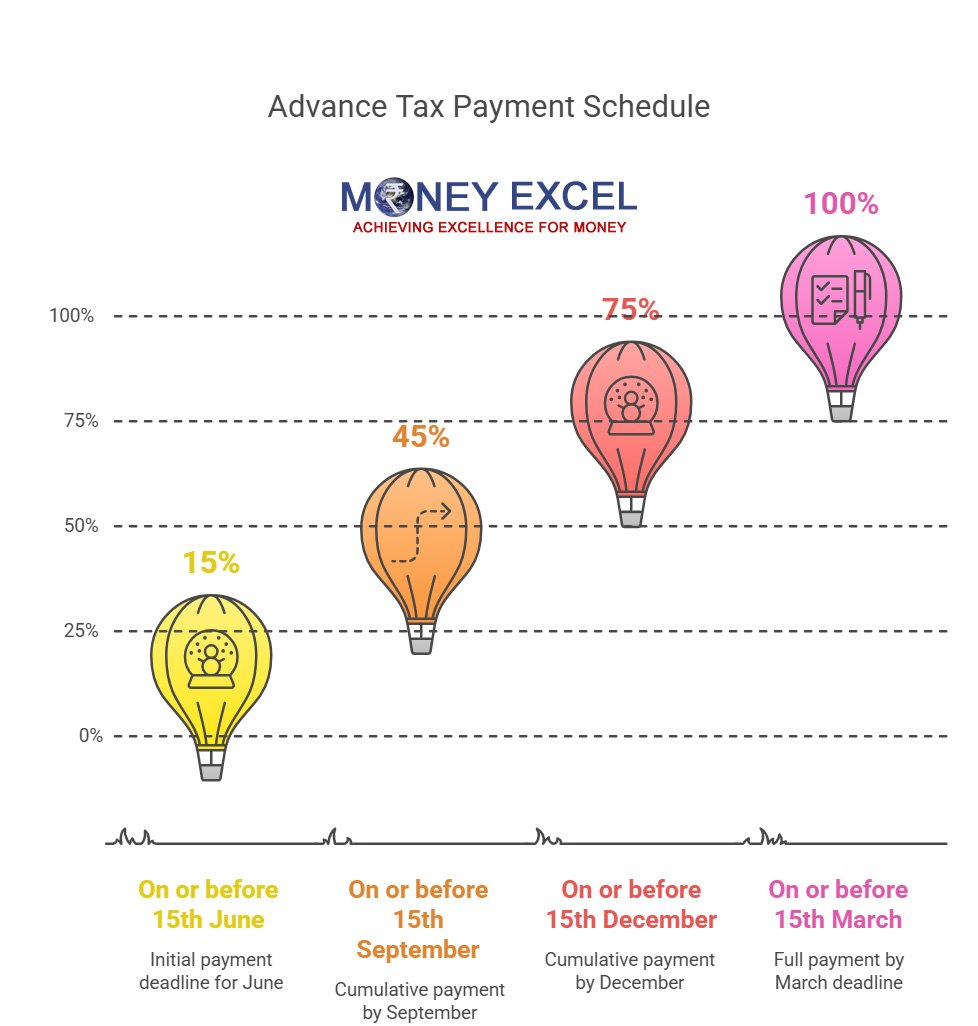
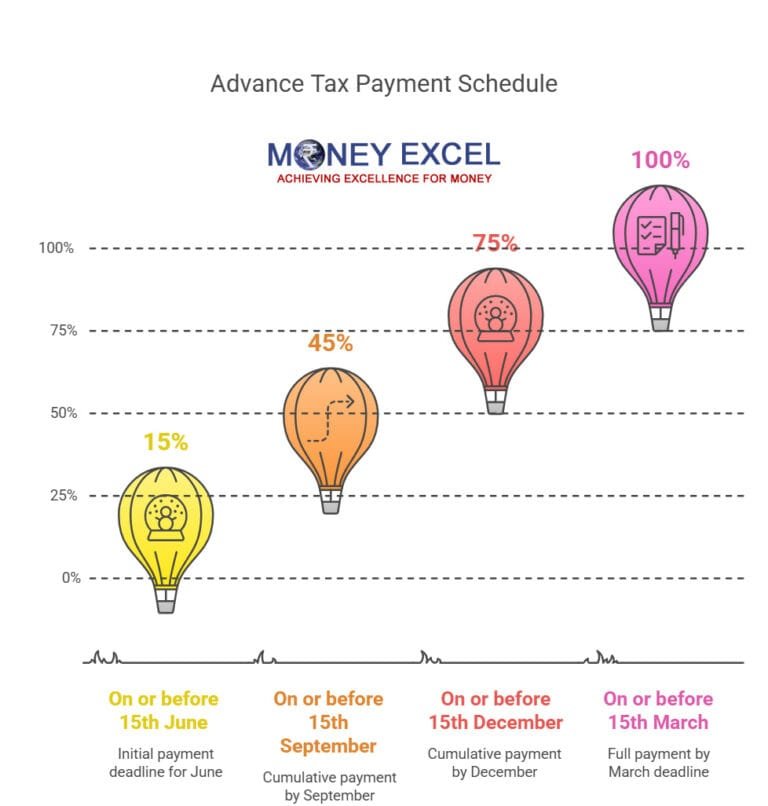
According to the new income tax bill taxpayers liable for advance tax must pay it in four installments:

June 15 – At least 15% of total tax due.

September 15 – At least 45% (cumulative).

December 15 – At least 75% (cumulative).

March 15 – 100% of the tax due.

Non-payment of advance tax results in penalties and interest charges.

Income Tax Bill 2025 – Tax Raids and Searches

The Income-Tax Bill of 2025 presents comprehensive measures regarding search, confiscation, and tax investigations. These regulations will enable tax officials to execute raids, confiscate assets, and examine undeclared income.

The justification for believing or suspecting ‘Searches’ does not have to be revealed according to Sec 149.

Income Tax Bill 2025 – No new penalty for late filing of Income Tax return

The updated income tax legislation has not introduced any new fines or fees for late tax submissions. Per the regulations outlined in the proposed legislation, taxpayers are required to pay self-assessment tax prior to submitting income tax returns.

Submitting late results in: Interest charges of 1% monthly. Penalties of ₹5,000 and ₹1,000 for taxpayers earning less than ₹5 lakh.