

Blog Page 465

How to Avoid TDS on FD?

Fixed deposits (FDs) are a go-to investment option for many, thanks to their safety, guaranteed returns, and flexibility. But here’s the catch—while you’re basking in the glow of assured interest, the taxman is keeping an eye on your earnings. Yep, the good old Tax Deducted at Source (TDS) comes into play if your FD interest crosses a certain threshold. Don’t let that scare you, though—there are smart ways to avoid TDS on your fixed deposit, and that’s exactly what we’re diving into today.

How to Avoid TDS on Fixed Deposit FD

Ready to learn how to keep more of that hard-earned interest in your pocket? Let’s break it down step by step!

What is TDS on Fixed Deposits (FD)?

Before we jump into the nitty-gritty, let’s get the basics out of the way. TDS is essentially the tax your bank deducts on the interest income you earn from your fixed deposit. Under current rules (as of the time of writing), TDS applies if the interest earned exceeds ₹40,000 in a financial year for regular taxpayers or ₹50,000 for senior citizens.

Think of it as the taxman taking a slice of your pie before you even get a taste. While it’s not the end of the world (you can claim it back during tax filing), wouldn’t it be better if you didn’t have to deal with TDS in the first place?

How to Avoid TDS on FD

#1 Submit Form 15G or 15H

This is the most popular trick in the book! If your total income is below the taxable limit, you can submit Form 15G (for individuals under 60 years) or Form 15H (for senior citizens) to your bank. By doing this, you’re declaring that your income is below the threshold, and the bank won’t deduct TDS on your FD interest.

You can download form 15 G and 15 H from here.

This form you need to submit to the bank at the beginning of every financial year. This form should contain information about your FD. These forms act as a self-declaration that you aren’t liable to pay tax. Submit the form at the start of the financial year to avoid any TDS deductions upfront.

#2 Split Your FDs Across Banks

Why put all your eggs in one basket? Splitting your fixed deposits across different banks can help you stay below the TDS threshold for each bank.

Let’s say you’re earning ₹50,000 in FD interest. Instead of parking all that money in one bank, split your deposits into two banks so that neither crosses the ₹40,000 threshold. Here you get the added benefit of diversifying your investments.

#3 Opt for Tax-Saving FDs Under ₹40,000

Tax-saving fixed deposits come with a lock-in period of 5 years and are eligible for deductions under Section 80C of the Income Tax Act. While the principal amount gets a tax break, the interest earned is still taxable. To avoid TDS, you can plan your investments such that the interest doesn’t exceed ₹40,000 in a financial year.

#4 Invest in the Name of a Non-Taxable Family Member

Here’s a smart hack: Open an FD account in the name of a family member who falls below the taxable income bracket, like your spouse, parents, or even adult children. The interest earned will be treated as their income, and if it’s below the taxable limit, TDS won’t apply. Ensure compliance with gifting rules to avoid clubbing of income.

#5 Time Your Fixed Deposit Wisely

TDS is calculated based on the interest accrued in a financial year. By carefully timing your deposits, you can spread the interest income across two financial years. If you start a one-year FD in November, only a portion of the interest will accrue in the current financial year, and the rest will fall into the next.This strategy keeps your annual interest below the TDS threshold.

#6 Use Cumulative FDs for Tax Deferral

Cumulative FDs don’t pay out interest annually or quarterly. Instead, the interest gets added to the principal and is paid at maturity. While this doesn’t eliminate TDS, it defers the deduction to the final year.If you’re expecting to fall into a lower tax bracket in the future, this can reduce your tax liability.

Why Avoiding TDS Matters

You might be thinking, “Why go through all this trouble when I can just claim a refund during tax filing?” Good question! The thing is, avoiding TDS in the first place has its perks:

  1. Immediate Access to Funds: No deductions mean you have full access to your earnings right away.
  2. Less Hassle During Filing: Filing for refunds can be a tedious process.
  3. Better Cash Flow Management: Why let your money sit with the government when you can put it to work for you?

Common Mistakes to Avoid

While these strategies are legal and effective, there are a few things you should watch out for:

  1. Failing to Submit Forms on Time: Late submission of Form 15G/15H can result in unnecessary deductions.
  2. Overlooking Clubbing Provisions: If you invest in the name of a family member, make sure the income isn’t clubbed with yours.
  3. Not Accounting for Total Income: Ensure that your total income stays below taxable limits when using these strategies.

Avoiding TDS on your fixed deposit isn’t rocket science—it just requires a bit of planning and awareness. Whether it’s submitting the right forms, diversifying your investments, or exploring alternative options like debt funds, there’s a strategy for everyone. The key is to be proactive and make informed decisions.

Remember, tax planning isn’t about dodging responsibilities—it’s about optimizing your finances within the framework of the law. So, take charge, and let your hard-earned money grow without unnecessary deductions.

FAQs

1. What happens if I don’t submit Form 15G or 15H?

If you don’t submit these forms, the bank will deduct TDS at 10% (or 20% if PAN isn’t provided) if your interest income exceeds the threshold.

2. Can I avoid TDS if I don’t provide my PAN?

No, it’s the opposite! If you don’t provide your PAN, the bank deducts TDS at a higher rate of 20%.

3. Are tax-saving FDs completely tax-free?

No, only the principal amount is eligible for deduction under Section 80C. The interest earned is still taxable.

4. Is splitting FDs across banks legal?

Yes, it’s perfectly legal and a common practice to manage interest income and avoid crossing the TDS threshold at any single bank.

5. What should I do if TDS has already been deducted?

You can claim a refund while filing your income tax return, provided your total income is below the taxable limit.


How to check LIC policy status Online,SMS & Phone

Now you can check LIC policy status online via LIC portal (http://licindia.in), by phone or by SMS. If you are LIC policy holder this post is for you.  Check LIC policy status, pay your LIC premium, get information about bonus, surrender value everything online.

You just need to enroll your policy details after the creation of user on LIC site. If you have purchased a policy for your spouse, children then you need to create separate user-id on LIC site. Let’s go through the entire process of checking policy status on LIC site.

How to check LIC policy status online?

Follow simple steps given below to register online on LIC portal to check policy status.

Step -1 – Register on LIC website (http://licindia.in)

1)      Go to LIC website and click on “New User”

You need to give following information for registering your id on LIC portal

  • Policy Number
  • Installment Premium
  • Date of Birth
  • Email Id

LIC New user

Next screen is for the password. Please ensure password contains at least one numeric character and it is greater than 8 digits.

Also Read – Buying Health Insurance Policy in India – Information Guide 

Step -2 – Enroll Policies 

Once you are registered kindly login to LIC portal with user id and password. After login from the right side menu click on Policy Tools à  Enroll Policies. Enter Policy Number, premium amount and Name of life insured and click on enroll.

Once your all policies are added you can see enrolled policy details by clicking on Policy Tools > View Enrolled Polices. You will see something like –

For Policy status click on policy number, for getting Vested Bonus information, click on the link in the column “Vested Bonus”.

You can also pay LIC premium online by clicking on Left side menu Pay Premium Online.

Also Read – My LIC & LIC Customer New Andriod App by LIC 

How to check LIC policy details via Phone? 

If you don’t have internet access, you can check LIC policy details via phone. To know Policy details through IVRS, simply dial 1251. This facility is available 24×7 in selected cities.

To know Policy details through IVRS, simply dial 1251. This facility is available 24×7 in selected cities. 

For more information visit – LIC Helpline

How to check LIC policy status via SMS?

You can get your LIC policy status and other information via SMS by sending SMS to 56767877. Your SMS will be charged as per your mobile operator and selected plan. This option will be expensive as charges applicable here are from 3 Rs/- to 10 Rs/-.

Type the following in your mobile message box:

ASKLIC < POLICY NO > Desired code

  • To know your Premium amount:- ASKLIC < POLICY NO > PREMIUM
  • If your policy has lapsed, to know your revival amount: ASKLIC < POLICY NO > REVIVAL
  • To know the amount of bonus vested for your policy:- ASKLIC < POLICY NO > BONUS
  • To know the amount of loan you can avail against your LIC policy:- ASKLIC < POLICY NO > LOAN
  • To know the nomination details for your LIC Policy:- ASKLIC < POLICY NO > NOM

Also Read – 5 Best Travel Insurance in India 

Send SMS to – 56767877

Have you ever check LIC status online? Do you have LIC portal user id? Have you made LIC policy premium payment online? What is your experience do share your views!

How to calculate the Gold Ornament Price?

My friend today shared with me one mouth-watering offer of purchasing gold ornament at the lowest rate. He heard about this offer on the radio. At the initial stage, I was excited about this offer. After interaction with the shopkeeper, I could make out that the gold ornament sold by his jewelry shop is 18 Karat that’s why they are offering gold ornament at the lowest rate. Lower karat jewelry 18 K contains more impurity hence it is lower in rate. So beware of such offers. Make sure to check these 5 signs before purchasing gold. Suitable gold karat for gold ornament is 22K.

gold ornament price

What is the Gold Rate?

The gold rate is essentially the market price of gold per gram. It changes daily based on global market trends, demand and supply, currency fluctuations, and geopolitical events. This rate is usually quoted in rupees per gram for 24-carat gold.

You can find the current gold rates at the following places:

  • Online portals: Websites like Goldprice.org, LiveMint, and India Bullion offer updated gold prices.
  • Jewelry stores: Most jewelers display the current rate prominently.
  • Financial newspaper: Financial sections of newspapers give information about current gold rates.

Types of Gold -Purity Levels

Gold ornaments are rarely made of pure 24-carat gold due to its softness. Instead, they are crafted from gold mixed with other metals, creating different purity levels:

  • 24-carat gold: Pure gold, rarely used for jewelry.
  • 22-carat gold: 91.6% pure, common for ornaments.
  • 18-carat gold: 75% pure, often used for more intricate designs.
  • 14-carat gold: 58.3% pure, less common but durable.

How to calculate the Gold Ornament Price?

Calculate the gold ornament price with the simple formula given below.

Gold jwelry price = (Gold price per gm)* (Weight in gm) + (Making charges)*(Weight in gm) + GST

Let’s try to understand from one example:-

  • If 22 K Gold rate per gram is 2530 Rs/-
  • Purchase weight  – 2 gm
  • Making charges – 200 Rs/- per gm

Price of Gold ornaments =2530* 2+200*2 =5660 +GST (3%) = 5828 Rs/-

One important point you need to remember gold price which you see online is 24 K pure gold and for gold ornaments 22 K gold is used.

Why Gold ornaments price is different at different shops?

Although the same formula is applicable for calculating gold prices, still you find differences in gold prices from shop to shop. You might be wondering why gold ornament prices are different in different shops. I am herewith answer.

  • Gold Rate: – Gold ornament price variation is mainly due to differences in gold rate. Many shopkeepers purchase gold in bulk when the price is low. They might be selling gold at a lower rate compared to the market to clear the stock. A reduction in gold price like this makes gold jewelry cheaper in that shop.
  • Making Charges: – Another reason for the price difference in gold ornaments is a change in making charges. Making charges vary between 150 Rs/- per gm to 300 Rs/- per gm.
  • Discount:- Sometimes to clear stock gold shopkeeper makes various offers like a reduction in making charges or a flat discount this could be another reason for gold price variation.

In India, the huge demand for gold ornaments made the gold market unorganized and unregulated. The common man always wonders where to purchase gold from a Branded jewelry shop like TBZ, Tanishq, or a family jeweler shop.

Exploring World of Business

business world

Prior to this article, we have discussed a lot about business on our blog. We have discussed Business ideas, steps to start a business, and ways to become wealthy. Today I am going to take you into the world of business and we are going to explore the characteristics of business, the category of business, and their differences.

What is business?

Business is commercial activity (buying selling goods or providing services) undertaken by an individual or group with the objective of earning profit & satisfying customer needs.

A Business includes only economic activities i.e. all those activities relating to the production and distribution of goods and services are called economic activities, any activity undertaken without economic consideration will not be a part of business

Businessman:-

All of us need food, clothing, and shelter. We also have many other household requirements to be satisfied in our daily lives. To satisfy this need we need to purchase goods from shopkeepers. The shopkeeper get these goods from the distributor and the distributor gets them from the manufacturers. So the shopkeeper, distributor, and manufacturer are called a businessman.

Characteristics of Business:-

Let us check out a few common characteristics of business required by business enterprises irrespective of their nature, size, and form of ownership.

  • Vision & Mission: – You must define what you want to do in business -vision and how you will do it – mission.
  • Business with ethics: – You must carry out business with ethics.
  • Buyer & Seller :-In any business /commercial activity buyer and seller is must.
  • Continuity in dealings: – Business is said as business only if you have continuity in dealings.
  • Exchange of goods and Services with money
  • Risks and Uncertainties:- Risks and Uncertainties are more in business
  • Legal Obligations: – You need to take care of all Legal obligations arising from business.
  • Customer Satisfaction: – You need to satisfy your customer to get another business.
  • Profit is  the main objective i.e. desire to earn profit
  • Business Skills for Economic Success: – Skill is a must for achieving economic success in business.

Category of Business:-

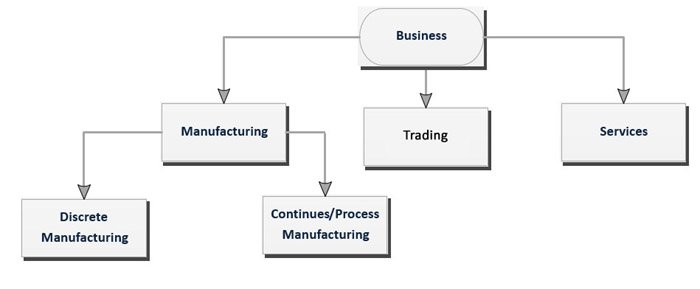
Business is broadly classified into three distinct categories. Manufacturing, Trading and Services.

business

Manufacturing: – It is related to production/manufacturing of goods. E.g If you are running a mill for making clothes you are in the manufacturing industry.

Discrete Manufacturing: – Discrete manufacturing is the production of distinct items. Automobiles, furniture, toys, smartphones, and airplanes are examples of discrete manufacturing products.

Continues/Process Manufacturing: – Continuous manufacturing is associated with batch manufacturing or process-based manufacturing.  Process industry examples are pharma, food, chemical, etc.

Trading:- Trading means buying and selling goods to earn profit. Examples of traders are retailers, wholesalers, Garment stores, Departmental stores, etc.

Services: – Services is another business category. Service industries include banks, hospitals, insurance, Transportation, IT, etc.

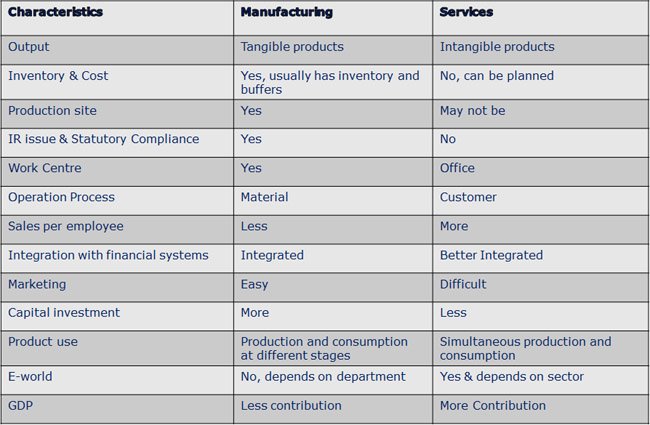
Key Differences between manufacturing and services:-

diffrence_business

Hope I have clarified your doubts related to the business world.

Remember:-

Profit is the lifeblood of business……
The world we live in………………………
is the world of business………………

Do share your views on the above. Stay tuned for more business updates.