Blog Page 452

How to Become Wealthy? – Robert Kiyosaki Cashflow Quadrant

When it comes to wealth, people often struggle & spend their entire lives to become wealthy. Some of them can change the wheel of fortune and become wealthy while others don’t. In this post, we will suggest a proven way to become wealthy.

Many people believe that “Being rich is being wealthy” This is not true; being Rich is about how much money you possess at a specific moment in time.

Being Wealthy is about . . .

  • How much money do you keep?
  • How hard it work for you?
  • How much is left for future generations?

Being Wealthy is about exploding your Passive Income. (How long you can survive without ever having to go to work?).

  • A million-dollar question arises as to why only a few people are wealthy.
  • What do others have to do to become wealthy?

Let’s check out the views of the famous writer “Robert Kiyosaki “on this.

become wealthy

How to Become Wealthy? – Robert Kiyosaki Cashflow Quadrant

What The Wealthy Teach Their Kids About Money That The Poor And Middle Class Don’t.

We are a free country, not necessarily a fair country. We are all free to fail. We’re being taught to be “Good Employees.”  Process flow from the beginning of our childhood is:-

Go to school  –> Get good grades/results  –> Get a good “JOB” –> Work hard –> Maintain good credit

So we can consume lots of stuff. “JOB” for most means “Just Over Broke.”

This is a way to become “Wealthy?  –  NO

It is not your boss’ / employer’s job to make you wealthy or secure. Their job is to give you a paycheck. . . for work you have done & nothing more. You have to decide what you want to do with this money to become wealthy. The first thing you must learn is how to drive this money.

The biggest problem today is money drives most of us and we obey money.

  • Employers/Bosses
  • Landlords
  • Friends /Family

Probably it is because we are unable to drive money or maybe we are not smarter than our money?

If you want to be wealthy you have to be smarter than your money. You have to decide:-

Do you want to work for money? or do You want your money to work for you?

When money works for you, every rupee is your employee & you can decide how to take work from it. You have to manage the rupee so that every rupee works to bring you even more rupees while you’re asleep.

Yes, we are talking about the power of passive income. Passive income is income by Interest, dividends, real estate, rent, royalties, stock market, and annuities.

So it is not important that “What do you do?” but important is “What do you own?”

The key to becoming wealthy:-

  • Make investments that will bring passive income.
  • Know the difference between an ASSET and a LIABILITY, and only buy assets.
  • A True Asset will bring positive cash flow every month.
  • Live below your means, while constantly increasing your means. (Try to increase your active income)
  • Make your PASSIVE INCOME cover your Lifestyle Expenses forever.
  • Buy assets first, luxuries last.
  • If today you are unable to buy something ask yourself “How can I afford it?” This stimulates your creativity.

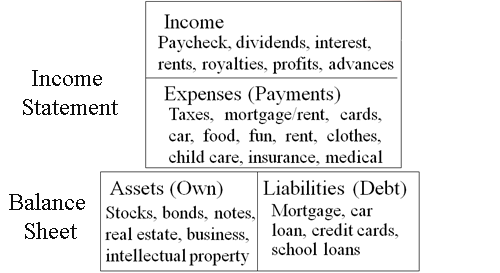
Sadly, most of us have been taught to read words and books, but not numbers and financial statements. Two key personal and business financial statements we all must be able to read.

  • The Income Statement shows the amount of money coming in and going out.
  • The Balance Sheet shows the balance of what you own and what you owe.
Income Balance

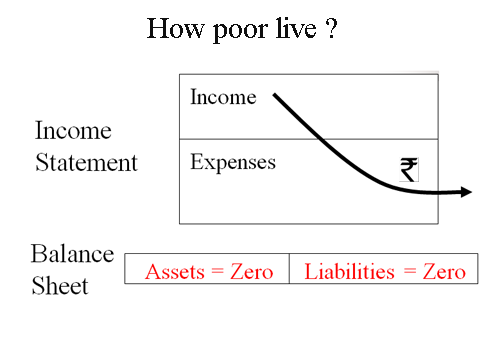
Let’s study the Income statements and balance sheets of the poor, middle-class, and wealthy people. Poor have small incomes and small expenses. Assets are zero and liabilities are zero.
Poor Live
The middle class has a stable income but they buy expenses and liabilities by thinking that they are buying assets. Expenses and liabilities are more and assets are less.

Middle Class Live

Now let’s take a look at how wealthy live. They usually take the income of the poor and middle class and buy assets that produce more income. Their assets produce passive income by which they again invest in assets to become wealthier. So to become wealthy you must invest in assets that are true assets and that will produce income for you.

Wealthy Live

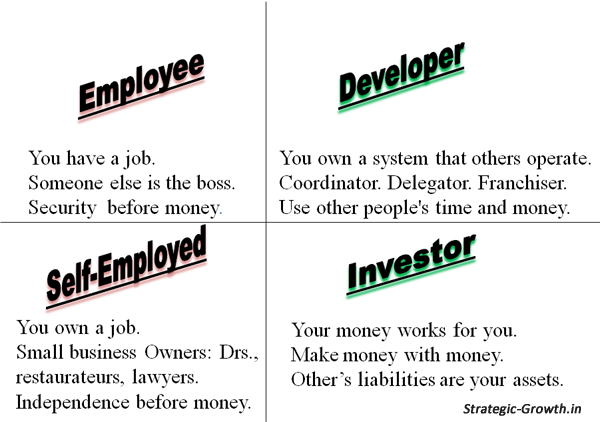
As per the Cash Flow Quadrant In the world, we have four types of people. Employees, Self-Employed, Developers, and Investor look at the following diagram.
Cash Flow

Understanding the Cashflow Quadrant is essential for individuals seeking financial success. It provides clarity on the various paths to wealth and helps individuals identify where they currently stand and where they aspire to be.

The E Quadrant: Employee

Characteristics of the E Quadrant

The E Quadrant comprises individuals who work for others and earn a fixed salary or wage. Employees typically exchange their time and labor for monetary compensation, often with limited control over their income and schedule.

Advantages and Limitations of Being an Employee

While being an Employee offers stability and certain benefits such as health insurance and retirement plans, it also comes with limitations. Employees have less autonomy and are subject to layoffs, salary caps, and the whims of employers.

The S Quadrant: Self-Employed

Characteristics of the S Quadrant

The S Quadrant consists of self-employed individuals who own their businesses or work as freelancers or independent contractors. They have greater control over their work and income compared to employees but often shoulder more responsibilities.

Pros and Cons of Being Self-Employed

Self-employed individuals enjoy autonomy and the potential for higher income, but they also face challenges such as irregular income, long hours, and the need to handle all aspects of their business.

The B Quadrant: Business Owner

Characteristics of the B Quadrant

The B Quadrant is inhabited by business owners who create systems and leverage the efforts of others to generate income. They focus on building scalable businesses that can operate independently of their direct involvement.

Benefits and Challenges of Being a Business Owner

Business owners enjoy the potential for unlimited income and the ability to create wealth through asset accumulation. However, they must navigate risks, manage employees, and adapt to market changes to succeed.

The I Quadrant: Investor

Overview of the I Quadrant

The I Quadrant represents investors who make money by putting their capital to work in various asset classes such as stocks, real estate, and businesses. Investors seek to generate passive income and grow their wealth over time.

Strategies for Becoming a Successful Investor

Successful investors employ strategies such as diversification, risk management, and long-term planning to achieve their financial goals. They continuously educate themselves and make informed decisions based on market trends and opportunities.

Transitioning Between Quadrants

Moving from the E or S Quadrants to the B or I Quadrants

Transitioning between quadrants requires a shift in mindset and approach to income generation. It often involves acquiring new skills, building networks, and taking calculated risks to pursue entrepreneurial ventures or investment opportunities.

Steps to Transition Effectively

Effective transition requires careful planning and execution. Individuals should assess their strengths, interests, and financial goals, and then develop a strategic roadmap to move toward the B or I Quadrants.

Building Wealth Through the Cashflow Quadrant

To build wealth using the Cashflow Quadrant, individuals must focus on leveraging assets and creating passive income streams. This involves investing in income-producing assets such as stocks, bonds, rental properties, and businesses that generate recurring revenue.

Conclusion

In conclusion, becoming wealthy is attainable for those willing to learn, adapt, and take action. By understanding and leveraging the principles of the Cashflow Quadrant, individuals can create multiple income streams, build assets, and achieve financial freedom.

FAQs

Is it possible to become wealthy without taking risks?

    • While risk-taking is often associated with wealth creation, there are ways to build wealth through conservative strategies such as disciplined saving and long-term investing.

Do I need a high income to become wealthy?

    • High income can accelerate wealth accumulation, but it’s not the sole determinant. Consistent saving, smart investing, and prudent financial management are equally important factors.

How long does it take to become wealthy?

    • The timeline for wealth accumulation varies depending on individual circumstances, goals, and strategies. However, achieving significant wealth typically requires time, patience, and diligent effort.

Can anyone become wealthy, or is it reserved for a select few?

    • Wealth is attainable for anyone willing to educate themselves, take calculated risks, and stay disciplined in their financial habits. It’s not reserved for a select few but rather accessible to those who are committed to their goals.

What role does financial education play in wealth creation?

    • Financial education is critical for making informed decisions about saving, investing, and managing money effectively. By improving financial literacy, individuals can navigate the complexities of wealth creation with confidence and competence.

Retirement Planning – Download Free Retirement Planner

Retirement planning is a crucial aspect of financial management that often gets overlooked until later in life. Life is full of uncertainty but few things are certain and retirement is one of them. Once you are tired, you leave your employment/business, we call this retirement.

retirement planning

Retirement Planning – Download Free Retirement Planner

Retirement is the time to sit back and enjoy your life! You have a lot of time to do what you want when you want and how you want to, so we can say life begins at retirement.

To enjoy this life you require a lot of money, you might be thinking that retirement is quite far away why we should think about this money requirement today, We have to because:-

Our future tomorrow depends on the choices we make today.”

Today, you are having a comfortable lifestyle. There is regular income and your day-to-day expenses are taken care of. However, the future will not be the same. Rising inflation will affect everything. A packet of bread that costs Rs.60 today could cost around Rs.300 twenty years later. This means on retirement your expenses will skyrocket. Unless you have sufficient income after retirement, it may be very difficult to manage your expenses.

Therefore we need to plan for retirement today itself. It’s something like “Working for not to work.”

Download Free Retirement Planner

This workout is very important because your retirement income –

  • needs to last a long time. (Up to your life expectancy.)
  • needs to cover all your living expenses:
  • the necessities,
  • the things you want to do, and
  • any future health care costs.
  • will come from multiple income sources that will start and end at different times, possibly leaving gaps.

Retirement Planning involves making financial decisions now to ensure a comfortable and secure retirement in the future. Retirement planning in India requires a deep understanding of various factors. Retirement planning should account for potential future needs including rising cost of living, inflation rates, changing lifestyle preferences, and access to home health care service. This ensures that retirees can receive personalized care in the comfort of their own homes, which can be essential for maintaining quality of life and independence as they age. Additionally, knowing the retirement age in India is essential for planning purposes, as it affects the duration of savings and investments.

Plan your retirement

Retirement Planning Quiz

So, let’s take a small quiz to find out if you are ready for retirement or not.

Have you planned your retirement?

1. How much of your income is predictable?

a. 100%  b. Up to 80%  c. Up to 50%  d. Less than 50%

2. What are the sources of your retirement income?

a. Pension b. Returns from investments c. Bank Deposits d.  All of these

3. How long will your retirement corpus last?

a. Lifetime b. Five years after retirement c. 10 years after retirement d. I don’t know

Key to quiz: –

If you answered a. or b. to question 1, d. to question 2, and a. to the last question, you have planned your retirement well. If you have answered differently, then you must plan for your retirement.

So, if you are not ready for your retirement we will help you to figure out how much you will need in your sunset years.

Retirement corpus calculation is one of the most complex economic calculations. Most of the clients when thinking of retirement corpus have simple calculations in mind that they spend X amount every year & in the future they need some X retirement corpus assuming a rate of 8% but they ignore many things including tax & inflation once they reach to retirement they don’t have any choice but to adjust their lifestyle.
To avoid this type of situation we are here with a step guide to plan your retirement.

Retirement Planning Steps

To avoid this type of situation we are here with a five-step guide to plan your retirement.

Step- 1 – Find out your Monthly Expense

To estimate your expenses post-retirement you must know your current expense. Based on your current monthly expense you can drive your total annual expense, just multiply it by 12.

Step -2 – Future Annual Expense

To calculate future annual expenses you must decide the assumption on the Inflation rate the number of years left for your retirement &  Your life expectancy. Based on the above input we will calculate Future Value

FV (Inflation Interest, Number of Years left for retirement, Present Expense) FV is a Microsoft Excel function

Step-3 – Retirement Corpus

To calculate retirement corpus apart from the above we have to assume the inflation rate during retirement years. Based on these inputs we will calculate Net Returns and corpus required.

PV(Net Returns, Retirement Years, Expense First year of retirement, Payment due =1) PV is a Microsoft Excel function

Step-4 – Utilization of Current Assets

In this step, you have to make a list of your current assets and their values (like equity, mutual funds, PPF, or others). Based on this value we will come to know the deficit (actual amount) for which investment is required (Corpus required – Current Assets).

Step-5 – Monthly Investment required

Once you know the actual amount for which you need to invest your task will be quite easy. Based on investment options available in the market you can select the the best suitable option for your needs, if required you can get advice from a financial planner.

Download Free Retirement Planner

Please note: –

  1. This retirement corpus calculator is made by using the inbuilt functionality of Excel FV= Future Value & PV = Present Value we have tested it repeatedly for the accuracy of the result. Like every tool it provides an estimated retirement corpus and monthly investment required.
  2. For simplicity, the inflation rates before and after retirement are taken to be the same 7%. This inflation rate is an assumption only it may fluctuate from time to time.
  3. The rate of return is taken constant it may change based on investment options.  

Conclusion

In conclusion, preparing for retirement in India requires careful planning and proactive decision-making. By understanding the intricacies of retirement planning, leveraging free resources, and adopting a holistic approach that encompasses finances, healthcare, and lifestyle considerations, individuals can embark on their retirement journey with confidence and security.

FAQs

What is the ideal age to start retirement planning?

It’s never too early to start retirement planning, but ideally, individuals should begin in their 20s or 30s to maximize the benefits of compounding interest.

How much should I save for retirement?

The amount varies depending on individual goals, lifestyle preferences, and anticipated expenses in retirement. It’s advisable to aim for saving at least 10-15% of income towards retirement savings.

Are there any government schemes for retirement planning in India?

Yes, the government offers various schemes such as the Employee Provident Fund (EPF), Public Provident Fund (PPF), and National Pension System (NPS) to facilitate retirement planning.

Is it possible to retire early in India?

Early retirement is possible with careful planning, disciplined saving, and strategic investments. However, it requires meticulous financial management and realistic goal setting.

How can I ensure my retirement savings last throughout my lifetime?

To ensure longevity of retirement savings, consider factors such as inflation, investment returns, healthcare costs, and potential lifestyle adjustments. Regularly review and adjust your retirement plan as needed to stay on track.

Prepayment of Home Loan – Good Decision

Prepayment of Home Loan – Everyone has a dream of purchasing their own house, where one can live with peace and happiness. Many people can’t afford to purchase it due to the hefty price or may end up purchasing it by taking a Home loan.

Once you take home loan property is yours but you have a home loan as a big financial obligation. Every month you have to pay a considerable amount of money as EMI (Equated monthly installment).

E.g  If you take a Home loan of Rs. 10 lakh for 20 years at an interest of 8%, you have to pay nearly Rs.10,500 per month. If you make a calculation you will end up spending a hefty amount of more than Rs.25 lakh this is due to payment interest on the principal.

At any point in time do you feel uncomfortable that you need to wait for a number of years to free your home from loan? Think of closing your home loan before it becomes a lifetime burden. One good way to close your home loan earlier is “prepayment”.

prepayment home loan

Prepayment of Home Loan – Good Decision

Prepayment refers to the act of repaying a loan, whether partially or in full, before the stipulated loan tenure. In the context of home loans, prepayment involves making additional payments towards the principal amount of the loan.

You need to find out the following information from your bank:-

(1)   When you can start prepayment of your loan?

(2)   Whether you can make part-prepayment or not?

(3)   Any penalty is applicable on prepayment or not?

Once you have the above information you need to calculate the outstanding loan amount and how much repayment is possible for you.

Most banks do not impose any penalty but, if your bank has a limit of partial repayment you need to ensure that part-prepayments do not exceed this limit to avoid a prepayment penalty. If by any chance you need to pay a penalty charge keep in mind that this penalty should be much less than the interest value saved.

You can plan to make prepayment every quarter or half yearly based on your convenience. Every month start preserving some money for this. If possible follow discipline and make SPP – Systematic prepayment plan. This prepayment will bring down your outstanding loan and lead to saving on overall loan payments.

By prepayment like this, you can not only save on net interest but you will get ownership of your home earlier than planned. The longer the tenure more you will pay, hence it is a good decision to make multiple parts- repayments of home loan to shorten the tenure and to reduce interest burden. Provided you can manage the outflow of this prepayment comfortably from your current income.

Another way to reduce the home loan burden is to increase EMI. Banks usually cap a certain maximum limit on EMI based on your monthly income. So, the way out is to make part-prepayment.

Let’s take a small example of how much interest you can save when you prepay your home loan.

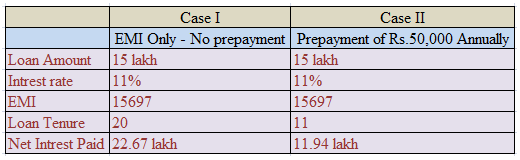
Mr.X has taken a home loan of Rs15 lakh for a loan tenure of 20 years @ 11 % interest rate. The EMI of this loan comes out to be Rs.15,696. If Mr.X does not opt for any prepayment he will end up paying Rs 15 lakh principal and net interest of Rs.22.67 lakh.

If Mr.X is a wise person like you and opts to pay 50,000 Rs/- every year towards repayment (total repayment of 5.5 lakh), the tenure of this loan will be reduced to 11 years and the net interest paid will be Rs 11.94 lakh. So actually Mr. X can save a hefty Rs 10.73 lakh which can help him build a good retirement corpus or may be useful for other needs.

Home Loan Prepayment Example

Click Here to download excel sheet which will help you to calculate how much you can save by doing prepayment.

So due to prepayment, Mr.X could close the home loan 9 years earlier. He could save significantly on the interest part. The above table shows that by making a prepayment Mr.X could reduce the interest burden by 50 %.

Advantages of Prepayment

Reduced Interest Burden

One of the primary benefits of prepayment is the reduction in the overall interest burden. By making extra payments towards the principal, borrowers can lower the total interest payable over the loan tenure.

Shorter Loan Tenure

Prepayment allows borrowers to expedite the repayment process, leading to a shorter loan tenure. This not only saves on interest costs but also helps in achieving debt-free homeownership sooner.

Improved Credit Score

Timely prepayments demonstrate financial discipline and responsibility, which can positively impact the borrower’s credit score. A higher credit score can lead to better loan terms in the future.

Equity Buildup

Prepayment accelerates the buildup of equity in the property. As the outstanding loan amount decreases, the homeowner’s equity stake in the property increases, providing a sense of ownership and financial security.

Tax Implication

As per current Income tax law principal repayment of housing loans up to 1 lakh (Under 80 C) is exempted, not only interest payment up to 2 lakh is also exempted. So by making prepayment, you can avail of dual benefits, tax saving, and saving on net interest paid.

If you are thinking of taking tax benefits also, do remember that the value of prepayment and EMI put together do not exceed the 1 lakh 80 C limit. Amounts exceeding 1 lakh will not be beneficial to you in terms of tax savings.

Caution

Another important point on the tax saving part is prepayment amount causes direct reduction in principal and hence reduction in the interest component. If you are in a higher tax bracket and want to take maximum advantage of the exemption limit of interest payment (2 lakh) you can avoid this prepayment it is your decision.

But we see that a small prepayment of a home loan at an earlier stage is a good decision to save money on net interest paid.

So finally if you can afford to make multiple prepayments towards your home loan, possibly due to a salary hike, promotion, bonus or abrupt business profit then making prepayment of the home loan is a good proposal that can save you a lot of money and term of loan.

Prepayment Tips for Different Stages of Loan Tenure

Early Stage

In the early stages of the loan tenure, borrowers can benefit significantly from prepayment due to the higher allocation of interest in EMIs. Making regular prepayments during this stage can yield substantial long-term savings.

Mid-Stage

As the loan tenure progresses, borrowers may have more financial stability and surplus funds available for prepayment. Increasing prepayment amounts during the mid-stage can further accelerate the repayment process.

Final Stage

In the final stage of the loan tenure, borrowers may prioritize complete repayment to achieve debt-free homeownership. Making strategic prepayments in this stage can help clear the remaining balance and secure full ownership of the property.

Conclusion

Prepayment of home loans can be a prudent financial decision for borrowers seeking to reduce debt, save on interest costs, and achieve homeownership goals sooner. By understanding the benefits, risks, and strategies associated with prepayment, borrowers can make informed decisions tailored to their financial circumstances and objectives.

FAQs

Is prepayment of home loans always beneficial?

Prepayment can be advantageous for many borrowers, but its suitability depends on individual financial circumstances, loan terms, and alternative investment opportunities.

What factors should I consider before opting for prepayment?

Factors such as prepayment charges, savings vs. investment opportunities, financial stability, and tax implications should be carefully evaluated before deciding to prepay a home loan.

Are there any tax benefits associated with prepayment?

Prepayment may impact tax deductions on home loan interest, depending on applicable tax laws and individual financial situations. Consulting a tax advisor is advisable for clarity on tax implications.

Can prepayment affect my credit score?

Timely prepayments demonstrate financial responsibility and may positively impact credit scores. However, the extent of the impact may vary based on individual credit histories and other financial factors.

What if I have surplus funds but uncertain about prepayment?

If unsure about prepayment, consider consulting a financial advisor who can assess your financial situation, goals, and the potential impact of prepayment on your overall financial plan.

Investment options available for NRIs in INDIA

India is fast emerging investment destination for NRIs. Indian economy is shining like anything. Every now and then we hear in the news that FII (foreign Institutional investor organizations that pool large sums of money and invest those sums) invested so much amount in the Indian stock market. Similarly to FII, so many NRI individuals might be looking for good Investment options in India.

From real estate to mutual funds, the investment landscape in India is vast and varied. In this comprehensive guide, we delve into the top investment options available for NRIs in India, helping you make informed decisions to maximize returns and achieve your financial goals.

Definition of NRI

An NRI, as per the Indian government’s definition, is an individual of Indian nationality or origin who resides outside India for employment, business, or any other purpose indicating an indefinite stay abroad.

NRI Investment Options in India

Investment options available for NRIs in INDIA

Real Estate Investments

Investing in real estate in India has long been a favored choice among NRIs. With rapid urbanization and infrastructural developments, Indian cities offer lucrative opportunities for property investment. From residential apartments to commercial spaces, NRIs can explore various options based on their budget and investment goals. Additionally, rental income and capital appreciation make real estate an attractive long-term investment avenue.

Investment in real estate can be further diversified by exploring emerging markets, such as tier-II cities and suburban areas, offering higher growth potential and competitive pricing.

Stock Market Investments

The Indian stock market, known for its dynamic nature, provides ample opportunities for NRIs to invest in equities, mutual funds, and exchange-traded funds (ETFs). With the advent of online trading platforms, NRIs can easily participate in India’s stock market from anywhere in the world. Diversifying your portfolio across different sectors and industries can mitigate risks and maximize returns in the long run.

Fixed Deposits and Bonds

Fixed deposits (FDs) and bonds remain popular investment avenues for NRIs seeking stability and assured returns. Indian banks offer competitive interest rates on NRI fixed deposits, providing a safe haven for parking surplus funds. Government bonds and corporate bonds are also viable options for NRIs looking to earn steady income while preserving capital.

Mutual Funds and SIPs

Systematic Investment Plans (SIPs) offered by mutual funds have gained traction among NRIs as a disciplined approach to investing in the Indian market. SIPs allow NRIs to invest small amounts regularly, thereby averaging out market volatility and benefiting from rupee cost averaging. Moreover, mutual funds offer diversification across asset classes, including equity, debt, and hybrid funds, catering to varying risk appetites.

Public Provident Fund (PPF)

The Public Provident Fund (PPF) remains a preferred investment avenue for NRIs seeking tax benefits and long-term wealth accumulation. NRIs are not eligible to open a new PPF account; however, those who held accounts before becoming NRIs can continue investing until maturity. PPF offers tax-free returns and enjoys the sovereign guarantee, making it a secure investment option for NRIs.

National Pension System (NPS)

The National Pension System (NPS) provides NRIs with an opportunity to build a retirement corpus while enjoying tax benefits. NRIs can open an NPS account and contribute towards retirement savings, with the flexibility to choose between equity, corporate bonds, and government securities. Contributions to NPS qualify for tax deductions under Section 80C of the Income Tax Act, enhancing its appeal among NRIs.

How NRI can get benefits of DTAA agreement?

Investment in Startups and Ventures

With India emerging as a global hub for innovation and entrepreneurship, NRIs can explore investment opportunities in startups and ventures across various sectors. Platforms like AngelList and SeedInvest facilitate investments in early-stage startups, offering potential high returns on investment. NRIs can leverage their expertise and network to identify promising startups and participate in India’s burgeoning startup ecosystem.

Gold and Precious Metals

Investing in gold and precious metals has been ingrained in Indian culture for centuries. NRIs can diversify their investment portfolio by allocating a portion towards gold in the form of jewelry, coins, or gold exchange-traded funds (ETFs). Gold serves as a hedge against inflation and geopolitical uncertainties, making it a valuable asset for wealth preservation over the long term.

Cryptocurrency Investments

The burgeoning popularity of cryptocurrencies has piqued the interest of NRIs looking to explore alternative investment avenues. While regulations surrounding cryptocurrency investments in India are evolving, NRIs can participate in global cryptocurrency markets through international exchanges. However, it’s essential to conduct thorough research and exercise caution due to the volatile nature of cryptocurrencies.

NRI requires one of the following accounts to make these Investments:-

NRE Account (Non-Resident External Rupee Account)

A Non-Resident External (NRE) account is a bank account that’s opened by depositing foreign currency at the time of opening a bank account. An NRE (Non-resident External Accounts) account is a Rupee-denominated account. Funds in the NRE account are maintained in Indian rupees only. The source of funds into NRE accounts must be from your earnings abroad or from another NRE. Interest earned on this account is not taxable.

NRO Account (Non-Resident Ordinary Rupee Account)

A Non-Resident Ordinary (NRO) account is the normal bank account opened by an Indian going abroad with the intention of becoming an NRI. This account is also Rupee Rupee-denominated account. Current income earned in India, such as rent, dividend, pension, or interest can be deposited in the NRO account. Interest earned on an NRO account is taxable.

FCNR Account (Foreign Currency Non Resident Account)

The account can be opened with funds remitted from abroad, or transferred from an existing NRE/FCNR account. FCNR accounts can be opened with designated currencies, which are: GBP, USD, Deutsche Mark, Japanese Yen, and the Euro. Only term deposits can be maintained in FCNR accounts, in a time range of 6 months to 5 years.

Tax Impact on NRI Investments

  • All income earned by NRIs in India is taxable and returns are to be filed every year.
  • Long-term and short-term capital gain liability is the same on the sale of shares, redemption of mutual funds, or in real estate.
  • Bank deposits investments in shares, units of mutual funds, etc. are exempt from wealth tax in India.
  • Interest earned on NRE and FCNR accounts is completely tax-free.

A non-resident Indian making any investment in India would have to quote his PAN for every transaction and to file returns on his Indian income.

India has signed DTAA treaties with several countries to avoid double taxation for NRIs. These agreements provide relief by allowing NRIs to claim tax credits or exemptions in their home country for taxes paid in India.

NRIs can repatriate funds from India subject to certain conditions and limits prescribed by the Reserve Bank of India (RBI). Repatriation can be done for various purposes, including investment, maintenance, or gifts.NRIs must follow the prescribed procedures and submit the necessary documentation to repatriate funds from India.

FAQs

Are NRIs allowed to invest in Indian real estate?

NRIs are permitted to invest in residential and commercial properties in India, subject to certain regulations and guidelines set by the Reserve Bank of India (RBI).

Can NRIs invest in Indian mutual funds?

Yes, NRIs can invest in Indian mutual funds, subject to compliance with KYC (Know Your Customer) norms and FEMA (Foreign Exchange Management Act) regulations.

What are the tax implications for NRIs investing in India?

NRIs are liable to pay taxes on income earned in India, including capital gains from investments. However, certain investment avenues, such as NPS and PPF, offer tax benefits to NRIs.

Is it advisable for NRIs to invest in cryptocurrency?

Cryptocurrency investments involve high risk due to price volatility and regulatory uncertainties. NRIs should exercise caution and conduct thorough research before venturing into cryptocurrency investments.

Can NRIs open a PPF account in India?

NRIs cannot open a new PPF account after becoming non-residents. However, they can continue to contribute to existing PPF accounts opened before their NRI status.

Are there any restrictions on NRIs investing in Indian startups?

NRIs can invest in Indian startups and ventures, either directly or through platforms like AngelList and SeedInvest. However, they must adhere to regulations governing foreign investments in startups.

Conclusion:

Investment options for NRIs in India are diverse and abundant, catering to varying risk profiles and investment objectives. From traditional avenues like real estate and fixed deposits to emerging opportunities in startups and cryptocurrencies, NRIs have ample choices to grow their wealth and achieve financial prosperity in India’s thriving economy. By understanding the intricacies of each investment option and seeking expert advice, NRIs can make informed decisions to capitalize on the lucrative opportunities available in the Indian market.