Blog Page 446

Expense Tracker Google Forms

google docs

Tracking expenses is an essential need to control finances. Each of one uses different mechanisms to track spending, like Excel sheets, smartphone apps, or certain software on desktop, but the bottom line is the same to track where each penny/rupee is going.

I am herewith way to make a simple expense tracker using Google Docs, this expense tracker will take details of your expenses in a simple form. It will allow you to track your expenses not only you can do analysis by using built-in charts anytime. So let’s check out how you can make your own ‘Simple expense tracker” using Google Docs.

Expense Tracker using Google Docs

Step 1:- Create a new Google Docs – Form

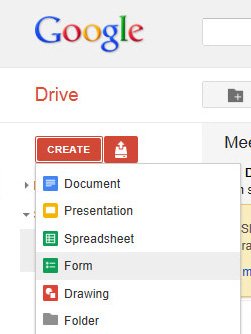
Login to Google Docs using your Google account once you are inside click on create “form” tab as shown below.
google form

Once you click this tab it will open a new window where you can create a form. We will use this form to enter spending details.

Step 2:- Create a basic expense tracking form

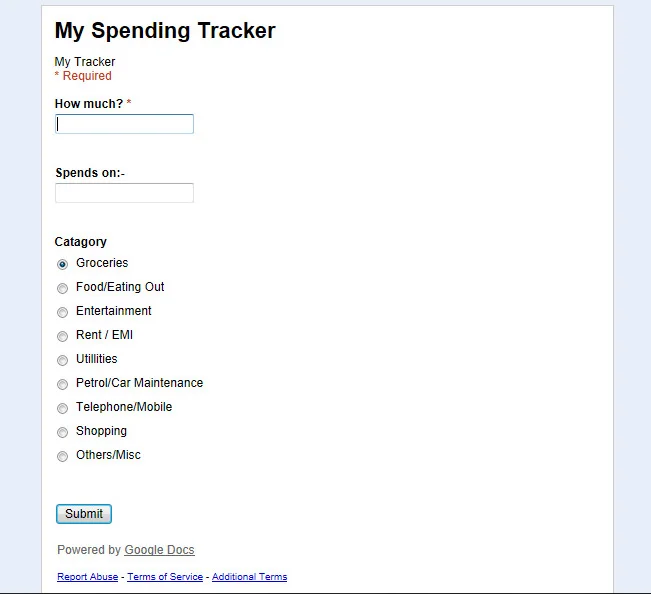
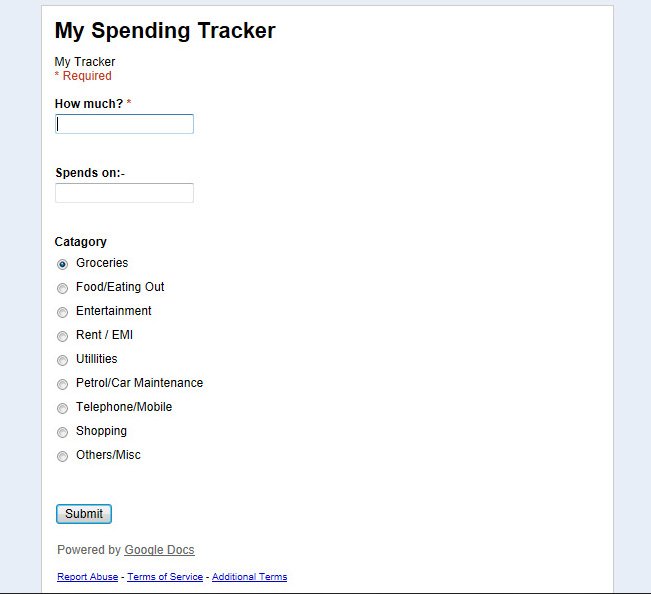
We will now create a basic form with the following fields:

  1. How much?       – Money Spending
  2. Spends on:-  A description of the spending
  3. Category:- A      list of categories for spending

google spend tracker

The first step is to name the form. I have chosen “Spending Tracker”. You can give your own name. Next, add three basic questions, as shown above, the process is very simple, just try for yourself. Finally, save expenditure tracking form.

Step 3:- Enter Expense in the form

Once you are done, open the link which is marked by the red box in the above figure, or Identified by “You can view the published form here”. Don’t forget to bookmark this link. This is the URL you will access whenever you want to enter a new expense.

The form will look like this:-
spending tracker

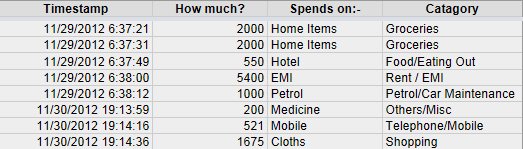
Just start adding your expenses once you enter a few expenses the spreadsheet will look like this:
spreadsheet

Google adds the time stamp for each expense made by you. So you don’t have to worry about entering the expense date. You can use this tracker to track your spending. (provided you enter information as soon as possible)

Step 4:- Analysis of Expense

Google docs also give you the facility to analyze your expenses, just use built-in charts in Google Docs to do some analysis of the expenses. I did a bar chart to show what is possible.
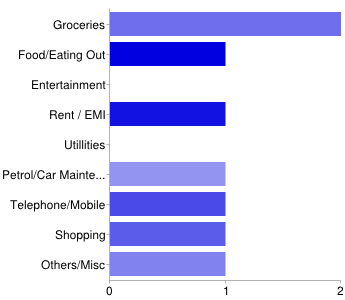
chart

So, what are you waiting for just click here to take a test drive for the expense tracker made using Google Docs.


Saving for Child education is not child’s play

1

Education Saving

Mr.Rakesh Mishra Mumbai Mumbai-based MNC employee earns a good salary of Rs 60,000 and has only liability in terms of Home loan EMI. Yet every quarter his bank balance drops close to four digits, this is because every quarter amount close to 35000 Rs/- goes to school and tuition fees of his sons Shyam and Ram.

He keeps on praying that no unexpected expense turns up during this time. This could be the case with you A massive surge in education costs in the past five years has stretched the monthly budgets of middle-class families like anything.

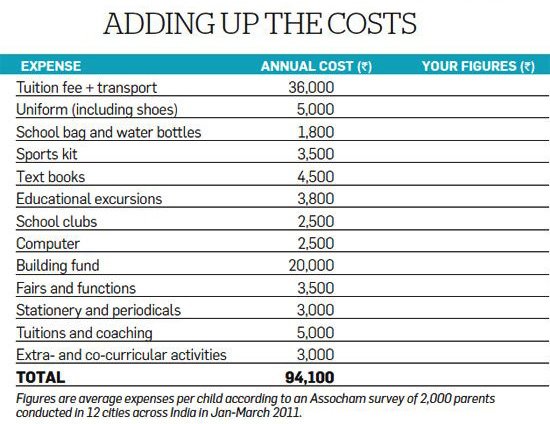
According to an Assocham survey of 2,000 families across 15 cities, the annual school education expense on a child has risen from Rs 35,000 five years ago to Rs 94,000 now. It is observed that the cost of education usually rises twice as fast as normal inflation.

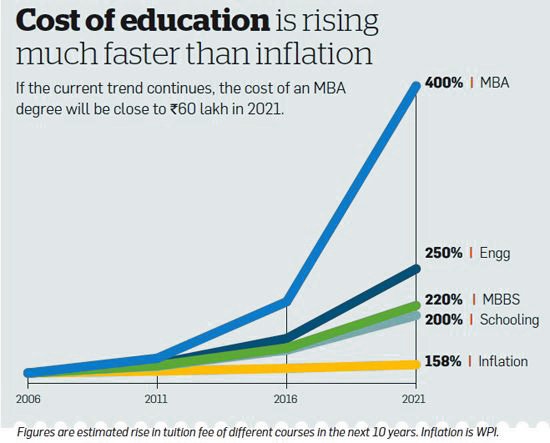
If you are worrying about this sharp rise in school education expenses, there’s a bigger time bomb ticking away. Higher education costs are growing at an even faster rate. The average fees of an Engineering course is roughly Rs 6 Lakh today, five years down the line it would be close to double meaning Rs 12 Lakh. In 10 years’ time, it’s likely to cost around Rs 20 Lakh.

Education Cost

The cost of the MBA course has grown even faster current cost is approximately 15 Lakh and is expected to be 40 Lakh after 5 years. MBA is likely to cost 60 Lakh in 2027.

This exponentially growing cost has no dead end. Many of you are planning for your retirement but looking to the future cost of education you must plan for your child’s education.

If the current trend continues then to make your child an Engineer or MBA like you is not child’s play.

You have to save & invest enough money for your child’s education.

Save Education Cost

If you are thinking that you need to save only for fees then you are wrong your child’s school fee is not only an expense related to the child’s education. A lot of other expenses is involved in child education. There are books, stationery, uniforms, transportation, projects, picnics, annual school/college functions, sports, extra-curricular activities etc.

The estimated annual cost for one child is formulated in the below table. You can put your figures and see how much it costs in your pocket.

Education Cost

As we said saving for child education is not child’s play but if you think long term and invest Rs 5,000 a month in an option that delivers a 12% return every year, you would build a Rs 25 lakh corpus in 15 years.

If you can manage to increase this investment amount by Rs 1,000 every year and then your corpus will be almost doubled and you can build to Rs 50 lakh for child education.

It seems very simple, it is but parents should feel strongly that they need to save regularly for child education one of the crucial financial goals.

Remember your Investment amount, discipline & selection of the right asset class will decide whether your child goes to a premier institute like IIT, or IIM for higher studies or ends up doing a correspondence course in a small institute. This education will also decide the career path he plans for himself.

Essesnse of this article is not to increase your worry about the cost of child education but to make yourself aware of the situation so that appropriate steps can be taken.

Free Smart Phone Apps to Manage your Money

Finance Apps

Do you know how much money you spend in a month? Do you know the percentage of your spending on different categories like house hold, food, entertainment or health/medicine? It is advisable to keep an eye on the income and expenses. This will help you be aware of your financial situation and you will know how much you need to save for future needs.

Technology touches life, in good old days people were using notebook and pens to track and calculate monthly expenses and saving. Than we used excel based tool to track expense. Today technology has shrunk the world on our 3X2 inches mobile screens. Everyone wants everything on mobile. Yes we can track our expenses, set payment reminders and manage bills all with a few taps and clicks with a variety of applications available for smart phones. Here are free smart phone apps to manage your money in better manner.

Expense Manger:

If managing your expenses is an issue, this app will help you with your monthly budgeting. This app is available for the Android platform.  Features of Expense manager are:-

  • Just feed in your expenses and income and you will be able to track the same on a daily, monthly and yearly basis.
  • Schedule payments and recurring payments like electricity bill. Automatically add expense is to defined category. For example if you have a category like “Utilities” then payment towards electricity bills would be added to this category.
  • Get alert for payment dues.
  • Generate dynamic reports. You can also export the data to excel files to do more analysis.
  • Data can be stored SD card & Dropbox account.

 Toshl Finance:

Toshl is easy to use mobile app to organize your expenses in a streamlined manner. This application is available for multiple platforms Android, Blackberry, Symbian or Windows. Features of Free version of Toshl Finance are:-

  • Track expenses and incomes with ease
  • Set up repeating expenses and incomes to organize your bills
  • Export your expense reports into CSV
  • Lock this application using passcode
  • Graph generation a& visualization of your finances with infographic
  • Automatic Backup mechanism

This apps also has paid version Toshl Finance pro, Incase if you are ready to purchase Toshl Finance Pro than you can have advantage of adding multiple incomes, advance fancy graph facility, searching within expense you can also export this report in Excel, pdf or doc.

Money Lover:

Money lover is another application to track income and expense. This apps is available for iOS and Android. Features of Money Lover are:-

  • Budgets for different expense categories for various time periods
  • Supports 45 different currencies and many languages
  • Alert/ Reminder of dues
  • Income / Expense Category modification
  • Backup and restore facility

You can download these Apps from Google App store.

There are many apps available in google play app store like Expensify, Manila, Perfios, Quicken or Mint which allow you to manage your entire personal finances. You can manage your portfolio, manage your bank accounts and do a whole lot of other activities.

Do you use any mobile app to manage your money? Do share your experience via comments.

90 Famous Quotes by Warren Buffett

1

The Oracle of Omaha Investor Guru, Warren Buffett is one of the wealthiest people in the world. Buffett uses extremely easy-to-understand language when referring to business and investments.

Many of his most thoughtful quotes are found in his annual letters to Berkshire Hathaway shareholders, which are worth reading.  But some of his gems come from random interviews, speeches.

warren bufett quotes

I have compiled 90 best quotes from the Oracle of Omaha. If we’ve missed any of your favorites, let us know in the comments.

90 Famous Quotes by Warren Buffett

  1.  ‘Never invest in a business you cannot understand.’
  2. ‘Always invest for the long term.’
  3. ‘Buy a business, don’t rent stocks.’
  4. ‘Someone’s sitting in the shade today because someone planted a tree a long time ago.’
  5. ‘I really like my life. I’ve arranged my life so that I can do what I want.’
  6. ‘We will only do with your money what we would do with our own.’
  7. ‘If you don’t feel comfortable owning something for 10 years, then don’t own it for 10 minutes.’
  8. ‘I am a better investor because I am a businessman and a better businessman because I am an investor.’
  9. ‘Price is what you pay. Value is what you get.’
  10. ‘The Stock Market is designed to transfer money from the Active to the Patient.’
  11. ‘Stop trying to predict the direction of the stock market, the economy, interest rates, or elections.’
  12. ‘I never attempt to make money on the stock market. I buy on the assumption that they could close the market the next day and not reopen it for ten years.’
  13. ‘I don’t look to jump over 7-foot bars: I look around for 1-foot bars that I can step over.’
  14. ‘For some reason, people take their cues from price action rather than from values. What doesn’t work is when you start doing things that you don’t understand or because they worked last week for somebody else. The dumbest reason in the world to buy a stock is because it’s going up.’
  15. ‘We don’t get paid for activity, just for being right. As to how long we will wait, we’ll wait indefinitely.’
  16. ‘As Buffet said in the speech, “He’s not looking at quarterly earnings projections, he’s not looking at next year’s earnings, he’s not thinking about what day of the week it is, he doesn’t care what investment research from any place says, he’s not interested in price momentum, volume or anything. He’s simply asking: What is the business worth?’
  17. ‘Buy companies with strong histories of profitability and with a dominant business franchise.’
  18. ‘Most people get interested in stocks when everyone else is. The time to get interested is when no one else is. You can’t buy what is popular and do well.’
  19. ‘When asked how he became so successful in investing, Buffett answered: ‘we read hundreds and hundreds of annual reports every year.’
  20. ‘When a management team with a reputation for brilliance joins a business with poor fundamental economics, it is the reputation of the business that remains intact.’
  21. ‘Only those who will be sellers of equities in the near future should be happy at seeing stocks rise.  Prospective purchasers should much prefer sinking prices.’
  22. ‘Diversification is a protection against ignorance. It makes very little sense for those who know what they’re doing.’
  23. ‘Wide diversification is only required when investors do not understand what they are doing.’
  24. ‘You’re neither right nor wrong because other people agree with you. You’re right because your facts are right and your reasoning is right – that’s the only thing that makes you right. And if your facts and reasoning are right, you don’t have to worry about anybody else.’
  25. ‘It takes 20 years to build a reputation and five minutes to ruin it. If you think about that, you’ll do things differently.’
  26. ‘The first rule is not to lose. The second rule is not to forget the first rule.’
  27. ‘Only buy something that you’d be perfectly happy to hold if the market shut down for 10 years.’
  28. ‘I will tell you how to become rich. Close the doors. Be fearful when others are greedy. Be greedy when others are fearful.’
  29. ‘Why not invest your assets in the companies you really like? As Mae West said, ‘Too much of a good thing can be wonderful.’
  30. ‘Our favorite holding period is forever.’
  31. ‘Risk comes from not knowing what you’re doing.’
  32. ‘Time is the friend of the wonderful company, the enemy of the mediocre.’
  33. ‘Unless you can watch your stock holding decline by 50% without becoming panic-stricken, you should not be in the stock market.’
  34. ‘The critical investment factor is determining the intrinsic value of a business and paying a fair or bargain price.’
  35. ‘Investors making purchases in an overheated market need to recognize that it may often take an extended period for the value of even an outstanding company to catch up with the price they paid.’
  36. ‘Risk can be greatly reduced by concentrating on only a few holdings.’
  37. ‘It is not necessary to do extraordinary things to get extraordinary results.’
  38. ‘An investor should ordinarily hold a small piece of an outstanding business with the same tenacity that an owner would exhibit if he owned all of that business.’
  39. ‘Great investment opportunities come around when excellent companies are surrounded by unusual circumstances that cause the stock to be misappraised.’
  40. ‘In the business world, the rearview mirror is always clearer than the windshield.’
  41. ‘If a business does well, the stock eventually follows.’
  42. ‘Cash never makes us happy, but it’s better to have the money burning a hole in Berkshire’s pocket than resting comfortably in someone else’s.’
  43. ‘A public-opinion poll is no substitute for thought.’
  44. ‘I never buy anything unless I can fill out on a piece of paper my reasons. I may be wrong, but I would know the answer to that. “I’m paying $32 billion today for the Coca Cola Company because.” If you can’t answer that question, you shouldn’t buy it. If you can answer that question, and you do it a few times, you’ll make a lot of money.’
  45. ‘The investor of today does not profit from yesterday’s growth.’
  46. ‘You only have to do a very few things right in your life so long as you don’t do too many things wrong.’
  47. ‘It’s far better to buy a wonderful company at a fair price than a fair company at a wonderful price.’
  48. ‘You ought to be able to explain why you’re taking the job you’re taking, why you’re making the investment you’re making, or whatever it may be. And if it can’t stand applying pencil to paper, you’d better think it through some more. And if you can’t write an intelligent answer to those questions, don’t do it.’
  49. ‘Look at market fluctuations as your friend rather than your enemy; profit from folly rather than participate in it.’
  50. ‘An investor needs to do very few things right as long as he or she avoids big mistakes.’
  51. ‘Do a lot of reading’ (On how to determine the value of a business)
  52.  ‘Only when the tide goes out do you discover who’s been swimming naked.’
  53. ‘The fact that people will be full of greed, fear, or folly is predictable. The sequence is not predictable.’
  54. ‘You do things when the opportunities come along. I’ve had periods in my life when I’ve had a bundle of ideas come along, and I’ve had long dry spells. If I get an idea next week, I’ll do something. If not, I won’t do a damn thing.’
  55. ‘I do not like debt and do not like to invest in companies that have too much debt, particularly long-term debt. With long-term debt, increases in interest rates can drastically affect company profits and make future cash flows less predictable.’
  56. ‘We will reject interesting opportunities rather than over-leverage our balance sheet.’
  57. ‘I always knew I was going to be rich. I don’t think I ever doubted it for a minute.’
  58. ‘Turnarounds seldom turn.’
  59. ‘If at first you do succeed, quit trying on investing.’
  60. ‘I don’t measure my life by the money I’ve made. Other people might, but certainly don’t.’
  61. ‘Anything can happen in stock markets and you ought to conduct your affairs so that if the most extraordinary events happen, that you’re still around to play the next day.’
  62. ‘You shouldn’t own common stocks if a 50 per cent decrease in their value in a short period of time would cause you acute distress.’
  63. ‘With few exceptions when a manager with a reputation for brilliance tackles a business with a reputation for poor economics, it is the reputation of the business which remains intact.’
  64. ‘The business schools reward complex behavior more than simple behavior, but simple behavior is more effective.’
  65. ‘It’s not debt per say that overwhelms an individual corporation or country. Rather it is a continuous increase in debt in relation to income that causes trouble.’
  66. ‘A great investment opportunity occurs when a marvelous business encounters a one-time huge, but solvable problem.’
  67. ‘You do not adequately protect yourself by being half awake when other are sleeping.’
  68. ‘We like to buy businesses, but we don’t like to sell them.’
  69. ‘Money to some extent sometimes let you be in more interesting environments. But it can’t change how many people love you or how healthy you are.’
  70. ‘It’s us fun being a gorse when the tractor comes along, or the blacksmith when the car comes along.’
  71. ‘Enjoy your work and work for whom you admire.’
  72. ‘With enough insider information and a million dollars, you can go broke in a year.’
  73. ‘Read Ben Graham and Phil Fisher read annual reports, but don’t do equations with Greek letters in them.’
  74. ‘In a commodity business, it’s very hard to be smarter than your dumbest competitor.’
  75. ‘A hyperactive stock market is the pickpocket of enterprise.’
  76. ‘Valuing a business is part art and part science.’
  77. ‘Chains of habits are too light to be felt until they are too heavy to be broken.’
  78. On Earning: “Never depend on single income. Make investment to create a second source.”
  79. On Spending: “If you buy things you do not need, soon you will have to sell things you need.”
  80. On Saving: “Do not save what is left after spending, but spend what is left after saving.”
  81. On Risk: “Never test the depth of river with both the feet.”
  82. On Investment: “Do not put all your eggs in one basket.”
  83. On Expectation: “Honesty is very expensive gift. Do not expect it from cheap people.”
  84. “Rule No.1: Never lose money. Rule No.2: Never forget rule No.1”
  85. “I try to buy stock in businesses that are so wonderful that an idiot can run them. Because sooner or later, one will.”
  86. “Should you find yourself in a chronically leaking boat, energy devoted to changing vessels is likely to be more productive than energy devoted to patching leaks.”
  87. “Never count on making a good sale. Have the purchase price be so attractive that even a mediocre sale gives good results.”
  88. “The stock market is a no-called-strike game. You don’t have to swing at everything–you can wait for your pitch. The problem when you’re a money manager is that your fans keep yelling, ‘Swing, you bum!'”
  89. “You don’t need to be a rocket scientist. Investing is not a game where the guy with the 160 IQ beats the guy with 130 IQ.”
  90. “The best thing that happens to us is when a great company gets into temporary trouble…We want to buy them when they’re on the operating table.”