Blog Page 447

Learning Value Investing in Stock Market

value investing

Value investing is one of the old and best methods of stocks picking. Today we will learn about the concept of value investing in stock market.

What is Value Investing?

Value investing in the stock market means finding companies that are trading below its intrinsic value. Investors of these companies are known as a value investor.

The value investors always look for strong companies with good fundamentals. Becoming value investor means finding companies that seem to be undervalued by the market and contains good potential upside. Value investor needs to do sufficient homework for picking value stock.

It is an extremely difficult task. It is not like e-commerce site announcing the online sale and offering a discount. It is like finding the stock which is available on discounted price.

How to Pick Value Stock?

In order to find value stock first evaluate following fundamental values of stock.

Price to Earning Ratio –

A price to earning ratio compares company’s current share price and its earnings. Price to earning ratio (P/E) gives a quick snapshot of company finance. It indicates that how much an investor is paying for company’s growth (profit). You should compare P/E ratio of one stock with other equivalent stock in the same sector.

Lower the P/E ratio means better the stock for investors, as there are chances of higher appreciation. The higher P/E ratio means you are paying more for the stock.

Return on Equity –

Return on Equity (ROE) is important ratio it indicates profit a company is earning as a percentage of total equity. It is useful in comparing the profitability of company over a period of time.

You should average out ROE for past 5-10 years to get better understanding of historical growth. ROE value should be higher.

Price to Book Value –

Price to Book value (P/B ratio) compare share price to book value. P/B ratio indicates how much investors are willing to pay for each rupee of company’s asset. Company’s asset means physical tangible assets it does not take in account other intangible assets.

Debt to Equity Ratio –

Debt to Equity ratio is the financial ratio that indicates what portion of the debt and equity is used in order to finance the business of the company. This ratio is calculated by dividing total liabilities of the company by equity invested by the investor.

A high debt to equity ratio may cause hindrance in company’s growth as more liability means company need to pay more interest.

Price Earning Growth Ratio –

The Price Earning Growth Ratio is known as PEG ratio. PEG ratio takes in to account company earning and growth. PEG ratio gives an indication about company growth and earning.

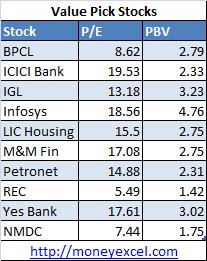
Considering all above factors in mind following, 10 most valued fundamental stock pick is recommended by the analyst.

value stocks

Don’t forget to share this stock recommendation on facebook and twitter!

Missed Call Banking Phone Number of All Banks

missed call banking

Missed call banking is a new way of banking, where you can give missed call with your register mobile number to avail banking facility. Using missed call banking you can avail various banking facilities like balance enquiry, mini statement, blocking ATM card etc.

Missed call facility is a boon to the customer. It is like doing banking on finger tips. One can get all account related information over the phone. All major Banks including SBI, Axis Bank, ICICI Bank, HDFC Bank, Bank or Baroda offers this facility.

In this post, I will provide missed call banking phone numbers of all major Banks.

Missed Call Banking Phone Number of All Banks

State Bank of India

SBI offers a quick missed call banking facility. To avail this facility first, you need to register for this facility. You can register by sending SMS ‘REG(space)account number’ to 09223488888. Bank will send confirmation message indicating registration status successful or unsuccessful.

Once you are registered you can use this facility.

  • To know your bank balance give missed a call to 09223766666.

Axis Bank
This facility is also available for axis bank customers. Service offered by axis bank is free of cost.

  • Dial 1800 4195959 to know your account balance
  • Dial 1800 4196969 to get your Mini Statement

ICICI Bank

India’s largest private sector bank ICICI also provides a missed call banking facility.

  • Dial 02230256767 once connected ring will be made and a call will be disconnected automatically.

You will receive SMS from a bank which will contain your balance information.

HDFC Bank

HDFC Bank provides the free missed call banking facility.

  • Call 1800 2703333 to get your account Balance
  • Call 18002703355 to get your Mini statement
  • Call 18002703366 to give request for Cheque Book
  • Call 18002703377 to give request for Account Statement

Bank of Baroda

Bank of Baroda also provides this facility.

  • Call 09223011311 to know your bank balance.
  • You will get SMS containing details bank balance to your register mobile number.

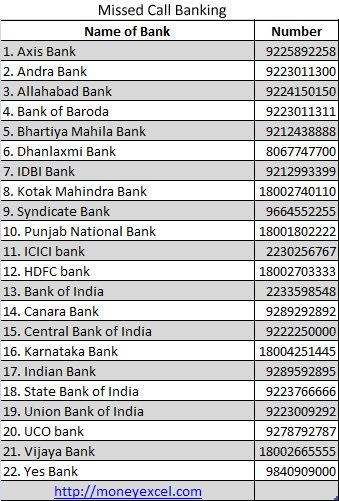
Ready Reference list containing information about all other banks is given below.

missed call banking

Hope you will find this information useful. Do share this information with your friends!

Cost of Child Education – Planning and Calculator

We always dream of giving the best education to our children but do we really think about the growing cost of child education? We want a child to become a doctor or engineer but do we really plan for this? As per me saving for child education is the most important goal for parents. Other goals like buying a car or buying a home can be compromised, but we cannot compromise our child’s education.

Education is often considered the best investment for the future. However, providing quality education for children in India seems like a huge financial challenge. Due to increasing tuition fees, expensive extracurricular activities, and a persistent rise in inflation, parents frequently experience feelings of being overwhelmed. Let’s explore the details of the expenses for child education in India and how inflation can impact your costs.
cost of education

Breaking Down the Cost of Child Education in India

If you’re a parent or planning to become one, you might have already caught yourself daydreaming (or panicking) about how much education is going to cost. Let’s break it down step by step:

Pre-Primary and Primary Education: The Foundation Phase

This is where it all begins, with toddlers heading off to preschools like Montessori or nursery schools. These early years are surprisingly expensive in India, especially if you’re aiming for premium schools.

  • Cost: Expect to shell out anywhere from ₹50,000 to ₹2,50,000 annually for private schools. The fees vary depending on whether it’s a local school or a prestigious international institution.
  • Additional Expenses: Transportation, uniforms, books, and school supplies can add ₹30,000 to ₹50,000 a year.

And this is just the start. Scary, right? But wait, there’s more!

Secondary and High School Education: The Real Investment Starts

When your child enters middle and high school, the stakes—and the expenses—start climbing. Schools begin to focus more on academics, sports, and overall personality development, which means more resources and higher fees.

  • Cost: Fees for secondary education in private schools range between ₹1,00,000 to ₹5,00,000 per year, depending on the school’s reputation and facilities.
  • Coaching and Tuitions: If your child is preparing for competitive exams like JEE or NEET, be prepared to spend an additional ₹50,000 to ₹3,00,000 annually on coaching.
  • Extracurricular Activities: Sports, music, robotics, and other after-school programs could add another ₹20,000 to ₹1,00,000 annually.

When you add all this up, it’s clear that high school is where education begins to pinch your wallet harder.

Higher Education: A Whole New Ballgame

Higher education, whether in India or abroad, can easily become the single largest expense in your child’s life. Whether it’s an engineering degree, medical school, or an MBA, the numbers are staggering.

  • Engineering and Medical Degrees: Private colleges charge ₹5,00,000 to ₹25,00,000 for a four- or five-year course.
  • MBA Programs: Premier institutions like the IIMs demand upwards of ₹20,00,000 for a two-year program.
  • Study Abroad: If your child dreams of studying in the US, UK, or Australia, the costs could range between ₹25,00,000 and ₹1 crore, depending on the course and university.

How Inflation Affects Education Costs

Inflation is that silent predator lurking in the background, making everything—yes, even education—more expensive over time. The average inflation rate for education in India is around 10-12% annually, which is significantly higher than the general inflation rate of 5-6%. Let’s understand this with a quick example.

The Snowball Effect

Imagine you’re paying ₹1,00,000 a year for school fees today. With a 10% inflation rate, this amount becomes ₹1,10,000 next year. Fast-forward 10 years, and you’re staring at a fee structure that’s doubled to ₹2,00,000 annually!

But inflation doesn’t just affect tuition fees. Everything from books to uniforms, extracurricular activities, and even transportation costs rises in tandem. Over 15-20 years, these incremental hikes can amount to a small fortune.

Why Are Education Costs Rising So Rapidly?

Ever wondered why education costs in India are skyrocketing? It’s not just inflation. There are a few other culprits at play:

Increasing Demand for Quality Education

India’s growing middle class aspires for world-class education, which has led to a surge in demand for premium schools and colleges. Naturally, when demand outstrips supply, prices go up.

Infrastructure and Technology Costs

Schools and colleges now invest heavily in smart classrooms, advanced labs, and high-tech infrastructure. While these advancements are great for your child’s learning, they come at a steep price.

Global Influence

Many schools, especially international ones, benchmark their pricing against global standards. This drives up costs even further.

Competitive Exam Preparations

With intense competition for top colleges, private coaching has become the norm. Institutions charge exorbitant fees, further adding to a parent’s financial burden.

How to Plan for Your Child’s Education Expenses

Now that you know how expensive education can get, let’s talk about solutions. Don’t worry—there’s light at the end of this tunnel. Here are some practical tips:

Start Early with Education Savings

The earlier you start saving, the better. Education inflation outpaces regular inflation, so it’s wise to invest in high-return instruments like mutual funds, stocks, or ULIPs designed for child education.

Explore Scholarships and Grants

Many schools, colleges, and even coaching centers offer scholarships based on merit or financial need. Make sure to explore these options early.

Invest in an Education Loan

For higher education, especially abroad, education loans can be a lifesaver. They offer flexible repayment options and tax benefits under Section 80E of the Income Tax Act.

Leverage Insurance Plans

Child insurance plans provide financial coverage for education in case of unforeseen circumstances. These can be a safety net against uncertainties.

Future of Education Costs in India: Is There Hope?

While education costs will likely continue to rise, governments and educational institutions are making efforts to ease the burden. Initiatives like subsidized loans, increased public school funding, and the promotion of online learning could provide some relief.

Online education, in particular, is emerging as a game-changer. With platforms like BYJU’S, Unacademy, and Coursera offering affordable alternatives, parents now have more choices than ever before. While it may not completely replace traditional education, it can definitely complement it.

Conclusion

The cost of child education in India is undeniably high, and inflation only makes it tougher. But with careful planning, strategic investments, and smart choices, you can ensure your child gets the education they deserve without breaking the bank. Think of it as a marathon, not a sprint. Start early, stay consistent, and you’ll cross the finish line with ease.

FAQs

How much should I save for my child’s education in India?

It depends on your child’s age, the type of education you’re aiming for, and inflation. A rough estimate is to save around ₹50,00,000 to ₹1 crore over 15-20 years for quality schooling and higher education.

Are there affordable alternatives to private schools in India?

Yes! Kendriya Vidyalayas and state-run schools offer quality education at a fraction of the cost. However, they might lack the infrastructure and extracurricular exposure of private schools.

Can inflation in education costs ever be controlled?

While it’s hard to eliminate inflation, steps like government subsidies, online education, and increased public funding could help slow down the rise in costs.

Is an education loan a good idea?

Absolutely, especially for higher education. Education loans come with flexible repayment options and tax benefits, making them a practical choice for many families.

What is the biggest contributor to rising education costs?

Apart from inflation, factors like demand for premium education, rising infrastructure costs, and private coaching fees significantly drive up costs.

By staying informed and proactive, you can navigate the maze of education expenses and secure a bright future for your child!

To extend help to you we have developed one calculator you can download it from below.

Download Child Education Calculator

Hope you find this calculator useful.

Do share this calculator with every parent you come across!

Leadership Lessons from Lord Ram and Krishna

Ram and Krishna are two great gods and the main protagonist of Hindu epics Ramayana and Mahabharata.

The central story of Mahabharata and Ramayana is around the victory of good over evil.

In the story of Ramayana Lord Ram leads an army to monkey’s to surmount Ravana, while in the story of Mahabharata Lord Krishna guided Pandavas to defeat Kauravas in Kurukshetra.

Lord Ram and Krishna teach us the following lessons of leadership through Ramayana and Mahabharata.

Krishna Ram Leadership Lessons

Leadership Lessons from Lord Ram

Lord Ram was the true leader and front-end fighter of his army. He was supreme in deciding strategy during the fight of Ramayana. He directed his team to meet objectives. His team was happy to follow his orders.

Lord Ram’s leadership style was unique during the fight of Ramayana. He was leading an army of Monkey’s who were unskilled fighters and always looking for directions.  His army was fighting for his cause. Lord Ram shows the way to his team and directs them on what to do in tough times.

Lord Ram –

  • Skill Warrior
  • Leading Team from the front
  • Gives specific roles and instructions – Tells
  • Showing the way in difficulties
  • Motivating people to fight for his cause

Leadership Lessons from Lord Krishna

Lord Krishna was totally different from Ram. During Mahabharata Lord Krishna told Arjun that, He won’t pick up any weapon and he would not fight any battle. He will be there as a charioteer to Arjun. He does exactly the same. He never fought the battle and never picked up any weapon. He was just a guide to Pandava’s.

Lord Krishna was aware that he had one of the best archers Arjun in his team. Krishna acted as coach to Pandava’s. His main job was to remove cobwebs from Arjun’s mind. He was able to show a different perspective to Arjun by delivering Bhagavad Geeta during the battle of Mahabharata.

Lord Krishna –

  • Does not fight any battle
  • Works with the best professional
  • Leading Team from Back
  • Allow Team members to take the lead
  • Fight for the cause of the team
  • Clarifies doubts and guides the team

After knowing about lord Krishna and lord Ram, it is time to assess yourself, look at yourself, and decide –

What type of leader you are?

  • Are you a front worrier and leader who leads’s team from the front or do you allow your team to take the lead?
  • Do you have unskilled professionals in your team or you are working with the best professionals?
  • Do you show ways to your team directly or do you ask them relevant questions so that they can find their own solution?

The Younger generation today wants leaders like Krishna. They don’t want anyone who tells them, how things are getting done, but they want to know the meaning of their job. Look at your team members if they are like Arjun’s, who are skilled and then they want someone to clarify their doubts and guide them.

If your team members are unskilled, then it is appropriate for you to apply the leadership style of Lord Ram.

Which leadership style is appropriate for you – Lord Ram or Lord Krishna?

Do share your views!