
Blog Page 441

Capital Gain Tax Calculator – Download

1

capital gain tax

How to calculate capital gain for computing taxes? I have seen many people committing mistake while calculating capital gain tax. Many people believe that calculation of capital gain tax is complex. So, let’s try to simplify this calculation by understanding Capital Gain and Capital Gain Tax.

What is Capital Gain?

My friend recently sold property purchased by his father. This property was purchased at the cost of 25 lac in 2010. He sold this property in 50 lac recently. What will be profit 25 Lac simple right? If you are thinking it is 10 Lac you are wrong! Continue reading you are going to learn lot of things today.

Ideally capital gain is gain arising from sale or transfer of capital assets like property, shares, mutual funds, bonds etc. However when it comes to capital gains in taxes above definition of capital gain is not true.

Capital gains is divided into two types (1) Short-term Capital Gain and (2) Long-term Capital Gain. This classification is based on holding period of assets.

Also Read – How to know your Gratuity Benefits – Calculator Download 

capital gain

How to Calculate Capital Gain Tax for Property?

Short Term Capital Gain Tax on Property

You can get calculate Gross Short Term Capital Gain by subtracting cost of purchase, expense on transfer/sell and cost of improvement from sale price.

Gross Short Term Capital Gain =

“Fair Market Value or Sale Price – Expense on Transfer – Cost of Purchase Cost of Improvement”

  • Sale Price is price on which you have sold your property.
  • Expense on Transfer includes any cost incurred for selling this property i.e stamp duty, advertisement, legal expense etc.
  • A Cost of Purchase is amount paid by owner at the time of acquiring property.
  • A Cost of Improvement includes any cost incurred on improving or altering property since its acquisition.

You can get calculate Net Short-Term Capital Gain by subtracting Gross Short Term Capital Gain from Exemption.

Also Read – Cost of Child Education – Planning and Calculator 

Net Short-Term Capital Gain =

Gross Short Term Capital GainExemption (If any) (54B/54D/54G/54GA)”

  • 54B – Transfer should be of agricultural land. One should purchase New Agriculture land in 2 years from capital gain.
  • 54D – Property acquired for Industrial purpose. One should purchase new Industrial property within 3 years from capital gain.
  • 54G – Transfer should be of Machinery building or plant. Transfer should be due to shifting to any area other than an urban area.
  • 54GA – Transfer should be of Machinery building or plant. Transfer should be due to shifting to any Special Economic Zone.

Once you obtain this value calculate tax on this value as per normal income tax slabs, that amount will be your short term capital gain tax on property.

Long Term Capital Gain Tax on Property

Long Term Capital Gain Tax rate is 20%.

You can get calculate Gross Long Term Capital Gain by subtracting index cost of purchase, expense on transfer/sell and index cost of improvement from sale price.

Gross Long Term Capital Gain =

“Fair Market Value or Sale Price – Expense on Transfer – Index Cost of Purchase Index Cost of Improvement”

  • Index cost of purchase is process by which the cost of purchase or acquisition is adjusted against inflationary rise in the value of asset. For this purpose Central Government notify cost inflation index (CII) every year.

Index cost of Purchase = Actual cost * CII for Year of Sale/ CII for Year of Purchase

Index cost of Improvement = Cost of Improvement * CII for Year of Sale/CII for Year of Improvement

Download Capital Gain Calculator

How to Calculate Capital Gain Tax for Shares & Mutual Funds?

Short Term Capital Gain Tax on Shares & Mutual Funds

Short Term Capital Gain Tax applicable on Transfer of shares and mutual funds is flat 15%, provided transaction is taking place at the recognize exchange and Security Transaction Tax (STT) is paid.

Short Term Capital Gain = Sale Price – Expense on Transfer – Cost of Purchase – Cost of Improvement

  • Sale price is price at which you have sold the shares or mutual funds.
  • Expense on Transfer in this case is brokerage charged by AMC or brokerage house.
  • Cost of purchase is purchase price of shares or mutual funds.

Also Read – All you want to know about your Salary Slip

Long Term Capital Gain Tax on Shares and Mutual Funds

Long term capital gain tax on shares and mutual funds is reintroduced in 2018.

  • As per new rule any person who sells shares after April 1, 2018, will pay a long-term capital gains tax at the rate of 10 percent on gains of more than Rs 1 lakh. For such shares, the cost of acquisition will be price as on Jan. 31, 2018.
  • If a person who has held shares for more than one year sells them before March 31, 2018, there will be no long-term capital gains tax.
  • No changes are made in short-term capital gain tax. Short-term capital gain would be taxed @15%.

Let’s try to figure out how this change will impact you.

Case 1 –

If you sell your equity or mutual fund investment before April,1,2018 you need not pay any LTCG as a new rule of LTCG will be applicable after April,1,2018.

Case 2 –

Suppose you sell shares after March,31,2018 you need to pay LTCG. LTCG is applicable beyond 1 Lakh. This means no tax is payable on profit amount up to 1 lakh per annum. Any amount beyond 1 Lakh will be taxed @10%. Suppose your long-term capital gain from equity and the stock market is 1.5 Lakh in a year. You need to pay tax on Rs.50000.


PAN Card mandatory for these 20 Financial Transactions

0

PAN card

PAN Card is important document issued by Income Tax department to the taxpayer. PAN Card contains 10 digit unique alphanumeric number. PAN card also serve purpose of valid identity proof. However, prime objective of PAN card is to track financial transactions done by tax payer. Income tax department enforced individual to mention PAN card while doing financial transactions. This is to eliminate tax evasion and malpractices like usage of black money.

20 Financial Transaction where quoting PAN card is Mandatory

  1. You need to quote PAN in case you are doing sale or purchase of immovable property worth 5 lac or above.
  2. PAN card is mandatory for sale or purchase of any goods costing 1 Lac or above.
  3. If you are planning sale your car or planning to purchase new car you need to mention PAN number.
  4. PAN is required for opening bank account. In case you are opening account on the name of minor PAN card of parents is required.
  5. PAN number is required If you want to deposit 50,000 Rs or above in cash for bank account.
  6. Quoting PAN number is mandatory if you purchase a bankers draft, pay order or bankers cheque exceeding 50,000 Rs.
  7. Any payment made to hotel or restaurant exceeding 25,000 Rs you need to mention PAN card.
  8. PAN card is required in order to apply for new telephone connection including mobile connection.
  9. You need to mention PAN number while buying financial securities (stocks, bonds, debenture) costing 50,000 Rs or above.
  10. Payment of 50,000 Rs or above for the purchase of Mutual Funds units.
  11. Applying for Credit Card or Debit Card.
  12. You need to mention PAN number if you are making payment for foreign travel exceeding 50,000 Rs or above.
  13. Quote PAN number if you are making payment of 50,000 Rs or above for the insurance premium payment.
  14. On purchase of gold jewelry worth 5 lac or above.
  15. PAN card is required if you want to obtain Sales tax, service tax or Excise registration number.
  16. Mention PAN number on rent receipt if rent value is exceeding 1 lac in financial year.
  17. PAN card is required if you are taking Fixed deposit exceeding amount 50,000 Rs.
  18. You need PAN number for the payment of Tax.
  19. While Filing Income tax return.
  20. You need PAN while submitting form 15G/15H.

You must be convinced  that PAN card is important document for financial transactions. If you have not got your PAN card follow the steps given in post – Apply and verify PAN card details online.

Points to Remember:-

  • You need to mention PAN number only if it is required.
  • Avoid mentioning PAN number anywhere else.
  • Do not give Xerox copy of PAN card in any other transaction. This is to reduce Benami/Hawala Transactions.
  • Avoid use of PAN card as identity proof.
  • If you lost your PAN card apply for new card. You can also file FIR to police in order to avoid liability.

Hope you find above information useful. Do share your views on above.

List of Certified Financial Planners (CFP) in India

Certified Financial Planners (CFP) – Who are certified financial planners (CFP) in India? How much fee do they charge? What should you look for while hiring a financial planner? If you are looking for these answer you are at right place. In this article, I will be sharing information about the point you should consider before hiring financial planner. I will also share a list of Certified Financial Planners (CFP) in India.

Who is a Financial Planner?

A Financial planner is an individual who helps you to deal with financial issues via proper planning. Just like we have doctors for medical problems, we have financial planners for financial problems.
To become a doctor, we have certification course MBBS, to become advocate we have certification course of LLB. Similarly in order to become financial planner certification course of CFP is offered by FPSB – Financial Planning Standards Board India.

Certified Financial Planners (CFP) are professional authorized to do financial planning. If you are planning to take help from financial planner you must opt for CFP (Certified Financial Planner).

Who is not a Financial Planner?

Today we find a lot of people advertise themselves as a financial planner. By education either they are CA, MBA (finance), ICWA or CS. Although they have knowledge in finance domain that does not mean that they can act as a financial planner.

In the same way Insurance agent, Mutual Fund agent, Wealth Manager or Relationship manager is not a financial planner. These people can definitely help for the selection of right investment product, but that does not mean that they are financial planners.

Financial planning is a personalized service. A financial planner makes a financial plan. This financial plan contains detailed information about the future financial goal, tax planning, insurance planning, investment advice, cash flow management, and lot more.

List of Certified Financial Planner CFP India

Where to Find Certified Financial Planners?

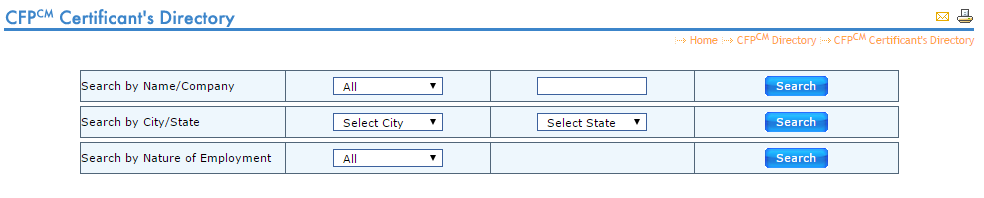
So, Big question is where to find certified financial planners? One good news is FPSB provides an online facility to search certified financial planners. Kindly visit FPSB website to search for certified financial planners nearby your area.

certified financial planners

You can find CFP based on Name/company, City/State and Nature of employment.

List of Certified Financial Planners in India

Here is a list of selected certified financial planners in India.

Sr No Name of Financial Planner Address Website
1 Mr. Jayesh R Parekh B-702, Ruchi Apt,
Devidas Road,
Borivali (West)  Mumbai
Maharashtra  400103
2 Mr. Ramesh Chouhan Max Secure Financial Planners Sector-20, CBD Belapur, Navi-Mumbai http://www.maxsecfp.in/
3 Mr.Amit Suri H-81/1, Shivaji Park, Punjabi Bagh,  Delhi 110026 http://amitsuri.com
4 Mr. Basavaraj 153, 19th Cross Road, 7th C Main Road, 3rd Block, 4th Stage,, Basaveshwara Nagar, Bengaluru, Karnataka 560079 http://basunivesh.com 
5 Soubhagya Patra BIIT Business Centre, # 257, First Floor, 9th ‘A’ Main , 3rd Block, Jayanagar, Bangalore – 560011  http://www.succinctfp.com
6 Mr.Sukhvinder Sidhu SCO-76, 2nd Floor, Mugal Canal
Karnal, Haryana – 132001
http://www.finlifecare.com
7 Salma Sony Flat No. 34, Zircon, Vatikaa Green City, Dimna Road, Mango, Within P.S Mango, East Singhbhum Jamshedpur, Jharkhand- 831018 https://salmasony.com/

Points you should consider before Hiring a financial planner

  • Education qualification
  • Experience
  • Knowledge and competence
  • Confidence
  • Trust and Credibility
  • Reference

How much fee Financial planner charge for financial planning?

Financial planner charge 150$ to 300$. This means 10,000 Rs to 20,000 Rs/- for financial planning. However, this fees varies from planner to planner.

Apart from financial planning these financial planner also offers services like tax planning, retirement planning, insurance planning, portfolio tracking advice etc.

Certified Financial Planner (CFP) or Registered Investment Advisor (RIA)

Apart from certified financial planner we have another category called as Registered Investment Advisor (RIA). An investment advisor registered with SEBI for offering investment advice on stock, mutual funds, bonds, ETF is known as RIA.

Registered Investment Advisors are authorized by SEBI to give investment advice relating to investing in, purchasing, selling or dealing in securities or investment products, and advice on investment portfolios containing securities or investment products for the benefit of the client and shall include financial planning.

Registered Investment advisors are equally capable of providing financial planning services, however, the decision of taking services is from them is entirely up to you.

RIAs generally charge fixed fee or hourly fees. Many RIA charges a percentage of the value of the assets they manage for a client.

Request-

If you have taken services from any financial planner and are satisfied with them. Do share with us so that we can expand the list of financial planners given here.

I would also appreciate it if you can leave a note sharing your experience in the comment section.