

Blog Page 423

Home loan Tax benefits – Section 24, 80EE & 80C- 10 less known facts

home loan

Many of us take a home loan to buy the dream home. However, we hardly know the tax benefits associated with Home loan. In this post, I will throw light on Home loan tax benefits. I will also cover 10 less known facts which are not known to a majority of people.

Home Loan Tax Benefits

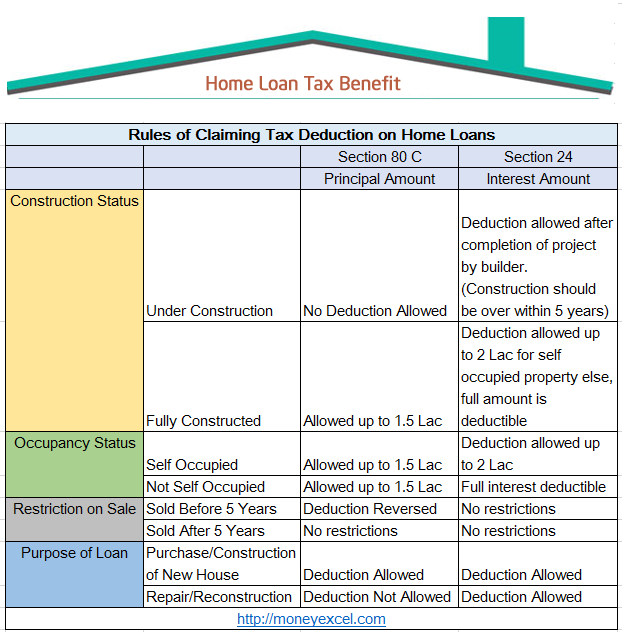
Home Loan EMI payment has two components (1) Principal (2) Interest (Section 24). You can avail tax benefit on both these components.

  • Principal – You can claim tax deduction on the Home loan principal paid by you. The limit for this deduction is 1.5 Lac (Section 80C). You can get details about principal amount paid by you from your lender.
  • Interest – You can also avail tax benefit on the interest component of the home loan. The total deduction allowed on interest component is up to 2 Lac. The condition of availing this tax benefit is owner should live in the house for which home loan is taken or house should be vacant.

Total Tax Benefit = 1.5 Lac Principal (80 C) + 2 Lac Interest (Section 24) = 3.5 Lac

Now let’s take a look at 10 less known facts about home loan tax benefit section 24.

10 Less Known facts about Home Loan Tax Benefits

First time home buyers can claim additional tax deduction of Rs 50,000 on Home Loan Interest

In budget 2016 new section 80EE is introduced for the first time home buyers. As per the new section 80EE, first time home buyers can claim an additional tax deduction of Rs 50,000 on home loan interest. This deduction is over and above tax deduction of 2 Lac under section 24 and 1.5 Lac under section 80C.

So, maximum tax benefit shall be 4 Lac per year. This new benefit is applicable under following conditions.

  • You are first time home owner.
  • No other house is owned by you.
  • The value of the loan is less than 35 lacs and property value is less than 50 lacs.
  • The loan should be sanction between 1st April 2016 and 31st March 2017.

This benefit shall be extended till the time repayment of home loan continues.

Deduction is allowed to the borrower and co-borrower

Home loan deduction on principal and interest is extended to the borrow and co-borrower both. This means if you have taken a home loan on your and your wife’s name you and your wife both can claim these tax deductions. So, effectively you and your wife both can enjoy tax benefit applicable on a home loan.

No benefit on principal payment during construction on property

As per income tax law, you can not avail any tax benefit on principal payment during the construction of the property. You are eligible for this benefit only after the project is completed and property possession is given to you.

Preconstruction period interest is also deductible in 5 equal proportion in 5 years.

You can claim home loan benefit only on the possession of the property. Any preconstruction payment towards principal cannot be claimed. However, you can claim preconstruction period interest payment once you received possession of the property. The tax deduction benefit on such interest is available equally over a period of 5 years starting from the year of possession.

Tax benefit on Home Protection Insurance premium payment

Many banks offer home protection insurance scheme. If you opt to take home protection scheme, an insurance premium paid towards this scheme can be claimed for tax deduction under section 80C. For home protection scheme sum assured and premium changes with the time.

Principal and repayment tax benefit shall be reversed if you to sell the property before 5 years.

You cannot sell the property before 5 years. If you sell the property before 5 years, all principal paid by you in last five years shall be reversed and added to your income. In addition to this, you may need to pay capital gain tax.

Loan from relative and friends is also eligible for tax benefits

You can take home loan from your friends and relatives and avail tax benefits. However, you will not get any tax benefit on the principal amount.

Let me explain, if you take home loan from your friend you can claim a tax deduction on interest paid to your friend (Under section 24). The following condition should be fulfilled in order to avail this tax benefits.

  • You need to submit proof that you have paid interest to your friend. This may be in the form of a certificate.
  • Your friend needs to show this interest income and he/she need to pay income tax on this income.

You can not avail tax benefit on principal payment under such case.

Benefit of section 80 C, section 24 and HRA

You can not avail the benefit of HRA if you are living in your own house and getting tax benefit towards section 80 c and section 24. However, if you are living in rented house despite owning your own house you can avail the benefit of section 80 C, section 24 and HRA also.

Buying multiple homes using home loan

You can purchase multiple home and avail tax benefits. The benefit under section 80 C for the principal payment shall be capped at 1.5 Lacs for all loans. The benefit under section 24 for the interest payment for the self-occupied property shall be 2 Lacs.  For the house which is given on rent, there is no limit on interest payment claim.

Stamp Duty, Registration fee, Processing Fee and Tax Deduction

In addition to principal and interest component other expenses can also be claimed for the tax benefit. These expenses include stamp duty, registration fee expenses etc. All these expenses can be claimed as tax benefit under section 80C. Any processing fees for getting home loan sanction can also be claimed for tax benefit.
home loan tax benefit

Over to you –

Hope I have clarified your doubts about home loan and tax benefits. If you have any other confusion related to home loan and tax benefit, feel free to post your query in the comment section.

RNOR Status NRI can save Tax up to 3 Years

RNOR

RNOR Status NRI – Today many NRI are planning to shift to India. They will be changing their investor status from NRI to a resident and they are worried about huge tax applicable on investment options for a normal resident.

Recently I got an email from Mr.Shiva. Mr.Shiva is NRI and living in Singapore since 2001. He is planning to return to India permanently and bringing all his saving from overseas to India. It will be his retirement saving and he is looking for safe investment option with a reasonable return and tax saving benefits in India. He is planning to invest in fixed deposit but he wants to enjoy tax benefit. As he will be ordinary resident he needs to pay Tax on FD. However, RNOR status can help him to save tax up to 3 Years on FCNR deposit. So, let’s take a look at RNOR status for NRI and how it can help to save tax.

Also Read – Health Insurance Plans for NRI in India

What is RNOR Status?

RNOR is Resident but Non Ordinary Resident status. It is a transitional state between becoming resident of India from NRI. The special status of RNOR is given to individual if he/she satisfy following conditions.

  1. If you are holding NRI status for 9 out of 10 previous years.
  2. If you have spent less than 729 days in India in past 7 years.

RNOR

Note – Above conditions are either or conditions. This means any one condition should be satisfied in order to become RNOR.

Also Read – How NRI can transfer money abroad from property sale?

What are the Tax benefits of RNOR status?

RNOR is special status given to NRI returning to India. RNOR in India can continue to enjoy tax benefit like NRI. RNOR has to pay taxes only on the income generated from India. They will continue to enjoy tax benefit on Foreign Income. In the other words “Income which has no relation with India” will be tax free.

This includes –

  • Any interest or dividends from foreign securities
  • Any capital gains from the sale of foreign assets including property
  • Any withdrawals made from foreign retirement funds
  • Interest earned on Foreign Currency Non Resident (FCNR) bank account or deposit held in India (until maturity).
  • Interest on foreign currency accounts held in India.

Recommended Post – Financial Checklist for NRI before leaving India

How long can I be RNOR?

Answer of this question depends on the fulfillment of conditions for RNOR. If you fulfilled first condition for RNOR means if you are holding NRI status for 9 out of 10 previous years you will get RNOR for 1 year. Secondly, if you have spent less than 729 days in India in past 7 years you can get RNOR status for 2nd and 3rd Year. Maximum you can get RNOR status for 3 years.

Example

Mr.Shiva is staying in Singapore for last 15 years. He will be returning to India in June 2016. He is not clear where to apply for RNOR status and how long he can be RNOR?

As Mr.Shiva is returning back to India in FY 2016-17 and both condition for RNOR is getting fulfilled he will be RNOR for 3 years and he can enjoy tax benefit for NRI up to FY 2018-19. After that, he will be an ordinary resident.

Mr.Shiva need not to contact to any authority to avail RNOR status. The RNOR status will be applicable to a person based on his or her length of stay outside India.

Important points Investor status from NRI to a resident

  • Once you become an ordinary resident you need to intimate bank. Now you cannot operate the NRO/NRE/ FCNR accounts.
  • You need to open ordinary saving bank resident rupee account.
  • You need to open a new Demat account with ordinary status for making investment in stock market.
  • Trading account with NRI status has to be closed.
  • A new KYC needs to be filled up mentioning new address and details. This is required for Mutual Fund Investments.
  • If you are not holding any PAN card, you need to apply for new PAN card.

Hope RNOR tax benefit and other details that are given above will help all NRI friends returning back to India?

If you have any query related to NRI taxation or any other problem related to NRI feel free to post in the comment section.

A special thanks to Mr.Shiva who inspired me to write this Post.

10 Most Expensive Stocks in the India

The Most Expensive Stocks in India – The stock market investment is a double-edged sword. It can make you rich or it can make you poor. To earn a handsome return, it is important that you invest in the right stock.  In this article, we will take a look at the 10 most expensive blue chip stocks in India. These stocks are the most expensive and instead of this one stock, you can purchase expensive items such as an iPad or even a 10 gm gold ring for your wife. 🙂

most expensive stocks india

10 Most Expensive Stocks in the India

#1 MRF

MRF is the most expensive stock in the Indian stock market. MRF is the largest tire manufacturer in India. MRF stock price as of today (i.e. 26/6/2024) is ₹ 1,25,821. You can purchase 20 gm gold on behalf of one stock of MRF. In the last few years, the stock price has increased significantly. MRF Shares price in 2019 was ₹66,327.75. By 2024, its share price rose to ₹1,26,954.85. It gave a positive return of over 91% with a CAGR of 13.8% over the last 5 years.

#2 Honeywell Automation India

Honeywell Automation is the second most expensive stock in India as of 2024. Honeywell produces a variety of commercial and consumer products. The stock of Honeywell Automation is trading at ₹ 57,600. Honeywell stock generated a positive return of over 110% with a CAGR of 16% over the last 5 years. Honeywell is one of the best stocks to invest in for the long term.

#3 Kaycee Industries

Kaycee Industries is a leading electrical switches manufacturer and exporter. The stock of Kaycee is one of the most expensive stocks in 2024. The stock is trading at ₹ 59,439. Kaycee Industries Stock price in 2014 was ₹ 3,500. This means the stock has generated a positive return of over 1,564% with a CAGR of 32.4% over the last 10 years.

#4 Page Industries

Page Industries is a textile company and holds an exclusive license of Jockey International for distribution in India and neighboring countries. The stock price of the Page Industries in 2024 is ₹ 39,585. The stock price of Page Industries was ₹11,647 in 2014. Page Industries stock gave a return of over 239% with a CAGR of 13% over the last 10 years.

Best Blue Chip Stocks in India (2024)

#5 3M India

3M India is also on the list of most expensive stocks. 3M India is a diversified technology company dealing in Safety & Industrial, Transportation & Electronics, Health Care, and Consumer segments. The stock price of 3M India in 2024 is ₹ 37,183. The company is almost debt-free. In 1993, the price of 3M India shares was ₹155.00. If you had put ₹10,000 into 3M India Shares in 1993, your investment would have increased to ₹23.98 Lakh by 2024.

#6 Bosch Ltd

Bosch is also on the list of most expensive stocks. Bosch has diversified businesses and deals with multiple sectors such as automotive technology, industrial technology, consumer goods and energy and building technology. The CMP of Bosch is ₹ 34,149. Bosch Share price in 2014 was ₹19,400. This means Bosch has given a 76% return with a CAGR of 5.8% over the last 10 years.

#7 Yamuna Syndicate

Yamuna Syndicate Ltd. is involved in the trading and marketing of a diverse range of products, components, and consumables associated with the automotive sector, agrochemicals, and industrial and consumer electrical goods. The stock price of Yamuna Syndicate Ltd in 2024 is

₹ 55,439. The Yamuna Syndicate stock price in the year 2020 was ₹9000. This means Yamuna Syndicate generated 515% returns from 2020 to 2024, with a compound annual growth rate (CAGR) of 57.5%.

#8 Shree Cement

Shree Cements is in the business of Cement manufacturing and selling. Shree Cements is one of the lowest-cost cement producers in India. The stock price of Shree Cements in 2024 is ₹ 27,499. The price of Shree Cement stock in 2014 was ₹9,350. This means Shree Cement generated a 194% return with a CAGR of 11.3% over the last 10 years.

#9 Abbott India Ltd

Abbott India Ltd is a top multinational pharmaceutical company in India that sells its products mainly through independent distributors within the country. The stock price of Abbott India Ltd in 2024 is ₹ 27,640. Abbott India’s share price in 2014 was ₹ 3,600. This means Abbott India gave a 647% return with a CAGR of 22.2% over the last 10 years.

#10 Bombay Oxygen

Bombay Oxygen is next on the list of Most Expensive stocks in India. Bombay Oxygen deals in primarily financing and investments business. The stock price of Bombay Oxygen in 2024 is ₹ 24,364. The stock price of Bombay Oxygen in 2014 was ₹ 5,607. This means Bombay Oxygen gave a return of 334% with a CAGR of 15.82% over the last 10 years.

Note – The above price comparison is as of June 2024.

Why are these stocks the most expensive stocks?

The reasons why these stocks are expensive is given below.

  • A limited number of stocks are available in the market for trading.
  • The demand for these stocks is high.
  • No split or bonus shares have been announced by a company for a couple of years hence face value of a share is high.

Over to You

Do you own any of the expensive stocks mentioned above?

Do you think these stocks will be able to outperform in the future?

Do share this list of the most expensive stocks with others.

Happy Investing!

Best way to purchase Online Term Insurance Plan

Today online term insurance plans are available at very low cost. It will cost you even less than your monthly mobile bill. So, if you have not taken life insurance yet it is advisable to go for an online term insurance plan. A term insurance plan provides risk coverage and financial stability to your family in your absence.

Let’s face it, life is unpredictable. One day you’re riding the high tide, and the next, you’re navigating choppy waters. That’s where a solid term insurance plan comes into play. It’s like a safety net that ensures your family’s financial stability if you’re not around. But wait—buying the right term insurance plan online in India can feel like trying to pick the perfect mango from a bustling market. Overwhelming, right? Don’t worry; I’ve got your back. Here’s a detailed, step-by-step guide to making the best decision.

Also Read – Best online Term Insurance in India

online term insurance plan

What Is a Term Insurance Plan

First things first—let’s demystify term insurance. In simple terms, it’s a pure protection plan. You pay a premium, and in return, your family gets a lump sum amount (known as the sum assured) if something happens to you during the policy term. It’s straightforward, no-frills insurance. Unlike other plans, there’s no investment component here, which is why it’s so affordable.

Why Online Term Insurance policy are less costly 

Online term insurance policy is 20-40% less costly compare to offline policy. The reason why there is a big cost difference between online and offline term plans is given below.

  • As an online term plan is purchased directly no intermediate agent is involved in between. So you will be saving big money on insurance agent commissions. You may not be aware but the agent takes a 15-20% commission on every insurance payment.
  • A mortality risk (unknown or hidden risk) associated with an online term plan is almost zero because people who opt for an online term plan are usually well educated and are expected to take good care of their health so the insurance company is willing to provide them term plan at a lower cost.
  • A paperless process further reduction in the overall cost of the policy.

How to Choose the Right Online Term Insurance Plan

Now, this is where the rubber meets the road. With so many options available, how do you pick the one that’s perfect for you? Follow these steps:

1. Assess Your Needs

Before diving into the sea of policies, ask yourself: How much coverage does my family need? A general rule of thumb is to aim for a sum assured that’s at least 10-15 times your annual income. Think about factors like:

  • Outstanding loans (home, car, education)
  • Future expenses (kids’ education, marriage)
  • Daily living costs for your family

2. Compare Policies

Comparison is key. Use trusted insurance comparison websites to analyze:

  • Premiums: How much you’ll pay annually
  • Claim Settlement Ratio (CSR): A higher CSR indicates the insurer’s reliability
  • Riders: Additional benefits like critical illness cover or accidental death benefits
  • Policy Tenure: Longer terms provide extended protection

3. Check the Insurer’s Reputation

Don’t just fall for a low premium. Dig deeper. Research the insurer’s credibility by checking:

  • Customer reviews
  • Solvency ratio (ability to settle claims)
  • CSR from IRDAI’s annual report

4. Choose the Right Riders

Riders are like toppings on a pizza—optional but can make a big difference. Popular riders include:

  • Critical Illness Rider: Covers major health conditions like cancer or heart attacks
  • Accidental Death Rider: Provides an additional payout if death occurs due to an accident
  • Waiver of Premium: Waives future premiums if you’re permanently disabled

5. Read the Fine Print

Don’t skim through the policy document like it’s a terms-and-conditions box you’re eager to skip. Pay attention to:

  • Exclusions (situations where claims won’t be honored)
  • Premium payment terms
  • Claim process details

6. Choose the Right Premium Payment Mode

You can pay premiums annually, semi-annually, quarterly, or monthly. Pick a mode that aligns with your cash flow. Annual payments are often cheaper in the long run.

7. Medical Tests and Declarations

Be honest while filling out your health details. Most insurers will require a medical test. It’s better to disclose existing health conditions upfront to avoid claim rejections later.

Best way to purchase online term Insurance plan

You can purchase an online term insurance plan in the following two ways.

  • Direct Online Purchase – In this case, you approach the insurance company directly from the insurance company website and purchase the policy online. No agent is involved and the entire process is completely transparent.
  • Purchase from Insurance Web Aggregator – You can also purchase an online term insurance plan from an insurance web aggregator. Insurance Web Aggregator is a web portal or search utility approved by IRDA. The insurance aggregator website provides you the facility to compare several insurance policies and helps you to get the best deal. In this process also no agent is involved and the entire process is transparent.

Steps to Buy a Term Insurance Plan Online

Here’s a simple roadmap:

  1. Visit the Insurer’s Website: Choose a trusted insurer and head to their official website.
  2. Use the Premium Calculator: Enter details like your age, income, and required sum assured to get a premium estimate.
  3. Fill in the Proposal Form: Provide personal, occupational, and health details accurately.
  4. Upload Documents: Typically, you’ll need to upload your ID proof, address proof, and income proof.
  5. Schedule Medical Tests: If required, the insurer will schedule a medical check-up.
  6. Make Payment: Pay the premium online via net banking, credit card, or UPI.
  7. Receive Policy Document: Once approved, you’ll get the policy document via email.

Mistakes to Avoid While Buying Term Insurance Online

Even seasoned buyers can stumble. Here are some common pitfalls to sidestep:

  • Underestimating Coverage Needs: Don’t skimp on the sum assured to save a few bucks.
  • Ignoring Inflation: Factor in rising costs when choosing the policy tenure and coverage.
  • Skipping Riders: Missing out on crucial riders could limit your coverage.
  • Providing Inaccurate Information: This can lead to claim rejection when your family needs it most.
  • Delaying Purchase: The younger you are, the lower the premium. Procrastination can cost you dearly.

Benefits of Buying Term Insurance Early

Still on the fence? Here’s why starting early is a no-brainer:

  • Lower Premiums: Age is a significant factor in premium calculation. Younger buyers pay less.
  • Longer Policy Tenure: Lock in coverage for a longer period.
  • Better Health Conditions: No pre-existing illnesses mean smoother approvals.
  • Peace of Mind: Start protecting your family’s future ASAP.

 Over to You –

An online term plan offers you multiple benefits including cost savings. So, always purchase a term insurance policy online. You should keep certain important factors in mind before purchasing a term plan such as sum assured, income, future expense, riders, etc.

In order to help you here is a comparison chart of Best Term Insurance Policy.

Remember – Buying a term plan is an important decision in your life. Be cautious and purchase the best term insurance policy based on your requirement.