Blog Page 424

What is required to become a successful businessman?

successful businessman

I come across many people who talks about starting a business.They aspire to become a successful businessman. However, a majority of them are talking about starting an own business since past several months or years and they have not taken any step in this direction.

Whenever I ask them that what you are planning to do? When you will be starting a business? I am getting following answers.

  • I have yet not decided anything. I am still thinking….!
  • I am thinking to start own tuition class or food business…or
  • I am in search of a partner.
  • You only tell me what to do and how to start?

Majority of people are not clear about what they want to do? So, there is no question of when.

Why many people talk about starting business but not able to implement it?

  • They are happy and satisfied with current situation. They don’t want to change. They think that they are earning steady paycheck why to take a risk?
  • They are not serious about starting a business. They are just talking about starting a business to impress the people. Actually, they don’t want to start a business they are just passing the time.
  • They think that they are not ready to start the business as they don’t have experience and money.
  • Fear of failure is another reason. When fear of failure is higher compare to the happiness of success it is very difficult to become a businessman.

Also Read – 10 Most Successful Business Ideas

What is required to become a successful businessman?

  • Passion – Burning desire to do something for own.
  • Clarity – Clarity of thought process behind starting own business.
  • Business idea – You should have a business idea or concept.
  • Business plan – You should have a business plan and money for starting own business.
  • Confidence – Confidence in your business idea. If you have multiple doubts it will be difficult to succeed in business.
  • Patience- You should have a lot of patience. It may be possible that initial stage your idea will not click or you will not make any profit.
  • Perseverance – You should have a strong determination to become a successful businessman.
  • Backup plan – You should be ready with a backup plan. If your business strategy fails, what alternative you have.
  • Luck – Luck is not everything but it also plays an important role in becoming a successful businessman.

As per me if you are doing a job and planning to start your own business, instead of resigning from job first try side-business or take leave from your job and do a pilot run of your business. 

Myths about Starting Business & Entrepreneurship 

  • Entrepreneurs are born and not made. It is not a reality today anyone who aspires to start a business can become a successful businessman.
  • You need an innovative idea to become a successful businessman. It is not a reality you can even pick up an old successful business idea and implement it in your own way.
  • It is necessary to have the experience to become a businessman. It is a myth, today you will find many people who start and run a business without any experience and they are successful. An example is Steve Jobs he started his own company without any experience and today Apple is one of most successful company all over.
  • You need education and training to start the business. Well, as per me, insight is more important than education. We have examples like Shri.Dhirubhai Ambani, Bill Gates etc. who has not completed their education yet they have built a successful business empire.
  • You can become crorepati by starting a business in few days. It is a myth it takes a time to make money from your business. Business is a way to become wealthy but it is not a shortcut. In any business, you need to first create a value and then you can sell it.   

Over to you –

At last, I would like to advise you that if you are doing a job and planning to start your own business start as early as possible.

To become businessman is a logical decision. Whatever efforts you are currently putting in your Job if same efforts you place it in business you can probably earn more money.

If you are aspired to become a businessman in future hope thoughts shared above will help you. In addition to I also recommend to go through my earlier post  – Your salary paycheck won’t make you rich.

10 Best Stocks to buy for the long term

long term stocks

It is a good idea to buy stocks for the long term. Long term investment in stock market always pays a higher return.Even stock gurus like Warren buffet and Rakesh Jhunjhunwala also advice to make investment for long term. However, it is not an easy task to identify best stocks for the long term investment. You need to carry out extensive research and evaluate various parameters of stock such as earning growth, past performance, dividend, market cap, future earning potential etc.

In a fast-growing economy like India, the stock market offers tremendous opportunities for those who can be patient. Whether you’re an experienced investor or just getting started, focusing on long-term potential can be the key to building wealth. But here’s the big question—which stocks should you invest in for the long haul?

In order to simplify your job, I have done analysis and identified 10 Best Stocks to buy for the long term. These stocks are selected based on multiple factors such as past performance, future earning potential etc. So, here is 10 Best Stocks you can buy for the long term.

Also Read – MoneyWorks4me – Mutual Funds and Stock Decision Making Tool

10 Best Stocks to buy for the long term

1. Reliance Industries Ltd. (RIL)

Let’s start with the big daddy of Indian stocks—Reliance Industries. Led by Mukesh Ambani, this conglomerate touches almost every corner of the Indian economy. From oil and gas to retail and telecom, Reliance has its hands in multiple profitable pies.

  • Why invest? The game-changer here is Reliance’s diversification. Jio has revolutionized the telecom sector, while Reliance Retail dominates the market with its vast presence. Moreover, the company is making big bets on green energy—a sector that’s expected to boom in the next decade.
  • Long-term outlook: With its strong financials, innovation-driven strategy, and a visionary leadership team, RIL is well-positioned to maintain its market dominance.

2. Tata Consultancy Services (TCS)

When you think of IT companies in India, TCS is the first name that comes to mind. A subsidiary of the Tata Group, TCS is one of the world’s leading IT services and consulting companies.

  • Why invest? TCS boasts steady growth, a global client base, and a strong focus on innovation and technology. The company’s consistent performance and stable dividends make it a go-to choice for long-term investors.
  • Long-term outlook: As digital transformation and AI adoption surge globally, TCS is likely to play a pivotal role, securing its position as a leader in IT services.

3. HDFC Bank

In the banking sector, HDFC Bank remains an unbeatable force. Known for its stellar management and customer-first approach, HDFC Bank has been a consistent performer over the years.

  • Why invest? The bank’s robust credit quality, expanding loan book, and wide network make it a favorite among investors. Its ability to navigate challenges like economic slowdowns while maintaining profitability is truly commendable.
  • Long-term outlook: With India’s growing economy and rising demand for banking services, HDFC Bank is poised for sustainable growth.

4. Infosys Ltd.

Another IT giant, Infosys, has cemented its position as one of India’s top-performing companies. Known for delivering cutting-edge tech solutions, Infosys continues to grow domestically and globally.

  • Why invest? Infosys is highly focused on innovation, digital transformation, and expanding its global footprint. Its strong revenue growth and consistent dividend payouts make it an excellent long-term bet.
  • Long-term outlook: With the tech revolution gaining momentum, Infosys is well-prepared to capitalize on emerging trends.

5. Hindustan Unilever Ltd. (HUL)

If you’ve ever used a soap, shampoo, or tea in India, chances are it’s a product of HUL. This FMCG giant is synonymous with daily essentials, and its brands like Dove, Surf Excel, and Brooke Bond are household names.

  • Why invest? HUL has an unrivaled brand portfolio and a massive distribution network. The demand for FMCG products will only rise as India’s population and middle class continue to grow.
  • Long-term outlook: Its strong fundamentals, brand value, and pricing power make HUL a safe and reliable choice for long-term investors.

6. Asian Paints

In the paints and coatings sector, Asian Paints is the undisputed leader. It has been painting India’s homes and dreams for decades with its innovative products and strong brand loyalty.

  • Why invest? Asian Paints has a commanding market share, solid financials, and an impressive growth trajectory. Its ability to innovate and meet consumer demand ensures a competitive edge.
  • Long-term outlook: With increasing urbanization and a rising preference for aesthetic homes, the demand for premium paints is expected to soar.

7. Bajaj Finance Ltd.

When it comes to non-banking financial companies (NBFCs), Bajaj Finance is a clear winner. Known for its focus on consumer lending, Bajaj Finance has witnessed incredible growth over the last decade.

  • Why invest? Its ability to cater to retail customers with innovative loan products has driven its growth. With digital adoption and fintech solutions, Bajaj Finance is redefining consumer lending in India.
  • Long-term outlook: As India’s middle-class population expands, the demand for consumer loans is bound to increase, putting Bajaj Finance in a sweet spot.

8. Larsen & Toubro (L&T)

Infrastructure is the backbone of India’s development, and L&T is the leader in this space. From building bridges to constructing power plants, L&T has been shaping India’s infrastructure for decades.

  • Why invest? L&T’s strong order book, diversified business segments, and execution capabilities make it a solid long-term investment.
  • Long-term outlook: With India focusing on infrastructure development, L&T will play a crucial role, leading to consistent growth in revenues and profits.

9. Dr. Reddy’s Laboratories

India is often called the “pharmacy of the world,” and Dr. Reddy’s stands out as a key player in the pharmaceutical sector. This company develops affordable medicines and has a significant presence in global markets.

  • Why invest? The demand for affordable healthcare and generic medicines is growing globally. Dr. Reddy’s R&D capabilities and innovative solutions give it a competitive edge.
  • Long-term outlook: As healthcare spending increases, both in India and abroad, Dr. Reddy’s is well-positioned to benefit.

10. Maruti Suzuki India Ltd.

When it comes to the Indian automobile sector, Maruti Suzuki is the undisputed king. The company has been leading the Indian car market for decades with its affordable and reliable vehicles.

  • Why invest? Maruti Suzuki’s strong brand reputation, wide product range, and focus on electric vehicles (EVs) make it a compelling long-term bet.
  • Long-term outlook: As India’s automobile industry grows and demand for EVs rises, Maruti Suzuki’s leadership position will help it thrive.

Investing for the long term is like planting a tree. You nurture it, give it time, and watch it grow into something strong and beautiful. The stocks listed above are some of the best options in India to help you achieve that financial growth. They’re industry leaders with solid fundamentals, visionary leadership, and growth potential.

Of course, the stock market comes with its share of risks. So, make sure you do your homework, diversify your investments, and stay patient. Long-term investing isn’t about timing the market; it’s about time in the market.

FAQ

1. Should I invest in all these stocks at once?

No, it’s better to start small and gradually build your portfolio. Focus on diversifying across industries to minimize risks.

2. How long is “long term” when investing in stocks?

Generally, long-term investing means holding stocks for 5-10 years or more to see significant returns.

3. Are these stocks suitable for beginners?

Yes, these stocks are relatively stable and backed by strong fundamentals, making them ideal for beginners.

4. Can I invest in these stocks with mutual funds?

Absolutely! Many mutual funds include these stocks in their portfolios, offering you an easy way to gain exposure.

5. Is now a good time to invest in Indian stocks?

While the timing depends on market conditions, the Indian economy’s growth trajectory makes it a favorable time to invest for the long term.


Credit Cards for Students Travelling Abroad

credit cards

Credit Cards offer a world of convenience whether you are a student or a professional and whether one is India or is travelling abroad. However, for someone travelling abroad, the requirements may be different then what would generally be required when staying within the country. Also, each card has different features so all cards might not be suitable for using abroad. So if one is a student going abroad then how do you choose the right card for yourself?

How is Using Your Credit Card Abroad Different?

The first thing obviously is a different currency. Depending on the country you are travelling and the currency being used there, your credit limit would automatically be enhanced or reduced when you travel. All currencies do not have the same exchange ratio, so if you travel to Europe remember that the current Euro to INR rate is I Euro = 76 INR so your credit limit will be reduced in that ratio.  Before choosing a credit card do compare credit cards as per the available credit limit so that you can choose one as per your requirements in the country you will be visiting.

 Then another difference is the various charges that may be levied by a credit issuer for using the card abroad. These charges are a significant factor when making a choice as for a student travelling abroad these could prove to be a huge burden as obviously there will be multiple transactions and paying a hefty fee/transaction could prove to be very expensive.

Also Read – 5 Best Travel Insurance in India

Factors to Keep in Mind When Choosing a Credit Cards:

When choosing a card for travelling abroad make keep the following factors in mind so that you can choose the best card as per your requirements.

Charges and Fees:

As we said in the above paragraph there are various types of fees applicable when credit cards are used abroad. These fees include the foreign currency conversion fee which may range between 1 to 2 % depending on the card issuer’s policy. The major portion is charged by VISA or MasterCard and a small portion is kept by the bank. Another charge is the foreign transaction fee which could be around 2.5% to 3.5.  Then there is the cash advance fee, within the country also cash advances are expensive, when doing so abroad you have to pay 1% to 4% extra! When you apply for credit card make sure you check about all these charges.

Acceptance:

Another aspect that requires focus is the card’s acceptance in the country you are travelling to. All cards might not be accepted everywhere, this could be due to a difference in the technology used or some other reason.

Customer Care and Ease of Contact:

One does not want to be stuck in foreign country with a card which offers no customer care or sloppy after sales services. Problems could range from a lost card, to card not being accepted, to emergency cash requirements and so on. It is important that the card issuer has a mechanism in place to take care of their customers abroad and offers them a speedy and effective solution.

Ease of Making Payments:

Any credit card whether used in India or abroad requires paying promptly on time every month. Usually for a student credit card a parent may be paying the credit card bills, whether the student pays or a parent makes the payment, make sure the process is hassle free else late or missed payments could impact CIBIL score, attract fines and hamper credit card usage.

Also Read – Best Credit Card in India – Review & Comparison

Special Credit Cards for Students Travelling Abroad

Keeping in mind a large number of students travelling abroad and their special requirements, many banks has come out with credit cards especially suited for students travelling abroad. Some of them are discussed below.

HDFC Regalia Credit Card: The card offers a low foreign currency fee of 2% and also complimentary airport lounge access.

SBI Student Plus Advantage Card: This card is issued to those students who have taken an education loan for abroad from SBI or against a deposit at SBI.

ICICI Bank Student Travel Card: This card gives a free membership of ISIC (International Student Identity Card) which can be used as an internationally accepted ID Proof and also allows one to use various discounts.

Choosing the right credit card as per your requirements is paramount if one wants to enjoy full benefits of using a credit card without any hassle so make sure you make the right choice.

Written by Arun Ramamurthy, Director, Credit Sudhaar & author of Unlock the Power of Your Credit Score : India’s first book on Credit Scores

Kindly note that Moneyexcel.com is not associated with Credit Sudhaar. This post is for information purposes only. This is a guest post and NOT a sponsored one.  We have not received any monetary benefit for publishing this article.

Peer to Peer Lending – P2P lending quick and easy way to get loan

A Peer to Peer Lending (p2p lending) concept is growing rapidly in India. Peer to Peer lending is easier and faster way to lend and borrow loans.

Let us say you are running out of money and you are in desperate need money for setting up a new business, medical expense, self-marriage, medical expense or anything else. What do you do? You generally talk to your friend or relative for the money or you approach a bank and take a personal loan – right?

Well, what happens if both the options are not available to you? Don’t worry p2p lending platform may solve your problem. In this post, I will be discussing peer to peer lending in detail.

Also Read – P2P Lending – How it works? Concept and Regulation

What is Peer to Peer Lending – P2P Lending?

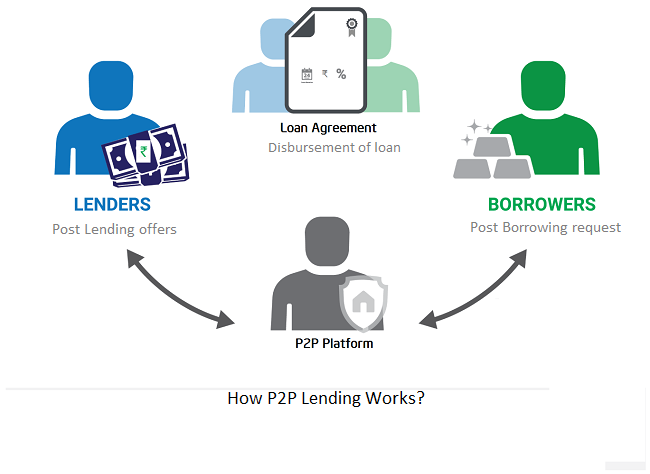
Peer to Peer Lending is an easy, convenient and hassle-free method, where individual lender lends unsecured loan to a borrower at a suitable interest rate. In P2P lending people who need money connects with people who are willing to lend on online web based platform. Peer to Peer lending is alternate but reliable financing option for many individuals. This option is now available in India. Let’s try to understand how p2p lending works.

How P2P Lending Works?

Step -1 – You need to register on the p2p platform as borrower or lender. During registration, you need to provide personal, professional and financial information.

Step-2 – P2P platform verifies the credibility of this information by checking documentary proof. This is in line with KYC verification norms.

Step-3- Once verification is completed lender or borrower can publish their listing on the site mentioning information like the purpose of the loan, interest rate etc.

Step-4 – Borrower or lenders can contact each other. They can also see documentary proof before lending a loan.

Step -5 – Loan tenure, a rate of interest and other terms and conditions are discussed between lender and borrower.

Step-6 – On agreement of both lender and borrower disbursement of loan happens. During disbursement P2P platform plays an important role in making loan agreement and money transfer from lender to the borrower.

how p2p works

Also Read – 5 Best Banks for Personal Loan in India

What are the benefits of P2P?

Benefits of peer to peer lending to investor or lender

  • Lender or investor can use surplus money to lend and can generate extra income.
  • Investor decide how much money he want to lend to borrower at what interest rate.
  • P2P lending is easiest way to generate regular passive income for the investor.
  • As investor can help someone in fulfilling their dream it is like leaving mark on someone’s life.

Benefits of peer to peer lending to borrower

  • Borrowing is easy and less time consuming.
  • Fixed rate loan once rate is fixed with lender it will not change.
  • No prepayment fees you can choose to fully pay your loan early, there won’t be a penalty fee for closure.

What are drawbacks of P2P?

  • As loan is unsecured if borrower default with nonpayment of EMI you can lose your money.
  • It is easier for criminal to cheat an online lender by providing fake identities.

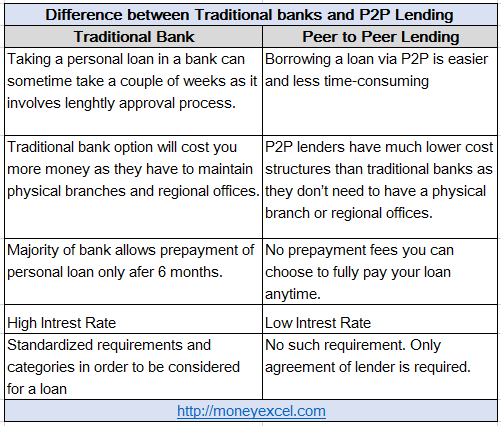
How Peer to Peer Lending is different from Traditional banks?

Difference between Traditional banks and Peer to Peer Lending is given below.

 p2p lending

How I can avail P2P Loan?

There are multiple P2P Loan lending companies in India. If you are seeking P2P loan you can log on to following websites.

  • Lendbox
  • Faircent
  • i2ifunding

Should you use Peer to Peer lending?

You can use Peer to Peer lending for borrowing money. It is a quick and easy way to get a loan. However, if you are lender please wait. At the initial instant, it looks very lucrative for lending money using P2P. However, there is a risk of unhealthy practice being adopted in this sector. It is unorganized sector without any regularization. You may end up making losses by lending money to the unknown person.

Also Read – 20 Types of Loans in India

Over to you

Have you heard about P2P lending?

Do you use P2P lending for lending or for your fund requirement?

Do share your experience.

Feel free to post your query about P2P lending. I will be happy to answer it.