Blog Page 340

10 Things to consider before buying resale flat house

In order to cut down costs, many individuals prefer to buy resale houses or resale flats. A flat that is sold twice is referred to as resale flat or resale property. In case of resale, obviously the price of such a flat will be less than that of a new one. But, a price of flat generally varies based on many factors like area, age of property, facilities, etc.

Now, if you are looking to buy a resale house or resale flat, here are some of the things that you need to take into consideration.

Real Estate Resale Flat

10 Things to consider before buying resale flat house

White to Black Money Ratio

The first point you should take into account before purchasing a second-hand home is the proportion of white to black money. The ratio of white to black money will depend upon the profession of the owner. If the owner is a businessman, he will prefer more black money, and vice versa if the owner is a salaried individual. This ratio will enable you to decide the amount of black and white money that needs to be collected.

Cost of Registration

The second important thing you should consider is the cost of registration or stamp duty. The cost of registration or stamp duty is an extra cost you need to pay to the government in order to transfer ownership or flat. This duty depends on the valuation of property.

Transfer Fees and other Charges

You need to pay additional share transfer fees at the society while buying a resale flat. Apart from this, you need to pay advocate fees and brokerage fees to an agent. So, add all these costs while calculating entire cost of the property.

Existing Loan

Generally, people mortgage the property and take loans against it. You must check if any existing loan is pending against the property. If existing loan is continue ownership documents of property are kept with the bank. These documents are only handed over to the owner once an entire loan is paid. If a loan is closed you must ask for No Due certificate issued by the bank.

Age and Condition of a Flat

Age of a flat is an important factor one should consider before buying. You should not buy a flat which is older than 10 years. Older flat give multiple problems related to maintenance. Apart from this, it will be difficult to get a home loan on old flat.

Older flats can also be less efficient than newer properties, which may result in higher utility bills and ongoing operating expenses. For this reason, buyers should look beyond the purchase price and consider how the property will perform over the long term. Exploring residential power monitoring and control solutions can be a useful way to better understand energy consumption patterns and identify opportunities to improve efficiency after moving in.

Extra Amenities and Cost

Before buying a resale flat you should consider extra amenities available with the flat. The owner might be charging extra money for the furniture and other amenities.

Document Check

You should ask your advocate to check the relevant documents of flat carefully. Your document checklist should include following documents.

  • Ownership document
  • Title clearance
  • Old Energy Bill payment
  • Property Tax payment
  • Approval plan
  • BUC documents

This document check will help you to avoid legal problems and financial burden at later stage.

Valuation of Property

You should consult the expert for the valuation of the property. Valuation of property plays important role in deciding price of property.  To get an idea you can also check price of new property in your area.

Payment Terms

 Another important thing you should consider before buying a resale house or flat is payment terms. Many owners ask for upfront payment. Under this condition, you should be in a position to make an early payment to the owner.

Area and Locality

Area and Locality is one of the prime things you should consider before buying property. Property in the posh area cost you more money and also gives you better appreciation at a later stage.

Lifetime Free Credit Card offer really worth to avail?

Credit cards — they’re like that mysterious dessert on the menu: tempting, alluring, but sometimes tricky. Among the sea of credit card options, “lifetime free credit cards” stand out as the shiny, no-strings-attached offer. Sounds perfect, right? But is it? Let’s dig in and figure out if a lifetime free credit card is truly a sweet deal or just a well-marketed mirage.

Type of Credit Cards

What Is a Lifetime Free Credit Card?

First things first. A lifetime free credit card means exactly what it says on the tin: no joining fees, no annual charges, ever. Unlike many credit cards that lure you in with an initial waiver and then quietly reintroduce fees a year later, these cards promise a fee-free experience for, well, life. But there’s always a catch. Banks aren’t running charities, so how do they profit? That’s where your usage comes into play.

The Appeal of “Free Forever”

Who doesn’t love the word “free”? Lifetime free credit cards sound like a dream for anyone who’s wary of hidden costs or looking to save money. Here are the key reasons why people gravitate toward these cards:

  1. No Maintenance Costs: Without annual fees, the card essentially pays for itself.
  2. Simple and Transparent: No puzzling over hidden charges.
  3. Perfect for Beginners: If you’re new to credit cards, this is a low-risk way to start.
  4. Great for Light Users: Ideal if you use your card sparingly and don’t want fees eating into your benefits.

But as with anything, the devil’s in the details.

Are There Really No Costs?

Here’s the tricky part. While there are no annual or joining fees, that doesn’t mean the card is entirely cost-free. Let’s break it down:

  • Interest Rates: If you’re someone who doesn’t pay their credit card bill in full each month, the interest rates can pile up fast. And guess what? That’s how banks make their money.
  • Foreign Transaction Fees: Traveling abroad? These cards might charge hefty conversion fees for international transactions.
  • Late Payment Charges: Forget to pay your bill on time? Say hello to penalties and reduced credit scores.
  • Limited Perks: Lifetime free cards often skimp on premium benefits like airport lounge access or cashback rewards.

Essentially, the “free” nature only holds up if you’re disciplined about payments and usage.

Who Should Go for It?

Lifetime free credit cards aren’t a one-size-fits-all deal. They’re best suited for certain types of users:

  1. Budget-Conscious Individuals: If you don’t want to shell out annual fees, this card is your best friend.
  2. Credit Score Builders: If you’re new to credit and want to build a good score without hefty fees, this is a solid start.
  3. Occasional Spenders: If you only use your credit card for emergencies or small purchases, you’re not missing out on premium perks.

However, if you’re someone who travels frequently, loves dining out, or enjoys rewards and cashback, these cards might feel a bit… basic.

Red Flags to Watch Out For

Before you jump in with both feet, here are some potential red flags:

  1. Minimum Spend Conditions: Some cards are free only if you meet a specific annual spend requirement. Miss it, and the fees kick in.
  2. Hidden Terms: Always read the fine print. Some “lifetime free” cards come with sneaky clauses.
  3. Limited Acceptance: Certain cards might not be widely accepted, which can be inconvenient.
  4. Basic Features: Don’t expect premium perks like travel insurance, concierge services, or high cashback rates.

How to Make the Most of a Lifetime Free Credit Card

If you’ve decided this is the card for you, here are a few tips to maximize its value:

  1. Pay in Full and On Time: Avoid interest and late fees by paying off your balance each month.
  2. Check for Partner Offers: Many lifetime free cards come with discounts on dining, shopping, or entertainment.
  3. Monitor Your Usage: Keep an eye on your spending habits and ensure you’re using the card to your advantage.
  4. Understand Your Card’s Benefits: Familiarize yourself with any rewards or features the card offers, no matter how limited they seem.

When It’s Not Worth It

Sometimes, the “free” deal isn’t worth it. If you’re someone who:

  • Values high rewards or premium perks.
  • Travels internationally frequently and needs a card with minimal foreign transaction fees.
  • Has a high monthly spend and can justify annual fees for better benefits.

Then you’re better off exploring other options. After all, what’s the point of a “free” card if it doesn’t match your lifestyle?

Conclusion

So, is a lifetime free credit card really worth it? The answer, like most financial decisions, is: it depends. If you’re a disciplined spender who values simplicity and hates annual fees, these cards can be a great choice. But if you’re after premium perks and high rewards, you might find them underwhelming.

Think of it like a no-frills flight ticket: it gets the job done, but don’t expect champagne service. As always, the key is to assess your needs, read the fine print, and choose a card that aligns with your financial habits and goals.

FAQs

1. Do lifetime free credit cards really have no fees?

Yes, they have no joining or annual fees. However, other charges like interest rates, late payment fees, or foreign transaction fees may still apply.

2. What’s the catch with lifetime free credit cards?

The main catch is that they might come with fewer perks, higher interest rates, or conditions like minimum spend requirements.

3. Can I upgrade a lifetime free credit card later?

Yes, some banks allow you to upgrade to a premium card if your spending pattern justifies it. However, the upgraded card may have fees.

4. Are lifetime free credit cards good for building credit scores?

Absolutely. They’re a low-cost way to build your credit score, provided you use them responsibly.

5. Which is better: a lifetime free credit card or a premium card?

It depends on your spending habits. If you value rewards and perks, go for a premium card. If you’re focused on cost-saving, a lifetime free card is a better option.

Unified Payment Interface UPI – Features Benefits Usage

UPI, which stands for Unified Payments Interface, is an instant digital payment platform enabling users to transfer funds, settle bills, and handle accounts using a single application.

Have you ever made a payment just by scanning a QR code? Or transfer money instantly without entering lengthy bank details? If yes, you’ve already experienced the power of UPI! Unified Payments Interface (UPI) has revolutionized the way we handle transactions, making payments seamless, instant, and secure. But what exactly is UPI, and how does it work? Let’s dive in!

What is UPI?

UPI, or Unified Payments Interface, is a real-time payment system developed by the National Payments Corporation of India (NPCI). It enables users to transfer funds instantly between bank accounts via mobile phones. Think of it as a digital wallet, but even better—it directly links to your bank account, eliminating the need to preload money.

UPI removes the requirement to input extensive bank details for every transaction, streamlining payments via QR codes, virtual payment addresses (VPAs), or mobile numbers registered with UPI.

UPI functions by utilizing current systems like the Immediate Payment Service (IMPS) and the Aadhaar Enabled Payment System (AEPS) to facilitate smooth payment settlements between bank accounts.

How Does UPI Work?

1. Linking Your Bank Account

UPI works by linking your bank account to a unique Virtual Payment Address (VPA), also called a UPI ID. This eliminates the need to share bank details every time you make a transaction. Following installation, users register by connecting their bank account and setting up a distinct virtual payment address (VPA), for example, user@bankname, which functions as their UPI ID.

2. Making Transactions

When a user intends to complete a payment, they have the option to choose the payee’s VPA (e.g., merchant@bankname), scan a QR code, or input their UPI ID. For example, if a consumer intends to pay a local vendor, they can easily scan the vendor’s QR code or input the vendor’s VPA.

UPI enables multiple types of transactions:

  • Peer-to-Peer (P2P) Transfers – Sending money to friends and family.
  • Merchant Payments – Paying for goods and services online and offline.
  • Bill Payments – Utility bills, subscriptions, and more.
  • Fund Requests – Requesting payments from others.

3. Authentication & Security

Every UPI transaction is secured by a two-factor authentication system:

  • UPI PIN: A 4-6 digit code set by the user.
  • Mobile Number Verification: Transactions work only from registered mobile numbers.

To authorize the transaction, users need to input their UPI PIN—a secure six-digit code established during the registration process. This process guarantees that solely the account owner can authorize transactions.

4. Transaction Processing

After the UPI PIN is submitted, the application forwards the payment request to the UPI server. The server checks the request and handles it by contacting the user’s bank (the issuer) and the recipient’s bank (the acquirer).

5. Confirmation

Once the banks verify the transaction, the user gets an immediate alert about whether the payment succeeded or failed. The UPI system guarantees that funds are transferred between banks quickly, typically within a few hours, while users notice the transaction in their accounts right away.

This smooth process, enabled by applications like PhonePe, Google Pay, and Paytm, renders UPI an effective, safe, and user-friendly option for digital transactions, helping to its extensive use in India.
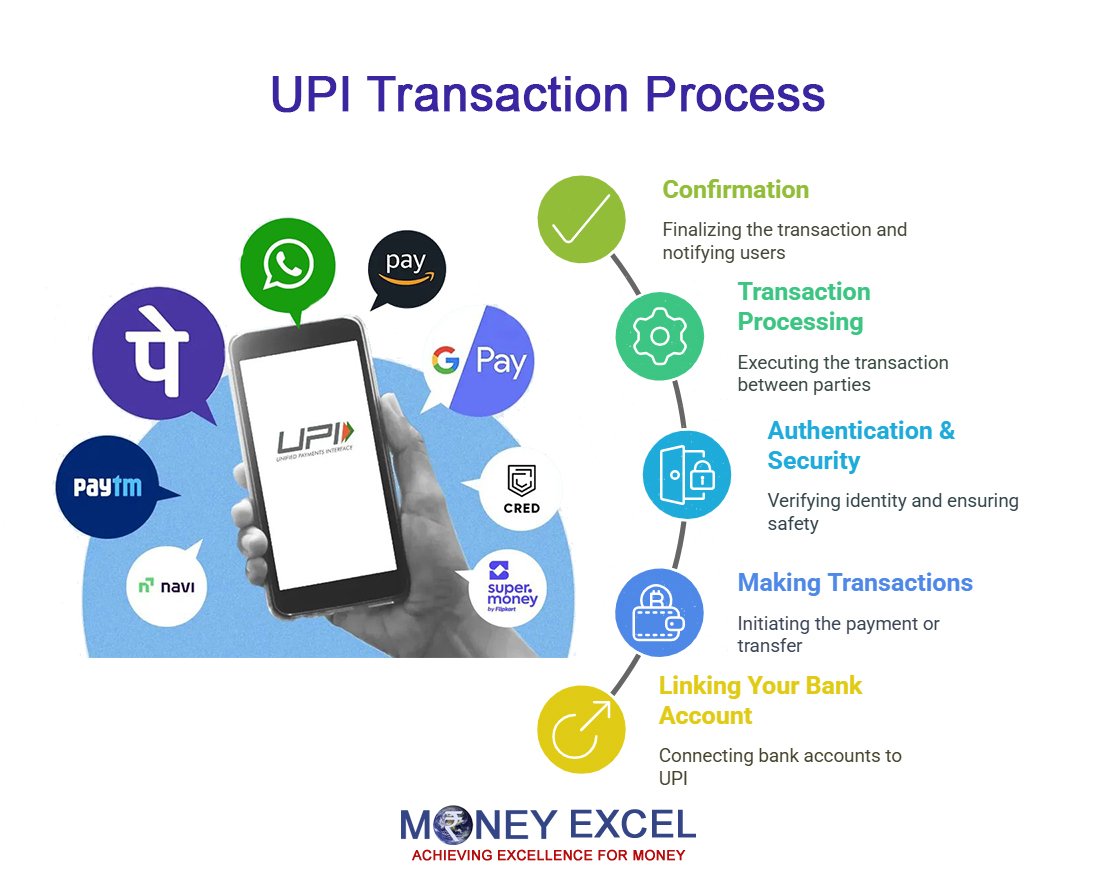
UPI Transaction Process

Key Features of UPI

1. Instant Transfers

UPI transactions are processed in real-time, unlike traditional NEFT transactions that take a few hours.

2. 24/7 Availability

Forget about bank holidays! UPI operates 24/7, even on weekends and public holidays.

3. No Need for Bank Details

Instead of sharing your account number and IFSC code, you only need a UPI ID or mobile number linked to the recipient’s account.

4. QR Code Payments

UPI supports QR code-based payments, making it easy to pay at local stores, restaurants, and street vendors.

5. Multi-Bank Support

You can link multiple bank accounts to a single UPI app and choose which account to use for transactions.

6. Recurring Payments

With the UPI AutoPay feature, users can set up automatic payments for subscriptions, EMIs, and more.

7. Split Bills with Friends

UPI allows users to split expenses with friends and send requests for shared payments.

8. High Transaction Limits

UPI supports large transactions, typically capped at Rs. 1-2 lakh per transaction, depending on the bank.

Popular UPI Apps in India

1. Google Pay (GPay)

Google Pay is one of the most widely used UPI apps, offering seamless transactions and cashback rewards.

2. PhonePe

Owned by Flipkart, PhonePe provides UPI payments, bill payments, and even investment options.

3. Paytm

Initially a digital wallet, Paytm now integrates UPI for instant payments.

4. BHIM UPI

The official UPI app by NPCI, offering a simple interface for direct bank transactions.

5. Amazon Pay

Amazon Pay uses UPI for payments on its e-commerce platform and bill payments.

Major UPI Apps

UPI App/PSPs Sponsor Banks Handles
Google Pay Axis @okaxis
ICICI @okicici
HDFC @okhdfcbank
SBI @oksbi
Phonepe Yes @ybl
ICICI @ibl
Axis @axl
Amazon Pay Axis @apl
WhatsApp Payments ICICI Bank @okicici
Airtel Payments Bank Kotak Mahindra Bank @Kotak
Paytm ICICI Bank @okicici
BHIM (Bharat Interface for Money) National Payments Corporation of India (NPCI) @upi

How to Set Up UPI on Your Phone

Step 1: Download a UPI App

Choose any UPI-enabled app like Google Pay, PhonePe, or BHIM and install it on your smartphone.

Step 2: Register with Your Mobile Number

Ensure the number registered with your bank is the same as the one used for UPI registration.

Step 3: Link Your Bank Account

The app will fetch your linked bank accounts automatically. Choose the primary account for UPI transactions.

Step 4: Set a UPI PIN

You will be prompted to set a UPI PIN, which acts as a security measure for transactions.

Step 5: Start Transacting!

That’s it! Now you can send and receive money instantly using UPI.

UPI vs Other Payment Methods

Feature UPI Credit/Debit Cards Net Banking Wallets
Instant Transactions ✅ ❌ ❌ ✅
Requires Bank Details ❌ ✅ ✅ ❌
Transaction Fees None May Apply May Apply May Apply
Works 24/7 ✅ ✅ ❌ ✅

Security Measures in UPI

1. UPI PIN Protection

Each transaction requires a UPI PIN, making unauthorized access difficult.

2. Fraud Detection & Alerts

Banks and UPI apps monitor unusual activity and send alerts for suspicious transactions.

3. Secure QR Codes

QR codes ensure payment goes to the correct recipient without manual entry.

4. Device Binding

UPI works only on the registered device with the linked mobile number, reducing fraud risks.

Future of UPI

The future of UPI looks incredibly promising. Some upcoming advancements include:

  • Cross-Border UPI Transactions: Making international payments possible.
  • Voice-Based UPI Payments: AI-driven voice commands for seamless transactions.
  • Offline UPI Payments: Transactions without the need for an internet connection.

Conclusion

UPI has completely transformed digital payments in India. Its ease of use, security, and instant transactions make it the preferred payment method for millions. Whether you’re paying bills, shopping online, or splitting dinner expenses, UPI makes it all effortless. If you haven’t already, set up UPI today and experience a new world of digital transactions!

Frequently Asked Questions (FAQs)

1. Is UPI safe to use?

Yes! UPI is highly secure due to two-factor authentication, encrypted transactions, and device binding.

2. Can I use UPI without the internet?

Currently, UPI requires an internet connection, but offline features are being developed.

3. What is the UPI transaction limit?

The limit varies by bank but generally ranges between Rs. 1-2 lakh per transaction.

4. Can I link multiple bank accounts to UPI?

Yes, you can link multiple accounts and select which one to use for each transaction.

5. What happens if I enter the wrong UPI PIN?

If you enter the wrong UPI PIN multiple times, your account may be temporarily blocked for security reasons.

6. How can I reset my UPI PIN?

You can reset your UPI PIN through your UPI app using your debit card details.

7. Are there any charges for using UPI?

Most UPI transactions are free, but some banks may charge for specific services.

8. Can I use UPI on feature phones?

Yes, through USSD-based *99# service, users without smartphones can still use UPI.

9. What happens if my UPI transaction fails?

Failed transactions are usually reversed automatically. If not, you can contact your bank.

10. Can I use UPI for international payments?

Currently, UPI is domestic, but efforts are being made to enable cross-border transactions.

20 Side Business You can Start with Full-Time Job

side business

Side Business – Quitting a 9 to 5 job and starting a business is a dream seen by many individuals. However, only a few can able to make it. The fear of not having a steady paycheck is one of the most prominent reasons, why people don’t quit a job to start a full-time business. If you are in the same boat I have something for you. You can first start a side business along with a full-time job. Starting a side business along with a job is a slightly less risky affair.

A question that might be popping up in your mind is what type of side business I can start along with a full-time job? So, here is a list of 20 Side Business Ideas that you can start keeping a full-time job intact. I hope these side business ideas will help you in starting your first business.

Also Read – 170 Small Business Ideas with low investment 

20 Side Business You can Start with a Full-Time Job

1 Tuition Class

The first side business you can start along with your full-time job is tuition class. Tuition class is an evergreen business. In order to start tuition classes, you don’t even need big capital. You can start this business from your home. Every evening or morning you can give tuition to school children and earn decent money. You can convert this side business to full-time business after running it for a few years.

2 Homemade food

The second side business for you is the homemade food business. To be successful in this business, you need to be very good at making food. You can initially start will small items like chocolates, namkeen etc and expand it at a later stage.

3 Catering

The food catering business is third side business you can start with a full-time job. However, you will need a team of people working with you. You should be extremely good at managing things as this business requires extremely good management skills.

4 Party Organizer

You can start your own side business as a party organizer. You need to be creative and good at management skills to become a party organizer. It will take time to establish you as a party organizer.

5 Interior Decorating

Interior decorating is next in the list of the side business. You need to be creative and result-oriented to start this business.  It is no investment business. As an interior decorator, you can charge fixed or commission-based money to your client.

6 Real Estate Agency

A very good side business along with a full-time job is a real estate agency. You can start this business with zero investment. You need to have contact with a few builders and clients who are looking for property for sale and rent. You can earn very good money from this business.

7 Computer Troubleshooting

If you have knowledge of the computer field you can start a part-time business in computer and IT device troubleshooting. In this business, you need to repair or replace IT devices. As IT field is growing this business could be a very good business idea.

8 Computer Training Institute

Computer training is an evergreen small side business idea. Today nothing works without a computer and everyone needs computer domain knowledge. If you have passion you can establish a very good computer training Institute.

9 Social Media Marketing

The next idea is also from the IT field, it is called as social media marketing. As a social media marketing expert, you need to serve to help companies to increase social engagement and marketing of products.

10  Blogging

Blogging is a very good side business. You can work for few hours and earn a decent income from this idea. However, it will take a time to establish yourself as a professional blogger. Here your income depends on multiple factors.

Also Read – Top 10 New Business Ideas in India

11 Content Writer

If you are good at writing content you can start working as a content writer. Many online websites are looking for a content writer and they are ready to pay in $ based on the quality of the content.

12 Website designer or Consultant

Startup businesses are growing in India and more than 60% of startup businesses own the website. This argument is enough to make website design an evergreen business idea. You can also take advantage of this by starting a side business as a website designer or consultant.

13 Network Marketing

One of the most powerful side businesses now a day is network marketing. You can start this business anytime. However, you need to be careful in selecting the right network and company for which you are acting as a network marketer.

14 Freelancer 

You can become a freelancer and start your side business as a freelancer by bidding on projects online. These projects are fixed-cost timeline-based projects. Some of these projects require special skills.

15 Photographer

Well, photography is not everyone’s cup of tea. However, if you are good at clicking photos you can start your second career as a photographer. You can start this side business with very low investment.

16 Fitness or Yoga Class

Starting a fitness or yoga class is a very good side business idea. People are health conscious today and they are ready to spend money for it.

Also Read – Starting a Business – 10 Questions You must ask yourself 

17 Accounting

If you are good at accounting and bookkeeping you can start your side business as an accountant. Many small firms and business organizations are looking for part-time person to manage an account. You can explore your skills to earn more money.

18 Marriage Bureau

If you are female and want to do something after office hours, the marriage bureau is an ideal side business for you. It may take some time at an initial stage to establish this business.

19 Skill or Hobby Class  

You can start your own Skill or Hobby class at your home and earn decent money part-time. You need to be skillful in order to run this class successfully.

20 Mechanical Turk or Virtual Assistant

Mechanical Turk means working online for some fixed task. These tasks are like data entry, letter typing, etc. It is also referred to as a virtual assistant task. Income earned from these tasks is low and depends on the type of work.