
Blog Page 311

20 Types of Loans in India

0

Loans are beneficial, especially to middle class and poor people. You can fulfil your dream by taking loan. Loans can help you to avail facilities such as home, car, study etc. There are different types of loans available in India. You can select a loan based your requirement. However, it is good ideas to explore the various loan options before taking loan. Here is information about 20 Types of Loans in India.

Loan is money which a borrower takes from the lender with the promise to return back in fixed period of time. The borrower will also pay an additional interest amount along with the principal amount.

Loan Types

20 Types of Loans in India

Home Loan

Home loan is most common loan available in India. Home loan is given by bank in order to purchase property. Home loan is available with two variant fixed interest and variable interest. It is good idea to purchase variable interest rate loan. Home loan gives you tax benefit also.

Interest rate: 9 -11%

Collateral: Physical property

How much can you get? – 85% of property value

Pros and Cons

  • You can avail bigger loan if your income level is high.
  • Flexibility of repayment
  • Tax Benefits
  • Home Loan is given maximum 85% of property value

Also Read – Prepayment of Home Loan – Good Decision

Education Loan

If you are student and seeking money for higher education you can apply for Education Loan. Education loan is available for Indian and foreign education.  You can avail tax benefit under section 80E for the education loan.

Interest rate: 11-14.5%

Collateral:   Varies from bank to bank.

How much can you get? – Depends upon collateral value.

Pros and Cons

  • Longer repayment
  • Tax Benefits
  • High Interest rates

Car Loan or Vehicle Loan

If you want to purchase new vehicle you can opt of vehicle loan or car loan. You can avail this loan from bank. You need to submit income proof in order to avail this loan.

Interest rate: 9.6-10.6%

How much can you get? – Up to 90% of vehicle value depending on your income documents.

Personal Loan

Personal Loan is loan given by bank or financial organization without any collateral. This loan is given purely based on your credit profile and credit score.

Interest rate: 15-25%

Collateral: Not required

How much can you get? – Based on your credit profile.

Pros and Cons

  • Banks cannot get hold of your assets if you default.
  • Loans are disbursed quickly, but need a formal application.
  • Given only to the salaried, self-employed or professionals.
  • Personal Loans are costly.

Also Read – 5 Best Banks for Personal Loan in India

Loan Against Car

If you are owner of a car you can apply for loan against car.

Interest rate: 13-17%

Collateral: Your Vehicle

How much can you get? – 70-75% of your car value.

Pros and Cons

  • If your car model is a popular with a good resale value, you can get a bigger loan.
  • Banks may not lend against vehicles that are more than 5 years old.

Loan against Mutual Funds or Shares

If you have invested money in shares or mutual funds you can avail loan against this investment.

Interest rate: 12-16%

Collateral:  Mutual Funds and Stocks investment

How much can you get? – Up to 60% the value of equity funds and 50% for shares.

Pros and Cons

  • A dividend will be paid on full repayment/closure of loan.
  • Bank can sell stock or ask for extra collateral investments in case of correction in share price.

Loan against FD

If you have invested money in fixed deposit you can apply for loan against FD.

Interest rate: 1-2% above FD rate 8.5-9.5%

Collateral: Your Fixed Deposit

How much can you get? – Up to 90% of the value of deposit.

Pros and Cons

  • The loan can be taken on the very next day after making the deposit.
  • If the deposit is held jointly, then all account holders have to sign the loan documents.
  • If the loan repayment is not done then the bank can close the account to recover the loan amount.

Also Read – Fixed Deposit or Fixed Maturity Plan (FMP)

Loan against Life Insurance

This type of loan is given against life insurance policy documents.

Interest rate: 14%

Collateral:  Life Insurance Policy

How much can you get? – 85-90% of the surrender value of the policy

Pros and Cons

  • Loan can be applied for fund requirement any purpose.
  • Only policies eligible for loan can be used for loan application.
  • Policy needs to be assigned in name of the lender.

Loan against Property

Interest rate:  11-15%

Collateral:  Physical property

How much can you get? – 60-70% of property documents

Pros and Cons

  • Documentation is similar to home loan but the processing time is less.
  • Prepayment charges apply.

Top up Home Loan

Top up home loan is also known as home renovation or modification loan. This loan is additional loan above home loan.

Interest rate:  12%

Collateral:  Existing Home Loan

How much can you get? – Up to 70% of existing home loan

Also Read – Top Up Loan vs Personal Loan

Gold Loan

Interest rate:  12-13%

Collateral:  Physical Gold

How much can you get? – 75% of the value of Gold

Pros and Cons

  • Sanction of loan can be obtained faster.
  • Loan Application does not require many documents.
  • You need to submit your gold holding, which may be sold off by the lender if the loan is not repaid in time.

Loan from PPF

Interest rate:  2% more than PPF rate

Collateral:  Not required

How much can you get? – The amount is restricted to 25% of the balance at the end of the second year

Construction Equipment Loans

You can apply for this loan for purpose of procuring equipment’s for farming or for business.

Interest rate:  12%

Collateral:  –

How much can you get? – 95% of the invoice value

Business Loan

Business loan can be availed to start or run your business.

Interest rate:  12-15%

Collateral:  Varies based on your requirement

How much can you get? – Variable

Pros and Cons

  • You can get business loan without collateral if your business is doing well.
  • You can avail this loan for longer duration.
  • Interest rates are high.

Rural Loans

Rural loans are mainly designed for rural farmer for meeting agriculture and production expense.

Interest rate:  13.5% -16%

How much can you get?  – Depends upon income proof.

Mudra Loan

Mudra loan is business loan given by government of India to Small and Medium enterprise.

Interest rate: 12- 15% (Depends upon bank)

Collateral:  Not required

How much can you get? – Up to 10 Lac for small business

Pros and Cons

  • Very good loan option for small business
  • Easy to obtain finance from Mudra
  • Loan limit is 10 Lac only.

Cash against Invoice

If you have already got the order and you want cash in order to complete the transaction, you can opt for cash against invoice.

Interest rate: 12-17%

How much can you get? – 90-100% of invoice amount

Pros and Cons

  • Faster processing
  • Low repayment terms.

Also Read – Credit Card Loan or Personal Loan

Over Draft

Bank will provide overdraft facility against asset. This facility can be used by individual to fulfill emergency requirement.

Interest rate:  1-2% higher against submitted asset documents (Usually FD)

Collateral:  Asset documents

How much can you get? – Depends on asset value.

Working Capital Loan

If you are in need of working capital to run the business you can opt for working capital loan.

Interest rate: 12-17%

How much can you get? – Depends on your income documents and financial statements.

Pros and Cons

  • Faster processing
  • Higher Interest rate
  • Low repayment duration.

Loan from unorganized sector

Last option for availing loan is from unorganized sector. This option is not advisable in majority of case. It is very difficult to avail this type of loan and it is very costly.

Interest rate:  20-25%

How much can you get?  –

Pros and Cons

  • Difficult to obtain this loan.
  • Interest rate and payment terms are unreasonable

Over to you –

Hope you have got information about loan type you are looking for.

Which Loan option is suitable for your requirement?

Do revert in case of any query.

7 Ideas to Create a Second Income

Money talks—and let’s be honest, it talks louder when you’ve got more of it coming in. With rising expenses, unpredictable job markets, and dreams that just don’t come cheap, many people are exploring ways to build a second income. But here’s the kicker: you don’t need to quit your 9-to-5 or sacrifice every weekend to make it happen.

Whether you’re saving for that dream vacation, planning early retirement, or simply want a cushion for rainy days, creating an additional stream of income is a smart move. The beauty of a second income is that it can start small, grow steadily, and one day—if you want—it might even overtake your main job.

So, how do you actually make it happen? Let’s dive into 7 creative and realistic ideas to create a second income that fit into everyday life.

second income

1. Freelancing – Turn Skills into Cash

Have a knack for writing, graphic design, programming, or even social media management? Freelancing might be your golden ticket.

Platforms like Upwork, Fiverr, and Freelancer are buzzing marketplaces where clients are eager to pay for talent. The best part? You get to set your rates and choose your projects.

How freelancing helps build a second income:

  • Start part-time while keeping your job.

  • Scale as you gain confidence and clients.

  • Potential to turn into a full-blown business.

Pro tip: Pick one skill you enjoy and sharpen it. If you try to be a jack of all trades, you’ll end up spreading yourself too thin.

2. Blogging or YouTube – Share, Teach, Entertain

Love talking about travel, finance, cooking, or tech gadgets? Then blogging or YouTube content creation could be your perfect second income path.

Yes, it takes time to build an audience, but once you do, money flows in through:

  • Ads (Google AdSense, YouTube Partner Program).

  • Affiliate marketing (earning a commission for promoting products).

  • Brand sponsorships (companies paying you to feature their products).

Imagine earning while doing something you love—whether it’s reviewing books, teaching recipes, or sharing productivity hacks.

Tip to fast-track success: Focus on a niche. A “general” blog is harder to grow than one targeting a specific audience.

3. Investing – Let Your Money Work for You

If you’re tired of trading hours for money, here’s a game-changer: make money while you sleep. Investing is one of the most powerful ways to create a second income.

Different investing paths include:

  • Stock market: Buy shares of companies and earn through dividends or price growth.

  • Mutual funds & ETFs: Safer, diversified options for long-term growth.

  • Real estate investing: Rent out property for passive monthly income.

Now, you don’t need millions to start. Even small investments can snowball thanks to the magic of compounding.

Quick example: Invest ₹5,000 monthly in a mutual fund at 12% annual return → In 20 years, you’d have over ₹50 lakhs. That’s a second income in retirement waiting to happen!

4. Online Courses & Digital Products – Sell Your Knowledge

Do you know something valuable—like coding, photography, or even yoga? Then why not package your knowledge into a digital product?

Options include:

  • Online courses (Udemy, Teachable, Skillshare).

  • E-books (Amazon Kindle or direct sales).

  • Digital templates/tools (resumes, planners, or financial trackers).

The beauty of this second income idea is scalability. Create once, sell forever. Unlike freelancing, where you trade time for money, digital products continue to earn for you—even while you’re on vacation.

5. Side Hustle with E-commerce – Sell What People Want

The e-commerce boom isn’t slowing down, and you don’t need a massive warehouse to get started. Thanks to platforms like Amazon, Flipkart, and Shopify, anyone can start selling online.

Popular ways to create a second income through e-commerce:

  • Dropshipping: You sell products, but suppliers handle inventory and shipping.

  • Print-on-demand: Sell custom-designed T-shirts, mugs, or phone cases.

  • Homemade crafts: Jewelry, candles, or even organic food items.

What makes this exciting is the flexibility—you can start small and scale big if things click.

6. Rental Income – Cash from What You Already Own

Guess what? You don’t need to buy a new property to create rental income. Look around—you might already have resources people would pay to use.

Some practical ideas:

  • Rent out a spare room on Airbnb.

  • Lease unused parking spaces.

  • Rent out gear—like cameras, bikes, or even party equipment.

The beauty of this approach is that you’re monetizing something you already own. That’s about as passive as a second income gets.

7. Part-Time Consulting or Coaching – Be the Expert

If you’ve got years of experience in a profession, why not leverage it? Many businesses and individuals are willing to pay for your advice.

For example:

  • A retired teacher could coach students online.

  • A fitness enthusiast could offer personal training.

  • A finance pro could provide money management sessions.

The demand for coaches and consultants has skyrocketed with the rise of remote work. It’s a high-value way to build a second income without needing tons of extra hours.

Bonus: Micro-Gigs & Passive Apps

Not ready for big leaps? Try micro-earning apps. Small, but they add up:

  • Survey apps.

  • Cashback apps.

  • Apps that pay for walking, watching ads, or testing websites.

Sure, this won’t make you rich—but it’s a no-effort stepping stone into the world of second income.

FAQs 

1. How much time do I need to build a second income?
It depends on the method. Freelancing or consulting may bring money faster, while blogging or investing requires patience.

2. Do I need a lot of money to start?
Not always! Many second income ideas—like freelancing, blogging, or consulting—require little to no upfront investment.

3. Can a second income replace my primary job?
Yes, but only if you’re consistent. Many people eventually turn side hustles into full-time businesses.

4. What’s the safest way to create a second income?
Investing in diversified mutual funds or ETFs is considered relatively safe, but it’s always best to consult a financial advisor.

5. How do I choose the best idea for me?
Ask yourself:

  • What do I enjoy doing?

  • How much time can I spare?

  • Do I want active or passive income?

Conclusion

The idea of having a second income isn’t just about extra cash—it’s about freedom, security, and peace of mind. From freelancing to real estate, online courses to e-commerce, the opportunities are endless.

Here’s the real secret: the best second income is one that excites you enough to stick with it. Don’t overthink. Start small, stay consistent, and watch your financial life transform.

So, are you ready to take the first step toward your second income? The clock’s ticking—your future self will thank you for starting today!

New PPF Rules – Premature Closure Relaxation

New PPF Rules – PPF is one of the most popular investment options in India. PPF offers multiple benefits including tax-free interest income, tax exemption, and risk-free investment. If you are holding PPF account this post is for you. PPF Rules are recently revised by the government of India. As per notification dated 13th Feb 2018, Finance ministry has proposed an expansion in the scope of benefit for PPF scheme.

At present, there are multiple acts with respect to Small Saving Schemes. It sometimes creates confusion among investors. In order to remove this ambiguity, it is proposed to merge the Government Savings Certificate Act, 1959 and Public Provident Fund Act, 1968 with the Government Savings Bank Act, 1873. Accordingly, NSC and PPF scheme provisions would be subsumed and a new amended act called as “Government Saving Promotion Act” is proposed.

Also Read – How to take PPF Loan against account balance?

New relaxation is proposed in this new act keeping all existing benefits intact. This means none of the benefits available to the investors under the present PPF Act would be withdrawn or amended. You will continue to earn tax-free interest income and tax exemption. PPF interest rates will remain intact.

In addition to all existing PPF benefits following additional benefits is proposed for PPF account holders.

New PPF Rules – Premature Closure Relaxation

PPF Rules

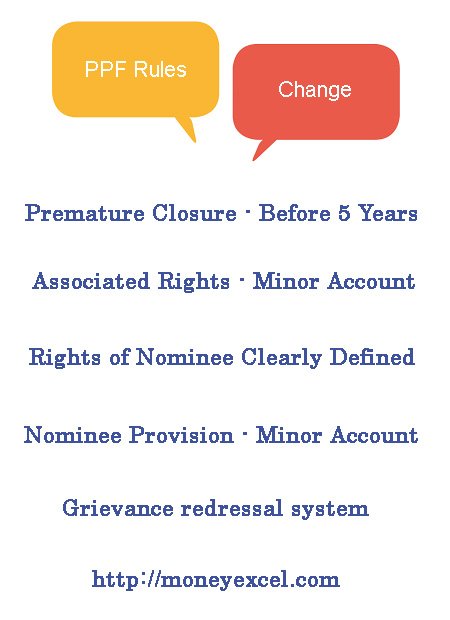
  • As per PPF rule, PPF account can’t be closed prematurely before completion of five financial years. This restriction is proposed to be relaxed and PPF account holder will be allowed to close PPF account in case of exigencies like a medical emergency, higher education etc.
  • For PPF accounts opened by the guardian in the name of the minor, the guardian would also enjoy associated rights and responsibilities.
  • In order to promote a culture of saving among children, clear provision is made regarding deposit made by minors.
  • In the present act provision about the operation of an account in the name of the minor or differently abled person is not available. The new act covers relevant rules in this regard.
  • The new act defines rights of nominee more clearly. This will help in faster claim settlement and also reduce disputes.
  • At present, there is no facility of defining nominee in case account is opened in the name of the minor. Further, existing Acts say that if account holder dies and there is no nomination and amount is more than prescribed limit, the amount shall be paid to legal heirs.  In this case, the guardian has to obtain succession certificate. To remove this inconvenience, provisions for a nomination with regard to an account opened in the name of minors have been incorporated. Further, the provision has been made that if the minor dies and there is no nomination, the balances shall be paid to the guardian.
  • The current act is silent about grievance redressal. The new act will ensure the provision of strong grievance redressal system so that dispute can be settled quickly.

Also Read – PPF Account Calculator Download

The new PPF Rules notification clearly specify that no changes are made with respect to interest rate or tax policy on small savings scheme. One should not worry that certain Small Savings Schemes would be closed.

These new PPF rules are proposed changes. It is not clear that when this rules will be imposed.

What is your opinion on PPF Rule Changes?

Virtual Trading Apps for Stock Market Trading

0

Virtual Trading

Do you know what is virtual trading? Virtual Trading is a concept of doing trading online in the virtual world. It is mainly done for the purpose of learning. In India, many people avoid stock market investing. The main reason is lack of knowledge and skillset required for the stock market trading. However, these factors are addressed with an advancement of technology and internet. You can use smartphone virtual trading apps for learning stock market trading using virtual money. This gives confidence to beginners in stock market trading.

What is Virtual Trading Apps?

You must have played games on the internet like Rummy where virtual currency is issued to a player for playing a game of cards. In the same way, the virtual trading app gives you virtual money (fake money) for dealing stock market. You can track stock price movement and changes happening on the fly. The main purpose of this trading app is to inculcate the concept of stock market trading.

In this apps, loss, and gain of money happen in the virtual world. However, you learn exactly how your actions influence the market. Some of the apps also allow you to compare and compete with your friends. In short, this app gives you an experience of investing in stock market.

Also Read – Intraday Trading in Stock Market as Career Option

Benefits of using Virtual Trading Apps

There are several benefits of using Virtual Trading Apps.

  • Virtual Trading App gives a completely risk-free environment for trading.
  • The apps are free of cost and money issued is fake. So, you are not losing anything.
  • You can use this app anytime anywhere on smartphone. You need not to allocate special time from your busy schedule.
  • You will learn stock market trading and investing. Mostly smartphone apps are distractive in nature. However, these apps gives learning experience.
  • Some apps reward real money in case you perform well and earn hefty profit.
  • It is a good idea to learn swimming before jumping in the water. Similarly, it is good to learn stock market investment. It will reduce a chance of losing money in the stock market.

Virtual Trading Apps for Stock Market Trading in India

There are several apps available on Google Play Store that helps you to learn investing in stocks, bonds, fixed deposit, mutual funds, etc. I have selected few such apps based on rating and user feedbacks.

Stock Market Challenge 2

Stock Market Challenge is most popular virtual stock market trading app. This app is developed by Dalal Street Investment Journal. This app allows you to create and manage your own portfolio and compete with other players in a risk-free environment. You can use your facebook or google login in this app.

Every challenger is assigned with initial amount of 10 Lakh. You need to buy and sell stock same as that of live environment. You can apply stop loss and limit price in this app. You can see history and even do analysis. You can compete with other investor and win exciting prize. This app is rated 4 by users.

Stock Trainer

Stock Trainer is stock trading simulator with real-time market data. This app helps a beginner to take their first steps in the world of stock market.  In this simulator, everything is virtual, there is, therefore, nothing to lose. This app also gives facility to export portfolio, watch list. You need google account in order to use this app. This app is rated 4.4 by end users.

Trade Hero

Trade Hero is another Virtual Trading App. Trade Hero provide chance to deal with exchanges of different countries including BSE and NSE. This app is popular in USA and UK. Trade Hero allows you to trade in virtual environment once you are confident you can also go LIVE trading using this app.

Do you use any Virtual Trading App? Do share your views and experience in the comment section given below.

Don’t forget to share detail of these apps with your friends!