Blog Page 312

10 Midcap Multibagger Stocks from Dolly Khanna Portfolio

0

rajiv khanna stocks

Dolly Khanna is a popular stock market investor of Dalal Street. She is actually homemaker. Her husband Rajiv Khanna is a mind behind investment made by Dolly Khanna. Rajiv Khanna has an incredible ability to identify future multi-bagger stocks for investment. This Chennai based investor couple has started investing in the stock market with a capital of 1 Cr in 1996.

Dolly Khanna and Rajiv Khanna generally deal in Midcap and Small Cap stocks. As these stocks contain huge potential to become future multi-bagger. We have already discussed on success story and portfolio of Dolly Khanna. Today we will discuss on 10 Midcap Multibagger Stocks from Dolly Khanna Portfolio.

10 Midcap Multibagger Stocks from Dolly Khanna Portfolio

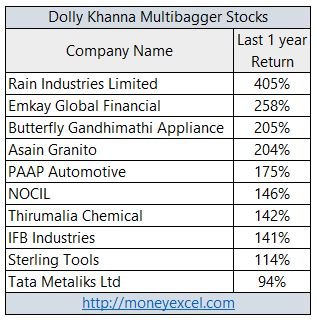
Top 10 Mid Cap Multibagger stocks from Dolly Khanna Portfolio are Rain Industries, Emkay Global, Butterfly Gandhimathi, Asian Granito, PPAP Automotive, Nocil, Thirumalai Chemicals, IFB Industries, Sterling Tools, and Tata Metaliks. Out of these Rain Industries has given 405% return to the investor. Emkay Global, Butterfly Gandhimathi and Asian Granito have given more than 200% return to the investors.

Please refer following table showing mid-cap multibagger stocks from Dolly Khanna Portfolio.

dolly khanna stocks

It is worth to know how Dolly Khanna and Rajiv Khanna identify future multibagger stocks for investment. Here is Investment Philosophy of this couple.

Investment Philosophy 

Fundamental of Stock –

The method adopted by Rajiv Khanna for Identification of stock is simple. Do a fundamental analysis of the stock. If fundamentals are strong, a stock is more likely to become multibagger. It is also called as a thoughtful investment.

Small Cap Mid Cap Stocks –

Dolly Khanna and Rajiv Khanna invest only in Small Cap and Mid Cap stocks. As per them a chance of finding multibagger in Mid Cap and Small Cap stock is very high.

Consumer Stocks –

They invest in consumption based stocks only like a home appliance, cooker, cement, plastic, paper etc. All these companies deal with a middle-class product where the demand for the product is likely to be very high.

Facts & Figures –

Facts figures and public information is very important when you are taking an investment decision. Never Invest based on insider’s information or speculation. Invest based on public knowledge and information. Study market situation and pick stock accordingly.

Rajiv Khanna on Stock Market

As per Rajiv Khanna, stock market investing is like playing a game of tennis. In tennis, a game is played on different courts – hard court, clay court, and lawn. Similarly, in the stock market, you have to take a decision based on a market situation like technical, fundamentals, a momentum of the stock. In Tennis, you have to play a game as situation demands. Similarly in stock market investing you have to take a decision based on the market situation. Stock market investing is a complex puzzle full of challenges and investor need to play it carefully.

Do you think multibagger stocks of Dolly Khanna and Rajiv Khanna will give better return in future also?

Do you think investment style of Dolly Khanna & Rajiv Khanna is useful?

3 Ways to invest in Direct Mutual Fund Plans

0

Picture this: you’re sipping your morning chai, scrolling through your phone, and suddenly it hits you – those small fees eating into your investments are adding up big time over the years. That’s the reality for many folks stuck with regular mutual funds. But here’s the good news – switching to Direct Mutual Funds can change the game entirely.

Direct Mutual Funds are basically the no-frills version of mutual fund investments. You deal straight with the fund house, skipping the middleman like distributors or advisors who take a cut in commissions. This means lower costs for you, and over time, that translates to higher returns compounding in your pocket. Isn’t that exciting?

In India, ever since SEBI introduced Direct Mutual Funds back in 2013, savvy investors have been flocking to them. Why? Because who doesn’t want more bang for their buck? Whether you’re a newbie just starting out or someone with a portfolio already, understanding Direct Mutual Funds Plans can help you keep more of what you earn.

Today, we’re diving deep into 3 Ways to Invest in Direct Mutual Funds Plans. We’ll keep it straightforward, no jargon overload, and throw in some real-life tips along the way. By the end, you’ll feel confident enough to take that first step. Let’s get started!

direct mutual funds investment

Why Choose Direct Mutual Funds Over Regular Ones?

Before jumping into the how-to, let’s chat about why Direct Mutual Funds are stealing the spotlight these days. It’s not just hype – there are solid reasons behind it.

First off, the big winner: lower expense ratios. In regular plans, fund houses pay commissions to agents or brokers, and guess where that money comes from? Your investments! That bumps up the expense ratio by about 0.5% to 1% or more annually. With Direct Mutual Funds, no commissions mean those savings stay invested, growing your wealth faster.

Think about it – even a 1% difference can turn into lakhs over 20-30 years thanks to compounding. For example, if you invest ₹10,000 monthly for 30 years at an assumed 12% return, the direct plan could leave you with noticeably more than the regular one. Mind-blowing, right?

Another perk? Full control. You’re the boss of your portfolio. No pushy sales pitches for funds that might not suit you. Plus, Direct Mutual Funds offer the same professional management, diversification, and options like equity, debt, or hybrid funds – just without the extra fees.

Of course, it’s not all rainbows. Direct Mutual Funds require you to do your own homework – researching funds, tracking performance, and staying disciplined. If you’re new to this, it might feel a bit overwhelming at first. But trust me, once you get the hang of it, it’s empowering.

Having said that, millions of Indians are making the switch, and platforms have made it easier than ever. So, if you’re ready to maximize returns, Direct Mutual Funds Plans are worth considering.

Lower Costs in Direct Mutual Funds

Let’s break down the cost thing a little more, because it’s the heart of why Direct Mutual Funds shine.

The expense ratio is that annual fee charged by the fund house for managing your money. In regular plans, it includes trail commissions paid to distributors – often trailing year after year. Direct Mutual Funds cut that out completely.

What does this mean in real numbers? Take a popular large-cap fund: the regular plan might have an expense ratio of 1.8%, while the Direct Mutual Funds version sits at 0.8%. That 1% saved annually compounds hugely.

Over time, your NAV (Net Asset Value) in Direct Mutual Funds grows higher because more money stays invested. It’s like running a race with lighter shoes – you go further with the same effort!

And don’t worry, the underlying portfolio is identical. Same fund manager, same stocks or bonds. The only difference? You pocket the savings.

3 Ways to Invest in Direct Mutual Funds Plans

Alright, the moment you’ve been waiting for. Here are 3 Ways to Invest in Direct Mutual Funds Plans, each with its pros and cons. Pick what fits your style – or mix them up!

Way 1: Through the Asset Management Company’s (AMC) Website

This is the most straightforward, old-school-yet-reliable method. Going straight to the source!

Most fund houses like HDFC Mutual Fund, SBI Mutual Fund, ICICI Prudential, or Axis have user-friendly websites. Here’s how it typically goes:

  • Visit the AMC’s official site.
  • Register as a new investor (you’ll need PAN, Aadhaar, bank details).
  • Complete e-KYC if not done already – it’s quick these days.
  • Browse funds, select the “Direct” growth option.
  • Set up SIP or lump sum payment via net banking.

Pros: Zero chance of hidden fees, direct from the horse’s mouth. Great if you’re loyal to one fund house.

Cons: If you want funds from multiple AMCs, you’ll juggle several logins. A bit tedious for diversification.

Many folks start here because it’s simple and builds confidence. Plus, some AMCs offer exclusive tools or insights on their portals.

Way 2: Using Registrar and Transfer Agents (RTAs) Like CAMS or KFintech

If juggling multiple websites sounds like a headache, this is your savior.

CAMS (Computer Age Management Services) and KFintech (formerly Karvy) handle transactions for most fund houses. Their portals – myCAMS or KFintech online – let you invest in Direct Mutual Funds from dozens of AMCs in one place.

Steps are similar:

  • Sign up on mycams.myonlineaccount.net or kfinkart.com.
  • Link your folio or create new ones.
  • Choose Direct plans across AMCs.
  • Invest via SIP, lump sum, or even switch funds.

Pros: One dashboard for everything. Easy tracking, consolidated statements. Perfect for building a diversified portfolio.

Cons: Interface might feel a tad old-fashioned compared to flashy apps, but it gets the job done reliably.

This way is super popular among seasoned investors who value consolidation without extra bells and whistles.

Way 3: Via Dedicated Investment Platforms and Apps

Welcome to the modern era! Platforms like Groww, Zerodha Coin, Kuvera, Paytm Money, or ET Money make investing in Direct Mutual Funds a breeze.

These apps are designed for ease:

  • Download the app or visit the site.
  • Complete quick KYC.
  • Search for funds, compare performance, expense ratios, etc.
  • Invest in Direct Mutual Funds with a few taps – SIPs auto-debit seamlessly.
  • Track everything in one sleek dashboard, with alerts and reports.

Pros: Super user-friendly, loaded with tools like calculators, goal planners, and recommendations. Zero commissions, great for beginners. Many offer free insights or family accounts.

Cons: You’re trusting a third-party platform (though they’re SEBI-registered and secure). Some might push other products, but you can ignore that.

This is hands-down the most popular way nowadays, especially for younger investors. It’s like having a personal finance hub in your pocket!

Whichever way you choose, always double-check you’re selecting the “Direct” plan. It’s usually marked clearly.

Tips for Getting Started with Direct Mutual Funds Plans

Dipping your toes in? Here are some handy tips to make it smooth.

  • Complete KYC First: It’s a one-time thing. Use Aadhaar for instant e-KYC.
  • Start Small: Begin with a ₹500 SIP to test waters.
  • Research Wisely: Look at past returns, fund manager track record, and risk level. Sites like Value Research or Morningstar help.
  • Diversify: Don’t put all eggs in one basket – mix equity, debt, and hybrid.
  • Stay Long-Term: Mutual funds, especially Direct Mutual Funds, reward patience. Aim for 5-10 years minimum.
  • Switch Smartly: If moving from regular to direct, watch for exit loads and taxes.

And remember, markets fluctuate. Don’t panic-sell during dips – that’s when real wealth builds.

Common Mistakes to Avoid in Direct Mutual Funds

Even smart folks slip up sometimes. Here’s what to watch out for:

  • Chasing past performers blindly – what’s hot today might cool tomorrow.
  • Ignoring risk – equity Direct Mutual Funds can be volatile.
  • Frequent switching – it triggers taxes and disrupts compounding.
  • Forgetting to review – check your portfolio yearly, rebalance if needed.
  • Overlooking goals – align funds with needs like retirement or kids’ education.

Steering clear of these keeps your journey on track.

FAQs

What exactly are Direct Mutual Funds?

Direct Mutual Funds are plans where you invest directly with the fund house, bypassing agents. This skips commissions, leading to lower costs and higher potential returns.

Are Direct Mutual Funds safer than regular ones?

Absolutely the same safety – both regulated by SEBI. The difference is just in costs and how you buy them.

Can beginners invest in Direct Mutual Funds Plans?

Yes! Platforms make it easy, but start with index funds if you’re unsure about picking actively managed ones.

How much can I save with Direct Mutual Funds?

Typically 0.5-1.5% lower expense ratio annually, which compounds to significant savings over time.

Is there a minimum investment amount?

Most start at ₹100-₹500 for SIPs, ₹5,000 for lump sums. Super accessible!

Do Direct Mutual Funds have the same returns as regular?

The gross returns are identical, but net returns are higher in direct due to lower fees.

Can I switch from regular to Direct Mutual Funds?

Yes, but it counts as redemption – pay exit load if applicable and capital gains tax.

Are there any hidden charges in Direct Mutual Funds?

Nope, just the stated expense ratio. Transparent all the way.

Conclusion

Wrapping it up, folks – investing in Direct Mutual Funds Plans isn’t rocket science, but it can rocket your wealth growth! By choosing one of the 3 Ways to Invest in Direct Mutual Funds Plans we’ve covered – AMC websites, RTAs, or modern apps – you’re setting yourself up for lower costs, better control, and potentially richer returns.

It’s all about that long game. Start small, stay consistent, and let compounding do its magic. Whether you’re dreaming of a comfy retirement, a world trip, or just financial freedom, Direct Mutual Funds can be your trusty sidekick.

Feeling pumped? Grab your phone, pick a platform, and make that first investment today. You’ve got this! And hey, if markets teach us anything, it’s that starting now beats waiting for “perfect” timing every single time.

Happy investing – may your portfolio grow greener than ever!

5 Best Business Accounting Software India

accounting software

A business accounting software is mandatory need of every business owners. A business accounting software help you to organize your financial data so that you can take an informed decision as and when required. One of the most popular software used for accounting in India is tally. However, apart from tally, there are multiple accounting software available in the market. Let’s evaluate and find out best business accounting software available in India.

In order to evaluate these software first, you need to prepare the features you are looking for. I have evaluated software based on general features which is required for all types of businesses.

Key Features of an Accounting Software:

  • Sales and purchase management
  • Billing & Invoicing
  • Taxation
  • Inventory & asset management
  • HR & Payroll
  • Accounts payable and receivable
  • Payment & Expense handling

Based on above feature set best business accounting software in India for small and medium enterprises are given below. 

Also Read – 5 Best Current Account for Small Business in India

5 Best business accounting software India

Tally ERP 9

Tally ERP 9 is one of the most popular and widely used business accounting software in India. Tally ERP 9 provides powerful features such as accounting & finance, sales and purchase management, inventory, payroll, branch management and remote access. It is one of the oldest software developed two decades ago. Tally is available in two version (1) Standalone client (2) Client-server model.

Tally is user friendly software and suitable for small, medium and large enterprise. You can download evaluation version of Tally from Tally website.

Quick books

Quick books is business accounting software for small business. Quick book provides features such as book keeping, billing, invoicing, payroll, online banking etc. Quick books is developed by Intuit Inc and it is widely used accounting software in USA and other countries. Quick books is also available as a mobile app for mobile users.  Quick book is easy to operate and economical business accounting software.

For more information please visit Quick books website.

Also Read – 10 Best Salary Accounts in India

BUSY

BUSY is best business accounting software for Micro, Small and Medium businesses. BUSY provides features such as financial accounting, Inventory, Sales, Taxation, MIS reporting etc. BUSY also provides support for multi-currency and multi locations. You can download 30 days evaluation version of BUSY from the website.

Profit Books

Profit Books is cloud-based business accounting software. Profit Books provides features such as bookkeeping, sales, inventory, taxation, payroll etc. Profit books is easy to operate and provide almost everything for small business enterprise. You can download free evaluation version from profit book website.

MARG ERP 9

MARG ERP is software developed for small business organizations. MARG provides features such as payroll, accounting, sales and purchase management, barcode bill printing etc. MARG is also available as an app on mobile. You can get more information about MARG from MARG website.

Over to you –

It is recommended to evaluate the accounting software based on features requirement, after sales support, future version development plans and pricing. I hope this article Top 5 Best business accounting software in India will help you while selecting the software.

Which business accounting software is used by you for your business?

Do share your feedback in the comment section.

Rakesh Jhunjhunwala Story from 5K to $6 Billion

Rags to riches a success story of Rakesh Jhunjhunwala is truly inspirational. Big Bull Rakesh Jhunjhunwala Indian Warren buffet and king of Dalal Street has made a fortune of $6 Billion from small investment capital of Rs.5000. (5k to $6 Billion) Rakesh Jhunjhunwala is a common man with uncommon intelligence.

Making money from the stock market is like child’s play for Jhunjhunwala. Rakesh Jhunjhunwala is a qualified charted accountant and stock market Investor. He manages his stock portfolio as a partner in the asset management firm, Rare Enterprise.

You must be wondering how Rakesh Jhunjhunwala has done it. Well here is a success story of investment guru big bull, Rakesh Jhunjhunwala.

Rakesh Jhunjhunwala Success Story

Rakesh Jhunjhunwala Story from 5K to $6 Billion

Rakesh Jhunjhunwala was born in Mumbai on 5th July 1960. He was born in a middle-class family. His father was an Income tax officer and stock market investor.

From childhood days Rakesh Jhunjhunwala had thought to become a pilot and later stage he wanted to become a journalist. However, from the beginning, he was introduced to the world of the stock market by his father. He used to listen to a lot of stock market jargon from his father. His intuition about learning stock market was increasing day by day. Once he asked his father, what is the reason for fluctuations in the stock price? He got a simple answer that price fluctuation is linked to news flow. This was his first learning about the stock market. He started reading a stock market column in the newspaper with fascination. During the initial stage of his life, he decided to make a career in the stock market.

Rakesh Jhunjhunwala Portfolio Holdings

Before entering the stock market, he completed his graduation in commerce from Sydenham College. After commerce graduation, he enrolled himself in ICA and became a Chartered accountant in 1984. After completing CA, he expressed his wish to become a stock market investor to his father. This type of move was unorthodox and unacceptable to most people, but his father was democratic, he reacted differently by telling him that he can start a career in the stock market, however, he would not support him financially in this endeavor. He further advises him never to take any shortcuts and never forget that “Your word is your bonding”.

Rakesh Jhunjhunwala started stock market investment in the year 1985. He started his career with a small capital of 5000 Rs/- At that time BSE Sensex was at level 150. He was knowing that such small capital will not help him in the stock market. To get capital, Rakesh Junjhunwala approached his brother and was able to raise capital of 1.5 million. With this capital, in a short span of 1 year, he earned nearly 1 million and invested this profit in 5,000 shares of Tata Power.

He realized that trading is the only option for him to earn big money from the stock market. He started trading in stocks. He purchased Sesa Goa and Telco Stock. These stocks had generated a good return for him. He was doing trading extensively and trading gave him all the money required to invest. His every small move was making him wealthy.

Also Read – Dolly Khanna Stocks Portfolio Holdings

Rakesh Jhunjhunwala on Trading

The first and last principle of trading as per Rakesh Jhunjhunwala is “Trading is price based trend and not opinion-based”.
This means that if you buy the stock at Rs 100, and then the price falls to Rs 95 you can take your loss and square off your trade. This is one common quality of successful traders.

In trading you should remember Churchill’s words –

‘You have to lose many a battle to win the War’.

Along with that, one should also remember a word of George Soros –

“It’s not important whether you are right or wrong, it is more important how much you lose when you are wrong and how much money you make when you are right”.

This requires you to square unfavorable trade, and pyramid your profitable ones. In trading, everything else is illusion and hope, the sole reality being a price.

Good Trader qualities as per Rakesh Jhunjhunwala

  • Knowing what and how much to risk
  • Knowing when and how to take a loss
  • Independence of thought
  • A lot of discipline
  • Control over emotion

Ten Commandments for Trading

  • Be realistic. Make trading price dependent, no opinion dependent
  • Trading is a full-time profession, not a part-time job. It cannot be half-hearted
  • Know the rules and verify them for they may not do what you assume
  • Never aspire to be the market’s master. It’s best to be its slave.
  • Leverage your skills, not your capital
  • Have a broad idea of direction. Remember, the trend is your friend
  • Don’t be afraid to make a mistake. Only ensure you make one that you can afford so that you may love to make another
  • Play Seen’, not Blind’ for the market offers many opportunities even after the cards are open
  • Know what and how much to risk. Assess risk
  • Good judgment comes from experience. Experience comes from bad judgment. Trading can only be learned, it can’t be taught

Rakesh Jhunjhunwala on Investments

As per Rakesh Jhunjhunwala to be successful in investing, many elements have to fall into place. But four things are critical.

  1. Attractive, addressable, external opportunity
  2. Sustainable competitive advantage
  3. Scalability and operating leverage
  4. Management should be of high quality and integrity.

Ten Commandments for Investment

  • Be an optimist: the necessary quality for investing success
  • Expect a realistic return. Balance fear and greed
  • Invest in broad parameters and the larger picture. Make it an act of wisdom, not intelligence
  • Caveat emptor. Never forget this four-letter word: R-l-S-K
  • Be disciplined. Have a game plan
  • Being flexible in investing is always in the realm of possibilities
  • Contrarian investing: not a rule, not ruled out
  • It’s important what you buy, it’s more important at what price you buy
  • Have conviction, be patient. Your patience may be tested but your conviction will be rewarded
  • Exit an independent decision, not driven by profit or loss

I hope the inspiritional success story of Rakesh Jhunjhunwala will help to get succeeded in the stock market.

Do share your views on the success story of Rakesh Jhunjhunwala!