

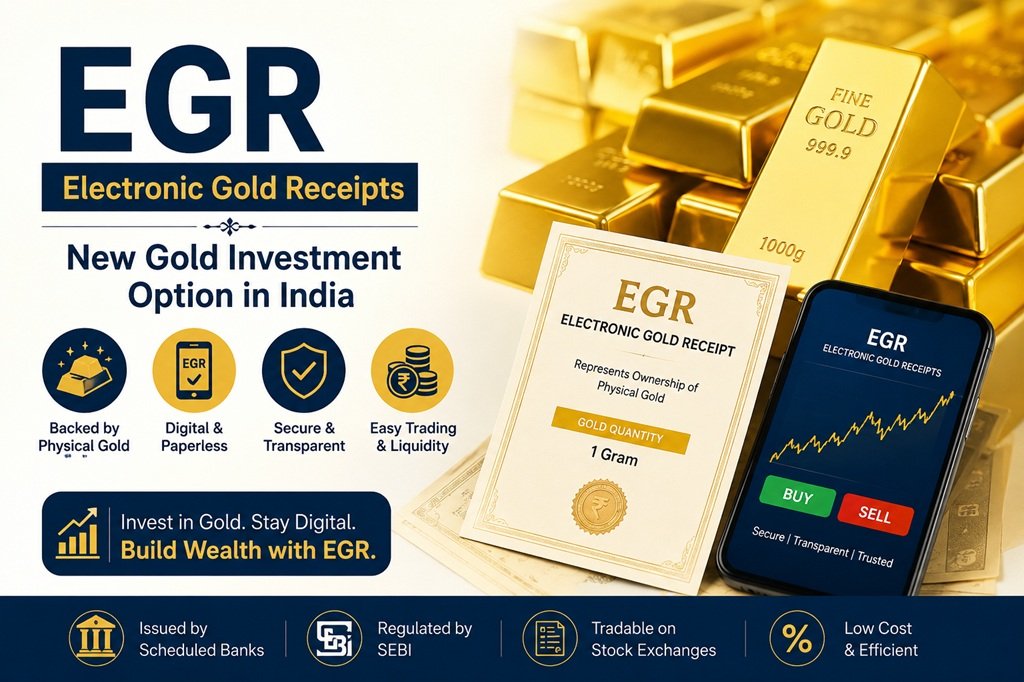
EGR (Electronic Gold Receipts) is new gold investment option in India introduced by the National Stock Exchange of India (NSE). EGR is demetallized form of receipts that physical gold is stored in the SEBI-accredited vaults.
When it comes to investing in gold, most of the people go for buying gold physically in terms of jewelry, gold coins, or gold bars. Few people opt for Gold ETF or SGB (Digital Gold). Physical and Digital Gold both have their own advantages and drawbacks. The new option EGR brings the best of both worlds, and it is government-approved and controlled.
In case you wish to learn more about EGRs, read on in this blog. You will discover what is EGR, the way they function, the salient features, and ways to invest in gold.
What is Electronic Gold Receipt (EGR)?
Electronic Gold Receipts (EGRs) are digital representations of physical gold held in SEBI-approved vaults. While the case with Gold ETFs is different, EGRs provide the facility for taking possession of physical gold within certain limitations.
Instead of storing gold in its tangible form, people can trade EGRs in the stock market (as they do with stocks). This makes it easier and more secure for Indians to invest in gold.
Every EGR certificate comes with an equal amount of real gold in standard purity. If required, one can even convert EGR to gold.
Key Features of Electronic Gold Receipts
Regulator – Securities and Exchange Board of India (SEBI)
Segment – EGR segment on National Stock Exchange of India (NSE)
Asset Class – Securities under SCRA, 1956
Ecosystem – SEBI, Exchanges, Clearing Corporations, Depositories, Vault Managers
Trading – Buy/sell like shares on stock exchange
Settlement – T+1 cycle
Depositories – Hold EGR in demat & manage settlement
Vault Managers – Handle gold deposit, storage & withdrawal
Market Timings – Mon–Fri: 9:00 AM to 11:30 PM / 11:55 PM*
Margin – VaR + ELM + MTM
Participants – Retail investors, jewellers, traders, refineries
Product Options – Multiple units (1kg to 100mg) in 999 & 995 purity
EGR vs Physical Gold vs Gold ETFs
The EGR is a receipt for physical gold traded on an exchange, which provides liquidity and physical delivery options. The physical gold provides ownership but entails storage and manufacturing costs. Gold ETFs are financial products that follow the price movements of gold without providing physical delivery.
The following are the distinctions between Gold EGR, Physical Gold, and Gold ETFs.
| Electronic Gold Receipts (EGR) | Physical Gold | Gold ETF | |
| Form | Digital (demat) | Physical (jewellery, coins, bars) | Digital (fund units) |
| Backing | Backed by physical gold in vaults | Direct ownership of gold | Tracks gold prices (no direct ownership) |
| Trading | Traded on the NSE and BSE | Not exchange-traded | Traded on stock exchanges |
| Minimum Investment | Flexible (small units like grams) | Higher (depends on form) | Flexible (1 unit onwards) |
| Physical Delivery | Yes (on request) | Already physical | No |
| Liquidity | High | Low to moderate | High |
| Storage | Stored in SEBI-approved vaults | Self-storage required | Managed by AMC |
| Costs | Storage & transaction charges | Making charges, storage cost | Expense ratio |
| Safety | High (regulated by Securities and Exchange Board of India) | Risk of theft/storage issues | High (regulated market) |
Step-by-Step Process to buy EGR
Step 1: Get Demat and Trading Account
The investors need to possess a demat account and trading account from a registered stockbroker by SEBI to trade in NSE EGRs since these are traded through stock exchanges.
Step 2: Do the KYC Verification Process
KYC stands for know your customer process that needs to be fulfilled by investors in terms of documents like PAN card, Aadhaar card, bank details, and proof of address for accessing the stock trading services.
Step 3: Find Out if Your Broker Offers EGR Services
As NSE EGRs represent a newer investment category, therefore, certain stockbrokers may not yet offer facilities for NSE EGRs trading. The investors may follow the below procedure to find out if their broker is offering EGR services.
Login to their trading app or website
- Check if there are EGR symbols listed on the platform of NSE
- Find out if their broker has enabled the EGR trading segment
Step 4: Finding NSE EGR Contracts
After confirming that the trader can trade in EGR contracts through the broker’s platform, now he can check for different NSE EGR contracts based on quantity denominations. These are 1 kg, 100 gm, 10 gm, 1 gm, and 100 mg.
Step 5: Issue a Buy Request
The value of EGR is affected by the market prices of gold within India and other international locations. After choosing the denomination of EGR to be bought, investors can then do the following:
- Enter the quantity
- Get the real-time market price linked with gold
- Place an order during trading hours
Step 6: Credit EGRs to Demat Account
Once the trade process is complete, the acquired EGR will be deposited into the demat account of the investor. As for the settlement process in NSE EGRs, it presently uses the T+1 structure wherein settlement occurs on the next business day after the trade.
Step 7: Keep, Track, or Liquidate
Because EGRs can be traded on exchanges, transparency in terms of liquidity and pricing is maintained. Therefore, EGRs may be held as gold investment and sold any time within market hours.
Tax on EGR
According to the tax law 2023, there will be no capital gains tax if the gold becomes electronic gold receipt or vice versa.
It should be remembered that capital gains tax applies only in case of redemption. Therefore, if someone makes gains through electronic gold receipt, then that person will have to pay capital gain on physical gold price.
Conclusion
Electronic gold receipts on the National Stock Exchange present an advanced solution that enables investors to trade gold virtually yet backed with actual gold holdings within regulated storage facilities.
Those interested in a more transparent and exchange-based form of gold investments may find NSE EGRs quite significant in the context of India’s gold investment landscape.

