

To invest wisely or manage a business, it’s essential to understand the fundamentals of how money flows in the financial realm. Two major components of this world are the money market and the capital market. They may seem alike, but they function in quite distinct manners. One assists with immediate cash requirements, such as covering bills this month. The other backs significant, long-term projects, such as constructing a new manufacturing plant or increasing your savings over time.
Recognizing the distinction between money market and capital market is akin to realizing the difference between getting sugar from your neighbor for today’s tea and securing a mortgage to construct your home. Both entail financial aspects, yet the time, risk, and objectives differ. In this piece, we will clarify everything using plain language. We will discuss what each market entails, its operation, key characteristics, and provide a straightforward side-by-side comparison. Ultimately, you will gain confidence in understanding how these markets integrate into daily life and the Indian economy.
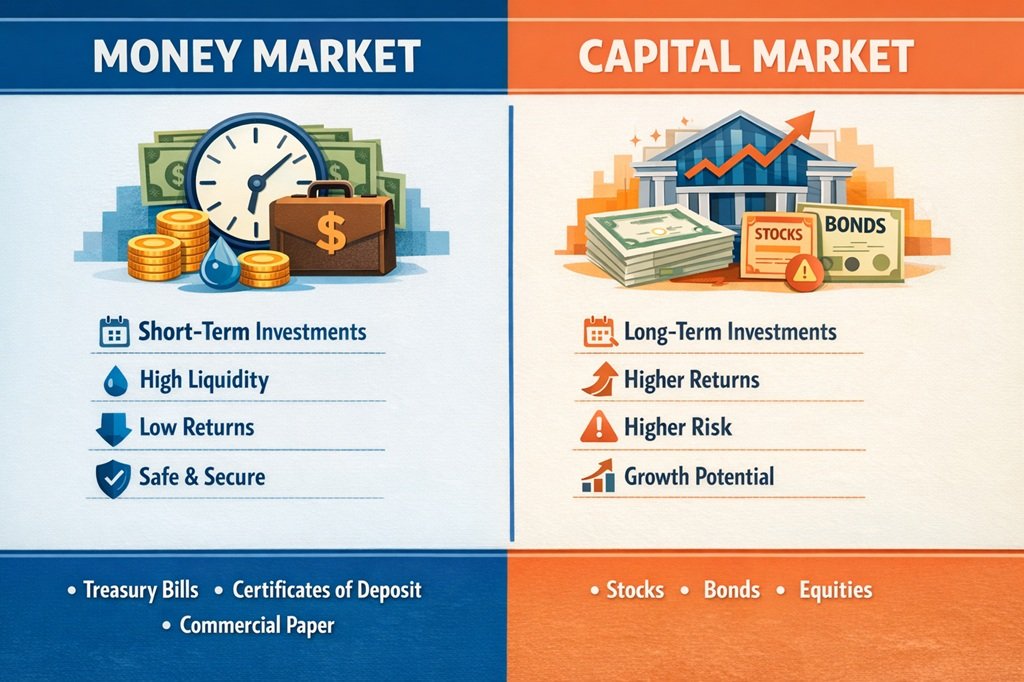
What is the Money Market?
The money market is all about short-term borrowing and lending. It deals with funds that usually come due in less than one year. Think of it as the place where banks, companies, and the government quickly fix their cash flow problems. Maybe a business needs money to pay suppliers right now, or a bank has extra cash it wants to lend out for a few days. This market keeps daily operations smooth.
In India, the Reserve Bank of India (RBI) plays a big role here. It makes sure the system runs safely. The money market is known for being safe and easy to enter or exit. You do not lock your money for long, so you get your cash back fast if needed.
Common instruments used in the money market include:
- Treasury Bills (T-Bills): These are short-term government papers issued by the RBI. You buy them at a discount and get the full amount back after a few months. They are super safe because the government backs them.
- Commercial Papers (CPs): Big companies with good credit issue these to borrow money for a short time, usually 7 to 365 days. No collateral is needed, but only strong firms can use them.
- Certificates of Deposit (CDs): Banks issue these to people or companies who want to park extra money for a fixed short period and earn some interest.
- Call and Notice Money: This is money lent for one day (call money) or up to 14 days (notice money). Banks use it to balance their daily cash needs.
- Repurchase Agreements (Repos): One party sells securities to another and promises to buy them back soon at a slightly higher price. It is like a short-term loan using securities as guarantee.
The main goals of the money market are simple: provide quick liquidity, help with day-to-day funding, and keep the financial system stable. It acts like the oil that keeps the economy’s engine running smoothly every single day.
What is the Capital Market?
Now, let’s talk about the capital market. This is where long-term funds are raised and invested. Here, money stays locked in for more than one year—sometimes for many years or even forever. Companies and governments use it to fund big projects like building roads, expanding factories, or launching new products. Investors come here hoping for growth in their wealth over time.
In India, the capital market is regulated by the Securities and Exchange Board of India (SEBI). It has two main parts:
- Primary Market: This is where new securities are issued for the first time. For example, when a company launches an Initial Public Offering (IPO), it raises fresh money directly from investors.
- Secondary Market: This is the everyday trading place, like the National Stock Exchange (NSE) or Bombay Stock Exchange (BSE). Here, investors buy and sell already-issued shares, bonds, or other securities among themselves. No new money goes to the company, but the market stays active and prices are discovered.
Popular instruments in the capital market are:
- Equity Shares (Stocks): Buying these makes you a part-owner of the company. You may get dividends and benefit if the share price rises.
- Bonds and Debentures: These are like loans to companies or governments. You get fixed interest regularly and your principal back at the end.
- Preference Shares: A mix of equity and debt—they give you priority for dividends but usually no voting rights.
- Government Securities: Long-term bonds issued by the government for big infrastructure projects.
- Mutual Funds and ETFs: These pool money from many investors and invest in a mix of stocks or bonds for long-term growth.
The capital market helps companies grow, creates jobs, and gives ordinary people a chance to build wealth. But it comes with ups and downs because prices can change a lot based on news, economy, or company performance.
Features of the Money Market
Here are some key things that make the money market special:
- Short-term maturity: Everything ends in a year or less, so you get your money back fast.
- High liquidity: You can turn investments into cash easily without losing much value.
- Low risk and low return: Issued mostly by trusted players like the government or big banks, so the chance of loss is small. But you also do not earn huge profits.
- Wholesale nature: Big players like banks, mutual funds, and corporations dominate. Small investors usually join through money market mutual funds.
- Over-the-counter (OTC) trading: Deals often happen directly between parties, not on a formal exchange.
These features make the money market perfect for safety and quick access.
Features of the Capital Market
The capital market has its own personality:
- Long-term focus: Funds stay invested for years, supporting big growth plans.
- Higher risk but higher potential return: Share prices can go up a lot—or fall sharply.
- Open to everyone: Retail investors (like you and me), institutions, and foreign investors all participate.
- Formal exchanges: Trading happens on regulated platforms like NSE and BSE, with clear rules.
- Wide variety of instruments: From simple stocks to complex derivatives.
This market is exciting for those who can handle some ups and downs in search of bigger rewards.
How Does the Money Market Work?
Picture this: A bank has extra cash on Monday but knows it will need it by Friday. It lends the money in the money market for a few days and earns a small interest. Or a company needs to pay salaries but is waiting for customer payments. It borrows through commercial paper.
Most deals happen over the phone or electronically between trusted parties. The RBI steps in to set interest rates and keep things stable. Transactions are fast, often unsecured (based on trust and credit rating), and focused on safety. The whole system helps the economy stay liquid so businesses do not stop working even for a day.
How Does the Capital Market Work?
In the capital market, things move slower but with bigger impact. A company that wants to expand decides to raise ₹500 crore. It can issue new shares in the primary market through an IPO. Investors buy them, and the company gets the money to grow.
Later, those investors can sell the shares on the stock exchange to others. Prices change every second based on supply, demand, company news, and economic conditions. SEBI makes sure companies share honest information so investors can decide wisely. Over time, successful companies reward shareholders with dividends and price growth. It is like planting a seed and watching the tree grow for years.
Key Differences Between Money Market and Capital Market
To make it crystal clear, here is a simple comparison:
| Feature | Money Market | Capital Market |
| Time Horizon | Up to 1 year | More than 1 year |
| Purpose | Short-term liquidity and working capital | Long-term growth and capital formation |
| Instruments | T-Bills, CPs, CDs, Repos, Call Money | Shares, Bonds, Debentures, ETFs |
| Risk Level | Low | Higher |
| Returns | Low but stable | Potentially high but variable |
| Market Type | Mostly OTC, informal | Formal stock exchanges |
| Participants | Banks, RBI, big corporations, mutual funds | Retail investors, companies, FIIs |
| Regulator (India) | RBI | SEBI |
| Liquidity | Very high | Moderate to high (depends on the security) |
| Role in Economy | Keeps daily operations running | Drives long-term development and jobs |
In short, the money market is for safety and speed. The capital market is for growth and patience. One is like a savings account for emergencies; the other is like investing in your future.
Advantages and Disadvantages
Money Market Advantages: Safe, easy to cash out, helps manage daily cash needs. Disadvantages: Low returns, not great for big wealth building.
Capital Market Advantages: Chance for high returns, helps companies grow, open to small investors through mutual funds. Disadvantages: Prices can drop suddenly, needs more research and patience.
Both markets are important. Smart investors often use both—one for safety, one for growth.
How Should You Choose?
If you need money soon or hate risk, look at the money market (maybe through liquid mutual funds). If you are saving for retirement or a child’s education and can wait, the capital market (stocks or equity funds) might suit you better. Always start small, learn, and maybe talk to a financial advisor.
Final Thoughts
The money market and capital market are two sides of the same coin. One keeps the economy breathing every day, while the other helps it grow taller over time. By knowing the difference, you can make better choices—whether you are a student, a business owner, or someone saving for the future.
Next time you hear about interest rates changing or a big IPO launching, you will understand exactly where that action is happening. Start small, stay curious, and let these markets work for you. Happy investing!

