
Download New Income Tax Calculator FY 2025-26 (AY 2026-27) in Excel Format. In the constantly changing realm of taxation, being aware of the newest income tax brackets and effectively handling your investments can greatly influence your financial health. With the new financial year rolling in, it’s time to get ahead and understand how to calculate your taxes in the most efficient way. Luckily, there’s a simple tool at your disposal: an Income Tax Calculator in Excel for FY 2025-26. This tool not only makes tax calculations easier but also ensures that you’re not leaving any money on the table. Our Income Tax calculator is for the financial year 2025-26 (Assessment Year 2026-27). This Excel-based Income Tax Calculator is easily downloadable. You can use it offline in Microsoft Excel. This tool acts as your companion in making informed financial decisions.
Income Tax Calculator FY 2025-26 (AY 2026-27)
In Budget 2025 major changes have been made in the New Tax Regime. A new Tax Slab is introduced and the tax structure is revised. Our new income tax calculator incorporates all changes.
This calculator will work for both old and new tax slab rates which were released and updated in the Budget 2025. You can calculate your tax liability and decide on tax-efficient investment options and the suitable tax regime for FY 2025-26.
The calculator is created using Microsoft Excel. Simple Excel-based formulas and functions are used in creating this calculator. Before downloading excel Excel-based income tax calculator let’s get acquainted with the Latest Income Tax Slab for FY 2025-26.
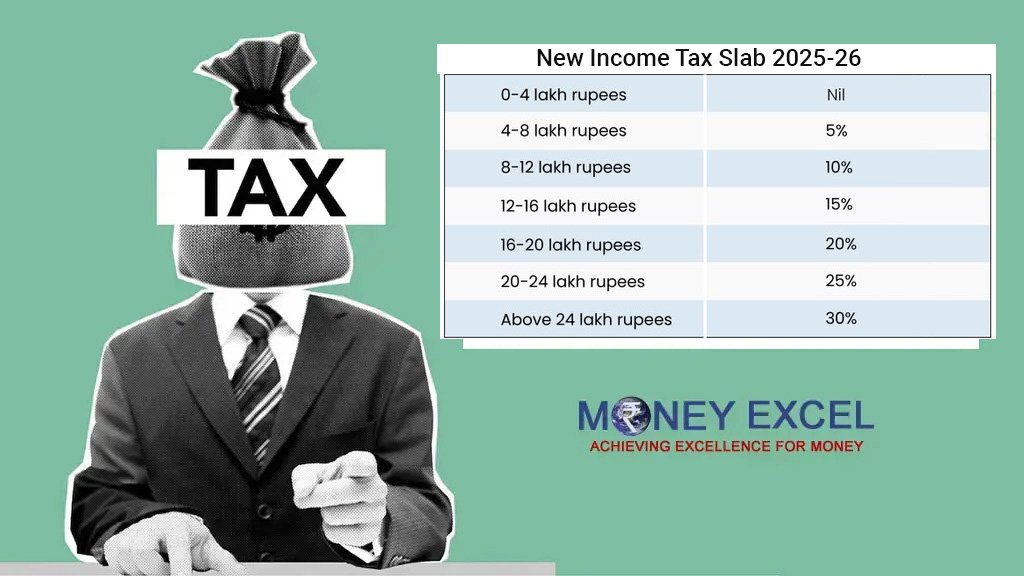
The New Tax Slab FY 2025-26 is given below – New Tax Regime
| Income range (₹) | Tax rate |
|---|---|
| 0 – 4 lakh | Nil |
| 4 – 8 lakh | 5% |
| 8 – 12 lakh | 10% |
| 12 – 16 lakh | 15% |
| 16 – 20 lakh | 20% |
| 20 – 24 lakh | 25% |
| Above 24 lakh | 30% |
The old Tax Regime also continued. This means if you want to invest in 80C and save tax you can still use the old tax regime.
The new tax regime announced is more tax efficient and less complicated as you need not exempt any income and remember any complicated tax exemptions such as 80C, 80CCD, 80D, 80DD, etc.
So, still, the taxpayer has two options –
Option 1 – Income Tax Slab – Old Tax Regime
The first tax slab is with a higher tax rate. In case an individual salaried or HUF wants to claim exemptions under 80C, 80CCC, 80CCD, 80D, 80DD, 80DDB, etc. the tax rate with a higher rate is applicable. The tax slab in case exemption is claimed is given below.
Individuals below 60 years, HUFs, BOIS, and AoPs –
- Up to Rs. 2.5 lakh: Nil
- Rs. 2.5 lakh to Rs. 5 lakh: upto 5% tax
- Rs. 5 lakh to Rs. 10 lakh: 20% tax
- Above Rs. 10 lakh: 30% tax
Senior Citizens (60-80 years) –
- Up to Rs. 3 lakh: Nil
- Rs. 3 lakh to Rs. 5 lakh: up to 5% tax
- Rs. 5 lakh to Rs. 10 lakh: 20% tax
- Above Rs. 10 lakh: 30% tax
Super Senior Citizens (80+ years) –
- Up to Rs. 5 lakh: Nil
- Rs. 5 lakh to Rs. 10 lakh: 20% tax
- Above Rs. 10 lakh: 30% tax
Option 2 – Income Tax Slab – New Tax Regime
The second tax bracket features a reduced tax rate. If the taxpayer chooses not to claim any exemptions, a new simplified tax system applies.
- Under the new tax regime, the tax exemption limit has been increased to Rs 12 lakh. This means that if your income is up to 12 lakhs and you opt for the new tax regime, you will not have to pay any taxes.
- The limit is still Rs 5 lakh under the old tax regime for the financial year 2025-26.
- The tax slab rates have been updated in the new tax regime.
- A standard deduction of Rs 75,000 will now be available in the new tax regime for the financial year 2025-26, due to which no income tax will be payable on income up to Rs 12.75 lakh in the new tax regime.
- In the new tax regime, you will not get any deduction other than the standard deduction. All other deductions are still available under the old tax regime and the new regime will be the default regime from FY 2025-26.
The new streamlined tax system featuring a reduced tax rate is outlined below.
| Income range (₹) | Tax rate |
|---|---|
| 0 – 4 lakh | Nil |
| 4 – 8 lakh | 5% |
| 8 – 12 lakh | 10% |
| 12 – 16 lakh | 15% |
| 16 – 20 lakh | 20% |
| 20 – 24 lakh | 25% |
| Above 24 lakh | 30% |
The taxpayer is not allowed to claim any exemption under 80C, 80CCC, 80CCD, 80D, 80DD, 80DDB, 80E, 80EE, 80EEA, 80EEB, 80G, 80GG, 80GGA, 80GGC.
However, there are certain deductions you can still claim using the new tax regime and they are as below.
- Retirement benefits, gratuity etc.
- Commutation of pension
- Leave encashment on retirement
- Retrenchment compensation
- VRS benefits
- EPFO: Employer contribution
- NPS withdrawal benefits
- Education scholarships
Salaried can select any tax slab. They can switch between old and new tax regimes. The option of switching between tax slabs is not allowed if an individual or HUF has business income.
What Is an Income Tax Calculator?
To put it simply, an income tax calculator helps individuals and businesses determine how much tax they need to pay based on their income. With so many slabs, deductions, exemptions, and changes in each financial year, calculating income tax can get a little tricky.
For the FY 2025-26, the income tax slabs, exemptions, and deductions may see some updates. An Excel-based income tax calculator streamlines this process by allowing you to input your income and other relevant details, and then automatically calculating your tax liabilities.
Why Use an Excel Income Tax Calculator?
Before we dive into the specifics of the FY 2025-26 tax slabs and how to use Excel, let’s quickly cover why you might want to use Excel over other tools like online calculators or manual calculations.
- Accuracy: Excel formulas are error-free, so once you input your data correctly, there’s no room for miscalculation.
- Customization: You can personalize the calculator based on your specific needs, including adding any income sources, deductions, or exemptions.
- Save Time: You don’t have to calculate manually or keep switching between web pages. Excel does all the heavy lifting for you.
- Record Keeping: With Excel, you can easily track your taxes year after year and make adjustments for future planning.
Download Income Tax Calculator FY 2025-26 (AY 2026-27)
Download the latest income tax calculator FY 2025-26 (AY 2026-27) from the link given below and calculate your income tax liability easily. 
Download the Income Tax Calculator in EXCEL Format.
It is not a comprehensive calculator, it is designed to give you a quick idea about your income tax liabilities so that, you can start tax planning. It also helps you to select an appropriate tax slab.
Key Features of this Income Tax Calculator are given below
- This calculator is a two-in-one calculator. You can make use of this calculator for calculating tax liabilities as per old as well as new tax slabs.
- You can compare your tax and decide which tax slab to opt for.
- The calculator can help you compare your tax deductions and by entering the investment amount over and over again, you can decide how much you would pay less income tax than if you chose the old tax regime.
- It is an Excel-based calculator. You can download and use it forever.
- This calculator is for people with a single home.
- You will not be able to calculate long-term capital gain tax from this calculator.
How to use the Income Tax Calculator?
Download Income Tax Calculator FY 2025-26 Excel on your device, and provide income as gross income for FY 2025-26.
Provide investment including standard deduction, section 80C investment, section 80CCD(1B) investment, and other tax saving options for which you are eligible. The total amount of investment has to be entered. A standard deduction of Rs 50,000 is applicable for employees.
Enter the amount of TDS already deducted from your salary in the financial year After providing all these parameters, the income tax will be calculated based on the old and new tax regime.
Conclusion
In conclusion, an Income Tax Calculator in Excel for FY 2025-26 can save you time, reduce errors, and give you a clearer picture of your finances. The process of setting it up is simple, and the benefits are immense. With a little upfront effort, you can easily handle tax season with confidence and peace of mind.
By keeping track of your income, deductions, and exemptions accurately, you’ll ensure that you only pay what’s necessary – no more, no less. Excel isn’t just for spreadsheets; it’s also your personal assistant when it comes to tax season!
I hope this Income Tax calculator for FY 2025-26 will be useful to you.
Do share this calculator and Tax structure with your friends on Facebook & Twitter.
If you have any suggestions share them at info@moneyexcel.com. It will help me to add new features and improve this calculator.