
Blog Page 463

Simple Principal of Investment – Invest 30%

Investment

When it comes to personal finance people often seek help from friends, relatives or financial planners. For majority of people handling finance is complex job. They often seek answer of questions such as How to invest wisely? Am I secure against financial risk? What Principal of investment I should follow?

Principal of Investment

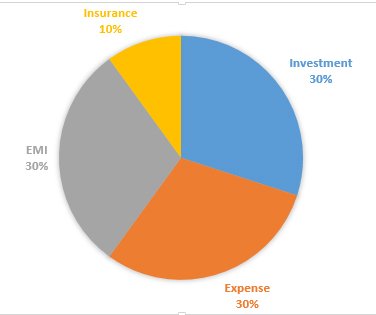
So to help you out all these people I am here with Simple Principal of Investment. I call this principle as 30% rule of personal finance. Divide your income in to four part. First 30% of income for Investing. Second 30% income for spending and third 30% for EMI. Rest 10% of income can be used for risk coverage.
investment

This means that if you are earning 10000 Rs/- as take home salary than 3000 Rs/- must be kept for saving and investment. You can keep maximum 3000 Rs/- for expense and 3000 Rs/- for EMI. Rest 1000 Rs/- can be used for life insurance and other insurance need.

Invest 30% first:-

First thing you need to take care is develop concept of paying yourself first. Invest 30% of your income for your financial goals. You can increase or decrease this ratio based on your situation. Set automatic mechanism for investment or be punctual in terms of investing money.

Before investing make emergency fund. Emergency fund should be at least 6 month of your household expense.

Limit Expense Up to 30%

Make monthly budget with categories. Try to limit your expense up to 30% of your income.

One very good method to control expense is to divide your expense in to discretionary and mandatory. Now whenever you spend money ask simple question to self that whether this expense is really required.

Limit your EMI to 30% 

It is not advisable to take loan but in today with limited income it becomes compulsion to take loan to meet lifestyle expense.

Limit your EMI at 30% of your income. This limit is for all loans like Home loan, personal loan, auto loan etc. If you have already taken excessive loan try to make repayment of expensive loans.

Keep 10% for Insurance

Insurance is vital need today. Keep 10% money for insurance. This limit includes all insurance premium for all family members including health and life insurance.

If your insurance expense is very high than you might have purchased expensive polices or you may be over protected.

Use this simple Principal for Investment for financial success.

Hope you find above principal of investment useful.
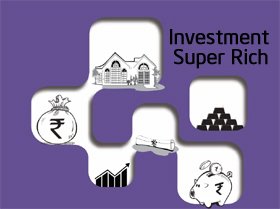
Real Estate and Business key source of wealth for super rich

super rich

Super rich is mouth-watering word. Today everyone wants to be super rich but very few knows how super rich generate wealth, where they invest and how they spend. We are herewith quick report on super rich.

Risk and reward are adjacent to each other. Super rich understand this fact very well. Super rich have strong preference for investing in to riskier asset class.  Real estate and equity are key source of wealth for super rich says Kotak Wealth Management Report 2014.

Real Estate:-

Real estate is most favored investment asset class for super rich. The tangible nature and lots of opportunities associated with real estate in terms of sale and rental attracts people to this asset class.

source wealth

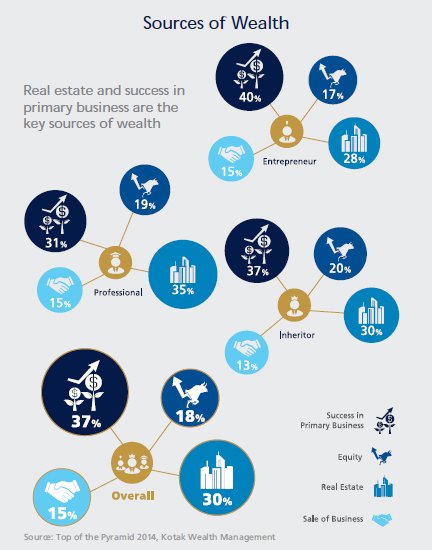
Two-thirds of the total distribution of wealth super rich comes from primary business and real estate. Among super rich, Professionals lay higher emphasis on premium real estate, whilst Entrepreneurs and Inheritors lay higher emphasis on their primary business. Real estate is trusted option for investment and it is not likely to lose its sheen in near future.

Equity:-

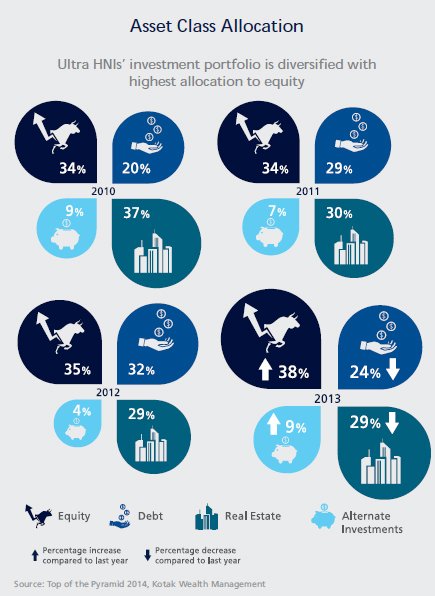
Equity is another asset class where all super rich invest their money. Even with formation of new government expectation in equity market is rising. Report indicates Allocation to equity has increased from 35% in 2012 to 38% in 2013 with a consequential reduction in debt investment to 24%.

Asset Allocation

Equity market was under performing since 2008 but now as market is picking up majority of investor will get attracted towards equity.

Super rich Style of Investing:-

Super rich have different styles of investing and decision making. Entrepreneurs tend to be more speculative in their investment styles of investing become more disciplined as we move from Entrepreneurs to Inheritors and Professionals.

Professionals rely on self-analysis for investment decision making. Entrepreneurs and Inheritors tend to consult family and friends more than Professionals when making decisions regarding investments. Our survey results show that 28% of Inheritors and 19% of Entrepreneurs rely on family and friends as compared to 13% of Professionals in their investment decisions.

Content credit –  Kotak Wealth Report

10 Best Short Term Investment Options

My friend Shyam has excessive money and he is in search of a short-term investment option. He wants to get a quick return. Do you have excessive money? Do you want to invest this money for the short term?  If yes you are at the correct place today we will be discussing about 10 best short-term investment options.

Short term Investment need

A short-term investment option is required when we have excessive money and there is a pressing expense expected shortly. Expenses could be anything but investment in good short-term investment would definitely increase the value of money.

short term investment options

Short-Term Investment Options

Fixed Deposit

Fixed deposit is the most popular investment option. FD is available with different tenures, starting from 7 days to 5 years. The interest rate varies of FD varies from 7% to 9.25%. Nationalized banks, Cooperative banks, and corporate FDs are a few lucrative investment options.

Saving Bank Account

Saving a bank account is a safe and very good short-term investment option. You must be thinking that savings banks will provide less interest 4% only but today you can earn up to 7% interest by placing your money in the savings bank. Few banks also offer higher interest on savings bank accounts.

Auto Sweep Account

Auto sweep provides the combined benefit of saving bank accounts and fixed deposits. An auto sweep account is a very good short-term investment option. Auto sweep account automatically converts the surplus amount of your account into a fixed deposit. In some cases, the penalty is applicable if FD under the auto sweep account is broken before 1 year.

FMP 

A fixed maturity plan is a closed-ended debt scheme. FMP as the name suggests it has a fixed maturity date and fixed return. FMP is a low-risk risk high-return investment option. Investment in FMP also provides attractive tax benefits.

Liquid Funds

A liquid fund is a mutual fund that invests in money market instruments like term deposits, certificates of deposits, treasury bills, etc. You can liquidate money from a mutual fund in 24 hours.

Ultra Short-Term Funds

Ultra short-term funds invest in fixed-income instruments with short-term maturities. Ultra short-term funds provide good protection against interest rate risk. Some Good ultra-short-term investment funds are ICICI Prudential Ultra short-term plan and HDFC Ultra Short-term Bond Fund.

Certificate of Deposit

A certificate of Deposit is usually sold by the bank. The bank gives you the guarantee of returning the bank principal amount with interest. Premature withdrawal is not allowed in this option.

Equity Market Investment

Investment in the stock market is a risky affair, but it is a very good investment option for hungry investors. In the short term, you can gain good profit but sometimes you can end up making a loss also.

Mutual Funds 

Mutual funds are also one of the risky investment options for the short term.  If your investment horizon is for 1 year then you can invest in a good blue chip large cap oriented fund to get a good return.

Gold ETF 

Yellow shining gold could be another option for short-term investment. As we know in recent past gold has given very good returns. Instead of investing in physical gold, you should invest in Gold ETF. Gold ETF investment provides good liquidity.

Before investing in any short-term investment option given above make sure you understand investment options in terms of associated risk and expected returns. Understand terms and conditions thoroughly before making investment.

Business or Job – Building Pipeline or Hauling Bucket

Today everyone is running after money. Everyone wants to build wealth, but very few know how to build wealth. Wealth is not about how much money you earn. Wealth is about how much money you keep. Today we keep on hearing one question  I should start business or continue with my job.

To answer this let me share with you interesting story of Building Pipelines or Hauling Bucket. This story I have read in book “Rich Dad Poor Dad” written by Robert Kiosaki.

Business or Job
Startup business

Story of Building Pipeline or Hauling Bucket

The story goes like this – Once upon a time there was a village. It was a very good place for living except for the problem of water. In order to get water villager needs to go to the river. River was a bit far away from the village.

In order to solve this water problem on permanent basis villagers called meetings. In the meeting, it was decided to give the contract to someone for the delivery of water to villagers. Incidentally, they found three contractors for the delivery of water to villagers.

Job Mind Set:-

The first contractor hired a person for hauling bucket and delivering it to villagers.  The person who joined him as the worker was from the mentality of doing a Job. That worker started hauling buckets in the early morning. Till evening he was hauling buckets. At the end of the month, the contractor was paid a small amount of money to him as salary and the rest contractor was keeping with him.

This is what is happening today for job-class people. People with the mindset of doing Job are hauling buckets on daily basis to make others wealthy.

Self Employer Mind Set:-

The second Contractor was of the opinion why share money with others. He started hauling buckets on self. Early morning he use to start hauling buckets and was delivering buckets till evening. He used to enjoy the money earned by doing this job.

This is what self employed people do today. They own job as they don’t want anyone else to participate in their job.

Business Mind Set:-

The third contractor was of a business mindset. He came up with the idea to build a pipeline. He invested money to build a pipeline with a water filter facility. On the day of the inauguration, he announced to give of 24×7 clean water facilities at the doorstep at low-cost compared to the first and second contractor.

Soon he got business from the majority of villagers. In order to compete with him first and second contractors had to deliver buckets in a penny.

That penny story continued and both of them worked hard for the rest of their life and had financial problems forever after.

The third contractor with a business mindset replicated this idea in other villages also and lived wealthy life.

Moral from Story

Million dollar question you need to ask yourself is:-

  • Am I building a pipeline or hauling buckets?
  • Am I working hard or am I working smart?
  • If I stop working from tomorrow would it affect my income adversely?
  • Have you ever wondered how are you going to pay your bills when you stop working today?
  • Is it possible to earn more money by giving less time?
  • What am I doing today and what should I do for the future?