Every Investment today comes with risk & return. The higher the risk, the higher the return that is a known fact. Asset class selection mainly depends upon individuals but given a chance, every individual will select low-risk and high-return investment right!
Many individuals today avoid stock market investment thinking that stock market investment is a risky affair. This is because the majority of them have experience in purchasing stock at overvalued/high prices so although it is blue-chip stock it may end up giving them low returns.
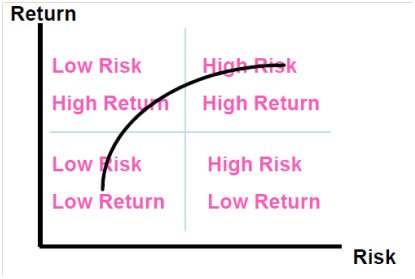
If we draw a risk and return diagram in two dimensional we have four types of stocks
(1) High Risk, High Return –Startup company with Strong business model
(3) Low Risk, High Return – Several-year-old company giving a good return
(4) High risk, Low Return – Startup company with weak business model
So, Million dollar question is how to select low-risk high-return stock in the equity market. Although it is a difficult question to answer we are here with a proven Capital Asset Pricing model that can help to select low-risk high-return investments.
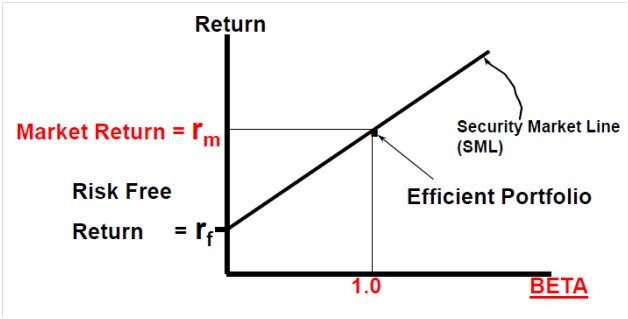
In the above diagram if we draw the parallel line, pointing it to the Y axis is known as a risk-free return. In the Indian context, risk-free return is said to be around 8% i.e risk-free return given by a bank on a deposit
The point of intersection in the Y axis is known as Market return and the X axis is known as Beta. Beta = 1 leads to an Efficient portfolio.
Beta measures volatility in a stock. It is the measure of systematic risk or more specifically, market risk of a stock investment.
Stocks that have a beta greater than 1 have greater price volatility than the overall market and are more risky.
Stocks with a beta of 1 fluctuate in price at the same rate as the market.
Stocks with a beta of less than 1 have less price volatility than the market and are less risky.
The higher the beta higher the risk you carry. There is no need to calculate betas of stocks (which would be a tedious process). Both Sensex and Nifty stocks’ beta values can be gathered from respective websites:
Please note these beta values are computed using trailing twelve months’ data.
This model is popularly known as the Capital Asset pricing model. (CAPM) The CAPM says that the expected return of a security or a portfolio equals the rate on a risk-free security plus a risk premium. If this expected return does not meet or beat the required return, then the investment should not be undertaken.
CAPM describes the relationship between risk and expected return and that is used in the pricing of risky securities.
R = Expected return on a company stock
B = Beta of the stock
rf = Risk-free return
rm= return on the efficient market portfolio
We can compute the expected return of a stock in this CAPM example: risk-free return is 8%, the beta (risk measure) of the stock is 2 and the expected market return over the period is 10%, the stock is expected to return 12% (8%+2(10%-8%)).
Beta is just one measure to identify low-risk high return stock, while selecting stock one should carefully consider company fundamentals, core business, and past return that will give you a much better picture of the potential long-term risk.
Starting a small business can be an exciting journey filled with opportunities for growth and success. However, many aspiring entrepreneurs have the misconception that starting a business requires a large amount of capital. In reality, many small business startup ideas require very low investment and have the potential for significant growth.
In this article, we will explore 40 small business ideas with low investment across various industries and sectors.
40 Small Business Ideas with Low Investment
#1 Personalized & Custom-made Gift Store
As the demand for personalized and custom-made gifts rises, consider launching your gift store specializing in these unique offerings. This venture promises not only creativity but also the potential for a thriving small business.
#2 Gym or Fitness Center
In a world where health and fitness are paramount, establishing a small gym or fitness center in a well-located area can be a lucrative endeavor. Cater to the fitness needs of your community and watch your business flourish.
#3 Event Organizer
Venturing into an event organization requires expertise and manpower, but the rewards can be substantial. This is a small business idea that combines low investment with the potential for high profits, making it an enticing opportunity.
#4 Interior Designer
Capitalizing on the growing demand for interior decorating services, starting an interior design business presents itself as an excellent opportunity. Specialized skills are essential, but the market for interior design services is vast and lucrative.
#5 Small Grocery Shop
For those seeking a business idea with minimal complexity, opening a small grocery shop is a practical choice. This business is accessible to beginners and can be expanded gradually based on demand.
In the modern age, wedding celebrations are intricate affairs. Seizing the opportunity as a matchmaker or wedding planner can be a fulfilling and profitable business endeavor.
#7 Tuition Class
In a world where education holds paramount importance, starting a tuition class is a solid business idea. Catering to the educational needs of students ensures a steady demand for your services.
#8 Mobile Shop
As the demand for mobile devices continues to soar, initiating a small mobile shop is a smart investment. This business idea taps into the ever-growing need for mobile technology.
#9 Ice Cream Parlor
Launching an ice cream parlor is a delightful business venture with broad appeal. Offering sweet treats to your community can be a rewarding small business endeavor.
#10 Xerox & Book Binding Services
Fill the gap in college and school areas by offering Xerox and bookbinding services. This niche business can be a valuable addition to communities lacking these facilities.
#11 Mobile Food Shop
Embrace the mobile generation by starting a mobile food shop. This business idea aligns with the fast-paced lifestyle of today’s consumers.
#12 Jewelry Maker
Utilize your creativity by taking up jewelry making. With the increasing demand for unique pieces, this niche business can turn your passion into a profitable venture.
#13 Insurance Consultant
Delve into the world of insurance by starting a consultancy or agency. This business opportunity, suitable for both men and women, offers the potential for a stable income.
#14 Freelancer
For those proficient in programming, freelancing presents a plethora of opportunities. Numerous websites connect freelancers with clients, providing a flexible and lucrative income stream.
#15 Book Store
Appease the literary cravings of book lovers by starting a bookstore. This business idea caters to a diverse audience and can be a fulfilling venture for book enthusiasts.
#16 Catering Service
Celebrations and events call for good catering services. If you excel in providing delicious food and top-notch service, starting a catering business is a viable option.
#17 Computer Training
In today’s digital age, computer skills are essential. Starting a computer training center addresses this need, offering valuable education and creating a sustainable business model.
#18 Yoga Center
Combat the stresses of modern life by establishing a yoga center. This business caters to the growing demand for holistic well-being practices.
#19 Baby Sitting Services
A home-based business catering to working couples, and babysitting services, is a viable option. This venture provides a valuable service to families in need.
#20 Real Estate Consultant
Real estate is a thriving industry, and providing consultancy services can be a lucrative business option. Assist individuals in navigating the complexities of buying, selling, and renting properties.
Tap into the gaming craze by starting a game parlor with unique offerings. This business idea caters to the preferences of today’s generation, promising a steady flow of customers.
#22 Photographer
Turn your passion for photography into a business with low initial investment. As a photographer, you can offer your services for various events and occasions.
#23 Motivational Speaker
If you possess the skill of motivation, consider becoming a motivational speaker. Transform your abilities into a business opportunity, inspiring and empowering others.
#24 Travel Agency
Embark on the exciting venture of starting a travel agency. This small-scale business idea with low investment allows you to assist individuals in planning memorable journeys.
#25 Computer Shop
Utilize your IT knowledge by starting a computer shop. Offer IT-related products and services to meet the technology needs of your community.
#26 Relaxation Center
Amid life’s stresses, a relaxation center provides solace. Initiating this business offers a unique and essential service to individuals seeking relaxation.
#27 Courier Company
Explore the delivery business by partnering with existing courier companies or starting your own. A small courier company can provide essential services and generate a steady income.
#28 Resale Auto Dealer
Entering the automotive market, consider becoming a resale auto dealer. This business idea addresses the demand for selling pre-owned cars and bikes.
#29 Recruitment Firm
In a world where employment is crucial, starting a recruitment firm is a business option with high demand. Connect job seekers with opportunities, creating a valuable service.
#30 Security or Spy Agency
With an increasing need for security, starting a security agency or working as a spy offers a unique business opportunity. Ensure the safety of individuals and businesses in your community.
Establishing an advertisement agency opens doors to an evergreen business opportunity. Assist businesses in creating impactful campaigns, and you can enjoy substantial returns.
#32 Web Designing & Hosting
If you possess knowledge of various IT tools and programming languages, consider starting a web designing and hosting firm. Cater to the digital needs of businesses and individuals.
#33 Online Blog
Leverage your expertise by starting an online blog. This home-based business idea allows you to share valuable insights and earn money through various online platforms.
#34 Antique Article Shop
Capitalizing on the trend of keeping antique items at home, opening an antique article shop is a lucrative business option. Cater to the aesthetic preferences of your customers.
#35 Fast Food Parlor
Embrace the preference for fast food in today’s generation by starting a fast food parlor. This business idea aligns with the culinary choices of a vast consumer base.
#36 Data Entry Services
Numerous companies rely on data entry work for their operations. If you have the skills, consider providing data entry services as a business opportunity.
#37 Resume Writer
Utilize your design skills and deep knowledge to become a resume writer. Assist individuals in crafting compelling resumes, creating a valuable service.
#38 SEO Consultant
With websites seeking optimization, becoming an SEO consultant is a lucrative business option. Develop the necessary skills to help businesses improve their online visibility.
#39 Dairy & Sweet Parlor
Address the demand for dairy products and sweets by starting a small dairy and sweet parlor. This business idea caters to the culinary preferences of your community.
#40 Packers & Movers Business
Embark on the business of packing and forwarding by starting a Packers & Movers venture. This business opportunity addresses the need for reliable relocation services.
Conclusion
In conclusion, starting a small business with low investment is not only feasible but also offers numerous opportunities for aspiring entrepreneurs to pursue their passion and achieve financial independence. Whether you’re interested in technology, service-based industries, product manufacturing, or community development, there is a small business startup idea that aligns with your skills, interests, and goals. By leveraging creativity, resourcefulness, and determination, you can turn your entrepreneurial dreams into reality and make a positive impact in your community and beyond.
Big bull Rakesh Jhunjhunwala is called as king of Indian stock market. Rakesh Jhunjhunwala has started n stock market with investment capital of just 5000 Rs/- and right now his net worth is more than 5000 Cr. Rakesh Jhunjhunwala has proved that if you adopt correct strategy and select right stock you can win the market and earn good returns.
Many individuals today follow rakesh jhunjhunwala and always eager to know about investment secrets & stock selection criterion of Rakesh Jhunjhunwal. We are herewith 11 tips of Rakesh Jhunjhunwala for stock market.
Rakesh Jhunjhunwala‘s Tip No. 1: Don’t Look For Multi-baggers
Rakesh Jhunjhunwala‘s first investment mantra on how to find multibaggers stock is surprisingly different from what you would expect. Rakesh Jhunjhunwala says: “Don’t look for multibaggers. Don’t seek them at all. Let the multibaggers come to you!”
Rakesh Jhunjhunwala says: Don’t go out into the investment world saying “I only want to invest in potential multibaggers”. Instead of that “Go back to the old-fashioned way of making investments try to do enough homework and select fundamentally sound companies with good growth prospects, your investments will by themselves become multibaggers after some time”.
Rakesh Jhunjhunwala‘s Tip No. 2: Forget ‘Large Cap, Small Cap’ – Look For Value
We always hear debate from analyst whether large cap, mid cap or small cap stocks are better.
Rakesh Jhunjhunwala says “Forget all that and Look for Value, If there is value in Large Cap, buy it. If there is value in Small Cap, buy it. But don’t obsess on irrelevant matters”
But Rakesh Jhunjhunwala makes his preference quite clear. He says that given a choice and all things remaining equal, a mid-cap or a small-cap is a preferred bet because the valuations will be low and they can scale it up quite quickly.
‘Rakesh Jhunjhunwala‘s Tip No. 3: Don’t Look for Profits; Look For Sources Of Profits
Rakesh Jhunjhunwala cautions that most investors obsess about the current sales and profits. They look at each quarter and focus obsessively on short-term profits. “That’s missing the wood for the trees” says Rakesh Jhunjhunwala.
Instead Rakesh Jhunjhunwala says “Look at the sources of Profits. What are the reasons/factors that will give rise to Profits in the medium and long-term term”.
Rakesh Jhunjhunwala gives classic example: That of Praj Industries, a company engaged in manufacture of bio-ethanol fuel. When Praj Industries started out, nobody realized the massive demand that would arise for alternate fuels like ethanol. An investor could have foreseen that would have had his multibagger.
Rakesh Jhunjhunwala‘s Tip No. 4: Give it Time, Be Patient:
Rakesh Jhunjhunwala repeats what investment guru Warren Buffet have been advising over the past several decades. Warren Buffet was plain in his advice “Our favourite holding period is Forever”. Rakesh Jhunjhunwala gives the same advice: “Give your investments time to mature. Be Patient for the World to discover your gems”. Rakesh Jhunjhunwala cites the examples of Crisil, Titan and Pantaloon Retail which he has held on for several years now and has absolutely no intention of divesting them any time soon.
When Rakesh Jhunjhunwala bought Lupin it was just another mid-cap pharma company starting out into the world of generic drugs. What Rakesh Jhunjhunwala saw was a good efficient management which knew its job, a debt-free status, a good product line up and a growing market. That’s all. Rakesh Jhunjhunwala bought and played the waiting game. When the market matured, Rakesh Jhunjhunwala raked in his billions.
Rakesh Jhunjhunwala‘s Tip No. 5: Don’t get carried away by short-term aberrations:
Rakesh Jhunjhunwala cannot stop criticizing investors who are obsessed with short-term trends. Rakesh Jhunjhunwala emphasizes that he does not worry about quarterly results. If the results are bad in one quarter, he does not get disturbed. What Rakesh Jhunjhunwala is looking for is: Is there a trend? Are the quarterly results showing a trend and suggesting something or are they a mere aberration?
Rakesh Jhunjhunwala also cautions that one should not get carried away by short-term trends. He cites the oft-repeated example of 1999 when investors bought truck loads of Himachal Futuristic, Global Tele, Pentasoft while he used to buy Shipping Corporation and Bharat Electronics because he saw long-term value in them. The Oracle of Mumbai says “Never get carried away by aberrations, recognize and respect them but do remember that the market corrects its aberration though it takes time.”
Rakesh Jhunjhunwala‘s Tip No. 6: Invest in a business that you can understand:
If you look at it hard enough, you will realize that Rakesh Jhunjhunwala‘s reluctance to buy Himachal Futuristic, Global Tele and Pentasoft even in their heydays and his preference to stick to Shipping Corporation, Bharat Electronics and the other tried and tested names reveals another great investment tip from the Prince of Dalal Street: Buy what you know. Do you understand the business enough to be able to know what will happen 10 or 20 years from today. With Shipping Corporation, you can because shipping of goods will continue to happen for our foreseeable future. But you can’t tell that with technology companies which may have a great product today but which may become obsolete in 5 years.
Rakesh Jhunjhunwala‘s Tip No. 7: Don’t worry about the macro stuff like fiscal deficit, inflation etc which are unknowable. Focus on what is knowable:
Another immensely practical tip from Rakesh Jhunjhunwala, India’s greatest investor, for us folk who keep obsessing about currency fluctuation rates, inflation, fiscal deficit, political turmoil is: “Don’t worry about things that you neither know about nor can do anything about. It’s not important. Instead focus your energies on what you can and should know well enough – the business of the company you are investing in“.
Rakesh Jhunjhunwala‘s Tip No. 8 : Don’t Try To Time The Market:
Rakesh Jhunjhunwala endorses the validity of investment advice that has been propounded time and again by the wizards of investment time and again. Never try to time the market because you can never find the bottom of the market. Instead if you are getting the stock cheap in terms of its intrinsic value and future prospects, buy it.
Rakesh Jhunjhunwala simply resonances words of the Oracle of Omaha when he says that you must get right is the business. If you get that right, everything else falls into place.
Rakesh Jhunjhunwala‘s Tip No. 9 : If it’s cheap, buy it- Don’t pass up something cheap today in the hope that it will get cheaper tomorrow:
Rakesh Jhunjhunwala says: If you see the opportunity today, GRAB IT! Many wonderful opportunities are lost to postponement and then you rue your missed opportunities. Rakesh Jhunjhunwala says that it is not only important to identify the opportunity but then to be decisive and to act on it. Rakesh Jhunjhunwala cautions against getting stuck in a trap where you are perpetually seeking extra information to validate your idea.
In this, Rakesh Jhunjhunwala echoes the wisdom of Warren Buffet, the Oracle of Obama, who in the depths of the great stock-market depression of 2008 inspired investors by his clarion call “If you wait for robins, summer will be gone”.
Rakesh Jhunjhunwala‘s Tip No. 10: Don’t buy stocks that have a fixed return:
Rakesh Jhunjhunwala‘s next tip seems to be a no-brainer but it is surprising how many investors overlook it. What is the point of buying shares in a company such as an electricity company where the return on investment cannot by law exceed a certain amount, asks Rakesh Jhunjhunwala. But, Rakesh Jhunjhunwala, emphasizes that this logic does not mean that electricity and utility companies should not form part of your portfolio because they offer an excellent defense mechanism to the vagaries of the stock market with the undemanding demand for their product and their predictable cash flows.
Rakesh Jhunjhunwala‘s Tip No. 11: Ride your winners!!
The one question on everybody’s mind is “When do I sell my multibagger?” Rakesh Jhunjhunwala answers with aplomb “Never”.
One must be careful to understand what Rakesh Jhunjhunwala is saying here. What the Greatest Investor in India is saying is: “Don’t sell for the sake of selling because you can never say that the 10-bagger today will not become a 20-bagger tomorrow”.
But, Rakesh Jhunjhunwala hastens to clarify that this does not mean that one will never sell a multibagger. He gives two situations when even he may sell his beloved multibagger. The first is when he is short of funds and he needs capital to invest in a stock that will give even better returns than what the existing one will give. And second, when the stock market has become so irrational that the perception of earnings and the P/E is unsustainable. Rakesh Jhunjhunwala gives the example of what happend in 2000 when euphoric investors laid bets that Infosys’ earnings would double every year for the next 10 years. Infosys’ P/E at the then current earnings was 100-150 times. So, says Rakesh Jhunjhunwala, when the expectation of earnings peaks and the P/E is unsustainable, that is the time to sell.
Nomura has identified top 10 listed Indian companies with strong competitive strength that can deliver long-lasting returns.
These companies have been shortlisted by carrying out detailed analysis of the sources of competitive strength across sectors and in-depth look at management capabilities.
The brokerage has also minimised subjective and personal bias by combining quantitative and historical analysis to rank firms based on competitive strength.
Following are the companies that have been identified as the most competitive companies:
1) Amara Raja Batteries
Action:Strong technology partner, growing brand awareness and cost advantage will remain key sources of competitive advantage.
Technological innovation, superior product quality, strong brand building efforts, and expansion of distribution networks and relationships with OEMs have helped AMRJ to gain significant market share across all segments. We expect the company to continue to deliver consistent earnings growth over the next five years as industry conditions remain favourable and AMRJ delivers on its strong execution capabilities.
The stock has re-rated significantly over the past two years on strong earnings and market share gains delivered across all segments. Current valuation (on 1-yr fwd P/E) is at a 13 per cent discount to EXIDE. We believe as Amara Raja increases its scale of operations and continues to deliver strong and consistent earnings growth, it should trade in line with EXIDE.
2) Cummins India
Action:Solid long-term fundamentals story
Cummins India has delivered a solid PAT CAGR of 22 per cent and 20 per cent over the past 10 and five years, respectively. We believe KKC remains a fundamentally strong business with a solid long-term opportunity in power-short India. With strong competitive advantages such as technology leadership in MHP and HHP engines, localized manufacturing, a wide service network and strong management, KKC looks poised to grow at a steady rate in the long term.
The stock is trading at ~16x one-year forward P/E and we believe captures most of the downside it currently faces from cyclical headwinds. We see limited downside from the current level, but given that our target price of Rs 496 (18x FY15F EPS of INR27.6) offers only limited potential upside, we remain neutral on the stock.
3) ITC
Action:One of the top five companies to own in India – simply put.
Since the turn of the decade, ITC has delivered 32 per cent -plus CAGR vs. the Sensex 21 per cent-plus and HUVR 15 per cent-plus.
The significant alpha generated by the stock amply demonstrates, in our view, the company’s ability to deliver consistent returns for shareholders despite various changes to tax laws over the past decade or so.
ITC’s one-year forward P/E was 10x in FY03, which is currently at 24.6x FY15F (EPS: INR13.57). This, in our view, clearly reflects confidence of the market in the company over the past decade. We believe multiples are likely to hold at these levels, with earnings growth being the key driver of stock price performance.
4) Nestle India
Action: Short term growth challenges should not cloud long term attractiveness.
Under-penetrated market categories, market leadership across segments, established brands, strong distribution and a global parent with a large portfolio of brands are all factors which we believe will remain the key drivers for Nestle in the long term. Nestle’s performance over the last few quarters has been underwhelming, but that should not concern long-term investors too much, in our view.
Over the last decade, Nestle has been an expensive stock, but the reason for that is the potentially attractive long-term opportunity it presents in the packaged food sector. For this, we believe Nestle’s valuation multiples should hold at high levels even within the consumer sector. However, we think high multiples are justified for a business with a high RoE and strong growth over the medium term. Our TP is under review.
5) Asian Paints
Action: Brands, execution, distribution network should continue to be key growth drivers and sources of competitive advantage.
Asian Paints over the last decade has not only been able to maintain its strong momentum, but has also meaningfully expanded market share vs both domestic and international players. The company’s efforts in brand building and excellence in execution has meant that APNT’s profits have increased at 23 per cent CAGR over FY03-13.
We see expensive valuations as continuing to sustain despite the fact that APNT does go through cycles and is impacted significantly by macro conditions. Valuations are likely to continue to remain high as, over the longer term, the company has delivered consistent shareholders returns higher than market average. We are reviewing our target price.
6) Pidilite Industries
Pidilite is a market leader in a range of categories within the consumer & bazaar segment (C&B) that includes adhesives, sealants, construction chemicals and art materials. We believe its strong brand, solid distribution network, and ability to launch innovative products in niche categories will help the company to sustain its competitive advantage.
The company has a strong balance sheet, with net cash and average FCF generation of INR2.3bn over FY09-12. Low capex and a longer product cycle have resulted in high ROCE, which has exceeded 20 per cent over the last 10 years ex FY09 and looks sustainable going forward.
We maintain our neutral rating and are reviewing our target price.
7) Sun Pharmaceuticals
A strong domestic business and balance sheet that allow the company to pursue value-accretive inorganic opportunities are the key sources of competitive strength, in our view. In the India formulation space, Sun Pharma has consistently grown ahead of the broader market. The company has an unparalleled presence in chronic segments, in our view.
We use the SOTP approach to value Sun. The parts we value are: a) specific product upsides at 8x FY15F; b) cash as at FY14F; c) Protonix liability; d) Taro at 10x FY15F, and; e) base business at 22.5x FY15F. Our Target Price is Rs 842/share. We maintain our buy rating and are reviewing our target price.
8) Lupin
The company has a successful track record of execution. In India, there is a complete transformation for the company from an anti-TB and anti-infective player to a prominent chronic therapy player. In the US, Lupin has emerged as the largest Indian generic company in terms of volume with higher per product sales.
Lupin trades at 22.6x FY14F and 18.2x FY15F our EPS of Rs 33.5 and Rs 41.5, respectively. We expect Lupin to trade at a premium to the peer group average given our expectation of sustained growth and the possibility of consensus earnings estimate hike. We maintain our buy rating and are reviewing our target price.
9) HDFC Bank
For HDFC Bank, we dissect the sources of competitive advantage which has helped it deliver 30% plus y-y PAT growth over the past 55 quarters, driving a significant valuation premium over its peers. Brand strength and reach, product diversification and management quality are the overarching sources of its edge, but we dig deeper into their impact on profitability.
At our target price, HDFC Bank trades at 4x FY14F ABV of INR175.5 and 21x FY14F EPS of Rs 34.3 for FY14F ROA of 1.8 per cent and ROE of 21 per cent.
10) Axis Bank
While HDFC Bank’s strengths are well received, Axis’ evolution as a fiercely competitive bank across asset and liability franchise has largely been overshadowed by its large corporate exposure. We list parameters on which we believe Axis has built a sustainable competitive edge.
Despite the risk perceptions, Axis’ delinquency ratio has been the lowest barring HDFC Bank’s. Proactive provisioning policy has ensured a similar rank in NNPL ratios. Axis’ portfolio is well diversified, with below 5 per cent funded exposure to the power sector. With its sustainable edge over quite a few components of profitability (RoA), we think Axis offers a compelling story given its steep discount to HDFC Bank.