

Picture this: You’ve found a beautiful plot of land on the outskirts of your city—peaceful, green, and perfect for your dream house. Or maybe you’ve spotted a ready apartment downtown with all the amenities. Either way, you’ll likely need some financial help to make it yours.
Here’s where the Land Loan Vs Home Loan debate begins. While both may sound similar, they serve different purposes and come with distinct sets of rules. A land loan helps you buy a plot to construct your own home in the future, while a home loan helps you buy a ready-made house, flat, or property under construction.
But that’s just the tip of the iceberg. The real difference lies in eligibility criteria, interest rates, tax benefits, and how lenders view your intent.
Let’s dive deeper and decode the Land Loan Vs Home Loan puzzle—without the jargon.
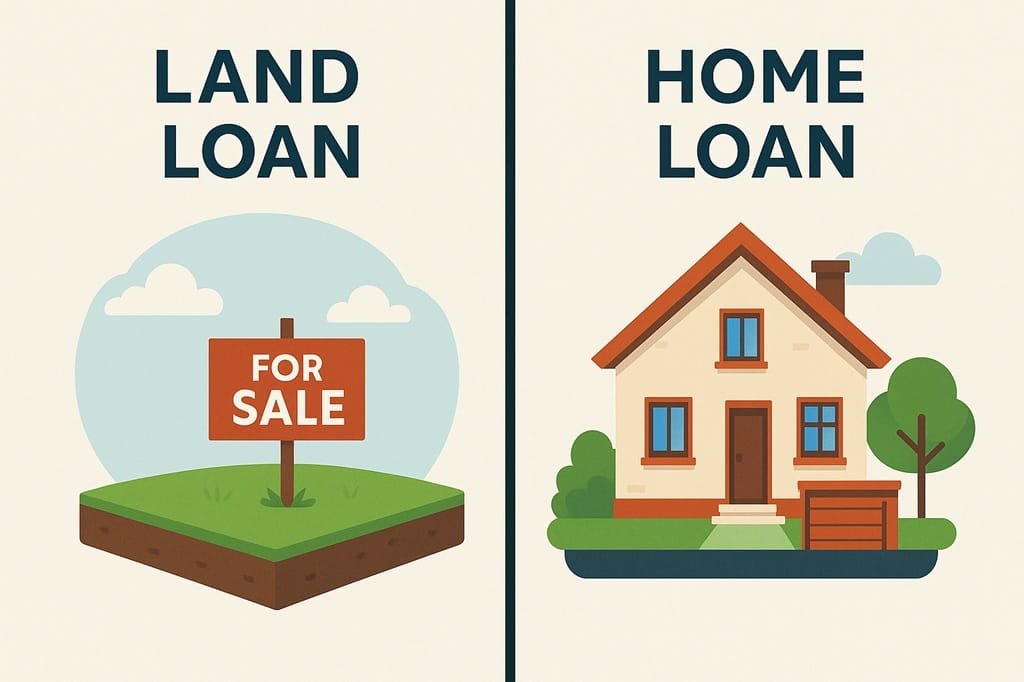
What is a Land Loan?
A land loan, also called a plot loan, is a financial product that helps you purchase a piece of land. The land could be:
- A residential plot within municipal limits
- A plot meant for constructing a house later
- A plot purchased from a government body or approved private developer
However, you can’t buy agricultural land or land in rural areas using a land loan. Banks usually finance plots located within city limits or in approved areas only.
Key Features of a Land Loan:
- Purpose: Buying a residential plot
- Property Type: Only non-agricultural, approved land
- Loan-to-Value (LTV): Up to 70–80% of the plot cost
- Tenure: Usually up to 15 years
- Construction Clause: Some lenders expect you to start construction within a certain time (say, 2 years)
In short, a land loan is perfect if you’re planning to build your dream home from the ground up.
What is a Home Loan?
A home loan is a loan taken to buy a ready-to-move-in house, an under-construction property, or even to renovate an existing home.
Key Features of a Home Loan:
- Purpose: Buying or constructing a house
- Property Type: Ready, under-construction, or even resale homes
- Loan-to-Value (LTV): Up to 90% of property value
- Tenure: Up to 30 years
- Tax Benefits: Yes, under Sections 80C and 24(b) of the Income Tax Act
Home loans are the go-to choice for anyone who wants to own a roof over their head right away.
Land Loan Vs Home Loan – What’s the Difference?
Let’s put both loans side by side and see how they really differ.
| Parameter | Land Loan | Home Loan |
| Purpose | Purchase of land or plot | Purchase or construction of a house |
| Property Type | Residential plot within municipal limits | Ready/under-construction homes |
| Loan-to-Value Ratio (LTV) | Up to 70–80% | Up to 85–90% |
| Tenure | Up to 15 years | Up to 30 years |
| Interest Rate | Slightly higher | Generally lower |
| Tax Benefits | Limited or none | Full tax benefits on principal & interest |
| Construction Requirement | Often mandatory within a time limit | Not applicable |
| Eligibility | Salaried or self-employed with proper documentation | Salaried or self-employed |
| Risk Perception (by banks) | Higher risk | Lower risk |
| Property Approval | Must be within municipal area & legally approved | Must have occupancy & builder approvals |
Why Are Interest Rates Different?
You might’ve noticed that land loans have slightly higher interest rates compared to home loans. But why?
It’s because banks view land as a non-productive asset. Until construction begins, the land doesn’t generate income or add tangible living value. On the other hand, a house provides immediate shelter and stability.
In simple terms, from a lender’s perspective:
- Land = Higher risk, lower resale value
- Home = Lower risk, stable value
So, if you take a land loan, expect to pay an interest rate that’s about 0.5%–1% higher than a typical home loan.
Tax Benefits – A Major Differentiator
When it comes to tax deductions, home loans take the trophy.
Home Loan Tax Benefits:
- Section 80C – Deduction up to ₹1.5 lakh on principal repayment
- Section 24(b) – Deduction up to ₹2 lakh on interest repayment for a self-occupied home
- Additional benefits for first-time buyers under Section 80EE or 80EEA
However, for land loans, tax benefits are limited:
- You can’t claim deductions on interest or principal repayment for just buying land.
- If you construct a house on that plot later using the same loan, you may claim benefits once the construction is complete.
So, in the Land Loan Vs Home Loan tax battle, the home loan wins hands down!
Loan-to-Value Ratio (LTV) – How Much Will the Bank Finance?
LTV simply means how much of the property’s value the bank is willing to finance.
- Home Loan: Up to 85–90% of the property value
- Land Loan: Around 70–80% of the plot value
For instance, if your plot costs ₹50 lakh, the bank may finance only up to ₹40 lakh, and you’ll have to pay the rest upfront.
That’s another subtle yet critical difference in the Land Loan Vs Home Loan comparison.
Repayment Tenure – Short vs Long Game
Time plays a major role in how comfortable your EMI feels.
- Home Loan: Tenure up to 30 years → smaller EMIs, easier repayment
- Land Loan: Tenure up to 15 years → higher EMIs, quicker closure
So, if you’re looking for flexibility and lower monthly stress, a home loan might be more manageable.
Eligibility & Documentation
Both loans require you to show steady income and a clean credit history. But the documentation may vary slightly.
Common Documents for Both:
- PAN card, Aadhaar card, and address proof
- Income proof (salary slips, ITRs, bank statements)
- Property documents (sale deed, approved plans, NOC, etc.)
Additional for Land Loan:
- Proof that the land is within municipal limits
- Land use permission (non-agricultural certificate)
- Encumbrance certificate
Since land carries higher risk, lenders scrutinize the paperwork more thoroughly.
Pros and Cons – Land Loan Vs Home Loan
Let’s weigh both sides of the coin.
✅ Advantages of a Land Loan:
- Freedom to design and build your dream home your way
- Potential appreciation in land value
- Option to construct later as per convenience
❌ Disadvantages of a Land Loan:
- Higher interest rates
- Shorter tenure and limited tax benefits
- Not available for agricultural or rural land
✅ Advantages of a Home Loan:
- Easier approvals and longer repayment period
- Full tax benefits on interest and principal
- Lower interest rates
❌ Disadvantages of a Home Loan:
- Less flexibility (you’re buying an already designed space)
- Higher property cost due to construction and amenities
Which One Should You Choose?
This depends on your goal, financial situation, and timeline.
Choose a Land Loan if:
- You want to build a custom home later
- You have patience and planning flexibility
- You’re comfortable with shorter tenure and higher EMI
Choose a Home Loan if:
- You want immediate possession of a ready house
- You seek tax savings and long-term repayment ease
- You prefer a stable, predictable investment
Simply put, if you’re a planner and dreamer, go for a land loan.
If you’re a doer who wants to move in now, pick a home loan.
How Do Banks View Each Loan Type?
Lenders love clarity. When you apply for a home loan, they see a tangible property with ready resale potential. It’s a safer bet for them.
But when it comes to land loans, banks are a bit cautious because:
- Land has no immediate use
- Resale is trickier if you default
- Value can fluctuate depending on location and future development
That’s why, during Land Loan Vs Home Loan evaluation, banks set stricter conditions for land loans—like higher down payment and faster construction timelines.
Construction Clause – The Hidden Twist
Here’s something many people miss: Some banks approve land loans only if you commit to start construction within a fixed period—say 2 or 3 years.
If you fail to do so, they might:
- Convert your loan into a personal loan (with higher interest), or
- Stop disbursing further loan installments
So, if your goal is just to invest in land for future resale, a land loan might not be ideal. Instead, consider other financing routes or invest from your own funds.
Future Value & Investment Perspective
From an investment lens, both have their unique charm.
Land:
- Appreciates faster in developing areas
- No depreciation
- Offers flexibility for future construction
Home:
- Provides immediate utility and rent potential
- Slower appreciation due to structure aging
- Easier resale and liquidity
If your aim is long-term appreciation, land could be your goldmine.
If your aim is steady returns and stability, home wins.
FAQs
- Can I convert a land loan into a home loan?
Yes, once you begin construction, some banks allow you to convert your land loan into a home construction loan.
- Can I buy agricultural land with a land loan?
No, land loans are strictly for residential plots within municipal or approved limits.
- Which has better tax benefits – land loan or home loan?
Home loans. Land loans offer no tax benefits unless you construct a home on that land.
- What’s the minimum down payment for a land loan?
Usually, around 20–30% of the plot’s value.
- Can NRIs apply for land loans?
Some banks allow NRIs to buy land, but it depends on local regulations and lender policies.
Expert Tips Before You Decide
Here are a few pointers to make your Land Loan Vs Home Loan journey smoother:
- Check property legality: Ensure clear titles, approvals, and zoning.
- Compare interest rates: Even 0.5% can make a big difference in total repayment.
- Read the fine print: Especially for construction clauses and penalties.
- Plan your EMIs smartly: Use online calculators to assess affordability.
- Think long-term: Choose based on future goals, not just immediate needs.
Conclusion
In the grand debate of Land Loan Vs Home Loan – What is the Difference? there’s no universal winner. It all boils down to your purpose and plans.
If you dream of designing your own home, enjoy flexibility, and can handle slightly higher EMIs, a land loan is your ticket.
But if you crave stability, ready possession, and tax savings, a home loan fits the bill perfectly.
Both paths lead to the same destination—property ownership—just through different routes.
So before you sign those papers, pause and ask yourself:
Do I want to build my dream… or buy it ready-made?
That one question will tell you everything you need to know.

