

Mutual funds investment in a child’s name would be a good start towards creating a financial base for the future. No matter whether it is for the purpose of funding their further education, marriage, or some other milestone, investing early would allow parents to have the benefit of time as well as that of the principle of compounding.
Parents/legal guardians of minors in India can invest on behalf of their children in mutual funds. The mutual fund in the name of the child is managed by the parent/guardian until the child attains the age of 18 years. Such minor mutual funds investment allows the parents to create a separate corpus for their children.
But, there are particular guidelines associated with investment in the child’s name concerning ownership, guardianship, KYC, taxes, SIPs, savings bank accounts and changeover of the MF portfolio after the child attains majority. One needs to learn about these guidelines prior to making any investment.
With consistent investments and sufficient tenure, even a small SIP can turn into a large sum. However, while choosing a mutual fund, one needs to keep in mind that mutual funds are market-based investments and hence returns are not assured. Therefore, a mutual fund must be chosen depending upon the child’s financial target, tenure of investment and the family’s risk appetite.
Why Consider Investing in a Child’s Name?
The process of bringing up children is full of fun, mayhem, and financial obligations. No matter if it is buying diapers or getting a degree, you will never stop paying for this. However, what if there were ways to turn some of those expenditures into capital accumulation? Investing money in a child’s name, especially using mutual funds, allows to accumulate a special fund which can be used for important events such as further education, wedding or even purchase of their first house.
This strategy allows creating a sense of difference between investing in yourself and investing in a child’s future. Moreover, due to compounding, even small regular investment over a period of 15-20 years will give great results and will provide your little baby with the opportunity to grow up into an adult person free from the burden of student debts – what a present!
Of course, all of that is not as easy as it may sound since you should take into account some laws and choose the appropriate fund. Don’t worry, however, we will do our best to simplify the whole process for you.
How Does a Mutual Fund Account for Child Actually Work?
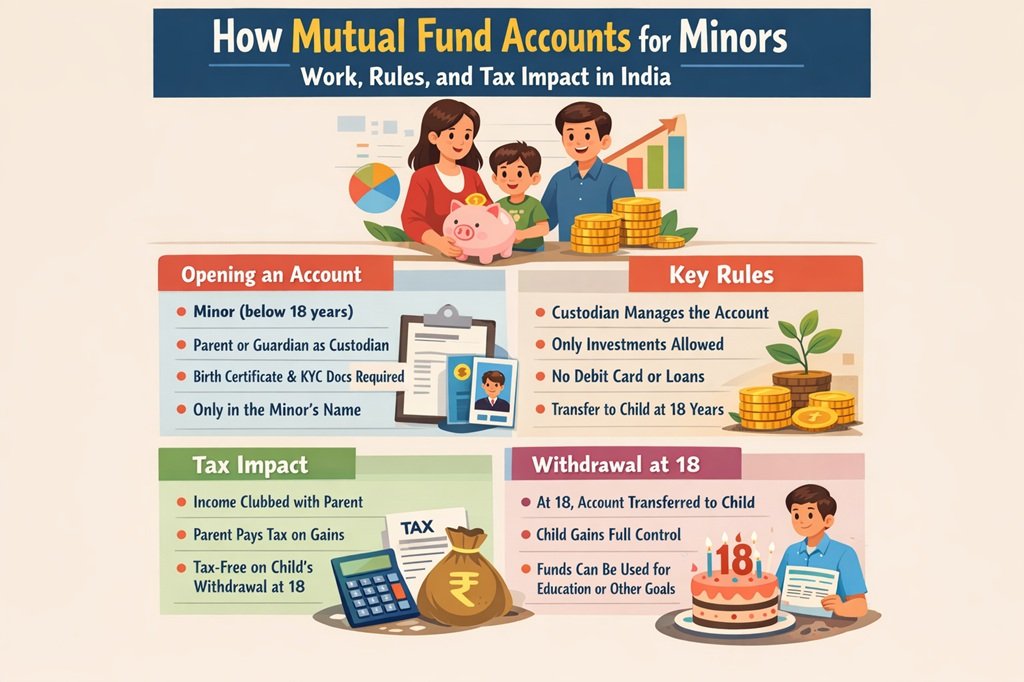
Once you apply for Mutual Fund Account for Child, the child (under 18 years of age) automatically becomes the sole shareholder of all investments done. The child’s name is entered in the folio as the first and the only one – no other names are acceptable in such accounts. Parent/legal guardian acts as the operator of the account till the child grows up and takes the responsibilities himself.
In simple words, the parent/legal guardian acts like a chauffeur for the kid’s financial account. You make the decision and drive the car of investment (decide how to invest), but the car itself is named in the kid’s name. You can buy equity funds for growth, debt funds for stability, or even choose a combination of both types of funds. The Systematic Investment Plan works wonderfully for such type of investments, but you can also choose lumpsum investment.
Ready for something special? It happens that parents start investing smaller amounts – for example ₹500 or ₹1000 per month. The market fluctuations will level off in the course of time with this approach, especially if the funds are diversified. But don’t forget about KYC regulations and transaction documentation!
Step-by-Step Guide to Opening a Mutual Fund Account for a Child
- Choose your AMC and schemes – Find out about various AMCs including HDFC, SBI or ICICI Prudential that have good reputations. Choose funds that suit your risk profile and time horizon.
- Prepare necessary documents – Age proof would be your child’s birth certificate or school documents, KYC documents including PAN and Aadhaar, relationship proof which would once again be the birth certificate and ideally a bank account in minor’s name or joint with the guardian.
- Filling up the form – Fill up the form with minor as the sole holder and yourself as the guardian of the minor. Mention whether it’s a new folio or addition to your existing folio.
- Submit and get verification done – Though several platforms allow for the online initiation, offline or e-signing would be required initially. Once done, you’re ready to go and start investing!
- Recurring investment setup – Make a bank mandate to do SIPs in future and reap the benefits of rupee cost averaging.
Rules and Regulations for Mutual Fund Accounts for Minors
As mentioned above, rules are aimed at protecting the minor’s assets; therefore, the list of rules is rather short and strict. The guardian has to be either a parent of the child or a legally appointed one; no uncles, aunts, or friends qualify. It’s usually father or mother and there is only one guardian in each folio.
What about redemptions or switches when the child is still a minor? It is done by the guardian, but the amount received goes directly to the minor’s bank account. It’s not recommended to keep the money for yourself unless there is an appropriate reason, as that may be considered as an abuse.
No joint holders – it’s a very important rule. The account should have a child’s name only. The category of investments is not limited; equity, debt, and whatever else is fine, but the goal of investing should stay the same – to build wealth.
Investing like this means thinking about the future of your children; however, if two parents are going to invest, it’s better to choose the guardian before starting.
The Tax Impact
But as it goes without saying, taxes tend to have a dampening effect on your zeal for investing. Under Section 64(1A) of the Income Tax Act, all such income from investments of dividends, interest, or from the sale of investment units are taxed at the hands of the parent whose income is higher till the child attains the age of 18. So, if your parents are in a higher tax bracket, they will have to pay taxes at their rate. Ouch!
There is still one bright spot, though. Under the erstwhile tax regime, one can enjoy an exemption of ₹1,500 per child per year of the clubbed income. Now that we talk of the new tax regime that is default for many taxpayers, the focus is more on reduced rates of taxes but lesser deductions.
In case of taxation of capital gains, short-term capital gains (less than 12 months for equity investments, 24/36 months for debt instruments) are added to your income and taxed at slab rates. Long-term equity investments beyond ₹1.25 lakh come at the rate of 12.5%. Debt investments may or may not benefit from indexation depending upon certain circumstances.
Tax Efficiency After the Child Turns 18
This is where it gets exciting, as well as tax-efficient. The Mutual Fund Account for Child becomes the complete responsibility of your child upon attaining majority age. The child will become an independent taxpayer. As most 18-year-olds have little to no other income sources, the basic exemption limit (which is about ₹3-4 lakh in the new system, subject to any revisions) can protect a significant portion of gains.
In addition, your child will have his/her own exemption of ₹1.25 lakh on the long-term capital gains from equity mutual funds. If he/she withdraws wisely (e.g., after holding it for years), the tax liability may be negligible or zero at all. Isn’t it great to have your now adult child able to use the money for education or a business with minimum tax deductions?
Well, if your child has already earned something by this time, the situation will change. However, proper planning of withdrawal can help greatly. Consult a tax professional for your particular case.
Conclusion
It was quite an informative discussion, wasn’t it? From the very principles of how a Mutual Fund Account for Child works to the details of legislation, taxation, and other recommendations, it’s easy to see why it’s such a beneficial investment option for parents. Of course, there are some bureaucratic issues and some taxation, but the results – providing secure future for your children and seeing their dreams come true – make everything worth it!
If you’re just beginning this journey or improving your already existing investments, now’s the time to start. Don’t be afraid to contact a financial consultant if necessary, evaluate your options periodically, and appreciate the process of creating your well-thought-out Mutual Fund Account for Child. It’s sure to pay off in both money and satisfaction from your hard work and loving attitude towards your family!

