

Indian investors have traditionally allocated their portfolios almost exclusively to local equities – Nifty 50, Sensex, and some large- and mid-cap mutual funds. This has been a profitable approach for most of the past decade. However, 2026 is shaping up to be a stark lesson in the dangers of “home bias.” As Indian benchmarks have been underperforming, there have been a number of foreign markets and mutual funds that have been doing remarkably well, thereby making a lot of retail investors wonder whether it makes sense to invest in global funds.
In this piece of article, we analyze the present performances of the foreign funds available to Indian investors, as well as analyze the foreign markets that are performing exceptionally well.
Why Indian Investors are Switching to Global Funds Now
The standard answer to this question would be diversification – spreading the risk across different economies, currencies, and macroeconomic factors. However, timing plays an important role as well. By August 2026, the performance of India’s own stock market has been noticeably worse than that of several Asian and Western competitors, whereas some overseas-oriented mutual funds accessible for Indian investors have shown returns that most domestic fund classes could not match in the current year.
This combination of poor performance of the home market and excellent options for overseas investments makes “global funds” the most sought-after investment category in the Indian retail sector.
Performance of Global Markets in 2026
An analysis of global indices reveals an interesting story on the areas that have performed well this year.
Asian Markets Are on Top
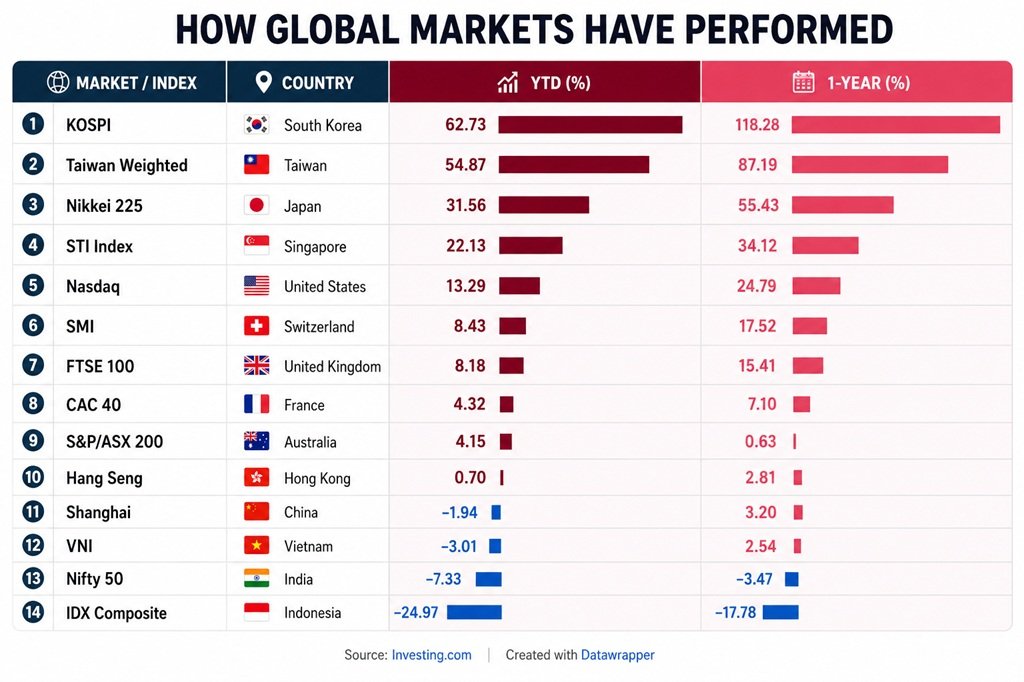
The South Korean KOSPI index has emerged as the best performing index globally this year, recording a year-to-date performance of 62.73% and a one-year performance of 118.28%. The Taiwanese Weighted Index has not been far behind either, having recorded a year-to-date performance of 54.87% and one-year performance of 87.19% due to their dominance in the manufacture of semiconductors and artificial intelligence.
Japan’s Nikkei 225 and the STI index in Singapore have also done very well, with a year-to-date performance of 31.56% and 55.43% respectively for the Nikkei 225 and 22.13% and 34.12% respectively for the STI index.
US and Europe: Gradual But Steady Progressions
On the other hand, markets of the developed West have shown a very conservative progression. In the US, Nasdaq has risen by 13.29% YTD and 24.79% over one year. In Switzerland, SMI has risen by 8.43% YTD (17.52% one-year), FTSE 100 of the UK has increased by 8.18% YTD (15.41% one-year), while the CAC 40 of France has increased by 4.32% YTD (7.1% one-year). As for Australia, the S&P/ASX 200 is up 4.15% YTD.
Position of India and Other Emerging Markets
Here comes the point that holds special significance for the investors from India. The Nifty 50 Index of India has shown a negative growth of -7.33% YTD with a one-year return of -3.47% in spite of the fact that most of the above markets have performed rather well over the period under consideration. The Hang Seng of Hong Kong has remained almost static (0.7% YTD), Shanghai index of China has fallen down a little (-1.94% YTD), while the VNI of Vietnam has fallen down by -3.01% YTD. On the other hand, the IDX Composite of Indonesia has suffered the worst YTD returns of -24.97%.
Highest Performing Overseas Mutual Funds Available for Indians to Invest In
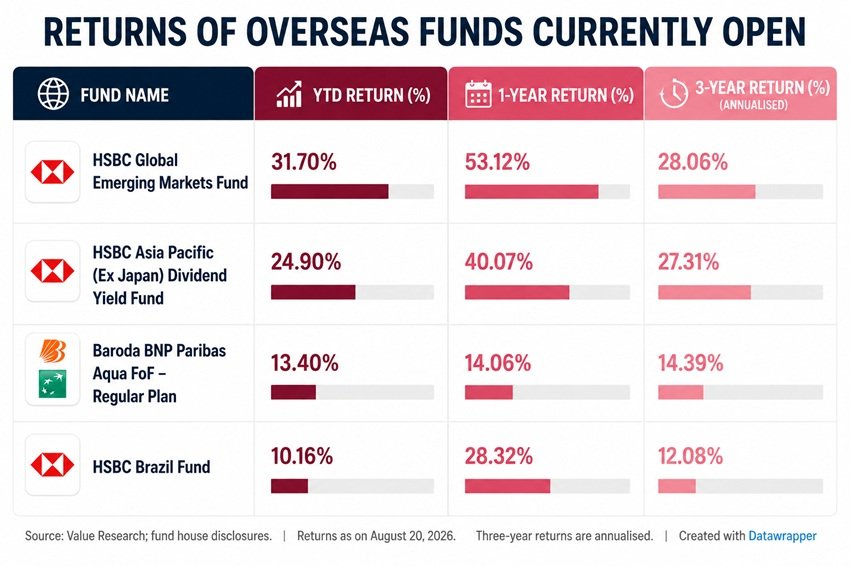
Thankfully, an Indian investor does not have to open any foreign trading account or go through the cumbersome process of money transfers for getting such exposure. There are many Indian asset management firms who offer various feeder funds and fund of funds products that invest in foreign markets. According to the latest performance results disclosed (performance up to August 20, 2026), the following are some of the best available funds that have performed well.
HSBC Global Emerging Markets Fund
This fund has generated a year-to-date return of 31.7%, a one-year return of 53.12%, and an annualized return over last three years of 28.06%. Since this is an emerging market fund, it stands to gain from the strong performance of emerging markets, particularly in Asia like South Korea and Taiwan.
HSBC Asia Pacific (Ex Japan) Dividend Yield Fund
Yielding an impressive YTD performance of 24.9%, one-year return of 40.07%, and annualized return of 27.31% in the past three years, this particular fund gives investors a chance to combine Asian region growth and dividends investment approach – a good choice for those who seek investments with international exposure without being subjected to risks involved in purely growth stocks.
Baroda BNP Paribas Aqua FoF – Regular Plan
Despite having much smaller numbers (13.4% YTD, 14.06% one-year, and 14.39% annualized three-year returns), this fund still shows decent results. The point is that being a thematic fund of funds (water and resource related themes), its return potential differs greatly from one of broad regional equity funds. Nevertheless, its thematic diversification cannot be replicated through domestic investment solutions.
HSBC Brazil Fund
Finally, the third fund with quite good return figures (10.16% YTD, 28.32% one-year, and 12.08% annualized in the past three years) is the HSBC Brazil Fund. It allows investors to receive good returns not only from Asian region but also from Latin America.
Indian Investor Access to International Funds
International mutual funds (also called feeder funds): This is one of the easiest ways to invest in foreign mutual funds, which are typically run by Indian AMC firms such as HSBC, Franklin Templeton, etc., and offer India-domiciled funds in an overseas fund/index structure. The investment is made in rupees, like any other mutual fund investment, either through SIP or in a lump sum format.
Fund of Funds (FoF): A concept similar to that of the feeder fund scheme, but at times specifically designed to invest in different foreign funds/indices or a particular theme-based index such as water, technology, and other international equities.
Direct international investments using the Liberalized Remittance Scheme (LRS): One may also directly make investments in international funds or stocks through opening an account with a foreign broker. However, it is subject to the foreign limit set by the RBI under the Liberalized Remittance Scheme ($250,000 in FY 2017-18).
Important Risks to Consider Prior to Investing Overseas
Investment in global funds does not necessarily ensure outperformance compared to domestic investments, and the data supporting diversification is a cause for concern as well.
Currency risk: The performance of overseas funds depends upon the rupee movement compared to the currency of the underlying market. Rupee depreciation will increase the performance of the overseas funds for the Indian investor, whereas rupee appreciation will decrease it regardless of the performance of the underlying market.
Hot theme bias: Most of the outperformance in 2023 has been on account of one particular theme, i.e., global demand for semiconductors and AI infrastructure, which has favored South Korea and Taiwan disproportionately, and it can turn around quickly.
Taxability: International mutual funds are generally considered to be debt funds from the perspective of capital gains (taxed at the rate applicable to the slab rate of the individual without any consideration for the holding period).
Fluctuations and drawdown risks: Developing countries, especially, tend to experience more volatility than those that are developed, and a fund that has generated 50% or more in a single year could as well end up making huge losses.
Expense ratios: FoF and feeder funds incur two expense ratios (the expense ratio of the fund itself and the expense ratio of the Indian scheme), which could significantly cut down the net income earned from investment.
Conclusion
Global funds should not be treated as a substitute for domestic stocks but more as a diversification sleeve — a percentage ranging from 10-20% of an equity portfolio, depending entirely on the individual’s objective, risk profile, and time frame. The objective of investing in such funds is not to capitalize on the markets that delivered the best returns for the year because that would mean buying when the price has already risen.
Since the domestic stock market of India has not performed well over the past year compared to other Asian markets, this could be a good time for the Indian investor to reassess how much of the portfolio is invested in domestic stocks alone and if it makes sense for them to invest internationally, at least in the form of funds mentioned above.

