

Creating an equipment rental business in India can prove to be a great business venture for any entrepreneur who is looking forward to making regular earnings without spending too much on the manufacturing process. People generally prefer to rent their equipment instead of buying expensive equipment which may not always be required. This is a growing requirement and one can make some good money through renting of such equipment including building equipment, agricultural equipment, sound systems, cameras, cleaning equipment, generators and many more.
The main benefit of the equipment rental business is that one can buy equipment once and then keep renting it over and over again to various clients. This will help in earning money from the same asset again and again. With proper equipment selection, pricing and maintenance, this business will definitely flourish. Whether someone wants to start the business with just a few rental items or wants to create a big equipment rental business, this business venture holds great promise in India.
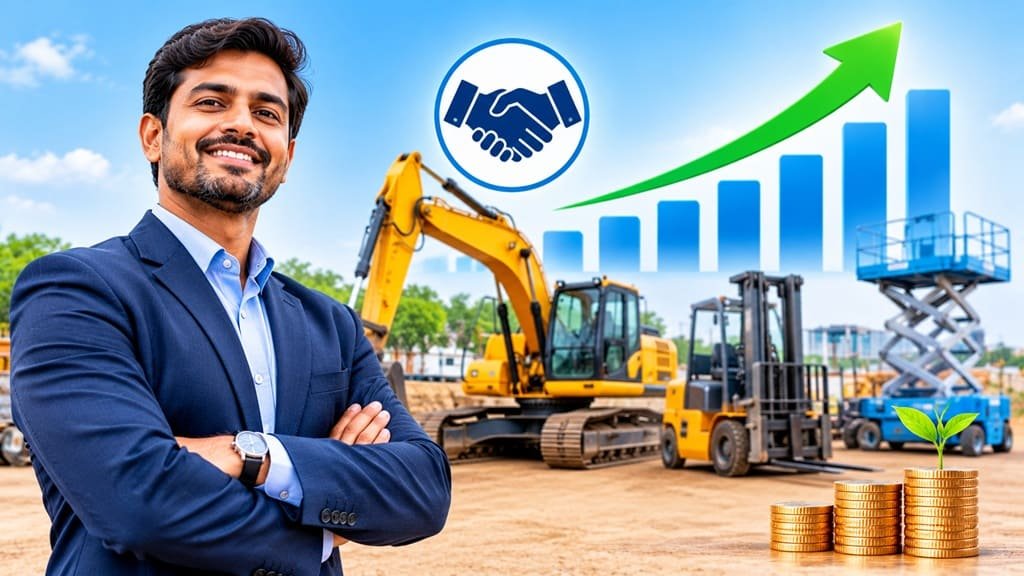
Why Equipment Rental Is a Smart Business Idea
This is a good business opportunity because there is no need to sell products every day to earn money. Instead, you purchase useful equipment and earn money by renting it out to customers whenever they want.
Here are some reasons why equipment rental business is a profitable business idea:
- Recurring revenue from the same asset. Once the item pays off its cost through rentals, all subsequent rentals are pure profit except maintenance.
- Growing demand. There is a growing demand among small contractors, event organisers, farmers, students and artists to rent equipment rather than buy costly equipment that is needed infrequently.
- Start small, grow slowly. You may start with just a few items and then use your earnings to purchase additional equipment.
- Asset backed business. Your equipment will have value and you may liquidate them if you want to change your direction.
Choosing the Right Niche
The key to starting this business with minimal investment is the choice of focused niche with consistent demand. Some popular niches in India are:
- Construction equipment – drills, breakers, concrete mixers, scaffolding, ladders and tile cutters for small contractors and home construction.
- Event equipment – tents, chairs, tables, lighting, sound system, generator and décor for weddings and functions.
- Agricultural equipment: sprayers, tillers, water pumps and harvest equipment for seasonal use.
- Camera and content gear: DSLRs, lenses, lighting and microphones for creators, students and small businesses.
- Medical equipment: wheelchairs, hospital beds and oxygen concentrators for home care.
- Power backup: inverters and generators for homes, shops and events.
Choose a niche you understand and where you can reach customers easily. Many other small business ideas with low investment share the same principle: start with what the local market already needs.
How Much Investment Is Needed
Investment depends on the niche. A camera and lighting rental business might start with a few lakh rupees in equipment. A small tools rental business can start with less. Event and construction rentals usually need more capital because of bulkier equipment, storage space and transport.
To keep investment low:
- Start with a small range of high-demand items.
- Buy good-condition used equipment where possible.
- Partner with other rental businesses to sub-rent items you do not own.
- Use a small storage space or home garage initially.
- Reinvest early profits instead of borrowing heavily.
Register and Formalise Your Business
Even a small rental business benefits from being formal. Register your business entity, open a business bank account and obtain GST registration if required. Registering as a micro or small enterprise on the Udyam Registration portal can make it easier to access government schemes, priority-sector lending and support programmes for MSMEs.
Registration instills trust amongst corporate clients, contractors and event agencies who prefer dealing with registered firms.
Pricing for Profit and Cash Flow
This is one area that causes rental businesses to fail. Your pricing must cover:
- Depreciation of the equipment
- Maintenance costs and repairs
- Delivery charges
- Insurance and storage costs
- Hours spent in setting up and dismantling equipment
- The equipment downtime due to non-utilization and repairs
Provide daily, weekly and monthly rates. Long-term rentals on daily rental basis often fetch better revenue with lesser hassles. Always collect a refundable security deposit to compensate for any possible losses in case of damage or delay.
An Example for Payback
Assuming you invest ₹60,000 in a concrete mixer and rent it out for ₹1,200 per day. Assuming it is rented out for 10 days a month, it will fetch a monthly income of ₹12,000. After taking into account its maintenance and transport costs, it will take you about six to seven months to recover your investment. After that, most of the rental income will be profit. The figures are illustrative; your actual figures will be different.
Managing Operations Efficiently
As your business starts growing, managing bookings and equipment will become harder and harder. Issues like double booking, forgetting to mark returns and not tracking deposits or maintenance will be a problem.
For most small rental businesses, it starts with using notebooks and WhatsApp. Then it switches to affordable rental billing software that helps manage equipment’s availability, booking, deposits, invoices and maintenance in one place. It will save you time, eliminate errors and help track which items bring you the highest income.
Promotion of Rental Business
- Create Google Business Profile with photos, prices and reviews of your services.
- Network in your local community. Contact contractors, event planners, architects, photographers and hardware stores.
- Promote your services on social media. Publish photos of your equipment working during events and at construction sites.
- Maintain a catalogue of equipment on WhatsApp with rates.
- Use referral discounts.
Risk Management
Any rental business has some risks – damaged equipment, theft, late returns and no payment. To minimize these risks, do the following:
- Take ID proof and deposit from the customer.
- Have rental agreements written.
- Take photos when delivering and picking up the equipment.
- Insurance for valuable equipment.
- Service equipment regularly.
Loyalty Building
Repeat customers are the lifeline of any rental service. Prioritize repeat customers and offer them preferential booking, ensure quality and timely services. A repeat customer will give you much more than a single booking.
Expanding after the First Venture
After establishing yourself in your first niche, you can expand your offerings by adding more equipment or servicing more areas around your city or collaborating with businesses that have a need for rental services on a regular basis, like construction companies, event planners and housing societies. Expand only as fast as you can manage to do so.
Maintain simple records of revenue per equipment per month so that you always know when it is time to add a second piece of equipment.
Conclusion
Equipment rental is one of the most practical low-capital business ideas in India. With a niche, proper pricing and management, your small scale rental business can generate sufficient cash flow to become a big business in the long run. Start small, track each rupee and reinvest in your business and you will be earning from your equipment for years to come.

