Blog Page 77

Gold Price Prediction 2026-2030 and Beyond

0

Gold Price – Gold has historically represented wealth and prosperity, particularly in India, where it is vital to culture, tradition, and investments. Archaeological discoveries indicate that gold was highly valued in ancient India, utilized not just for making jewelry but also for commerce and as a medium of exchange. It was greatly esteemed for its clarity and untainted quality. Gold has been a vital part of India’s heritage for centuries, from traditional jewelry to religious rituals. It is a reality that families in India together possess more than 11% of the world’s total gold.

Gold isn’t just an investment in India; it’s an emotion. From weddings to festivals, gold plays a central role in Indian culture. But beyond its cultural significance, gold is also a reliable financial asset. It’s no wonder that India is one of the largest consumers of gold in the world.

Have you ever considered how the price of gold has evolved over the years and what lies ahead for it? Let’s thoroughly examine the historical trends of gold prices in India and investigate expert forecasts for what lies ahead.

Gold Price Prediction

Gold Price History – 75 Years

Year Price (24 carat per 10 grams)
1947 ₹88.62
1948 ₹95.87
1949 ₹94.17
1950 ₹99.18
1951 ₹98.05
1952 ₹76.81
1953 ₹73.06
1954 ₹77.75
1955 ₹79.18
1956 ₹90.81
1957 ₹90.62
1958 ₹95.38
1959 ₹102.56
1960 ₹111.87
1961 ₹119.35
1962 ₹119.75
1963 ₹93
1964 ₹63.25
1965 ₹71.75
1966 ₹83.75
1967 ₹102.50
1968 ₹162.00
1969 ₹176.00
1970 ₹184.00
1971 ₹193.00
1972 ₹202.00
1973 ₹278.50
1974 ₹506.00
1975 ₹540.00
1976 ₹432.00
1977 ₹486.00
1978 ₹685.00
1979 ₹937.00
1980 ₹1,330.00
1981 ₹1670.00
1982 ₹1,645.00
1983 ₹1,800.00
1984 ₹1,970.00
1985 ₹2,130.00
1986 ₹2,140.00
1987 ₹2,570.00
1988 ₹3,130.00
1989 ₹3,140.00
1990 ₹3,200.00
1991 ₹3,466.00
1992 ₹4,334.00
1993 ₹4,140.00
1994 ₹4,598.00
1995 ₹4,680.00
1996 ₹5,160.00
1997 ₹4,725.00
1998 ₹4,045.00
1999 ₹4,234.00
2000 ₹4,400.00
2001 ₹4,300.00
2002 ₹4,990.00
2003 ₹5,600.00
2004 ₹5,850.00
2005 ₹7,000.00
2007 ₹10,800.00
2008 ₹12,500.00
2009 ₹14,500.00
2010 ₹18,500.00
2011 ₹26,400.00
2012 ₹31,050.00
2013 ₹29,600.00
2014 ₹28,006.50
2015 ₹26,343.50
2016 ₹28,623.50
2017 ₹29,667.50
2018 ₹31,438.00
2019 ₹35,220.00
2020 ₹48,651.00
2021 ₹48,720.00
2022 ₹52,670.00
2023 ₹65,330.00
2024 ₹80,450.00
2025 ₹120,000.00

Gold Price History in India

Gold prices in India have seen dramatic changes over the decades. Let’s take a trip down memory lane to understand how gold has performed over the years.

Pre-Independence Era – 1900s

Before India achieved independence, gold was essential as both a currency and a way to maintain wealth. Gold prices during this period stayed relatively stable, due to the established gold standard system. Since gold values were directly linked to the currency, variations were rare. The government-controlled gold imports, and the market wasn’t as open as it is today. During this period, gold was primarily seen as a cultural asset rather than an investment.

Post-Independence Period – 1947

Post-1947, India’s economic strategies started to change. The historical information on gold prices in this period shows a steady rise. The government enacted stringent rules on gold imports to control the economy, restricting the availability of the yellow metal and increasing its demand. Consequently, gold prices began to increase, reflecting India’s changing economic ambitions.

Liberalisation Phase – 1990s

In 1991, India’s gold market was transformed by economic liberalisation. By liberalizing the economy, the government permitted increased imports and implemented more adaptable pricing. Since the 1990s, there has been a significant increase in gold prices, influenced by evolving market conditions and heightened consumer demand.

A New Global Era – 2000s – Decade of Growth

The early 2000s significantly changed the global economy, influencing India’s gold prices. China’s rapid economic growth and the 2008 U.S. financial crisis triggered a worldwide surge in gold prices. In India, this period was marked by spikes in gold prices, reflecting international trends and the country’s economic development.

The 2000s were a golden era for gold prices. With increasing disposable incomes and a booming economy, Indians started investing heavily in gold. The global financial crisis of 2008 further boosted gold prices as investors sought safe-haven assets.

Volatility and Growth – 2010s

The 2010s were marked by both highs and lows. Gold prices hit an all-time high in 2011, only to fall sharply in the following years. However, by the end of the decade, prices had recovered and were on an upward trajectory.

Pandemic Era – 2020s

The COVID-19 pandemic brought unprecedented changes to the global economy, and gold prices were no exception. In 2020, gold prices in India crossed the ₹50,000 per 10-gram mark for the first time, driven by economic uncertainty and low interest rates.

Post-Pandemic Trend 

With economies recovering and inflation stabilizing, gold prices have seen fluctuations. As of 2025, gold is trading between ₹115,000 and ₹120,000 per 10 grams, reflecting global market trends and economic policies.

Gold Price Trend

Method of Checking Purity of Gold

What is Causing the Increase in Gold Prices?

Gold prices don’t move in a vacuum. Several factors influence the price of gold in India. Let’s break them down.

International Gold Rates

The fluctuation in global gold prices influences the gold rates in India. India’s economic connections with other nations significantly contribute to this aspect. Factors such as market sentiments, trade, and investment flows impact the Indian market.

Since India imports most of its gold, global prices play a significant role. Any change in international gold prices directly impacts domestic prices.

Dollar Exchange Rates

The value of the Indian rupee against the US dollar is another critical factor. A weaker rupee makes gold more expensive, while a stronger rupee can lower prices.

Demand and Supply

Festive seasons and weddings often drive up demand for gold in India, leading to higher prices. On the other hand, a surplus in supply can bring prices down.

Inflation and Interest Rates

Gold is often seen as a hedge against inflation. When inflation rises, so do gold prices. Conversely, higher interest rates can make gold less attractive compared to other investments.

Government Policies

The government develops various policies that impact the demand and supply of gold, consequently influencing its price. Import duties and taxes imposed by the government can significantly impact gold prices. For instance, an increase in import duty can lead to a spike in domestic gold prices.

Gold Investment Options in India

You can invest in gold online via several well-known platforms in India. These platforms are practical and accessible in various aspects. Explore some of the top gold investment opportunities listed below –

#1. Physical Gold – The Old but Gold Standard

Let’s face it, buying physical gold never really goes out of fashion in India. Whether it’s for weddings or as a rainy-day stash, it’s still the most emotionally satisfying way to invest.

Pros:

  • Tangible and easy to understand

  • Cultural significance

  • Easy to gift and pass on

Cons:

  • Making charges (up to 25%)

  • Risk of theft and storage issues

  • Difficult to liquidate instantly at fair value

Still, if you’re emotionally attached to gold, physical assets like coins and biscuits are a better bet than heavy necklaces.

#2. Gold ETFs – Trade Your Way to Gold Gains

Gold Exchange-Traded Funds (ETFs) let you invest in gold without holding it physically. They’re listed on the stock exchange and reflect the real-time Gold Price in India.

How it works:

  • You buy units just like you’d buy stocks

  • Each unit represents approximately 1 gram of gold

  • Backed by physical gold held by the fund

Why it shines:

  • Safe and secure

  • Transparent pricing

  • Lower expense ratios

#3. Sovereign Gold Bonds (SGBs) – Earn Interest on Your Gold

SGBs are the most underrated gold investment option out there. Issued by the RBI, these bonds offer the benefits of gold plus a 2.5% annual interest!

Key Highlights:

  • Tenure: 8 years (with an exit option after 5)

  • Issued in grams (minimum 1 gram)

  • No capital gains tax if held till maturity

Why go for it?

  • Safe (backed by Govt. of India)

  • Regular interest income

  • No storage hassle

Perfect for long-term investors who want to avoid the noise of daily Gold Price movements.

#4. Digital Gold – The 21st Century Piggy Bank

Gone are the days when gold investments meant standing in queues. Now, apps like Paytm, PhonePe, and Google Pay allow you to buy gold digitally, even for as little as ₹10.

What makes it click:

  • 24K gold purity (usually)

  • Can convert to physical gold anytime

  • Real-time tracking of Gold Price

Heads-up: Storage is handled by the service provider, usually backed by secure vaults and audit trails.

However, unlike SGBs or ETFs, digital gold doesn’t have any regulatory backing—so tread with caution.

#5. Gold Mutual Funds – Your Portfolio’s Golden Armor

If you want gold exposure but don’t want to juggle between ETFs and stock market apps, gold mutual funds are your jam. These invest in Gold ETFs and are managed by professionals.

Advantages:

  • SIP options available

  • Doesn’t require a Demat account

  • Diversified within the gold ecosystem

#6. Gold Savings Schemes – Traditional Meets Trendy

Jewelers like Tanishq, Kalyan, and Malabar offer monthly gold savings plans. You contribute monthly for, say, 11 months and get a bonus or discount in the 12th.

Should you invest?

  • Good for disciplined buyers

  • Fixed Gold Price not always guaranteed

  • Great for planning future jewelry purchases

Just remember—this isn’t an investment per se, but more of a pre-booking plan.

#7. E-Gold – NSE’s Hidden Gem

E-Gold, offered earlier by NSE’s NSEL platform, allowed investors to buy gold in dematerialized form. Though not currently active due to regulatory issues, similar platforms may arise in the future.

How it worked:

  • Units were stored in your Demat account

  • Can be converted into physical gold

  • Traded like shares

Watch this space—once rebooted, E-Gold could become a strong contender again.

#8. Gold Mining Stocks – Indirect, Yet Golden

Ever considered investing in companies that mine gold? While India has limited listed mining firms, global stocks via international mutual funds or ETFs can give you exposure.

Pros:

  • Potential for high returns

  • Diversification beyond metal

Cons:

  • Currency fluctuations

  • Subject to company performance, not just Gold Price

#9. Gold Derivatives – Not for the Faint-Hearted

For experienced traders, derivatives allow speculation on future Gold Prices.

Benefits:

  • Hedging tool for jewelers and importers

  • Potential to make profits in volatile markets

But beware—it’s not for beginners, and losses can be massive.

#10. Gold REITs – A New-Age Twist (Still Emerging)

Gold-focused Real Estate Investment Trusts (REITs) are a niche product abroad, but Indian markets may catch up. They typically invest in infrastructure for gold mining, logistics, or storage.

Watch this space—it might just become the next big thing.

#11. International Gold ETFs – Global Glint for Indian Investors

Indian investors can now invest in international gold ETFs through platforms like INDmoney or Kuvera.

What’s in it for you?

  • Exposure to global markets

  • Potential hedge against INR depreciation

  • Tracks global Gold Prices

Make sure to check for LRS rules (Liberalised Remittance Scheme) and other forex-related compliance norms.

Gold Price Prediction 2026-2030 and Beyond

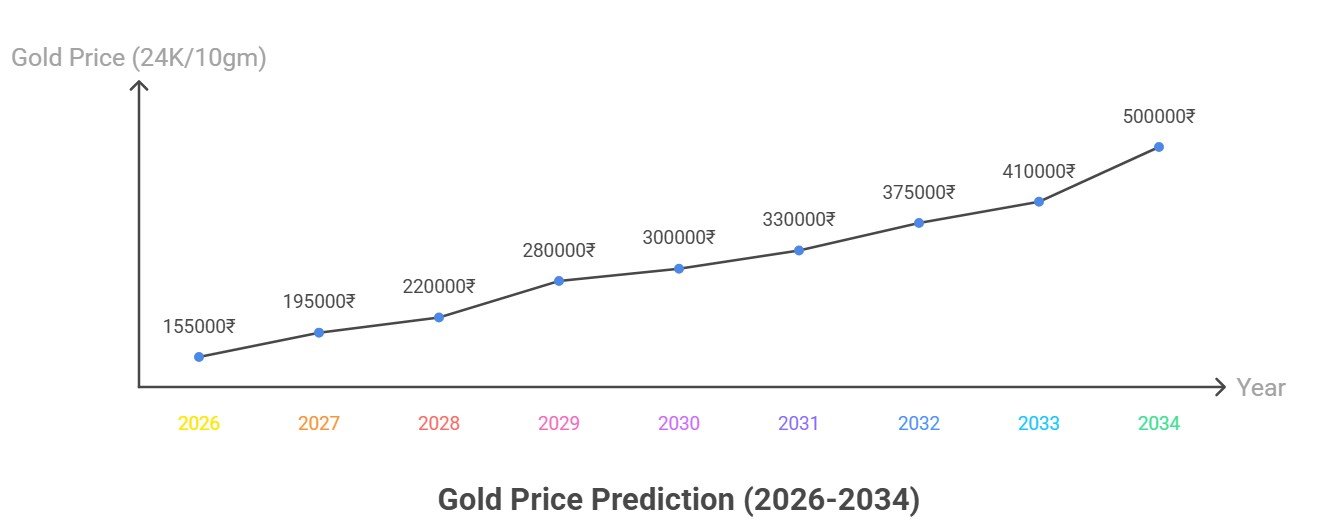
According to a survey, gold prices in India could reach a value of $3000 by December 2027 because of changes in the US dollar. The following chart shows the projected gold rates for the coming decade –

Year Expected Gold Price (24K/10gm)
2026 ₹ 155,000
2027 ₹ 195,000
2028  ₹ 2,20,000
2029 ₹ 2,80,000
2030 ₹ 3,00,000
2031 ₹ 3,30,000
2032  ₹ 3,75,000
2033 ₹ 4,10,000
2034 ₹ 5,00,000

Gold Price 2026-35

Gold Price Prediction 2026

Now, for the fun part: what do the pros say about gold price prediction 2026? Experts aren’t crystal ball gazers, but their forecasts, based on data and models, give us solid ground. UBS is optimistic, targeting $5,000 per ounce, driven by lower yields and economic woes. J.P. Morgan echoes that, eyeing $5,000 by Q4, with an average of $5,055, thanks to central bank buys and investor demand.

Goldman Sachs, tweaking their view, now sees $4,900 by year’s end, continuing the bull run. Over at the World Gold Council, they’re scenario-based: a mild slowdown could mean 5-15% gains, while a nasty recession might push 15-30% up from current levels. CoinCodex gets ambitious, predicting an average $5,540, ranging from $4,288 to $7,329.

Even Reddit folks are chiming in—some bet on $7,000+, citing ongoing dollar diversification and uncertainty. Trading Economics is more conservative, forecasting around $4,603 in 12 months. State Street sees $4,000-$4,500, but notes geopolitics could hit $5,000.

Synthesizing these, gold price prediction 2026 leans bullish, mostly in the $4,500-$5,500 range. But remember, experts can be wrong—markets have a mind of their own!

3 factors contributing to the rise in gold

  • Concerns about a trade war have risen because of the US tariff strategy. This could hinder the pace of economic growth. Concerns about a worldwide recession have also risen. In this scenario, individuals are boosting their investment in gold. Gold is regarded as a secure investment in periods of economic downturn.
  • The value of gold has risen because the rupee has depreciated against the dollar. The reason for this is that when the rupee declines, it becomes more expensive to import it. The rupee has lost roughly 4% of its value this year, creating upward pressure on gold prices.
  • As the wedding season nears, the need for gold jewelry is rising. Jewelers in cities such as Mumbai, Delhi, and Chennai reported that although prices are elevated, sales remain strong since individuals view gold as a representation of investment and wealth.

This means gold is expected to cross a level of 1 Lakh or above in 2025 itself.

FAQs

1. Why do gold prices fluctuate so much?

Gold prices are affected by multiple factors, including inflation, interest rates, global economic conditions, and currency exchange rates.

2. Is gold a better investment than stocks?

It depends on your investment goals. Gold is a safer bet during economic downturns, while stocks generally offer better returns over the long run.

3. How does the Indian government influence gold prices?

The government affects gold prices through import duties, taxation, and regulations on gold purchases and trading.

4. Will gold prices continue to rise in the future?

Most experts predict a gradual increase in gold prices due to rising demand, inflation, and limited gold reserves.

5. What is the best way to buy gold in India?

The best way depends on your needs. If you want physical ownership, gold coins or bars are good. For investment, ETFs, digital gold, and sovereign gold bonds offer better returns with lower risks.

6. What is the best time to buy gold in India?

The best time to buy gold is usually during the off-season when demand is low, and prices are more stable.

Conclusion

Gold has consistently proven to be a dependable investment, and its past patterns indicate that it will remain a worthwhile asset going forward. Although temporary variations might take place, enduring expansion appears unavoidable. If you want to broaden your investment portfolio, gold is a reliable choice. Just be certain to keep informed about market trends and invest prudently!

Gold has stood the test of time as a valuable asset. Whether you’re looking to invest or simply admire its beauty, gold will always hold a special place in India. As we look to the future, gold prices are likely to remain strong, driven by cultural significance and economic factors.

Wrapping this up, gold price prediction 2026 paints a mostly rosy picture, with experts betting on climbs amid ongoing global jitters. From UBS’s $5,000 target to wilder $7,000 guesses, the consensus is upward, though not without bumps. We’ve covered the history, factors, scenarios, and strategies—hopefully, it’s given you food for thought.

Remember, investing’s personal; do your homework, maybe chat with an advisor. Gold’s endured through ages, and in 2026, it might just keep glittering. Excited? You should be— the future’s golden! Stay tuned to markets, and who knows, your predictions might outshine the pros.

Why are millennials opting for term plans more than traditional life insurance?

Life insurance is one among a long list of things modern finance differs from how previous generations plan finances. Affordability, flexibility, and being able to do everything online are some features that these financial products have drummed in for millennials, and life insurance is no exception. Term plan insurance is now gaining popularity over traditional life insurance policies. But why? Let’s take a deep look into why that is happening.

why term plans

Affordability Matters to Millennials

The millennials prefer prudent management of finances. They are not fond of spending lavishly, and term plan insurance is the answer to this factor. Term plan insurance will offer coverage worth much more than traditional life insurance policies, including endowment plans or whole life insurance, at much lower premiums.

For example, a 30-year-old non-smoker can get a term insurance cover of ₹1 crore for as low as ₹700-₹1000 per month, but the same cover will be unaffordable in the traditional life insurance product because of its savings component. Most millennials would want to invest in products that provide a higher return and hence don’t see much value in tying up their money in low-yielding life insurance products.

Simplicity and Transparency

The other main reason why millennials prefer term insurance is its simplicity. Traditional life insurance policies have complicated structures, multiple charges, and unclear returns. Bonus components, maturity benefits and investment-linked returns can seem very complicated.

On the contrary, term insurance is very simple: pay a fixed premium and, in case of your unfortunate untimely death, dependents are paid. It’s this simplicity that appeals to millennials as they conduct research and make well-informed financial decisions.

Digital Convenience & Instant Decision Making

Millennials are digital natives. They rely heavily on online platforms for financial transactions, including purchasing insurance. The availability of term insurance calculator allows them to compare different plans, customize coverage, and make informed decisions without visiting an insurance agent or branch.

With online term plans, purchasing a policy has become seamless. Most insurers offer a fully digital buying process, thus eliminating the paperwork and cutting down on turnaround time. This is a solution that resonates with the quick and hassle-free solutions of the millennials.

Investments Instead of Savings-Based Insurance

Traditional life insurance, though carrying with it an element of investment also, has comparative returns much lower than other kinds of investments possible through mutual funds, stocks or real estate among others. Also, millennials believe in separating both their insurance as well as investments. They require term plan insurance for full protection and accumulate savings in comparatively high-return generating investments.

For instance, instead of investing money in an endowment plan that gives a return of 4-6%, a millennial may invest in a term plan and the rest in mutual funds that may generate 10-15% returns annually. This way, the wealth is created better and also provides financial protection.

Flexibility and Customization Through Riders

Unlike traditional life cover, term insurance has various rider add-ons that meet the needs of its policyholders. Millennials would like the flexibility to add on for example:

Critical Illness Rider- The insurance also includes the insurance part, which deals with major diseases, such as cancer, heart attack or kidney failure.

Accidental Death Benefit- An additional design would be subjected to unusual deaths.

Waiver of Premium- This is one way of the policy to be given another source of payroll if the principal cannot pay due to a disability or critical illness.

These add-on options enable term plan insurance to be the first choice of the leaners for they can extract the special offers that suit them.

Financial Independence and Responsibilities

Unlike the preceding generations, millennial people crave financial independence. Many of them take loans to pursue education or buy a house or even initiate their own ventures. With these financial liabilities, securing the future of their families in case they die early would be very crucial. A term insurance calculator lets them know exactly how much they need to buy to pay their debts and fund their family during their absence. This generation also believes in planning for uncertainties, especially after witnessing economic crises, job instability, and global pandemics. Term plan insurance is a reliable safety net that ensures dependents do not struggle financially if something unexpected happens.

Awareness of Financial Planning at an Early Age

Far more aware than any previous generation, millennials are hooked up to the internet and social media. They follow financial blogs, influencer webinars, and up-to-date smart money management knowledge that has been disseminated to the public via the internet.

With increasing financial education, they will realize the concept of term plans and make sure to calculate with a term insurance calculator what they need, after considering the kind of income or lifestyle they need to lead with their future visions. Another valid reason for increased popularity among youth professionals is for this reason.

Tax Benefits under Section 80C and 10(10D)

Tax benefits are another reason to encourage millennials to invest in term plan insurance. The deductibility under Section 80C of the Income Tax Act is up to ₹1.5 lakh with the amount of premium paid. The nominee also gets relief from tax on the death benefit received under Section 10(10D).

Millenials are eager to minimize their tax liabilities. Therefore, they view term insurance as a strategic financial tool rather than an expense.

COVID-19 and the Value of Life Cover

The occurrence of the COVID-19 pandemic became an eye-opener for most young professionals; thus, the likelihood of untimely death was portrayed. Heightened awareness regarding health and financial security resulted in a large surge in purchasing term insurance. Millennials learned that life insurance is not the exclusive preserve of the elderly but rather a financial safety net for anyone.

With the advancement of remote working, gig economy jobs, and self-employment, traditional employer-provided life insurance is not considered sufficient enough. Therefore, millennials are turning to independence to make personal-term plans that ensure financial security for their family.

Conclusion

Millennials are redefining financial planning by prioritizing affordability, flexibility, and high-value financial products. Their preference for term plan insurance over traditional life insurance stems from a rational approach to wealth management and financial security.

With easy access to online comparisons, the ability to use a term insurance calculator, and a proper understanding of financial planning, millennials are making very informed decisions about their lifestyle and goals.

Now is the perfect time to plan for your future if you haven’t already and secure your future with a term plan to financially protect your loved ones.

How to Choose the Best Guaranteed Income Plan in India

0

A guaranteed income plan can thus be viewed as a good financial plan that puts a guarantee on a stream of income. It is one of the favourite plans of those who want to receive a stable income for a long time. Key reasons that qualify individuals for these plans include retirement planning, major life milestones or a regular income during volatile economies. Investment options are manifold, and that is why, selecting the right guaranteed income plan in India remains a challenging task.

This blog section will help you to understand what key factors you need to consider while searching for the right plan for yourself.

Guaranteed Income Plan

What is a Guaranteed Income Plan?

Guaranteed income plan is an investment program that provides income payments in addition to life insurance. These plans provide a certain kind of assured return in a way furthering the financial security devoid of market affiliated risks of market-linked products.

Looking up for the best guaranteed income plan in India one will find a blend of life coverage, risk-free returns, tax exemptions and Flexibility which is worth being used as an effective financial tool.

Key Factors to Consider

  1. Evaluate Your Financial Objectives
  • Before selecting a plan, determine what you want from it:
  • Do you intend to have a regular postretirement income?
  • Do you need money for your child’s education or marriage?
  • Do you need steady inflow during working years?
  • Knowing your needs will enable you to select a plan that fits your needs.
  1. Guaranteed Payouts and Flexibility

Assess the payout design of the plan. The best-guaranteed income plan in India will provide you with flexible payout options that work for you:

  • Regular Income: Suitable for retirement or monthly needs.
  • Lump-Sum Payment: Suitable for major financial goals.
  • Combination Plans: Some plans provide a combination of regular income and a lump-sum payout, which offers more flexibility.
  1. Life Insurance Coverage

One of the primary advantages of guaranteed income plans is life insurance coverage. Ensure the plan will offer adequate protection for your family in the case of an untimely death.

This combined benefit of income and protection makes these plans a comprehensive financial tool.

  1. Terms and Premium

Select the terms of the policy that would cover your timeframes. For example:

  • Short periods may suit specific short-term purposes.
  • Long durations are good to use when a retirement or longevity income stream.

Check, also for the premium, how it fits on your pocketbook while being given the advantages for you to buy.

  1. Tax Advantages

The best-guaranteed income plan in India will provide tax benefits under Sections 80C and 10(10D) of the Income Tax Act. These deductions help reduce your tax liability and increase the return on investment.

  1. Reputation and Solvency of the Insurer

Choose a plan from a good reputed insurer with high solvency margins. High claim settlement ratios and solvency margins give the impression that they are reliable and can pay up their commitments.

Why a Guaranteed Income Plan?

A guaranteed income plan ensures:

  • Fixed payouts for stability
  • Life coverage for the family
  • Risk-free investment with predictable returns

By selecting the right plan, you can successfully work towards your financial goals while keeping your mind at peace.

SBI UPI Limit – How To Increase SBI Per Day Transaction Limit?

0

UPI (Unified Payments Interface) has revolutionized digital payments in India, making transactions seamless and instant. As an SBI (State Bank of India) customer, you may have faced problems with transaction limits when utilizing UPI. Regardless of whether you own a business, shop often, or are merely involved in high-value transactions, grasping and enhancing your SBI UPI limit is essential. Let’s delve into the specifics and examine ways to increase your UPI transaction limits.

SBI UPI Limit

Understanding SBI UPI Limits

Before we discuss increasing your UPI transaction limit, it’s essential to understand the restrictions SBI imposes on UPI transactions.

This SBI UPI limit helps you handle your finances more wisely and prevent unnecessary spending each day. Since mid-2023, the State Bank of India has implemented this new regulation for UPI transactions. The bank additionally limits its customers to a maximum of 10 transactions each day. SBI customers are required to follow this transaction limit for making payments on all UPI applications.

Understanding the SBI UPI transaction limits for 2025 guarantees that you can maximize your digital banking experience without encountering unforeseen challenges. By comprehending the daily and monthly transaction caps, along with knowing any relevant fees, you can organize your transactions efficiently. For any changes or questions about your UPI limits, SBI provides easy online and offline options to assist you in managing your banking requirements effortlessly. Keeping updated on these guidelines will assist you in ensuring seamless and effective digital transactions.

What Is the Default SBI UPI Limit?

SBI has set a default limit for UPI transactions to ensure security and prevent fraud. Here’s what you need to know:

  • Per Transaction Limit: ₹1,00,000
  • Daily Transaction Limit: ₹1,00,000
  • Newly Registered UPI Users: ₹5,000 per transaction for the first 24 hours

It is crucial to recognize that these limits may vary at the bank’s discretion. Consequently, customers must remain informed about the rules and regulations established by SBI to keep aligned with the SBI UPI limit.

Why Does SBI Impose UPI Limits?

SBI enforces transaction limits to:

  • Reduce the risk of fraud and unauthorized transactions.
  • Ensure banking system stability.
  • Prevent misuse of UPI services.

The highest SBI UPI transaction limit is Rs.1,00,000. You can customize this limit to fit your financial strategy using the SBI YONO app.

How To Check Increase SBI UPI Transaction Limit?

If you’re unsure about your current UPI transaction limit, follow these simple steps:

Using SBI YONO App

  • Download the SBI YONO app from the Google Play Store or Apple Store. Complete your first-time registration for SBI YONO App.
  • Login at SBI YONO using MPIN.
  • From the Left side menu item select “YONO Pay”. Click on View All, You will be taken to the “YONO Pay screen”, where you can find “Manage Transaction Limit”.
  • On clicking “Manage Transaction Limit”, the App will ask for an Internet banking profile password.
  • Enter your Internet banking profile password. Now you can set the transaction limit.
  • Enter the amount you want to keep as a transaction limit. Click on the confirm button given below.
  • OTP will be generated and sent to your registered mobile number. Once you enter the correct OTP and press the submit button, your transaction limit will be changed to a new transaction limit.
  • You will be able to see the message ” Your third-party transaction limit has been successfully set.

The limit set by you will be your revised overall third-party transaction limit. Please ensure sufficient limits in case you have scheduled transactions / standing instructions in your accounts.

How To Increase SBI Per Day Transaction Limit Using SBI Net Banking

  • Visit the State Bank of India Website and sign in using your SBI Net Banking Username and Password. OTP will be generated and sent to the registered mobile number for second-level authentication. Enter the OTP.
  • From the Left side menu Go to Profile >> Define Limit Option.
  • You will be prompted for a Profile Password. Enter your Profile Password and press the submit button.
  • On the Next page, you will be able to see various transaction limits such as – Demand Draft Limit, Tax Transaction Limit, and Merchant Limit for special category merchants.
  • Below you will find the option to change your daily and per transaction limit for General Category Merchants. It would be something like – Click Here to set up per day/per transaction limit for General Category Merchants.
  • Enter the amount for your transaction limit and press the submit button.
  • Press the approve button. The system will generate OTP. Enter the one-time password sent to your mobile number and press the confirm button to change your transaction limit.

If you’re facing issues increasing your limit, you can:

  • Call SBI Customer Care at 1800 1234.
  • Visit your home branch and request a UPI limit enhancement.
  • Drop an email to SBI support with a request to increase your UPI limit.

If you’re a new UPI user, SBI restricts your limit to ₹5,000 per transaction for the first 24 hours. After this period, your limit will be automatically raised.

Common Reasons for UPI Limit Issues

Even if you try increasing your UPI limit, you may still face limitations. Here are some common reasons:

1. New Account or New UPI Registration

  • If you’ve recently created an SBI account or just activated UPI, you’ll have to wait 24 hours before increasing the limit.

2. Exceeding Daily Transaction Limit

  • SBI has a hard cap of ₹1,00,000 per day for UPI transactions. If you hit this limit, you’ll need to wait until the next day.

3. Technical Issues

  • Sometimes, server outages or app glitches can prevent limit modifications. Try again after some time.

4. Inactive Account

  • If your bank account hasn’t been active for a long time, SBI may impose lower transaction limits for security reasons.

Tips to Avoid UPI Transaction Failures

If you frequently face UPI transaction failures, here are some handy tips:

1. Ensure Sufficient Balance

  • Insufficient funds can cause transactions to fail. Always check your balance before making payments.

2. Update Your UPI App

  • Using outdated versions of Google Pay, PhonePe, or SBI YONO might cause issues. Update regularly.

3. Use a Stable Internet Connection

  • Poor network connectivity can interrupt UPI transactions. Use Wi-Fi or a stable 4G/5G network.

4. Verify Payee Details

  • Entering the wrong UPI ID or mobile number can lead to failed transactions. Double-check before sending money.

5. Try Alternative UPI Apps

  • If one app (e.g., Google Pay) isn’t working, try another (e.g., PhonePe, Paytm, or SBI Pay).

Final Thoughts

SBI UPI limits are in place to ensure security, but they can sometimes feel restrictive. Luckily, increasing your limit is a straightforward process using SBI YONO, net banking, or customer support. By following the steps outlined above, you can seamlessly enhance your transaction limits and enjoy hassle-free digital payments. If you face any issues, SBI’s customer support is always there to assist you!

FAQs

1. What is the maximum UPI transaction limit in SBI?

SBI allows a maximum of ₹1,00,000 per transaction and per day for UPI transactions.

2. How long does it take to increase my SBI UPI limit?

If done via YONO or net banking, the change is instant. Otherwise, customer service requests may take 24-48 hours.

3. Why is my SBI UPI limit restricted to ₹5,000?

New UPI users have a default limit of ₹5,000 for the first 24 hours, after which it increases automatically.

4. Can I increase my SBI UPI limit beyond ₹1,00,000?

No, RBI regulations cap the maximum UPI transaction limit at ₹1,00,000.

5. What should I do if my UPI limit increase request fails?

Ensure your account is active, try a different method, or contact SBI customer support for assistance.