

Blog Page 474

Home loan HRA and your Taxes!

6

Home loan HRA

Suresh, currently employed with MNC Company in Mumbai, is staying in a rented apartment in Mumbai and has bought himself a property in Ahemedabad for which he has taken a home loan.

Now he is in confusion while filing tax returns – “Can I claim both HRA and home loan benefits?”

This seems to be a dilemma for most tax payers. When Suresh pays rent, under the Income tax act, he is definitely allowed to claim both HRA and home loan benefits (interest payment and principal repayment).

Similar to Suresh we have many queries about Home loan, HRA and Tax Benefits, Let us try to evaluate various possible situations an individual can find himself in and understand what the income tax act permits him to do.

Situation 1: You live in your own house purchased via Home loan

You have taken a home loan and residing in the house purchased with it. Since you are residing in your own house, you will not be able to claim HRA. However, you will be able to claim tax benefits on both, the principal and interest repaid on the home loan.

Situation 2: You own a house in another city

This situation was the one faced by Suresh. He resided in Mumbai but had bought an apartment in Ahmedabad taking a home loan. Suresh will be entitled to HRA exemption and tax benefits on both, the principal and interest repaid on the home loan.

Situation 3: Your house cannot be occupied at this point

You have bought a house in same city of your work by taking a home loan and you’re currently living in same city in a rented apartment because the house is under construction. In such a case, you are eligible to claim HRA.

In such case you can take partial tax benefit on the home loan, you can claim tax benefits only for your principal before the completion of your house.

Once your house is completed, you can claim tax benefits on the total interest paid up.

Situation 4: You have a house but you cannot reside in it

You have bought a house in Surat taking a home loan and now you aren’t residing in it but are living in a rented apartment in Surat itself for genuine reasons e.g. the house that you have bought is far away from your office.

In such cases, the Income tax act permits the individual to claim HRA and home loan benefits which includes both principal and interest repaid on the home loan.

Also, please note that if your house remains vacant, then you will still need to pay tax on a notional rent income.

Situation 5: You have rented your own house and currently residing in a rented house

You took a home loan and your house is now ready for occupation. You have rented the same out while you reside in a rented house. The Income tax act allows you to claim both HRA and home loan benefits.

However, in such a case, since you are the recipient of rent because you have let out your own house, that income is taxable at your hands.

The Income Tax Act treats HRA and home loan deductions under separate sections independently. The two are not interconnected to each other.

HRA is dealt with in section 10(13A) Rule 2A while home loans are entitled for tax benefits under section 80C (tax benefit on principal repayment) and Section 24 (tax benefit on interest payment) of the Income Tax Act. Hence, feel free to avail both tax benefits accordingly.


Tips to prevent credit card frauds

Credit card Fraud

Credit card and Debit card is good alternative to physical money. Most of the people use credit card & debit card to make payments. But this plastic card has to be used with care else you may end up lending in to fraud. According to a Times of India report today, a global gang has skimmed Rs 30 crore off Indian credit card users in just two months.

As per the report, numerous credit cards have been cloned by using skimmers and the card details have been used to make international online transactions. Cloning may happen when cardholders travel to some global destinations that are notorious for cloning. Not only that sometime cloning may happen with cards where the holder has neither travelled abroad nor used it for online transactions.

As per report all top credit card issuers — ICICI Bank, HDFC Bank, Citibank, SBI Cards and Axis Bank — have been affected by these frauds.

So how you can prevent various types of frauds? Here are quick answers.

First thing you must understand that there are two types of transaction you do with your credit card. One is online on internet for making online purchase and other is offline where card is required during transaction like shopping in mall or payment of restraint bill etc.

So your card is exposed to two types of risk cloning during online transaction or during offline transaction.

Online Transaction:-

Check out following tips to prevent online fraud using credit card.

  1. While doing online transaction with credit card look for website with https as starting web address and not http. Here“s” stands for “secured”. Http website passes information to server in plain text while Https transmit information in encrypted format so information cannot be accessed by any party/hacker other than the client and end server.
  2. Also look for a lock sign in the address bar as shown in picture below.

website lock

  1. Online transactions in Indian has two step authentications, where apart from using the card number and CVV (three digit number on the reverse side of the card) you need to use password a one-ime password provided by your bank and the secured access password via Verified by Visa and Master secure code, depending on your card service provider. If the website does not ask for authentication do not go ahead with the transaction.
  2. Check the security certificates on the payment gateways sites. Certificate looks like:-

website certificate

  1. Avoid using credit cards online, instead use virtual credit cards. A virtual card is a new 16-digit number, generated on the basis of your physical credit cards. You also get a CVV2 number and expiry date. You can generate a virtual card by doing a one-time registration with your bank. You get a unique login and password. You will need to specify the amount you want to spend with your virtual card. This ensures your entire credit limit is not exposed to the online transaction.
  2. Get yourself another card with a smaller credit limit, and dedicate this card for use in online transitions alone. That way you would decrease the risk of exposing a high credit limit online.

Offline Transaction:-

There is not much you can do about frauds that happen on your physical card. As card can be cloned easily by doing offline transaction, if person swipe your card on machine which capture data of card he/she can create clone easily. You can take following precaution to prevent this.

  1. Never give card to anyone. While shopping closely watch your card that it is not swiped on any other machine. But in some cases it is noticed that hacker has attacked EDC machine and stolen all data in this case you can’t do much about this.
  2. Move to a chip-and-PIN-based card. This card has a sim-card like chip on the front of the card and can be used only with a four digit PIN. So, unless you punch the PIN into the EDC machine, the card transaction won’t go through. Also chip-based card, the account information is stored on the chip and that too in an encrypted format. Since chip-based card stores the data in an encrypted format, the data cannot be skimmed.
  3. Also ensure that you blacken the CVV number (the three digit number at the reverse of your card) with a permanent ink marker. And, memories the number instead. That way, the fraudster won’t have access to this sensitive information.

The truth is that fraudsters are getting sophisticated by the day. So you have no option but to be careful and follow the tips given above to avoid any fraud.

Valuation of Property in India – Key Factors

1

Investment in Property can generate good returns for the investor. However, you need to be careful in the selection of property. While buying and selling real estate, the valuation of property is extremely important. If you are planning to invest in real estate or if you have already invested your money in real estate you might be worried about pricing part of property.

We are herewith an article focusing on the factors that affect the pricing or valuation of property in India.

real estate

Valuation of Property in India

Location and amenities

Location
Buildings, real estate, and properties, located in commercial and market areas or in the vicinity of schools, colleges, or posh areas, hold higher valuations. It is common to find brokers quoting a higher price for buildings in well-developed and approved colonies and areas as against those in the less developed and upcoming areas.

Amenities
The valuation of properties with better infrastructural capabilities and modern amenities are costlier than those that fail to provide proper electric connections, telephone lines, water sewerage facilities, and all other infrastructure such as community centers, clubhouses, children’s play areas, swimming pools, gymnasiums, parking lots or general stores, etc. Valuation of property is clearly based on the availability of necessities and facilities connected with comfortable housing.

Infrastructure

Infrastructural development is one of the most important factors which influence real estate prices in India. The presence of roads, airports, flyovers, malls bus terminals, and other facilities in the vicinity of the property, helps in value escalation of the same.

It is a known fact that connectivity is one of the most important requirements for investors looking to purchase land or property. This leads to the concept which explains a rise in the valuation of property that is well connected to entertainment hubs, medical facilities, educational institutions, retail markets, and business centers, along with other day-to-day facilities.

Commercial real estate

Places such as Noida, Gurgaon, Pune, Hyderabad, Navi Mumbai, and Andheri-Borivili in Mumbai, are striking examples of commercial development which have affected the valuation of property in these areas.

The development of malls, IT offices, and Special Economic Zones near residential areas helps cut down the time and energy wasted in commuting to workplaces and increase the price of real estate in the area.

Disposable income and availability of land

Disposable Income

Properties that are located in agricultural areas or those dominated by manufacturing units attract a lower price than those situated near the IT hubs. The valuation of property is in direct proportion to the quantum of disposable income in the hands of the purchaser or the majority of the population in that area.

Availability of land

In places where there is ample land available for residential purposes or the development of real estate, the graph reflecting the valuation of property shows a slower rise than in areas where land is comparatively scarce.

Demand and Supply

Demand for real estate in a particular area is inversely proportional to its supply. As the supply or availability of real estate decreases, the valuation of property increases.

Changes in population are the key drivers of demand. Along with an increase in the number of people inhabiting a particular area, the popularity of a particular locality in terms of people wanting to be a part of the locality also increases its price.

Affordability

Affordability refers to the cost incurred by the owner in the process of enjoying or retaining a property. In layman’s terms, it is the term that establishes a relationship between interest rates, property prices, and maintenance costs.

If any of the above three variables reach their maximum level in a particular area, then the inhabitants start looking towards a better lifestyle elsewhere.

Structure

The valuation of property is dependent on the specifications of materials used, layout, design, durability, and life cycle of the building.

The quality and cost of materials during construction, size, current rates of labor, frontage, and other physical attributes such as roof covering, height of the building, type of foundation, waterproofing, and plinth level, also affect the price of a particular property.

Customization

The cost of real estate becomes higher in the event of builders undertaking customization of residential space on the lines of the purchaser’s requirements. For example, some investors may want landscaped terraces or verandahs connected with their apartments, upgraded kitchens, specifically designed internal stairways in duplex apartments, higher quality paint and flooring, or other user-defined changes.

This leads to an escalation in the ultimate price charged to the buyer. Before making their real estate purchase decisions, investors should conduct an analysis of these drivers to get a fair valuation of the property that interests them. Careful investigation and homework can lead to better returns, easy liquidity, and more lucrative investments.

How to Generate Residual or Passive Income?

passive income

In today without income it is very difficult to live for anyone, thus Income is important part of our life. We do various things in order to generate income like job, business etc.  But do you know types of incomes and which one is best?  Let us discuss the same.

Types of Income:-

Earned Income or Linear Income:-

Earned income or Linear income is any income that is generated by working. More than 90% of people around the world are accustomed to the source of income known as Linear Income or Earned Income. Your salary or money made from employment is considered earned income.

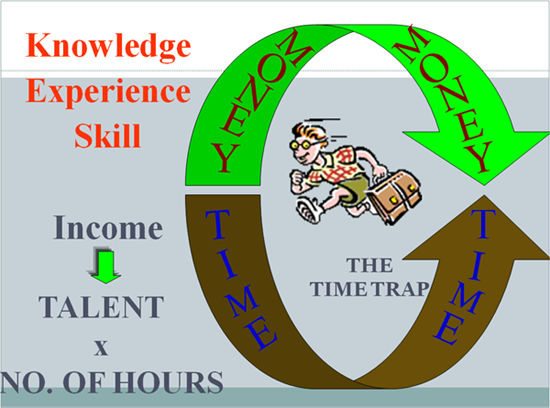
While earned income is the most common mechanism for making money, it’s obvious downside is that once you stop working, you stop making money. Additionally, because the amount of money that is made through earned income is directly proportional to the time and effort you spend working, it’s difficult for someone to make more earned income without either learning a new (or more valuable) skill or working longer hours. Additionally, earned income is taxed at a higher rate than any other type of income. Earned Income or Linear Income requires continued work.

Time Trap

One huge benefit of earned income over the other income types is that you generally don’t need any startup capital in order to make earned income, which explains why most people rely on earned income from the start of their working life.

Portfolio Income:-

Once we generate income we make investment, these investments put together is known as portfolio. Income generated by this investment is known as portfolio investment.

In other words Portfolio income is any income generated by selling an investment at a higher price than you paid for it. Some people refer to portfolio income as “capital gains.”

Income generated by buying selling stocks, mutual funds, real estate or other assets falls in this category.

Portfolio income certainly has some advantages over earned income. Once you have the knowledge and experience to generate portfolio income on a consistent basis, you can continually reap the benefits (compound your return) by reinvesting after each sale. Additionally, any portfolio assets held long-term are generally taxed at a lower rate.

Residual or Passive Income:-

Residual Income or passive income is different. It is the most powerful and profitable source of income. Residual Income or passive income is the income of the rich. It is a source of income that keeps coming in on a regular basis, from work you do once – meaning even when you are not working. Residual Income is not about “get rich quick” – the principal very much misunderstood by many people. It requires effort, determination, especially in the beginning… and some time for the magic to start working.

Solution for Time Trap:-

There is nothing wrong with having a Linear Income. It is considered to be an honourable form of earning a living. Some people can earn good money. Hourly wages can run from a few rupees to thousands of rupees. However, Linear Income is limited to the number of hours worked and only provides an income when you work. In other words, when you stop work, it stops.

More and more people are turning to something called time leveraging to create long term Residual Income. With time leveraging, there is no hourly limit placed on your worth and money continues to come to you whether you work or not. The difference between Linear Income and Residual Income is that with Residual Income, your productive time is leveraged. That is, your time spent at work becomes increasingly worth more and more. Unlike fixed-salary employment, leveraged income has no upper limit.

How to Generate Residual or Passive Income:

You can generate residual or passive income by following ways:-

  • Creating and Selling Intellectual Property — Books, Patents, Song writing, Internet Content. This type of income is also known as royalty income.
  • You earn interest on your savings account or certificate of deposit at your bank. That’s as long as you keep the money in the bank.
  • Real estate is proven way to earn good income but it requires special expertise and a great deal of money nowadays. You need to be a real estate owner to earn Residual Income through rent.
  • Direct selling, Referral, or network, marketing business

Earned income is Good Income, Portfolio income is better income but believe me residual income is best income. I can say it is the best retirement insurance and the only method for most people. If you agree with me start building residual or passive income now.

For more information get in touch with me on info@moneyexcel.com