
Blog Page 444

15 Tools & Apps for a Startup Company

You might have selected good business ideas for your upcoming startup company. You might be ready with the resources and money required to make this startup company successful. However, executing those ideas in a correct manner is a difficult task. In order to help you in fulfilling your business dream here are 15 Tools & Apps for your startup company.

15 Tools Application for Startup Company

15 Tools & Apps for a Startup Company

 1 Trello

Trello is a very useful task manager for your startup company. This free tool offers the facility to manage tasks in an organized manner. You need not maintain lengthy email, spreadsheets, and sticky notes for your project you can use Trello which provide a flexible and visual way to organize everything. A business version of this tool gives additional administrative controls and security.

2 OneNote

OneNote is a popular tool from Microsoft. OneNote can give multiple benefits to your startup. You can work in an organized manner using OneNote. It allows you to take notes on the fly. You can record minutes of meetings using OneNote. You can add any file, email, and tag information to this tool. I highly recommend the usage of this tool for a startup company.

Bidsketch

Bidsketch is proposal software that allows you to create professional client proposals in minutes. You can customize these proposals as per your requirement. You can even electronically sign these proposals. It is a paid product but if your startup company is involved in writing a lot of proposals to clients I recommend having a look at Bidsketch.

Recuruiterbox

It is obvious that you require good manpower to run your startup company. Recuruiterbox is a software that helps you to carry out the recruitment process easily. You can track and manage job applications. You can customize your recruitment process with this tool. You can even organize and share a review about candidates using this tool. It will also help you to do resume management.

Zoho Invoice Generator

Zoho Invoice generator is a free online tool that will help you to generate your invoice quickly. This tool gives various editable fields. You just need to input data and your Invoice is ready. You can print the invoice or save it for reference. It is the fastest and easiest method to generate an invoice.

6. Vyapar Invoicing software

Vyapar is GST Billing Software in India for small businesses. You can manage your business professionally with Vyapar. Vyapar is the software for billing, inventory, and accounting needs. It is a desktop-based application that allows you to create GST Bills for customers. You can share them online. You can manage bills and send payment reminders to recover dues. It also helps in managing inventory. Overall it is very good software for small and medium-size business owners.

7 DropBox

During the startup process of your business, you may need to store and keep a lot of documents. If you want to exchange information with other you can use DropBox. DropBox gives you a free facility to store your data.

Slack

Slack is a free communication tool for effective collaboration. This is a similar tool to MS Teams it allows you to do group conversations, file sharing, and content search. Slack is free to use for as long as you want and with an unlimited number of people. The paid version of Slack includes guest access, a searchable archive, etc.

Flyp

Flyp app allows you assign six phone numbers on your smartphone. This number remains simultaneously live on your smartphone. You can have a dedicated number for every activity. Each number has own SMS, voicemail, and profile facility.

10 Basecamp

Basecamp is online project management and collaboration tool. This tool gives essential workspace to a team for day to day operations. Basecamp is cloud base platform which gives task list, discussion platform, documents and calendar for project management. One can integrate basecamp with other desktop and web-based applications.

11 Wrike

Wrike is an online Project management tool for your startup company. Wrike combines project management with a real-time workspace for collaboration, discussion, and document sharing. You can set a goal, define priority, and track projects using this tool. This tool helps you to improve your planning and accountability.

12 Invision

Invision is a design, prototyping, collaboration, and workflow tool. You can transform static designs into a clickable prototypes using this tool. You can present and share designs using this tool. You can even gather feedback on the design. It is the best project management tool for web designers.

13 Product Hunt

Product Hunt is a tool to share and discover new products for your startup company. You can find detail about competitor products on this site. You can also share your product on this website and increase your revenue. Product Hunt is a free tool.

14 Quickbooks

Quickbooks help your startup company to organize your finances at one place. You can do invoicing, bookkeeping, billing, expense tracking, and sales using this tool. This tool works across all devices. (iPad, iPhone, Android). It helps business owners to make an informed decisions. You can avail of 30 days free trial of this tool before purchasing.

15 intercom.io

Intercom is a customer communication platform. Intercom helps you to have a live conversation with the customer. You can send targeted messages to website visitors and users of your app. Intercom gives you a free trial pack for 14 days. The observation package of this tool is free forever. You must try this tool for your business.

Hope you find the above tools useful and interesting. Please help us in growing this list by adding tools that you use for your startup company.

Do share your experience of using various tools & apps.

New Tax Free Bonds 2015-16: Features & Benefits

tax free bonds

Tax Free Bond is one of the popular investment option to earn a tax free return. In India, we have very few investment options offering tax-free returns. Public provident funds (PPF), Sukanya Samriddhi Scheme (SSA) and Tax free bonds are investment options that offer tax-free return. All other investment instruments including fixed deposits, NSCs, MIS etc., attract tax on interest income.

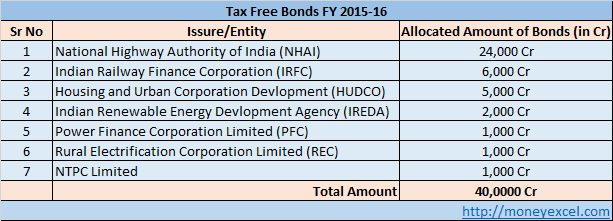
After a wait of one year, Tax free bonds are about to hit the market again. Finance Ministry has given the mandate to the seven companies including NHAI, Indian Railways to raise fund via New Tax-Free Bonds in the financial year 2015-16. The amount allocated for tax-free bonds this financial year is 40,000 crore. These funds are expected to offer interest rate in the range of 7.3-7.5%.  The maturity period of these funds will be 10-15-20 years.

New Tax-Free Bonds 2015-16

As discussed above government has given permission to seven different entities to sell tax-free bonds to raise capital of 40,000 crores. This fund will be used for infrastructure-related projects. List of New Tax free bonds for FY 2015-16 and allocation details are given below.

tax free bonds

What is Tax Free Bond?

Tax free bond is document security against money borrowing given to issuer (Government or PSUs). Issuer or borrower is bound to pay fixed rate of interest (coupon rate) against this bond till the maturity. Interest income earned from tax free bond is exempted from taxation u/s 10 of the Income Tax Act, 1961.

Tax free vs Tax Saving

People often get confused and between Tax free and Tax saving terminology. Although both these terminology sounds similar there is a huge difference between these two.

Tax Saving – Tax-saving instrument means an investment that saves your tax. There is certain provision made in Income tax that allows the tax payer to save tax by investing in some tax saving instruments like ELSS, Tax saving Fixed Deposit, Life Insurance premium, PPF etc. An investor can claim tax benefit by investing under this instrument under section 80C.

Tax Free –   Tax Free instrument means money earned from this investment is tax fee. No tax is applicable on this income. This income is not included while calculating tax on total income. An example of tax free investment instruments is PPF, Sukanya Samriddhi Scheme and Tax Free Bonds.

Who can invest in Tax Free Bond?

Tax Free bonds allow investment in three different category. Details of these categories are given below.

  • Retail Investor
  • High Net worth Investor (HNI)
  • NRI Non Residential Indians
  • Qualified Institutional Buyers
  • Corporates

How to Invest in Tax Free Bond?

You can invest in tax free bonds when bond issue opens for the subscription. This issue will be open for the specific duration. Bond can be purchased in physical or in demat format. PAN card is mandatory in order to buy Tax Free bonds.

The maturity period of Tax free bond is 10 years, 15 years or 20 years. In case you are in need of money in between, you can redeem this bond by selling them in the secondary market. Finding a buyer in the secondary market for the bond is challenging.

Interest rate paid by tax free bond is in the range of 7 -9%. This interest is paid by the issuer at the fixed set of the interval.

How to select Good Tax Free Bond?

Before making an investment in Tax Free bond you should carry out an independent study. Consider following factors before making the selection of tax free bond.

Credit Rating –

Credit Rating is a third party assessment of issuer providing this bond. This assessment is carried out by rating agency like CRISIL, ICRA or Fitch. You should buy Tax free bond with good ratings like AAA, AA+ or AA.

Interest Rate –

Another factor which is important in the selection of tax free bond is Interest rate. You should select tax free bond offering good interest rate.

Payment Frequency –

Payment frequency of bond is also important factor. Higher the payment frequency means better is a bond for investment. Generally issuer pays interest rate annually.

Tax free bonds vs other Investment Options

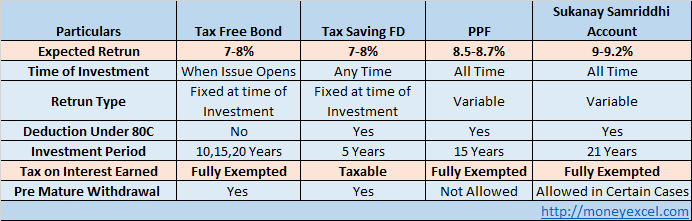
In order to compare tax free bonds with other investment options please refer to the table given below.

tax free bond comparision

Should you invest in Tax Free Bonds?

Tax Free bond is very good investment option providing consistent tax free return till maturity, however, longer maturity period of tax free bond is limiting factor. Investing in such a long term investment option is advisable only if you have surplus money for investment. Tax free bond is less liquid and traded seldom in the secondary market. Before investing make sure that this investment option fits well with your financial goal.

If you are falling under 30% tax bracket you can consider purchasing tax free bond as tax free bond provide better return compare to tax saving investment instruments.

New Tax Free bonds will be likely to hit the market in month of September, 2015. I will update this post as soon as I get information about these bonds.

Do share your views on Tax Free Bond.

If you like this post do share it on facebook and Twitter.

Credit Card Debit Card Payment may bring Income Tax Benefit

credit card income tax

Go Cashless make payment through credit card or debit card and get Income tax benefit. Soon this is going to become the reality.Guideline of encouraging electronic transaction is being proposed by the government today. This smart move is aimed towards reducing cash transaction, tax avoidance and black money. Let’s take a quick look at what benefit you are likely to get for using credit card and debit card.

Proposed Tax Benefit of using Credit Card Debit Card

  • The government is planning to give Tax benefits in terms of tax rebates to the consumer who use electronic mode for their expenditure.
  • Current transaction charges on utility service like petrol pumps, gas agencies, railway ticket booking will be removed.
  • Utility bill payment like electricity, gas, mobile bill etc. may fetch additional discount of 1%, similar to BSNL, which provide 1% discount on bill amount if bill payment is done through electronic mode.
  • It is proposed that high-value transaction say, more than Rs. 1 Lac shall be done through electronic mode only.
  • New grievance redressal mechanism to be introduced for supporting electronic transactions. In case of fraud transaction, the money will be credited back to customer account and card will be block. This card will be released after the investigation is over.
  • It is also proposed to offer tax rebate benefit to shopkeepers and merchants for doing significant amount of sale through credit card or debit cards. If merchant is doing at least 50% of sale through electronic means this benefit is applicable. Additional 1-2% reduction in Value added Tax will be given on all electronic transactions by the shopkeeper or merchants.
  • At present inter-change fee of debit card and credit card transactions are not uniform. Draft proposal said it should be rationalized.
  • At present, banks have to report the cumulative of all the payments made by a credit card holder as one transaction, if such an amount is Rs. 2 Lac in a year. To facilitate high-value transactions, the upper limit of Rs. 2 Lac could be increased to say Rs. 5 Lac or more.
  • Electronic transaction mentioned above also includes any prepaid instruments which facilitate electronic transaction like mobile wallets, mobile apps, net banking, Electronic clearing service, National electronic fund transfer and Immediate payment Service.

My opinion –

It is indeed very good initiative by Government of India. It will help government to achieve following.

  • Reduction in Cash Transaction
  • Reduce cost of managing cash in economy
  • Reducing Tax Avoidance and Increasing Tax Payment
  • Reduce Impact of Black Money

You will get following benefits as an Individual

  • Additional Income tax benefit and other incentives
  • Improving credit score based on transaction history
  • Ease of conducting transaction

For more information on this draft please visit mygov.in

I support this initiative. To support this initiative do share this post on Facebook and Twitter.

How to know your Gratuity Benefits – Calculator Download

Gratuity Calculator

Gratuity is a monetary reward paid by an employer at the end of employment. This benefit is applicable if you stay in employment for 5 years or more. It is a mandatory benefit as per the Payment Gratuity Act India 1972. This act applies to all establishments, where 10 or more employees are working in the preceding 12 months. If you are changing your job and want to calculate gratuity benefits here is a simple gratuity calculator, eligibility, and tax benefits.

Eligibility

  • An individual is eligible for gratuity benefits if he/she has completed 5 years of continuous service in the organization.
  • This benefit is not applicable if employment is terminated due to disability or due to death. In case of death, this benefit is payable to the nominee or legal heir.
  • The maximum amount payable shall not exceed 10 Lakh.
  • The time limit is 30 days of gratuity becoming payable.

Employer needs to pay gratuity amount –

  • On Resignation
  • On Retirement, Voluntary retirement, Superannuation
  • On Termination or Layoff
  • On Death
  • On Disablement

The application can be made by –

  • An individual eligible employee
  • Nominee of the employee (In case of death)
  • Legal Heir of the employee (If nomination is not made)

Gratuity Calculation –

The gratuity calculation of employees working with a company covered by the gratuity act is given below.

G = Y x S x 15/26

S = Last Drawn Monthly Salary (Basic + DA)

Y = Number of Years Completed in Service

15 = 15 days salary

26 = Number of working days in the month

Let’s say your last drawn monthly salary is 30,000 Rs and you have worked for the organization for 10 years. The amount payable would be

Gratuity Amount = 30,000 x 15 x 10 / 26 = 1.73 Lac

Download Gratuity Calculator

Gratuity Calculate

Note – The number of Years would be rounded off to the nearest year. The last 6 months or less are to be ignored, however, if it is more than 6 months it is to be counted as a full year.

You can download this Calculator from the following link.

Gratuity Calculation

Taxation 

The gratuity amount is taxable if received when you change your job (on resignation) or on termination. This amount falls under the head of “salaries”.

If this amount is paid at retirement, death, or superannuation it is tax exempted.

Conclusion –

The gratuity calculator given above will help you in calculating the right gratuity amount. If you are planning to change your job just before 5 years, do consider your decision after calculating gratuity amount. You may lose this excellent benefit you are entitled to after completion of 5 years.