Blog Page 438

EPFO mobile app launched – Check EPF balance on the move

EPFO Mobile App

EPFO mobile app is launched. Now you can check your EPF balance on the move. This EPFO mobile app also gives facility to SMS-based UAN (Universal Account Number) activation. EPF member can also access their account for viewing their EPF passbook and balance available in the account. Let’s explore the detail of EPFO mobile app.

EPFO mobile app Key Features –

  • A Member can activate UAN using this app.
  • Member can check EPF balance
  • EPF member can download EPF passbook.
  • EPF Pensioner can get information about pension disbursement details.
  • One can verify EPF deposit by entering TRRN number.

How to use EPFO mobile app?

First you need to download EPFO mobile app from EPFO website. You will find three different section under this application (1) Member (2) Pensioner (3) Employer.

Member

Under Member section, you have two options (1) Activate UAN (2) Balance/Passbook

Download EPFO Passbook via Umang App

Activate UAN

If your UAN Number is not activated you can use this section to activate your UAN.

Step-1 – Click on Activate UAN button.

Step-2 – You will be prompted with form asking for information about establishment code, extension, employee number, UAN number and Mobile Number.

Step-3 – After filling up correct detail click on “ACTIVATE” button to activate your UAN.

P2P Lending – How it works? Concept and Regulation

Balance/Passbook

You can check Balance or download your EPF Passbook using this option.

Step-1 – Click on Balance/Passbook button.

Step-2 – You will be prompted with form asking for UAN and Mobile Number.

EPF Balance

Step-3 – Enter the detail and click on “SHOW” button to know balance and other details.

Pensioner

Under Pensioner section, EPF pensioner can get information about pension disbursement.

Step-1 Click on Pensioner button.

Step-2 Enter PPO number and Date of Birth.

Step-3 Click on Submit button to know the details.

How to link Aadhaar to EPF Online on UAN Portal?

Employer

Under Employer section employer can get information about EPF deposit.

Step-1 Click on TRRN Status button under Employer tab.

Step-2 Enter TRRN Number

Step-3 Click on Show status button to know the details.

Prior to launching EPFO App, EPFO has already given facility to check EPF balance by sending SMS – EPFOHO. EPFO mobile app is additional facility given for the members. This mobile app facility is enabled only for the UAN activated members.  So if you have not done your UAN activation please get it done as early as possible.

If you are seeking more information about this app, please feel free to submit your query in the comment section.

Do share this app with your colleague.

National Pension Scheme and Atal Pension Yojana main differences

0

National Pension Scheme

National Pension Scheme (NPS) and Atal Pension Yojana are most popular social security schemes launched by the government of India. Both these schemes are intended to provide a pension at the retirement age. So, why two different pension schemes are required? What are the differences between National Pension Scheme and Atal Pension Yojana? Let’s try to figure out the difference between these schemes.

What is National Pension Scheme?

National Pension Scheme is retirement saving pension scheme launched by the government of India. This scheme is also known as a new pension scheme. This scheme is regulated and administered by PFRDA.

  • The minimum age of joining NPS is 18 years and maximum age is 55 years.
  • NPS is based on a unique Permanent Retirement Account Number (PRAN) which is allocated to each subscriber on joining NPS.
  • The NPS scheme offers two types of accounts.Tier I account – This account is known as a pension account. Withdrawal from this account is restricted till subscriber attains the age of 60 years.Tier II account – This account is normal investment account. Withdrawal from this account can be done as per requirement of the subscriber.
  • NPS gives options to invest in three funds. (1) Equity (2) Corporate Bonds (3) Government Securities.
  • NPS Subscriber can switch the asset allocation once in a financial year.
  • NPS does not provide guaranteed pension.
  • National pension scheme gives tax benefits up to 2 Lac.
  • All contributions of subscriber are invested in the pension fund schemes and the subscriber will be able to know the value of the investment on day to day basis.
  • One can open NPS account at point of presence of NPS.
  • NPS Scheme is mainly focusing on the organized sector.

For more information about National Pension Scheme visit official NPS site.

What is Atal Pension Yojana?

Atal Pension Yojana is pension scheme by the government of India. Atal Pension Yojana is also known as APY. This scheme provides a defined pension, depending on the contribution, and its period.

  • The minimum age of joining APY is 18 years and maximum age is 40 years.
  • Under the Atal Pension Yojana, subscriber will receive the fixed pension from 1000 Rs per month to 5000 Rs per month.
  • Atal Pension Yojana does not offer any tax benefits
  • You can apply for Atal pension yojana at designated banks.
  • APY Scheme is mainly focusing on unorganized sector.
  • Under APY, only one account is permissible.

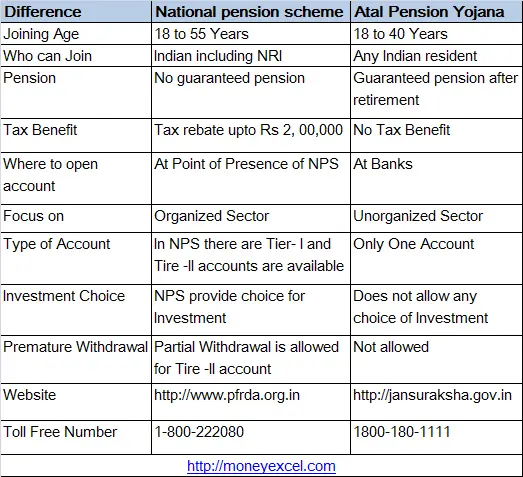
Key Difference between National Pension Scheme and Atal Pension Yojana

National Pension Scheme Atal Pension Yojana

Conclusion –

Looking at key features of Atal Pension Yojana and National Pension scheme it is clear that “National Pension Scheme” is more beneficial to subscribers. Although NPS does not provide fixed pension but it offers multiple benefits like –

  • Flexibility in terms of Investment selection
  • Tax Benefits
  • Partial Withdrawal

After looking at the detail of NPS and APY if you feel that these schemes can help you to fulfil your financial goal, you can invest in these schemes.

Gold Monetization Scheme and Sovereign Gold Bonds

1

gold monetization scheme

Cabinet recently approved Gold Monetization Scheme and Sovereign Gold Bonds. The prime objective behind the launch of Gold Monetization Scheme and Sovereign Gold Bond is to reduce Import of gold and reuse the gold lying idle in lockers of Indians. It is estimated that around 24,000 tonnes gold are lying into the locker or at household.

The second objective behind the launch of this scheme is to make gold productive asset. Currently, gold is a non-productive asset. Under this scheme on deposit of gold, you can earn interest. This scheme is likely to bring a lot of yellow shining metal into the banking system to give a boost to the Indian economy.

The third objective of this scheme is to provide a fillip to the gems and jewellery sector in the country by making gold available as raw material on loan from the banks.

Let’s take a look at key features of Gold Monetization scheme and Sovereign Gold Bonds.

Gold Monetization Scheme – Key Features

  1. Gold Monetization scheme allows investor and jewelers to deposit physical gold with banks. This scheme will also allow institutions like Tirupati Balaji Temple to deposit its idle lying gold.
  2. Basic fundamental of this scheme is like fixed deposit scheme. In fixed deposit scheme, you give money and earn interest while under this scheme you will give gold and earn interest. Bank will open gold deposit account for this scheme.
  3. 1-1.5% interest will be payable on deposited gold.
  4. A Minimum 30gms of gold can be deposited at the bank for an interest.
  5. The deposited gold will be melted and kept as a bullion.
  6. One has to specify maturity return preference in the form of cash or gold at the time of taking a deposit.
  7. If you give return preference as a gold interest will be given as a gold. For example, if you deposit 100gms of gold and get 1% interest, on maturity will receive 101 gms.
  8. The gold deposit can be done for minimum 1 year to maximum 15 years.
  9. You will be allowed to break gold deposit in between just like a fixed deposit.
  10. It is not clear that whether interest income will be exempted from income tax or not. No information is yet available on capital gain tax. However, it is expected that in next budget it will be considered.

How Gold Monetization Scheme function? 

Gold Deposit – 

Under Gold Monetization, scheme customer will bring gold in any form. Gold deposit account will be opened by banks. There will be collection center which will verify and assess the value of the gold. This center will inform the bank about value to be credited in the customer account. This gold will be converted into bar and stored in a vault at the refinery. Customer will be paid interest amount or gold as per scheme on maturity.

Gold Lending – 

Any jeweller who is looking to take gold from the bank can open approach the bank and open Gold Loan account. On payment of money for gold loan bank will instruct refinery to send gold to jewellers.

gold monitization scheme

Sovereign gold bonds – Key Features

  1. Sovereign gold bond is investment option to buy a paper bond linked to gold price. Sovereign gold bond is equivalent to Gold ETF.
  2. Sovereign gold bonds can be bought by only Indian residents. NRI is not allowed to purchase this bond.
  3. One person can purchase 500gms of sovereign gold bonds per year.
  4. This bond will be issued for 5-7 years and denomination will be 5, 10, 50 and 100gms.
  5. The RBI will issue the guarantee for the payment on behalf of the government of India.
  6. You will be allowed to trade this bond at the designated exchange.
  7. The risk of change in a price of gold will be borne by the government.
  8. One can use this bond for applying for loan as a security.
  9. Tax benefit applicable on Sovereign gold bond is yet not known. The government will probably extend tax benefit in next budget.

Benefits of Gold Monetization Scheme and Sovereign Gold Bonds

To Investor and Jeweler –

  • An investor can earn money from unused idle gold. This will make gold productive asset.
  • An investor can convert gold into cash using this channel.
  • The jeweler will get raw material gold from bank directly (domestic supply). This will reduce cost of imports.

To Government and Economy-

  • Gold import is expected to reduce. Foreign currency reserve will be saved. It will boost the economy.
  • The banks will be able to raise loan using this gold as a security in the foreign market.
  • This gold can be sold to generate foreign currency and it will increase foreign reserve.

This scheme will defiantly help millions of household and Indian economy. The success of this scheme will depends upon investors, however, the government has very high hope about these schemes.

Difference between MICR and IFSC Code

IFSC Code

Do you know difference between MICR and IFSC code? MICR and IFSC code are used for financial transaction in order to transfer money using NEFT and RTGS. Although this term sounds similar, it is not the same. There are many people who get confused about concept and importance of this terms. Let’s try to understand basic difference between MICR and IFSC Code.

What is difference between MICR and IFSC Code?

MICR Code –

MICR is an acronym of Magnetic Ink character Recognition. This code can be found in all cheques. You can locate this code at the bottom of check on MICR Band. This code is introduced to enhance security in transactions. MICR code can be used for International Transaction also. MICR system is very old system of identifying negotiable instruments. MICR code is 9 digit number.

The first three digit number of MICR code represent the city, next three represent the bank and the last three digit indicates the branch. MICR code was introduced by RBI to facilitate transaction of NEFT (National Electronic Fund Transfer).

MICR Code is written with special magnetic ink, This MICR code can be scanned by magnetic scanner. Any tempering can be easily identified.

Example of MICR Code is 700028015.

700 – City Code

028 – Bank code

015 – Branch Code

MICR code

You can visit RBI database of MICR code to find out detail about MICR code.

IFSC Code –

IFSC is an acronym of Indian Finance System code. This code is use to identify all NEFT transaction participating banks. This code is used for fund transfer like RGTS, NEFT and CFMS. IFSC code is 11 character code.

The first four alphabet character in this code represents bank name, and last six characters of this code represent the branch. The fifth character is 0 and reserved for future use. If fund transfer is taking place online using internet this unique code system is used. Even your refund of Income tax is remitted using IFSC Code.

Example of IFSC Code is ICIC0000193.

ICICI – Identity of Bank

000193 – Branch Code

IFSC Code

You can visit IFSC Database to find out detail about IFSC Code.