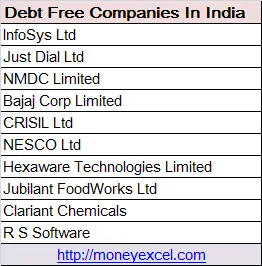
Debt Free Companies are companies with no or minimum debt. These companies are cash rich and they can withstand in any type of economic conditions. The Best example of debt free company in India is Infosys. Infosys doesn’t have any outstanding debt. Infosys is generates enough revenue to finance all internal operations and investment requirements. Infosys has given very good returns to investors. Debt Free Companies enjoys many benefits and are a good bet for investment.
Let’s have a look at Debt Free Companies as an Investment option.
Few pointers about why debt free companies are good bet for investment is given below:-
Debt free companies are not affected by economic slowdown or interest rate hike. They can sustain their business in economic slowdown condition also.
Profitability of debt free (Zero debt) companies will be high compared to high debt companies. High-Interest rate negatively affects profit margin of high debt companies.
In India Interest rate and inflation rate are unpredictable which makes debt free companies more suitable for investment.
These companies enjoy extra income as interest on cash balance which is added surplus in profitability.
High profitability means good dividend to investors.
These companies can expand their business due to ample amount of cash or can acquire other businesses.
Low debt companies need not to keep cash aside to meet the cost of capital, which high debt companies have to set aside.
Debt free companies are low-risk companies preferred by common man and expert investors.
It is but obvious that debt free companies are good for investment. However, all debt free companies are not good. It is a good idea to check company’s fundamentals, valuation, profit margin, future business opportunities and other factors before making an investment. You should debt free companiesalso check that company is able to maintain debt free status for several years or not, maintaining status only for one year will not serve any purpose.
These companies should be growing in terms of turnover and business growth. Low debt companies limiting business growth for maintaining debt free status is not good for investment.
Do proper study before making an investment in any debt free companies.
New Business Ideas – Today young and dynamic people are looking for new business ideas. They want to establish a successful business. In order to help them, I am here with 5 Unique New Business Ideas.
These unique business ideas are taken from western countries. We have seen majority successful business are first adopted in western countries and then started in India. One example of such business is E-commerce business portal. Similar to this several another services related businesses are successfully implemented in western countries. In India demand of such business, ideas are increasing rapidly. So, let’s look at these unique business ideas from western countries.
5 Unique New Business Ideas from Western Countries
House Sitter Provider
House sitter provider is a unique new business idea. Houser Sitter is a person who can take care of your home for a predefined period of time. House sitter service is one of the most successful businesses in USA and UK. The homeowner can leave their house on the trust of a house sitter. Responsibilities given to house sitter are given below.
Taking care of home owner pets.
Performing general maintenance including cleaning of pools, lawns etc.
Take care of Trash/ Recycling
Taking care of Children’s
Making Food
The homeowner needs to pay money to house sitter on the hourly or daily basis. According to American company http://housesitter.com/ average money charged for house sitter is USD 25-50 on a daily basis.
You can start the company that can help other to find a house sitter. You can charge commission from home owner and house sitter. This new business idea does not require any big investment or degrees. This idea can be more successful in big metro cities like Banglore, Mumbai where husband and wife both is working. You need to prove your credibility to become house sitter provider.
Personal Shopper
Personal Shopper is another new business idea. Personal Shopper is the business of helping people in buying a product by advising them. You can start your own company as personal shopper service provider. You need to create extensive research for all products before becoming a personal shopper.
Income generated in this business is multifold. You can charge fees to a customer for the advice apart from that you can get a commission from a store for bringing new customer. In western countries, the personal shopper gets 15% profit as a commission from store owners.
This business can be started without any investment; however, you need to work hard to establish your brand as a personal shopper.
Office Plant Services
Office Plant service is a successful business in western countries. Office Plant service includes professional installation and ongoing maintenance of plants and garden landscape. The responsibility of office plant service provides is make sure that garden and plants looks best and give a pleasant experience.
You can start this business by hiring experts in that area. You can also connect with the nursery. Many corporate customers do a long term contract with office plant service provider. Service charges in this business are based on project size.
Digital Marketing – Research and Review Services
Digital Marketing and Research and Review service is another successful business idea. If any company feels that your research and review can help them in increasing customer you can earn good amount of money.
In order to start this business, you need strong online presence and popularity. Companies paid reviewer and researchers in dollars.
Virtual Assistant
Another new business idea is a virtual assistant. Virtual assistants are independent entrepreneurs who work remotely and use technology to deliver services to clients globally. You can become a virtual assistant and can work from home or office. Responsibilities given to virtual assistant are given below.
Graphic Design
IT support
Translation
Marketing
Phone and Email Handling
Clients give work to a virtual assistant as it will save a lot of time and money. A virtual assistant is preferred by an employer who doesn’t want to bind themselves with fix employee.
You can become the virtual assistant or you can start your own company to provide virtual assistant service. Market your service 24×7 by making the website. IT Knowledge is must to become the virtual assistant.
Which new business idea you will adopt from above and why? Do share your favorite business idea in comments.
I hope you have enjoyed reading this article. Do share it with your friends on facebook and Twitter!
Tax-Free bonds are back. REC has recently announced the launch of Tax-free bonds for 2015. REC Tax Free bonds will be available with a coupon rate of 7.43%. Tax-free bond is good investment option. We had already had a comprehensive discussion about Tax free bonds 2015. Let’s discuss and review REC Tax-free bonds.
REC Tax Free Bonds 2015 Key Features
REC Tax Free bonds issue subscription will open on 27th Oct, 2015 – Tuesday and will be closed on 4th Nov, 2015.
Issue subscription will be closed early if it is fully subscribed.
The annual Coupon rate for the retail investor (investment less than 10 lakhs) are 7.14% for 10 years.7.34% for 15 years and 7.43% for 20 years.
The annual Coupon rate is 0.25% less for corporate and HNI investors.
REC Tax Free bonds are rated very good AAA by CRISIL, ICRA and IRRPL.
First interest would be paid on 28th December and after that it will be paid on 1st December every year.
The interest shall be paid without deducting TDS.
The price of each bond is 1000 Rs and the minimum investment is 5 bonds costing 5000 Rs.
Maximum investment limit for the retail investor is 10 lakhs.
This bonds will be allotted on first cum first serve basis.
REC Tax Free bonds will be listed on BSE and can be traded in the secondary market.
You can sell this tax-free bonds on the secondary market, however, you need to pay capital gain tax.
REC Tax Free bonds can be hold in DEMAT as well as physical form.
NRI can also participate and invest in REC tax-free bonds.
REC Tax Free Bonds Yield
Over to You –
REC Tax Free Bonds is very good investment option which can fetch maximum yield up to 10.75%. However, Investment in tax-free bonds is advisable if you are falling under high tax slab 20% or 30%. For lower tax slab, it is advisable to invest in fixed deposits or any other investments and not in tax-free bonds.
In addition to above you should evaluate this investment option based on your financial goal. If you are risk adverse investor and happy with fixed returns you can think of investing in REC Tax Free bonds.
Life insurance is supposed to give peace of mind, not sleepless nights. Yet, for countless policyholders, the story takes a darker turn. Why? Because some life insurance agents cleverly twist the truth, paint rosy pictures, and push policies that don’t fit the buyer’s needs. This sly practice is called misselling insurance, and sadly, it’s not rare at all.
But wait—before you jump to conclusions, let’s be clear. Not all agents are bad apples. Many work honestly and guide families toward sound financial protection. The real trouble begins when a few choose sales commissions over customer welfare.
So, how exactly are life insurance agents misselling insurance policy today? What tricks do they use? And most importantly, how can you safeguard yourself from falling into their web of half-truths? Grab a cup of coffee, because we’re about to dig deep into this messy yet eye-opening world.
Before we zoom in on agent tricks, it’s worth asking—why has misselling insurance become such a big deal in the first place?
Commission-driven sales: Agents earn hefty commissions on certain products, tempting them to push what pays more rather than what suits you.
Complex policies: Insurance jargon is confusing. Many buyers don’t understand what they’re signing up for, making them easy targets.
Financial pressure: High targets and monthly quotas force agents to sell aggressively.
Lack of awareness: Most people don’t research before buying. They trust the agent blindly, a perfect recipe for misselling.
When you mix these factors, you get a system where unsuspecting customers end up with policies that don’t serve their actual needs.
How Life Insurance Agents are Misselling Insurance Policies?
Let’s break down the most common tactics used by agents while misselling insurance:
1. Pitching Investment as Insurance (and Vice Versa)
One classic trick is blurring the line between insurance and investment. Agents often present ULIPs (Unit Linked Insurance Plans) or endowment policies as if they’re magical investment tools that guarantee sky-high returns. In reality, these products may offer neither strong protection nor attractive returns.
2. Overpromising Returns
“Sir, this policy doubles your money in 10 years!” Sounds tempting, right? Unfortunately, it’s usually far from the truth. Life insurance isn’t a get-rich-quick scheme, but misselling thrives on exaggerated claims.
3. Ignoring the Fine Print
Most people never read the 40-page policy document. Agents exploit this by downplaying exclusions, hidden charges, and lock-in periods. You realize the harsh truth only when a claim is rejected.
4. Selling to the Wrong Person
Imagine a retired person being convinced to buy a 20-year premium plan. Or a student being sold an expensive whole-life cover. That’s classic misselling insurance—selling the wrong product to the wrong person.
5. Emotional Manipulation
“Don’t you care about your family’s future?” This emotional pressure often pushes people into buying policies they neither need nor can afford.
6. Misrepresentation of Tax Benefits
Agents love to highlight Section 80C or tax exemptions without clarifying that these benefits are limited. It’s a half-truth that misleads buyers into prioritizing tax-saving over actual insurance needs.
Real-Life Examples of Misselling Insurance
To understand the gravity of the problem, let’s peek at some real-world scenarios:
Case 1: A young IT professional was sold three different endowment policies worth ₹60,000 per year. He thought they were mutual funds. Result? Poor returns and inadequate life cover.
Case 2: A senior citizen was convinced to invest her retirement corpus in a ULIP with a 15-year lock-in. The policy became a financial burden instead of support.
Case 3: A businessman bought an insurance policy pitched as a “guaranteed double return” scheme. Years later, he realized the maturity value was barely more than his total premiums.
These examples highlight how misselling insurance is more than a financial mistake—it can derail dreams and shake trust in the system.
The Psychology Behind Misselling
Why do people fall for these traps again and again?
Trust in authority: Agents often come across as knowledgeable, so buyers rarely doubt them.
Fear of missing out (FOMO): “Limited time offer” or “special bonus” tricks people into rushing decisions.
Financial illiteracy: Most individuals don’t compare policies or understand technical terms.
Emotional vulnerability: Family safety and future security are sensitive buttons that agents know how to push.
How to Spot Misselling Insurance in Action?
It’s not rocket science to catch a misselling attempt if you stay alert. Watch out for these red flags:
The agent emphasizes investment returns more than life cover.
You’re told the plan has “no risk” but promises very high returns.
They discourage you from reading the policy document.
You’re pressured to decide quickly.
The product doesn’t align with your financial goals (e.g., a student being sold retirement plans).
If any of these signs pop up, step back and rethink before signing.
Protect Yourself: Smart Moves to Avoid Misselling
Thankfully, you’re not helpless. Here’s how you can guard yourself:
Do your homework: Research online, compare policies, and understand basic insurance concepts.
Ask direct questions: “What’s the sum assured? What are the charges? What happens if I miss a premium?”
Read before signing: Yes, it’s boring, but the fine print matters.
Separate investment from insurance: Buy term insurance for protection and mutual funds/FDs for investment.
Get a second opinion: Talk to a financial advisor who isn’t commission-driven.
The Role of Regulators and Companies
The Insurance Regulatory and Development Authority of India (IRDAI) has introduced several measures to reduce misselling insurance:
Mandatory 15-day free-look period (you can cancel a policy if you’re unhappy).
Transparency in commissions and product features.
Strict penalties for agents found guilty of misrepresentation.
Still, enforcement is uneven, and companies often turn a blind eye because misselling boosts sales numbers.
FAQs
Q1. What is misselling insurance? Misselling insurance happens when an agent misrepresents or sells an unsuitable policy to a customer by hiding facts, exaggerating returns, or using emotional pressure.
Q2. Can I cancel a missold insurance policy? Yes. Most policies offer a “free-look” period of 15 days from the receipt of documents. You can cancel and get your premium back (minus nominal charges).
Q3. How do I complain about a misselling case? You can first approach the insurance company. If unresolved, escalate to IRDAI through their grievance redressal system.
Q4. Are all life insurance agents dishonest? Absolutely not. Many agents genuinely care about customer welfare. The issue arises with a few who prioritize commissions over ethics.
Q5. What type of insurance is least prone to misselling? Pure term insurance is straightforward—low premium, high cover. It leaves little room for manipulation compared to complex ULIPs or endowment policies.
Conclusion
So, how are life insurance agents misselling insurance policy? By twisting facts, exaggerating benefits, hiding details, and targeting vulnerable customers. The good news is, awareness can be your strongest shield.
Next time someone pitches you a “guaranteed plan” or “investment-cum-insurance wonder product,” pause and ask yourself: Is this truly right for me, or just another case of misselling insurance?
Remember: Insurance is for protection, not profit. Once you separate those two, you’ll never fall prey to crafty sales tactics again.