EPFO has recently launched facility of E-nomination on Unified Member Portal. EPFO subscriber can give nomination or change existing nomination by using this facility. If you are EPF subscriber you should use this facility to check and change your EPF account nomination. In this post, we will take a look at the step by step process of using E-nomination facility.
The earlier process of changing EPF nomination offline was lengthy and cumbersome. In an old offline process, EPF subscriber was submitting FORM 2 for the nomination. This form was submitted to an employer for authorization. An employer was sending this Form to EPF office for nomination change. The entire process was manual and time-consuming.
A new E-nomination facility is faster and it also removes intervention of employer for a change in nomination.
Let’s take a look at Steps of using E-nomination facility on Unified member portal.
Steps of using E-nomination facility – Unified Member Portal
Step 1 – Visit Unified Member Portal – https://unifiedportal-mem.epfindia.gov.in/memberinterface/ and login using UAN credential. In the Manage tab, you will find menu ‘E-nomination’.
Step 2 – Click on E-nomination and you will be taken to the Profile Page. Profile page shows your UAN number, Name, date of birth and gender. You need to enter your Permanent Address in the provided box and click on save button.
It will update your address. In order to complete this process, your Date of Joining EPF Scheme must be registered with EPF account. In case it is not defined it will not allow you to save address and update nomination.
Step 3 – Once you press save button it will update your profile details and prompt you by asking family declaration.
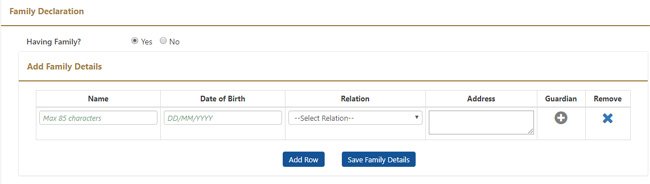
Step 4 – On selecting Having Family – Yes, you will be asked to input your family details. Enter Name, date of birth and address. Select a relationship from a drop down menu Relation. Once you are done with the process click on “Save Family Details” button.
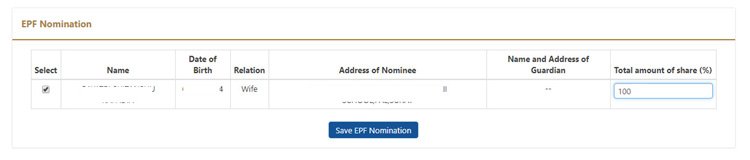
Step 5 – Next page is of EPF Nomination. In this page, you need to select your family member and provide input for Total Amount of Share %.
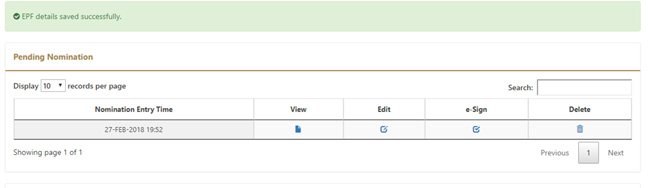
Step 6 – Once you are done press Save EPF Nomination button. It will save EPF details in your account.
Step 7 – Next step is approving nomination by using e-sign. You need to click on e-sign button.
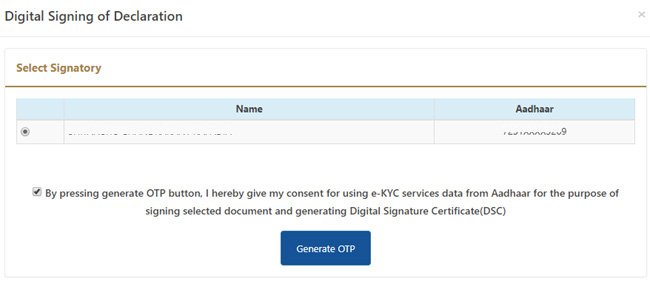
It will open popup window asking to select signatory and generate OTP button. You need to click on Generate OTP button. It will send OTP to your Aadhaar registered mobile number.
You do not require any additional Digital Signature Certificate. Your OTP consent is enough for signing a document and generating Digital Signature Certificate.
After entering OTP your nomination will be registered in your EPF account.
Over to you –
As per me, a launch of E-nomination facility is very good step towards digital India. It will surely help EPF subscriber for faster registration of EPF Nomination.
If you have not updated your details, I recommend updating them now.
Dividend Mutual Funds Equity Schemes are generally sold by giving sales speech that these funds can generate regular income for the investor. However, this regular income (dividend) will reduce now as Dividend Distribution Tax is introduced in Budget 2018. DDT is imposed on Dividend Mutual Funds Equity Schemes from April, 1st 2018.
If you have already invested in Dividend based mutual funds or planning to invest in these type of schemes this post is for you. In this post, we will discuss Dividend Distribution Tax (DDT) and disadvantages of investing in Dividend Mutual Funds. We will also compare DDT and LTCG applicable on dividend and growth based mutual funds respectively.
Dividend Mutual Funds Equity Scheme – Should You Invest?
A dividend based mutual fund is no longer recommended for investment post-budget 2018. Few pointers in this direction are given below.
Dividend Distribution Tax
A new tax called as Dividend Distribution Tax is introduced in Budget 2018. The rate of this tax is 10% on the dividend paid. On the top of this tax, 12% surcharge and 4% Cess is applicable. DDT is applicable only to a dividend based equity mutual funds after 1st April 2018.
DDT will be paid by the fund house on the behalf of investors. This means dividend income on the hand of investor will reduce. Please note that dividend income on the hand of investor will be still tax-free.
Let’s try to understand DDT calculation by example. Suppose a company is paying Rs.100 as a dividend to the investor. DDT is, in this case, would be calculated as follow.
DDT = 100 x 10% = Rs.10
Surcharge of 12% is applicable on DDT = Rs.10×12% = Rs. 1.2
Cess @4% is applicable on DDT and Surcharge = 4% (Rs.10 +Rs.1.2) = 0.448
As you are getting Rs.100 as Dividend and DDT is Rs.11.648. So, NAV of fund will go down by Rs.111.648.
So, the effective rate of DDT is 11.648%.
Quantum of Dividend
When you invest in Dividend based mutual funds, you cannot control the quantum of a dividend. Distribution of dividend and quantum is based on the fund manager discretion. Fund Manager tries to meet an expectation of investor. However, if fund manager failed to fulfill expectation of investor or dividend amount is reduced investor cannot do anything.
Dividend based on Profit
Dividend based equity mutual funds pay a dividend only from accumulated profit amount. If a fund is not doing well or if the stock market is down your dividend pay-out will get affected or you may not get dividend.
So, DDT and other disadvantages make Dividend Mutual Funds less attractive option for investment.
Growth or Dividend Mutual Funds?
Well, in order to compare growth and dividend mutual funds let’s compare LTCG and DDT. You must be aware that Growth based mutual fund is also under a tax regime. LTCG (Long-term capital gain) is applicable on growth based mutual funds. The effective rate of LTCG is 10.4%. LTCG is applicable to the capital gain amount exceeding 1 Lakh in a fiscal.
Few differences between Growth and Dividend Mutual funds post-budget 2018 are given below.
Looking at above points, it can be concluded that growth based mutual fund is better choice for investment compared to dividend mutual funds.
What is your choice of investment Dividend Funds or Growth Funds?
Do share your views and recommendation in the comment section.
Mohnish Pabrai is an Indian-born American Entrepreneur and popular stock market investor. Mohnish Pabrai is die-hard fan and follower of Investment guru Warren Buffett. He has spent $650000 in 2007 just to have lunch with Warren Buffett. He has made a career in the stock market by mimicking the investment style of Warren Buffett. Mohnish Pabrai is the managing partner of the Pabrai Investment Funds. The Stock Portfolio of Pabrai contains 3 stocks. Here is detailed information about Mohnish Pabrai’s Stock Portfolio and success story.
Mohnish Pabrai Success Story
Pabrai was born and brought up in Mumbai. He attended Elite Private School. After completion of high school, Pabrai came to the United States in 1983. He studied Computer Engineering in the USA. After graduation, he worked in Tellabs. In 1991 he started his own IT consulting company TransTech. He was deeply interested in stock market investment. In 1999 he started Pabrai Investment Funds.
The main reason behind the stock market success of Pabrai is following learning from Warren Buffett. In a short span of time, he became one of the most recognized investors in the world. His net worth is approximately $60 million. It is claimed that his net worth is increased at an annual rate of 16% from 1992 to 2012.
Pabrai is a master in identifying multibagger stocks. He has created massive wealth from the stock market in the USA and also in India. In order to help you here is Mohnish Pabrai Portfolio.
Mohnish Pabrai Portfolio
Mohnish Pabrai’s Latest Portfolio consists of 3 stocks. Data shows that the Pabrai Fund has given very good returns in the last few years. Detailed information about Mohnish Pabrai’s Portfolio is given below.
Stock
Holding Value
Qty Held
Edelweiss Financial Services Ltd.
88.3 Cr
11,522,642
Sunteck Realty Ltd.
–
–
Rain Industries Ltd.
–
–
Note – Above portfolio is made from information available from the public domain and may not be accurate.
Mohnish Pabrai Investment Style and Advice to Investors
Identification of Stock for Investment
Stocks are not a piece of paper. Buying a stock means buying a fraction of ownership in the company. You should not buy a single share of stock if you are not willing to buy entire business. You should buy a valued company and stay invested in it forever. Mohnish Pabrai is holding stock of Rain Industries and Kolte Patil Developers since so many years.
Few Bets, Big Bets
Usually, you find multiple stocks in the portfolio of any investor. However, you will find very few stocks in Pabrai portfolio. This is because he believes in few bets, big bets. He has selected all these stock carefully. All of these stocks are likely to become big bets in future.
Value Investing
Pabrai always explains that one should become value investor. He says that you should try to get $1 worth of assets for much less than $1. It is basic truth and in order to do that, you should know what is the fair value of a stock for investment.
Moat
As per Mohnish Pabrai it moat is most important. Moat means company’s ability to withstand in a competitive market and generate sustainable growth/profit. A moat is very important if you want to buy and hold a stock forever.
Hope you like the investment style and philosophy of great investor Mohnish Pabrai.
Loans are beneficial, especially to middle class and poor people. You can fulfil your dream by taking loan. Loans can help you to avail facilities such as home, car, study etc. There are different types of loans available in India. You can select a loan based your requirement. However, it is good ideas to explore the various loan options before taking loan. Here is information about 20 Types of Loans in India.
Loan is money which a borrower takes from the lender with the promise to return back in fixed period of time. The borrower will also pay an additional interest amount along with the principal amount.
20 Types of Loans in India
Home Loan
Home loan is most common loan available in India. Home loan is given by bank in order to purchase property. Home loan is available with two variant fixed interest and variable interest. It is good idea to purchase variable interest rate loan. Home loan gives you tax benefit also.
Interest rate: 9 -11%
Collateral: Physical property
How much can you get? – 85% of property value
Pros and Cons
You can avail bigger loan if your income level is high.
If you are student and seeking money for higher education you can apply for Education Loan. Education loan is available for Indian and foreign education. You can avail tax benefit under section 80E for the education loan.
Interest rate: 11-14.5%
Collateral: Varies from bank to bank.
How much can you get? – Depends upon collateral value.
Pros and Cons
Longer repayment
Tax Benefits
High Interest rates
Car Loan or Vehicle Loan
If you want to purchase new vehicle you can opt of vehicle loan or car loan. You can avail this loan from bank. You need to submit income proof in order to avail this loan.
Interest rate: 9.6-10.6%
How much can you get? – Up to 90% of vehicle value depending on your income documents.
Personal Loan
Personal Loan is loan given by bank or financial organization without any collateral. This loan is given purely based on your credit profile and credit score.
Interest rate: 15-25%
Collateral: Not required
How much can you get? – Based on your credit profile.
Pros and Cons
Banks cannot get hold of your assets if you default.
Loans are disbursed quickly, but need a formal application.
Given only to the salaried, self-employed or professionals.
Bank will provide overdraft facility against asset. This facility can be used by individual to fulfill emergency requirement.
Interest rate: 1-2% higher against submitted asset documents (Usually FD)
Collateral: Asset documents
How much can you get? – Depends on asset value.
Working Capital Loan
If you are in need of working capital to run the business you can opt for working capital loan.
Interest rate: 12-17%
How much can you get? – Depends on your income documents and financial statements.
Pros and Cons
Faster processing
Higher Interest rate
Low repayment duration.
Loan from unorganized sector
Last option for availing loan is from unorganized sector. This option is not advisable in majority of case. It is very difficult to avail this type of loan and it is very costly.
Interest rate: 20-25%
How much can you get? –
Pros and Cons
Difficult to obtain this loan.
Interest rate and payment terms are unreasonable
Over to you –
Hope you have got information about loan type you are looking for.
Which Loan option is suitable for your requirement?