Blog Page 360

LIC Bima Shree (Plan 848) – Key Features, Benefits & Review

LIC Bima Shree

LIC Bima Shree Plan 848 is insurance cum money back policy launched by LIC in the year 2018. The tagline for this policy is “Live every moment tension free, buy LIC’s Bima Shree”. This plan is specially designed for High Net worth Investors (HNI) or High-End Customers.

Looking at first instance LIC Bima Shree seems to be a replica of LIC’s Jeevan Shiromani with few changes. Minimum sum assured amount in Bima Shree is changed to 10 Lakh, which was 1 Crore in Jeevan Shiromani. LIC Jeevan Shiromani was providing inbuilt critical illness cover, however new policy LIC Bima Shree is not providing this benefit.

LIC Bima Shree Policy (Plan 848) can be defined as non-linked, with profit, guaranteed additions, limited premium money back plan. Let’s take a quick look at Key features and benefit detail of LIC Bima Shree Plan.

LIC Bima Shree (Plan 848) – Key Features

  • Non-Linked, Money Back, Limited Payment, Guaranteed Addition Plan.
  • Guaranteed Addition for Full Premium paying term.
  • Critical Illness Benefit coverage for fifteen specified critical illnesses available as an optional rider.
  • The flexibility of policy term. Policy term can be opted from 14, 16, 18 and 20 years.
  • Loan facility after 2 years.
  • Money Back in 2 years gap.
  • Four Years premium holiday.
  • Loyalty Addition after 5 years
  • Exclusive Plan for Upper Middle Class
  • Survival benefits available for a plan can be deferred, as per the wish of the policy holder.
  • Settlement Option for Survival benefits and Claim for 5, 10 and 15 years.

Eligibility for LIC Bima Shree Plan 848

Eligibility conditions for LIC Bima Shree Plan are given in the following table.

Eligibility for LIC Bima Shree Plan 848
Minimum Sum Assured 10 Lakh
Maximum Sum Assured No Limit
Policy Term 14,16,18 and 20 Years
Premium Paying Term Policy Term – 4 Years
Minimum Age at Entry 8 Years
Maximum Age at Entry
55 Yrs for 14 Yrs Policy
51 Yrs for 16 Yrs Policy
48 Yrs for 18 Yrs Policy
45 Yrs for 20 Yrs Policy
Maximum Age at Maturity
69 Yrs for 14 Yrs Policy
67 Yrs for 16 Yrs Policy
66 Yrs for 18 Yrs Policy
65 Yrs for 20 Yrs Policy
Risk Commencement Immediate

LIC Bima Shree (Plan 848) – Benefits

Survival Benefits

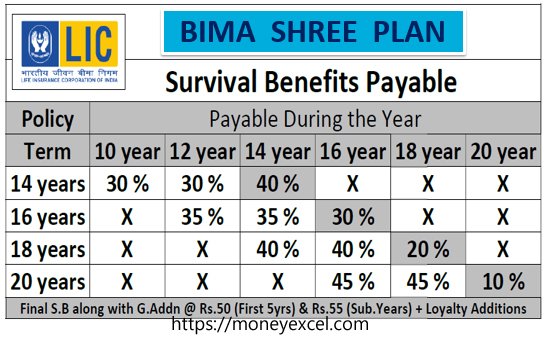
If policyholder survives to the specific duration of the policy term, a fixed % of money is payable. The detail of survival benefit is given below –

  • For 14 Years Policy – 30% of Basic Sum Assured on 10th and 12th policy year.
  • For 16 Years Policy – 35% of Basic Sum Assured on 12th and 14th policy year.
  • For 18 Years Policy – 40% of Basic Sum Assured on 14th and 16th policy year.
  • For 20 Years Policy – 45% of Basic Sum Assured on 16th and 18th policy year.

Death Benefits

The risk commences under this plan is immediate from the date of issuance of the policy. The death benefit under the plan varies based on the period completed.

  1. Death occurs during the first 5 years of the plan – 125% of the Basic Sum Assured + Accrued guaranteed additions shall be paid.
  2. If the death occurs after completion of 5 years – 125 % of Basic Sum Assured + Accrued guaranteed additions + Loyalty additions shall become payable.

Maturity Benefits

On the survival till the maturity term. Following maturity benefit is payable.

  • For 14 Years Policy – 40% of Basic Sum Assured + Accrued guaranteed additions  + Loyalty additions
  • For 16 Years Policy – 30% of Basic Sum Assured + Accrued guaranteed additions + Loyalty additions
  • For 18 Years Policy – 20% of Basic Sum Assured + Accrued guaranteed additions  + Loyalty additions
  • For 20 Years Policy – 10% of Basic Sum Assured + Accrued guaranteed additions  + Loyalty additions

For more information refer to the following table –
bima shree

LIC Bima Shree Illustration

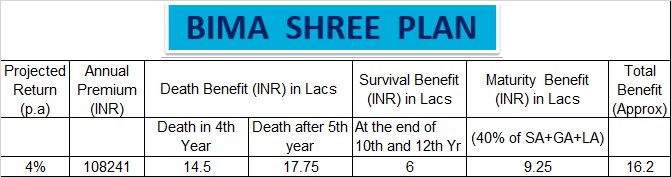
 In order to understand benefits of this plan let’s take one example. Suppose a person with age 25 plans to buy this policy with a policy term of 14 years and sum assured 10 Lakh. The premium paying term would be 10 years. An annual premium of the policy would be Rs. 108241.

Based on the assumption that projected return by this policy would be 4%, a policy is expected to give following benefits.
bima shree example

The above figures are sample illustration only and are subject to change depending upon loyalty addition declared.

LIC Bima Shree (Plan 848) – Review

Based on the limited information available on LIC Bima Shree Plan 848 I can make out following points-

  • LIC Bima Shree seems to be normal Money Back plan by LIC except few changes like money back in shorter duration 2 years and four year premium paying holiday.
  • A Guaranteed addition is payable under this plan. However, it will be up to premium paying term only. The value of guaranteed addition is not fixed.
  • The Plan is projected as high net worth plan and hence premium of this plan is very high.
  • The new change offered by LIC under this plan is loan facility. This plan offers loan facility after 2 years. Generally, all other policies are eligible for a loan after 3 years.
  • Critical illness benefits are available as optional benefits under this plan.
  • The plan is expected to return 4-6% return as illustrated in the example above.

In short LIC Bima Shree is an old product with a new cover. I suggest to purchase term plan with good coverage and invest remaining amount either in the mutual funds or PPF to earn better returns.

Lending Money to Friends or Relative – Points You Must Consider

lending money

“Lend money to friends or relative and invite worry in the return.” Lending money to friends and relative is common practice nowadays. From small amount to meet emergencies to large sum given to recover from business losses, everything is done without paperwork in an unsecured manner on the basis of trust.

Let me share one incident with you. Before few days I got a call from one of my family member. He was in trouble and was in need of money. He described his situation that he has taken money from a moneylender at 5% monthly interest and as he is unable to pay loan amount. Now, he wants interest free loan from me for the longer duration. Well, my immediate response to this proposal was NO. My relative gave counteroffer by saying we will make legal document clearly defining terms and condition of the loan. I am thinking about that proposal.

These types of incidents of giving a loan to friends and relative with or without legal paperwork on the basis of trust are increasing. Most of the time it is seen that these type of loans are the main reason for spoiling a relationship. Well, it’s up to you to extend help to friends or relative by giving a loan. In this post, let’s focus important points you must consider while making a legal agreement for lending money to friends and relatives.

Also Read – Things to do before giving loan to relative or friend

Points to check before lending money to friends or relatives

  1. Legal Document

Don’t lend money without a legal document. Legal document for this type of loans would be loan agreement or promissory note. It should be made on stamp paper and notarized by concern authority.

  1. Personal Information

The document should clearly capture identity proof such as PAN card, Aadhaar card of both lender and borrower.

  1. Repayment Schedule & Interest rates

Your document should clearly mention about repayment schedule monthly, yearly or lump sum. Along with periodicity or repayment, It should also mention interest rates applicable on loan amount.

  1. Dispute and Exclusion conditions

The legal document may or may not include a condition in case of dispute or default. One should also mention exclusion condition if any.

  1. Amendment

A loan agreement or promissory note can be modified/amended by mutual agreements between lender and borrower. You can make provision of amendment clause in the agreement.

  1. Witness

There is no legal requirement of a witness in the loan agreement or promissory note. However, as an additional safety get the document signed by a witness. The witness should not be related to any party.

  1. Payment via Cheque Only

Make sure to pay money via Cheque only and mention transaction amount and cheque number in the legal document.

  1. Interest on Tax Component

Interest-free loans are non-taxable for both lenders and borrowers. However, if a provision of interest is kept lender have to pay tax on interest earned.

  1. Loan without Interest

Loans without interest from friends and relative are considered as Gift. Gifts from family members are not taxable.

Additional Food for thought before lending money to friends and relatives

  • You should assess the capacity of the borrower to pay loans in the future.
  • You should remember that there are chances that you can lose relationship because of these types of loans.
  • If a relationship is important consider loan as a gift. Assess your capacity and lend the amount which you are capable to write off.
  • You can earn more money if you invest this money in other instruments as mutual funds/equity.

Also Read – How to Stop Living Paycheck to Paycheck?

Over to you –

As per me, lending money to relative or friend is not a good idea. You may end up losing a relationship, money or both. Still, if you have decided to give a loan to lend money to relative or friend please remember points which we have discussed above.

Have you lent money to relatives or friends? What was your experience? Would you do it again?

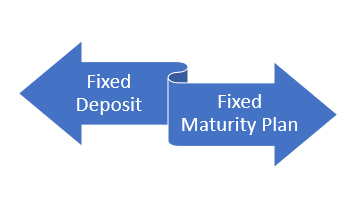
Fixed Deposit or Fixed Maturity Plan (FMP)

Fixed Maturity Plan

We find many Fixed deposit lovers in India. Who are not ready to take any risk and happy with the fixed return. However, in a recent past, it is seen that return on fixed deposits are reducing and it is likely to reduce further. So, what fixed deposit lovers should do? Well, they can explore investment option called as Fixed Maturity Plan (FMP). A Fixed Maturity Plans (FMP) are like FDs only. It can generate fixed returns and has a lock-in period. One can also use Fixed Maturity Plans to save income tax.

What is Fixed Maturity Plan?

A Fixed Maturity Plan is “closed-ended” debt based mutual funds. Closed-ended means it comes with pre-defined lock-in period. This lock-in period varies from 1 month to 3 years.

Fixed Maturity Plan do not invest anything in equity. It invests mainly in debt related investment instruments like –

  • Bonds
  • Debentures
  • Government Securities
  • Certificate of Deposits
  • Commercial Papers

FMPs are suitable for investors who love FD or in the other words for the investors with low-risk appetite.

  • The basic difference is between bank FD and FMP is return from FD is assured. However, in Fixed Maturity Plans (FMPs) returns is not assured. However, FMP generally gives better return compared to Fixed Deposits.
  • Another difference is in FMP we have an option to check rating before investing. Credit agencies give rating to FMPs based on performance A, A+, AAA etc. In FD investment is done based on the trustworthiness of bank.
  • In FMP one can go through Investment objective and past performance.

Which is better FMP or FDs?

Return –

Let’s take an example of SBI Bank Fixed deposit Interest rate applicable as on today (i.e March 2018)

If you invest in SBI Fixed deposit with following lock-in periods, the interest rate offered by the bank are –

  • 1 Year – 6.40%
  • 3 Year – 6.50%

This return is pretax return. Tax is applicable on the interest amount based on your tax slab. Now let’s compare the historical return on Fixed Maturity Plans. Historically average return of AAA-rated FMP is in the range of 7.25-7.5%.

Taxability –

The interest amount earned from Fixed deposits is added to the income of investor and taxed as per tax slab. If you are in highest tax bracket it is recommended not to invest in the fixed deposit as post-tax return can’t even beat inflation rate.

In FMPs, there are two options –

  1. Dividend
  2. Growth

In dividend option the investor has to face dividend distribution tax, plus applicable tax rate as per slab.

In a growth option two types of taxes are applicable.

  • STCG – Applicable if you sell FMP before 3 years of holding time. The rate of STCG is as per ones tax slab.
  • LTCG – Applicable if you hold mutual fund for 3 years and above. LTCG is applicable 20% flat, one can take indexation benefit while calculating LTCG.

This means if you are in highest tax bracket it is recommended to invest in FMP compared to FDs.

Also Read – Company Fixed Deposit – 10 Most Important Things to Know before Buying

What are advantages of FMPs?

  • Low risk and No interest rate volatility.
  • Return is high compared to fixed deposit.
  • Tax benefit and indexation benefit.
  • Expenses are very limited as FMP invest in debt instruments.

What are Limitations of FMPs?

  • Return is not assured in FMP.
  • The exit from FMP is slightly difficult as trading volume of FMP is very low.

Points to consider before investing in Fixed Maturity Plan

  • Select FMP carefully. Please consider rating given by credit agencies while making a selection. Also check historical return and trustworthiness of fund house.
  • Exit from fund is slightly difficult. So, if you have surplus money you can select FMP with long term perspective.
  • FMPs are less risky. However, we cannot eliminate risk possibility of default.

I hope you have got answers to all your queries related to Fixed Deposit and FMP.

Do you prefer FMP for investment? Do share your views in the comment section.

Chartink Screener – Fundamental and Technical Scanner

Fundamental and Technical Analysis Scanner or Screener are widely used tools by stock market experts. The Stock Scanner tool helps investors and traders in doing fundamental and technical analysis. On the scanner tool, you can filter stocks based on various parameters such as stock price, daily moving average, market cap, dividend yield, and many more.

I have already discussed 5 Stock Screener websites for doing fundamental analysis of the stock. In this post, I will share information about Chartink Screener. Chartink is the most popular stock screener website that provides both fundamental and technical screener tool. It also provides a facility to generate SMS and E-mail alert. Let’s take a quick look at Chartink Scanner.

Chartink Screener - Fundamental and Technical Scanner

Chartink Scanner – Fundamental Analysis Filters

Readymade Fundamental Analysis Filter

Chartink Provides multiple readymade fundamental analysis filters. To access fundamental scans kindly visit – https://chartink.com/screeners/fundamental-screeners

You will be able to see readymade category-wise scanners. To find a specific scanner enter your query in the search tab and press Search scans. It will show relevant scanners associated with your search query. 


How to create your own filter for Fundamental Analysis?

It is easy to create your own customized filter using the Chartlink website. Let’s try to understand the process by example.

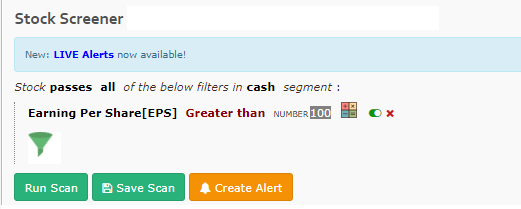
Example -1 Suppose you want to find out and compare Stock with the Highest EPS.

  • The first step is going to the Screener tool.
  • From the navigation, tab click on “Create Scan” under the scanners tab.
  • Click on the green color funnel – Filter icon.
  • Select “Earning Per Share [EPS]” from a drop-down menu.
  • It will automatically open another menu where you need to select “Greater than”
  • Now enter the value of EPS.
  • Next is to press the Run Scan button.
  • It will display all stocks with EPS greater than a value specified by you.

Chartink stock screener EPS

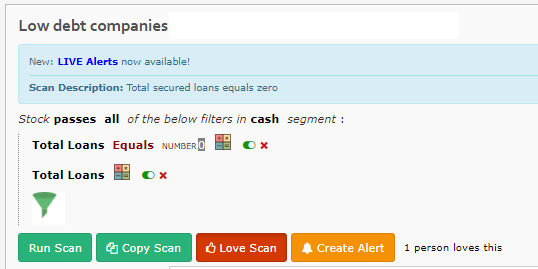
Example -2 Suppose you want to find out low-debt companies.

  • Visit Chartink screener tool.
  • Click on green color funnel – Filter icon.
  • Select “Total Loans” from a drop-down menu.
  • Next is select “Equals” and enter number 0.
  • Press Run Scan button and you will be able to see debt-free companies on the screen.

Chartink Low Debt

Chartink Scanner – Technical Analysis Filters

Technical Analysis filters help you to do technical analysis. You can find many things such as candlestick scans, buy/sell signal, a stock with rising/falling price, increase in volume, bullish golden cross scan, technical breakouts, etc.

How to create a filter for Technical Analysis?

Example -1 Suppose you want to find High Volume Stocks.

  • The first step is going to the Screener tool.
  • From navigation, tab click on “Create Scan” under scanners tab.
  • Click on green color funnel – Filter icon.
  • Select “Volume” from a drop-down menu.
  • Now select “Greater than equal to” and Enter Number.
  • Press Run Scan button and you will be able to see all high-volume stocks on your screen.

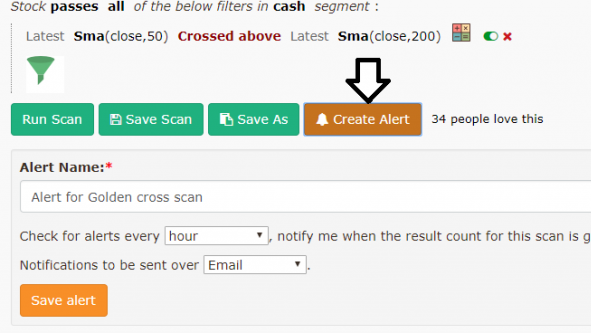
Chartlink Scanner – How to create and configure alert?

You can also configure SMS or E-mail alert for all these reports.

To configure alerts, you need to click on “Create Alert” button as shown in the screenshot below.

chartink create alert

However, it is a premium facility and you need to pay money for the same. The monthly cost for this facility is Rs.750.

You can configure to run alerts every 5/10/15/20/30/60/120/240 minute & on a daily, weekly or monthly basis. Alerts can also be configured to run after the market close & open.

Do you think Chartink Scanner for Fundamental or Technical Analysis is helpful?

Make sure to share this post, with your friends and collogues and on social pages like Facebook & Twitter.