
Blog Page 306

SBI Mutual Fund Bandhan SWP – Should You Invest?

Bandhan SWP

SBI Mutual Fund Bandhan SWP is an innovative way to gift money to your family member. If you are looking for income solution for the family which generate a regular cash flow in a tax-friendly manner, you should defiantly consider SBI Bandhan SWP. SBI Bandhan SWP has a beneficiary feature which allows you to create an income stream for your family members.

What is Systematic Withdrawal Plan (SWP)? What is SBI Mutual Fund Bandhan Systematic Withdrawal Plan (SWP)?  How do SBI Bandhan SWP works? How to Start Bandhan SWP? What are the benefits of Bandhan SWP plan from SBI? Let’s try to find out.

What is Systematic Withdrawal Plan (SWP)?

Systematic Withdrawal Plan allows an investor to withdraw from a mutual fund scheme at regular interval. This could be monthly, quarterly, half-yearly or annually. The withdrawal can be fixed or variable. This helps an investor to generate regular income flow.

E.g You have 5000 units in your MF scheme and you have given instruction to fund house to do SWP of Rs.1000 every month. This means every month based on NAV applicable equivalent number of MF unit will be sold and Rs.1000 will be credited to your account.

What is SBI Mutual Fund Bandhan SWP?

SBI Bandhan SWP is like plain vanilla Systematic Withdrawal Plan, with a twist of crediting withdrawal amount to the family members (parents, sibling, spouse or child) bank account instead of your account.

The money transferred to a family member is treated as a gift in case of Bandhan Systematic Withdrawal Plan. As per current income tax law, there is no gift tax if any money is received as a gift from a relative. This means no tax is applicable for the beneficiary.

An investor needs to bear short-term capital gain tax if withdrawals are made in the first year of investment. Long-term capital gain tax is applicable if withdrawals are made after the first year. Exit load is also applicable.

How does SBI Bandhan SWP works?

Suppose you have 1 Lakh balance in your mutual fund and you opt of Rs.5000 as SWP amount from March 2018. Taking hypothetical example here is how SWP will work.

Date Beginning Value (Rs) Growth (Rs) Withdrawal (Rs) End Value (Rs)
1st March 2018 100000 1000 5000 96000
1st April 2018 96000 1500 5000 92500
1st May 2018 92500 1200 5000 88700

If you are an existing investor of SBI Mutual Fund Growth Plan, you can avail SWP facility of Bandhan just by giving beneficiary detail. If you want to start a new plan, follow the steps given below.  

  1. Invest in SBI Mutual fund scheme growth option. A scheme should be open-ended.
  2. After few months or years opt for SWP facility. Specify beneficiary details, withdrawal amount, time period and other details. Please note that beneficiary should be Indian resident and immediate family member of the investor.
  3. KYC documents of the beneficiary, including proof of the relationship between investor and beneficiary needs to be submitted. Also, provide cancel cheque copy of beneficiary account for SWP transfer.
  4. The beneficiary account will get credited as per specified amount at a specific time interval. 

What are the benefits of Bandhan SWP plan from SBI?

SBI Bandhan SWP

  1. Regular cash flows to your loved ones

The first benefit of this plan is regular cash flow to your loved ones. You can take help of this plan to fulfill a financial need of your family member which demands funds at fixed intervals. This could be pocket money for your children or regular monthly income to your parents after retirement.

  1. Tax Benefit to Beneficiary

As discussed earlier Bandhan SWP is a tax-efficient solution for the beneficiary. The fund transfer to a family member is considered as a gift and no tax is applicable to the beneficiary. If a received amount is invested again, the interest income will carry tax liability.

  1. Long-term wealth creation opportunity

This new SWP not only provides regular cash flows and tax benefit but also gives investors long-term wealth creation opportunity if invested in right growth SBI mutual funds.

When can you opt for SBI Bandhan SWP?

SBI Bandhan SWP makes clever use of gift tax law. It also provides control to the investor. You should opt for SBI Bandhan SWP when you are looking for regular income option for your family member. Few examples are given below.

  • To provide pocket money or monthly expense to your son/daughter when he/she is living in another city.
  • When you want to gift money to your sister/brother at specific occasion say at birthday or anniversary.
  • To provide financial support to your parents in retirement.
  • When you want to enjoy duel benefit of regular cash flow and long-term wealth generation.

I hope you have got a complete understanding of SBI Bandhan SWP Plan. If you have any query do post it in the comment section.

Best Cashback Credit Cards with Best Cashback Offers

Picture this: You’re at the grocery store, tossing veggies into your cart, and swiping your card at checkout. Ding! A notification pops up— you’ve just earned 5% back on that haul. Sounds like a dream, right? Well, welcome to the magic of cashback credit cards in India. In a country where every rupee counts, these little plastic wonders are turning everyday spends into sneaky savings. Whether you’re a chai-sipping commuter battling fuel prices or a weekend shopper hunting deals, the best cashback credit cards can feel like a loyal sidekick, quietly padding your pocket.

But hold on—why all the buzz? India’s credit card scene has exploded, with banks throwing out offers left and right to snag your loyalty. From HDFC’s snazzy rewards to SBI’s no-frills reliability, there’s something for everyone. In this guide, we’re spilling the beans on the top picks, decoding those fine-print cashback offers, and sharing hacks to squeeze every paisa out of your spends. No jargon overload here; just straightforward chat about how these cards can lighten your load. By the end, you’ll be ready to ditch that dusty old debit card and upgrade to cashback glory. Let’s dive in, shall we?

Why Cashback Credit Cards Are a Game-Changer

Let’s face it—life in India isn’t cheap. With inflation nipping at our heels and EMIs stacking up like Diwali sweets, who wouldn’t want a financial hack that rewards you for buying what you need anyway? Cashback credit cards aren’t just fancy perks for the elite; they’re everyday heroes dishing out real money back into your hands. And boy, do they shine brighter here than anywhere else!

The Perks That Keep on Giving

First off, imagine getting paid to pay your bills. That’s the gist of cashback—straight-up rebates on categories like dining, travel, or online shopping. In India, where UPI rules the roost, these cards bridge the gap by offering seamless rewards that hit your account faster than you can say “transaction approved.” Plus, with digital wallets everywhere, redeeming that cashback feels effortless, almost like finding extra change in your jeans pocket.

Take a breath—it’s not all rainbows. Fees can sneak up if you’re not careful, but the best cashback credit cards in India keep those joining and annual charges low or waivable. And here’s a kicker: many come bundled with lounge access or insurance, turning a simple swipe into a mini-vacation vibe.

How Cashback Stacks Up Against Miles or Points

Ever wondered why cashback trumps those murky reward points? Points sound glamorous, but they’re often locked in ecosystems, expiring quicker than yesterday’s news. Cashback? It’s liquid gold—direct to your bank, no strings attached. In a fast-paced place like Mumbai or Bangalore, where time’s money, this simplicity wins hands down.

That said, if you’re a jet-setter, miles might tempt you. But for the average Joe juggling rent and roti, cashback credit cards deliver the bang without the confusing math. It’s like choosing biryani over fusion cuisine—comforting, reliable, and oh-so-satisfying.

Top 10 Best Cashback Credit Cards in India for 2025

Alright, enough chit-chat. You’re here for the goods, so let’s roll out the red carpet for the best cashback credit cards in India right now. We’ve handpicked these based on real-user vibes, current offers, and that sweet spot between rewards and requirements. No fluff—just cards that’ll make your spends sing. We’ll break ’em down with key deets, so you can match one to your lifestyle.

  1. HDFC MoneyBack+ Card This one’s a crowd-pleaser for the urban hustler. Snag 5% cashback on Swiggy, Uber, and Zomato—perfect if your life’s a whirlwind of deliveries. Annual fee? A breezy ₹500, waived on ₹50,000 spends. Users rave about the milestone bonuses, like extra ₹500 after hitting quarterly targets. If food and rides are your jam, this card’s your new BFF.
  2. SBI Cashback Card Straight shooter from SBI—4% back on online spends, 1% elsewhere, capped at ₹2,000 monthly. No annual fee screams “budget-friendly,” and it’s a godsend for e-shoppers. Pro tip: Pair it with Amazon Prime for double dips. Folks say it’s like having a discount code that never expires.
  3. Amazon Pay ICICI Card Amazon addicts, assemble! 5% back on Amazon buys if you’re Prime’d up, 3% on Amazon Pay partners. Lifetime free, no cap on rewards—wow, talk about endless moolah. It’s seamless with your app, turning impulse buys into smart ones. Just watch out for that 1% on non-Amazon stuff; still, for Prime loyalists, it’s unbeatable.
  4. Flipkart Axis Bank Card Flipkart fan? This bad boy offers 5% on Flipkart, 4% on Cleartrip, and 1.5% everywhere else. Joining fee ₹500, but the welcome ₹500 Flipkart voucher softens the blow. Ideal for big-ticket sales during those mega sales—imagine cashback funding your next gadget spree.
  5. Standard Chartered Super Value Titanium A gem for fuel fiends—5% on fuel (up to ₹100/month), 5% on utilities via bill pay. Low ₹750 fee, and it edges out competitors with no expiry on rewards. Commuters in Delhi or Chennai swear by it, saving enough to cover that extra coffee run.
  6. HSBC Cashback Card HSBC steps up with 10% on dining and groceries (capped at ₹1,000/month), 1.5% on others. ₹999 fee, but lounge access sweetens the pot. It’s like your card’s whispering, “Treat yourself,” without the guilt. Great for families stocking up at Big Bazaar.
  7. Kotak 811 #DreamDifferent Card Digital-first from Kotak—5% on online, 2% on offline, all fee-free. Zero everything: no joining, no annual. For the tech-savvy millennial scrolling late-night deals, this is pure joy. Rewards hit your 811 account pronto, ready for instant transfers.
  8. RBL Bank World Safari Credit Card Travel twist on cashback: 10% on travel bookings via RBL portal, 2% on all else. ₹3,000 fee, but forex markup’s low at 1.99%. Backpackers love the lounge perks too—cashback that funds your next escape.
  9. IndusInd Bank Platinum Aura Edge 2% unlimited cashback on all spends, plus 1% fuel waiver. ₹1,500 fee, but the no-cap policy means rewards snowball. It’s the set-it-and-forget-it option for steady earners, quietly building a buffer.
  10. Axis Bank ACE Credit Card Wrapping up with this millennial magnet—5% on Swiggy/Zomato, 4% on Preferred partners like Ola. ₹499 fee, with vouchers galore. It’s got that fresh energy, making even mundane bills exciting.

Whew, what a lineup! Picking one? Think about your spend hotspots—groceries? Fuel? Online hauls? These best cashback credit cards in India cater to all, but remember, the real win’s in using ’em wisely.

Decoding the Best Cashback Offers: What to Watch For

Cashback sounds simple, but oh boy, the devil’s in the details. Those “up to 10%” banners? They often hide caps, categories, or blackout dates. Let’s unpack this like a fresh Amazon box, so you don’t get caught off guard.

Caps and Categories

Most cashback credit cards cap rewards at ₹500–₹2,000 monthly—fair enough, or so banks say, to curb abuse. But here’s the rub: Categories matter. Dining might net 5%, but that jumps to 10% at select spots only. Pro move? Track your app’s merchant list; it’s like having a cheat sheet for max rewards.

And exclusions? They’re sneaky—rent or school fees often don’t qualify. Once, a buddy of mine chased 8% on utilities, only to find his provider wasn’t “eligible.” Lesson learned: Read the terms over chai, not in a rush.

Milestone Bonuses and Accelerators

Now, for the fun part—milestones! Hit ₹1 lakh spends? Boom, extra ₹1,000 cashback. It’s motivational, like gym rewards for swiping. Axis and HDFC ace this, with accelerators boosting rates after thresholds. Imagine your card leveling up mid-year—pure adrenaline!

Transitionally speaking, these bonuses bridge the gap between steady earners and big spenders, making cashback accessible without feeling gimmicky.

Maximizing Rewards

Got your card? Great—now let’s turbocharge those returns. It’s not rocket science; just a few tweaks to your routine. Trust me, these tips have turned my coffee runs into savings sessions.

Bundle Your Bills and Everyday Buys

Why pay utilities straight from your account when your cashback credit card can snag 5% back? Apps like Cred or Paytm let you route everything through the card—bills, recharges, even EMIs. Just ensure no surcharges eat your gains.

For groceries, stick to partner stores. BigBasket with ICICI? Instant 5%. It’s like shopping with a discount superpower.

  • Tip 1: Set up auto-pays for insurance and subscriptions—steady 1-2% without lifting a finger.
  • Tip 2: Use cashback portals like Gyftr for gift cards; double-dip on rewards.
  • Tip 3: Track expiry dates religiously—nothing worse than unclaimed rupees gathering digital dust.

Avoiding Common Pitfalls

Exclamatory alert! Don’t chase sign-up bonuses alone; they’re flashy but fleeting. Focus on long-term fit. And fees? Waive ’em by hitting spend mins—easy peasy if you’re consistent.

One dangling thought: Overspending to earn rewards? Big no-no. It’s like borrowing to save—ends in tears. Stick to your budget; let the card enhance, not dictate.

Comparing Cashback Credit Cards

Side-by-side? That’s where clarity shines. Here’s a snappy table pitting three heavy-hitters against each other. Eyeball it over lunch; it’ll save you hours of scrolling.

Feature HDFC MoneyBack+ SBI Cashback Amazon Pay ICICI
Annual Fee ₹500 (waivable) Nil Lifetime Free
Key Cashback Rates 5% on food delivery, 2% others 5% online, 1% offline 5% Amazon (Prime), 2% others
Monthly Cap ₹1,000 ₹5,000 (5%), ₹2,000 (1%) Unlimited on Amazon
Best For Urban foodies E-commerce warriors Amazon loyalists
Welcome Bonus ₹500 voucher ₹100 on first use ₹250 Amazon credit

See? SBI’s your low-commitment pal, while Amazon’s a niche ninja. Pick based on your “spend story”—no one-size-fits-all here.

FAQs

Got queries? We’ve got answers. Fire away in your mind—these cover the classics.

Q: What’s the easiest cashback credit card for beginners? A: Hands down, the SBI Cashback Card. No fee, simple rates—dive in without drowning.

Q: Can I get cashback on international spends? A: Yep, most offer 1-2%, but watch forex fees. Axis ACE shines here at 1%.

Q: How do I redeem cashback rewards? A: Varies by card—statement credits, bank transfers, or vouchers. Check your app; it’s quicker than a Mumbai local.

Q: Are cashback credit cards worth it if I pay off monthly? A: Absolutely! No interest means pure profit. Just avoid carrying balances— that’s where the trap snaps.

Q: Which card for high fuel spends? A: Standard Chartered Super Value—5% back, plus waivers. Your tank thanks you.

Q: Do these cards affect my credit score? A: Only if you miss payments. Timely use actually boosts it—win-win.

Conclusion

Whew, what a ride! From HDFC’s delivery delights to SBI’s online oohs, the best cashback credit cards in India are more than metal—they’re your ticket to financial flair. We’ve unpacked perks, pitfalls, and pro tips, all to arm you with choices that fit like a favorite kurta.

Remember, the magic’s in the match: Align your card to your chaos, track those rewards, and watch savings stack. It’s not about getting rich quick; it’s the quiet thrill of turning “must-buys” into “me-time” funds. So, grab that application link, make the switch, and here’s to fewer regrets, more rupees. What’s your first swipe gonna be? Drop a comment—we’re all in this spend-together. Happy saving, folks!

20 Retail Business Ideas with Low Investment

A retail business means selling product or services to the customer directly for earning a profit. A person running a retail business is called as a retailer. In India retail business is considered as one of the most profitable and lucrative business options. A few years back retail was considered as an unorganized sector, but due to the entry of big players and the start of shopping malls we have seen a lot of change in the retail industry.

The retail sector has evolved rapidly over the past few years. With the rise of e-commerce, niche shopping trends, and flexible consumer behavior, opportunities are everywhere. From your neighborhood to the online marketplace, low-investment retail businesses are not just possible—they’re booming!

In a retail business, you can start with a small shop and expand your business to setup retail chains. The key to success in retail business is quality of product, price, place and customer support. You can start a retail business even from home.

There are multiple types of retail businesses or retail stores. These businesses are classified based on size. The retail store types include –

  • Small Retail Store
  • Departmental Store
  • Super Market
  • Online Store
  • Franchise Store

Based on your interest and availability of capital, you can select a type of retail business.

Retail Business ideas

So, if you are young and dynamic individual and looking for profitable retail business ideas, here are 20 Retail Business Ideas and opportunities with low investment.

Also Read – 40 SMALL BUSINESS IDEAS WITH LOW INVESTMENT

20 Retail Business Ideas with Low Investment

Food-Related Retail Business Ideas

  1. Grocery Store

A Small Grocery Store is a profitable retail business option. The investment requirement for this business is moderate. You can start this store in any residential area. Grocery is an evergreen business option. You even don’t need any special skill for starting this business.

  1. Namkeen & Sweet Store

Another evergreen retail business idea is Namkeen Store. Namkeen & Sweets are an integral part of every celebration, be it a marriage, a New Year celebration, or any other festival. If you are good at making namkee,n you can start your own Namkeen Store.

  1. Ice Cream Store

Ice Cream store business, along with associated products, is a profitable business option in India. You need to select the right location and the right product. You can even take the franchise of famous ice cream manufacturers. It is a moderate investment business.

  1. Organic Food Store

The demand of organic food is growing all over. People are becoming health conscious, and they are ready to spend money on organic foods. You can start your own organic food store where you can keep organic foods and other food items.

  1. Tea Store

Opening a Tea store is low-investment, low-profit retail business idea. Location and format of the business play an important role in the success of this business. You can start this business on your own, or you can even think of taking franchises of popular brands that are already in this business.

Recommended Post – 15 Best Distribution Business Ideas

Household and Other Products Retail Business

  1. Hardware Store

A small hardware store near a residential or office area is another profitable retail business option. In a hardware store, you can keep a wide range of hardware and furniture-related items. The investment requirement in this business is moderate.

  1. Auto Spare Part Store

Auto Spare Part Store is the most profitable retail business idea. In an auto spare part store, you need to sell auto spare parts in the retail store. Make sure to open an auto spare part store in the middle of city or near garage. It is a moderate investment business.

  1. IT Hardware Store

IT Hardware Store is the next retail business idea. In this business, you need to sell IT Hardware items such as laptops, desktops, hard disks, mouse, speakers, etc. The success of this business depends on demographics and demand.

  1. Customized Gift Shop

Customized Gift Shop is one of the highly successful business options in the city. Gifts are purchased on almost every occasions like birthdays, marriages, anniversaries, etc. Nowadays, people prefer personalized gift and experiential gifts. If you can offer this type of gift with a satisfactory buying experience, you can become successful in this business very easily. Furthermore, to support such a setup, practical fixtures like gridwall panels can help organize and display a wide variety of merchandise efficiently, improving product visibility and making browsing easier for customers.

  1. Stationery & Book Shop

Stationery & Book Shop is education education-related business idea. In this business, you need to start a retail shop of stationery items and books near school or colleges. You can club Xerox along with sa tationery store. You will need manpower to run this business. A profit margin in the stationery business is low.

  1. Cosmetic Store

A cosmetic store is a place where cosmetic items and beauty products are sold. The demand of cosmetic items remains very high in the ladies. In your cosmetic store, you can keep branded as well as non-branded products.

  1. Perfume Store

A perfume store is next in the list of retail businesses. In a perfume store, you need to keep various perfumes imported and local. You should open this store in the center of the city or in the shopping mall.

  1. Mobile Store

Mobile store is next lucrative retail business option. It is a moderate investment business. The success of this business depends upon demographics and type of mobile sold by you. As it is a dynamic industry, it is advisable to avoid big investment at starting stage in this business.

Must Read – 90 Business Ideas with Low Investment

Service Related Retail Business Ideas

  1. Xerox Shop

Xerox Shop is small investment business option. You should open xerox shop nearby school, colleges or office area. Volume should be very high in order to earn high profit.

  1. Yoga or Fitness Studio

Health and wellness industry is growing at faster pace. People are becoming more health conscious. Thus starting a Yoga or Fitness Studio could be a profitable affair. A yoga studio can be started without any investment however fitness studio demand heavy investment.

  1. Beauty Parlor  

Beauty Parlor is business option for ladies. Ladies are fond of beauty services. They spend lot of money on beauty treatment. If you have done beauty course you can plan to open beauty parlor.

  1. Courier Services

Indian parcel and courier industry is growing at the rate of 25%. If you want to take advantage of this emerging business you can start your own courier store. You have to be very good in providing customer service. If required you can take franchise of famous courier companies.

  1. Medical Diagnostic Store

Medical Diagnostic Store is lucrative business idea. In almost every medical problem doctor demands diagnostic report. If you are qualified professional you can start medical diagnostic store.

  1. Tour Travel Organizer

Tour Travel Organizer is one of the most profitable business options. In this business, you need to help the customer in organizing tours. In order to run this business, you have to be very good at knowing demographic and developing contacts.

Also Read – 170 Small Business Ideas with low investment

  1. Photo Studio

Photography is an art in itself. If you have high quality camera and skill for clicking various photos you can open your own photo studio. You can also accept contract for marriage and event photography.

FAQs

Q1: Which is the most profitable retail business idea with low investment?
A: It depends on your interest and location, but online boutiques, mobile accessories, and pet supplies generally see quick returns.

Q2: Can I start a retail business from home?
A: Absolutely! Many of the above ideas, like baking, t-shirt printing, or boutique selling, can begin right from your living room.

Q3: Do I need a license for a small retail business in India?
A: Yes, you may need a Shop Act license, GST registration (if turnover exceeds limits), and FSSAI for food businesses.

Q4: How can I market my retail business with a small budget?
A: Social media marketing, word-of-mouth, and listing on local directories can give you great visibility without spending a fortune.

Q5: What if I don’t have storage space for inventory?
A: Consider dropshipping or selling digital products, or partner with wholesalers who offer storage options.

Conclusion

There you have it—20 retail business ideas with low investment that could be your stepping stone to financial freedom. No big loans. No massive risk. Just smart planning, consistent effort, and a dash of entrepreneurial spirit.

The retail business world is vast and welcoming. You don’t need a swanky office or a million bucks to get started. What you do need is passion, resilience, and a keen sense of what your customers want.

So, pick an idea that clicks with you, create a solid plan, and just begin. It’s okay to start small—some of the biggest empires started in a garage or a spare bedroom. Your journey to retail success could begin today!

Remember: Start smart, stay consistent, and never stop learning. The world of retail business is waiting for you!

How to Switch from Regular Mutual Fund to Direct Mutual Fund?

Direct Mutual Funds, as the name suggests, are for direct investor where no intermediary or distributor is involved in making an investment. It makes sense to Direct mutual fund as it provides multiple benefits like low expense ratio, better returns over long-term and elimination of commission.

The elimination of commission and lower expense ratio seems to be minimum at first instance, but over the long run, it will make a lot of difference in returns generated by the mutual fund.

To know more about a difference in return between a regular mutual fund and direct mutual fund, do read – Why Direct Plans are cheaper?

Investors who have realized the potential of a direct plan may have already shifted to them. The Investors who are unaware of benefits of the direct mutual fund might not have moved to direct plan. Even exit load and lock-in period might be a concern to many investors.

If you are convinced that direct mutual fund is a better choice compared to regular mutual fund and planning to switch to direct mutual funds this post is for you. In this post, I will share information about switching from Regular Mutual Fund to Direct Mutual Fund – Online and Offline method.

However, before making a switch from the regular fund to direct fund you need to consider various important factors affecting this switch.

Why Switch to a Direct Mutual Fund?

Before we jump into the how-to, let’s talk about the why. Regular mutual funds are managed by intermediaries or distributors who charge a commission for their services. While this might seem like a small cost, over time, these charges can eat into your returns. Enter direct mutual funds. They cut out the middleman, which means lower expense ratios and better returns for you. Plus, you’re in the driver’s seat, calling the shots and keeping more of your hard-earned money.

The Basics: Regular vs. Direct Mutual Funds

Regular Mutual Funds

These come with a distributor’s commission embedded in the expense ratio. You’re essentially paying for advice, convenience, and the services of a middleman.

Direct Mutual Funds

These skip the commission, offering a lower expense ratio and potentially higher returns. They’re ideal for seasoned investors or anyone willing to learn the ropes.

Important factors to consider before switching from Regular Mutual Fund to Direct Mutual Fund –

Elimination of Distributor Services

The step of switching from the regular fund to direct fund means an indirect elimination of distributor services. The distributors provide you a consolidated direct platform for an online transaction where you can buy and sell mutual funds. They also remove the need for paperwork. They charge fees for this. If you are moving to direct plan means you will not use services of distributor anymore. So, you have to be ready for handling more paperwork and working with multiple platforms.

Exit Load

Second important factor for consideration while switching from regular plan to direct plan is exit loan. Exit load is applicable on redemption of the units which are held less than one year. So, you have to bear applicable exit load on a mutual fund. If you have invested via SIP route, the exit load is calculated from the date of each installment.

Once you switch to direct plan new tenure will begin so exit load period will be calculated from the date of switching. If your financial goals are due to mature in short term you should avoid this switch.

Recommended – 3 Ways to Invest in Direct Mutual Funds Plans

Lock-in period

If you have invested in ELSS, it comes with lock-in period means you cannot switch from these type of fund till lock-in period is over. The lock-in period in ELSS case is 3 years.

LTCG

You also need to consider LTCG (Long-term capital gain) tax applicable on the mutual fund. You must be aware that as per new rule LTCG @10% is applicable to capital gain above 1 Lakh. This rule is applicable from FY 2018-19 onwards.

This means if your capital gain is exceeding 1 lakh, you need to start withdrawal in a manner that you will not lose money. Remember for switching also LTCG is applicable.

Stock Broker

If you have invested via a stockbroker, your stock broker should support direct plans. Please note that switching of a fund from a regular fund to direct plan will not be possible if your stockbroker is not supporting direct plan option. In that case, the only option left with you is redeeming mutual fund and investing it again in direct plans.

I hope you are clear about switching of funds. If you need any help you can consult fee-only financial planners. Now, let’s take a look at How to switch from Regular Mutual Fund to Direct Mutual Fund?

 How to switch from Regular Mutual Fund to Direct Mutual Fund?

Offline Method

The offline method of switching fund is given below. This method is applicable for all funds.

  • Visit the office of fund house or respective Mutual Fund distributor. You can get information about registered mutual fund distributor from AMFI website.
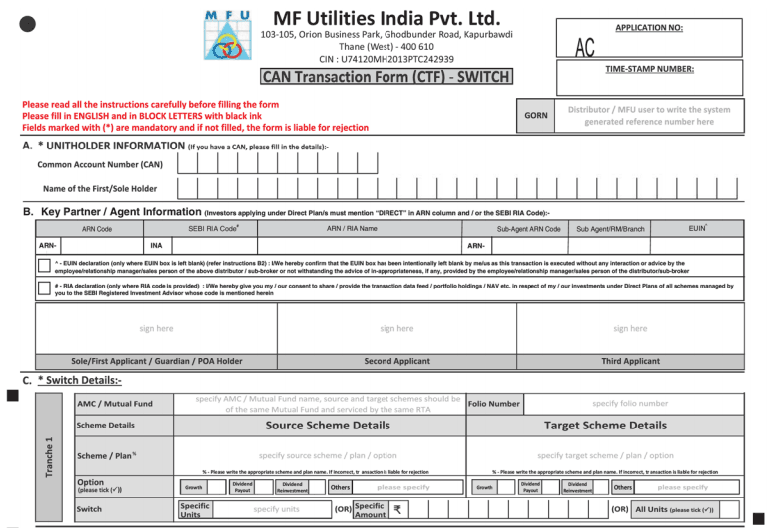
  • Ask for the Common Transaction Form for Switching Mutual Fund. If you have CAN at MFU you can also use the form available at MFU website. Fill up the form with required details along with source scheme and target scheme details. A sample form screenshot is given below. You can also use fillable form.

Common Transaction Form

  • Make sure all details are correct, especially source scheme, target scheme, amount and number of units to be switched. After verification sign it on the form and submit it to respective center.
  • Collect the acknowledgment receipt as a proof of submission.
  • Once transaction takes place you will get email and SMS intimation on register email ID/Mobile number.

Also Read – How to invest in Direct Mutual Funds Plans?

Online Method

The second method of switching fund is an online method. This method varies from fund house to fund house. I have used online method of switching fund via myCAMS which is described below.

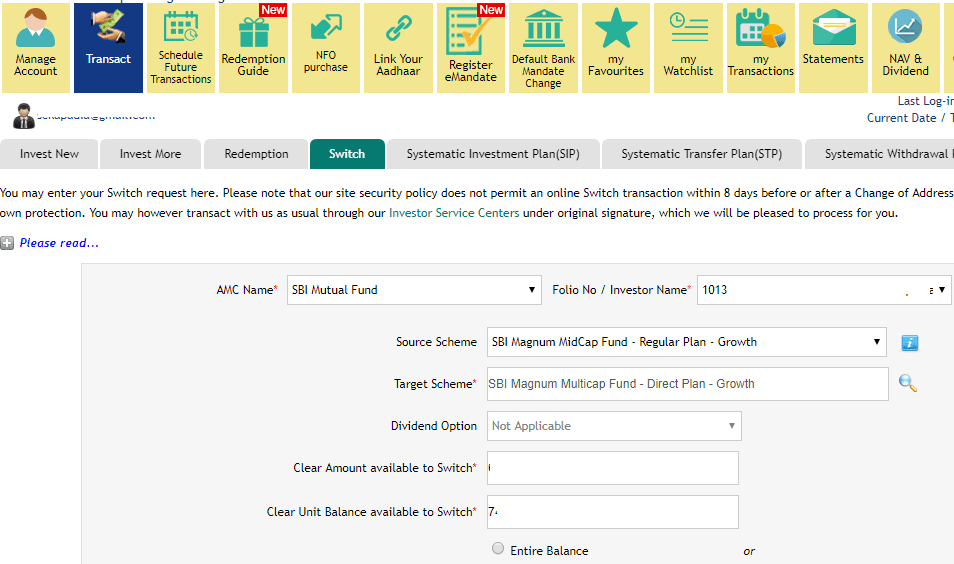
  • Visit myCAMS site and log in using your username and password.
  • From Top navigation, click on Transact icon.
  • You will be redirected to the page where it will show various options such as Invest more, Redemption, Switch, Systematic Investment Plan, Systematic Transfer Plan etc.
  • Click on Switch, you will be prompted to select AMC Name. Drop down menu only displays a list of AMC where you are holding mutual funds.
  • Select AMC and Folio Number. You will be asked to provide Source Scheme and Target Scheme. You have the option to switch entire balance or number of units.

direct mutual fund

  • Accept terms and condition and press on switch button to initiate switching. You can also schedule this transaction at later date.
  • On submission, you will get a confirmation page. The certain portals may ask transaction PIN or ask to re-enter your password for verification.
  • Once the process is completed you will receive intimation on your registered email id and mobile via SMS.

Step-by-Step Guide to Switching

Switching isn’t as complicated as it sounds. Here’s a step-by-step guide to help you transition smoothly –

1. Evaluate Your Current Investments

First things first: take stock of your current mutual fund portfolio. Look at your funds’ performance, expense ratios, and exit load. Why? Because some funds may charge an exit load (a small penalty) if you redeem units within a specific period. Also, selling your funds may trigger capital gains tax. Both factors can affect the overall profitability of your switch.

2. Understand the Tax Implications

Switching from a regular to a direct plan is treated as redemption and re-investment for tax purposes. This means:

  • Equity Funds: Gains are taxed at 15% (short-term) or 10% (long-term if gains exceed ₹1 lakh).
  • Debt Funds: Short-term gains are taxed as per your income slab, while long-term gains attract a 20% tax with indexation benefits.

Crunch the numbers before making a move. Sometimes, the tax burden can outweigh the benefits of switching.

3. Choose Your Platform

You can switch directly through the Asset Management Company (AMC) website, a robo-advisory platform, or even apps like Groww, Zerodha, or Paytm Money. Each platform has its pros and cons, so pick one that aligns with your comfort level and ease of use.

4. Initiate Redemption in Regular Plan

To switch, you’ll first need to redeem your units in the regular plan. This is straightforward:

  • Log in to your mutual fund platform or AMC website.
  • Select the regular mutual fund you wish to switch from.
  • Click “Redeem.”
  • Specify the number of units or amount you want to redeem.

5. Reinvest in the Direct Plan

Once your funds are redeemed (usually takes 1-3 business days), reinvest the amount in the direct plan of the same mutual fund. Here’s how:

  • Go to the AMC’s website or your chosen platform.
  • Search for the direct plan of your desired mutual fund.
  • Select “Invest” and input the redemption amount.
  • Complete the transaction.

6. Track and Review

Switching is just the beginning. Keep an eye on your investments’ performance, expense ratios, and overall portfolio health. Direct plans require a hands-on approach, so stay vigilant.

Pro Tips for a Hassle-Free Transition

  • Stagger Your Switch – Instead of switching all your funds at once, consider staggering the process over a few months to minimize tax impact.

  • Focus on Long-Term Benefits – Don’t get bogged down by short-term tax liabilities or exit loads. Think of the long-term cost savings.
  • DIY Research – Educate yourself about market trends, fund performance, and portfolio allocation to make informed decisions.

Common Mistakes to Avoid

  1. Ignoring Tax and Exit Loads: A hasty switch can lead to unnecessary costs. Always evaluate the financial implications.
  2. Overlooking Fund Performance: Don’t assume direct plans automatically outperform. Always review a fund’s historical performance.
  3. Not Staying Updated: Direct mutual funds require active management. Keep yourself updated with market changes and fund updates.

Switching from a regular mutual fund to a direct mutual fund can be a game-changer for your investment strategy. It’s all about cutting costs, maximizing returns, and taking control of your financial future. Sure, it’s a bit more work, but isn’t your hard-earned money worth it? Armed with the right knowledge and tools, you can make the transition seamless and rewarding.