
Blog Page 299

Hybrid Funds – Key Features, Types and Benefits

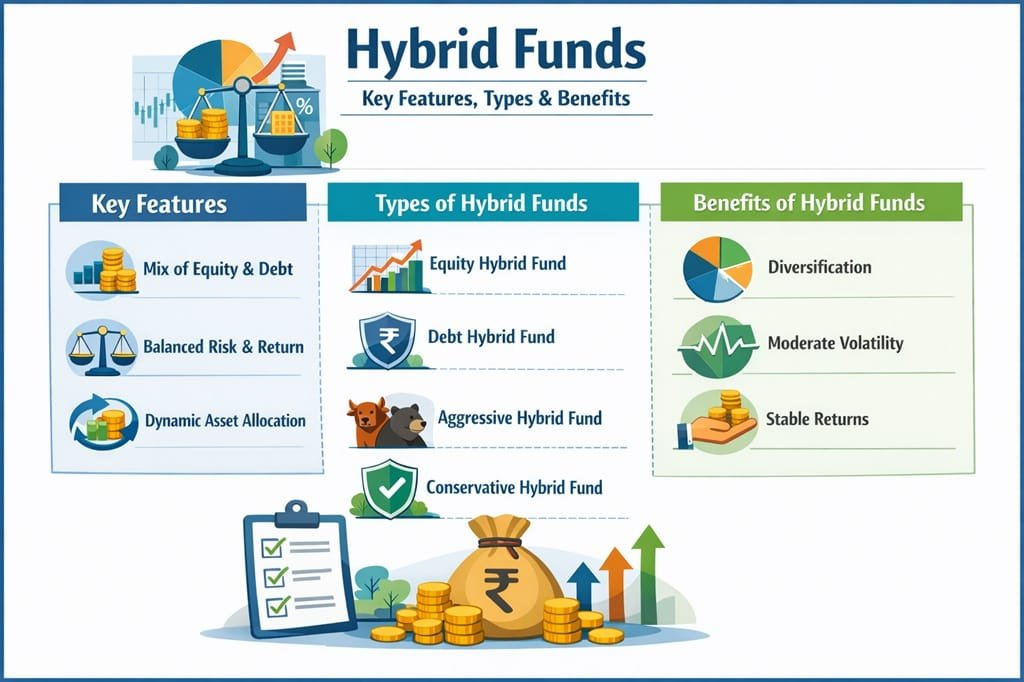
Hybrid Funds means funds made by combining two or different category of assets equity and debt. As hybrid fund invest in two asset categories investor can avail the benefit of both. The Hybrid Fund offers maximum diversification and moderate returns. A hybrid fund is a combo of equity and debt. There are various types of hybrid funds available to Indian stock market investors. The decision of investing in hybrid mutual funds depends upon investors risk profile and investment objective. Prior to recategorization Hybrid fund was known as a balanced fund.

Picture this: You’re at a buffet, and instead of loading up on just spicy curries or bland salads, you mix ’em up for the perfect meal. That’s hybrid funds in a nutshell! These mutual funds invest in a combo of asset classes, mainly stocks (equities) for that growth kick and bonds (debts) for stability. Sometimes, they even toss in a bit of gold or real estate to spice things up. In India, the Securities and Exchange Board of India (SEBI) keeps a close eye on them, ensuring they’re categorized properly so investors know what they’re getting into.

Why bother with hybrid funds? Well, life’s unpredictable, right? The stock market can swing like a pendulum, and pure debt funds might not keep up with inflation. Hybrid funds aim to smooth out those bumps, offering a middle ground. They’re managed by pros who tweak the mix based on market vibes, saving you the headache of doing it yourself. And get this – they’re accessible to everyone, from fresh-out-of-college millennials to retirees eyeing steady income. No wonder they’ve become a staple in many Indian households’ investment plans!
hybrid funds

How Do Hybrid Funds Work Behind the Scenes?

Ever wondered what happens after you invest? The fund pools money from thousands like you, then allocates it per the scheme’s mandate. For instance, an aggressive hybrid fund might park 70% in blue-chip stocks from NSE giants like Reliance or HDFC, and the rest in government bonds or corporate debts. Fund managers use tools like fundamental analysis and economic indicators to decide – it’s like having a financial wizard on your team. And with SIPs (Systematic Investment Plans), you can drip-feed investments, averaging out costs over time. Simple, effective, and oh-so-convenient!

Types of Hybrid Funds

Hybrid funds aren’t one-size-fits-all; they’ve got varieties to match your risk appetite. Think of them as different ice cream scoops – some bold, some mild. Here’s a rundown:

Aggressive Hybrid Funds

These are for the thrill-seekers! With 65-80% in equities and the rest in debt, they chase higher returns but with a cushion. Ideal if you’re young and can handle market dips. In India, funds like HDFC Hybrid Equity Fund have delivered solid gains over the years. Pros? Potential for double-digit returns. Cons? Volatility can keep you up at night.

Balanced Hybrid Funds

The middle child – balanced and reliable. They keep equity at 40-60%, blending growth with stability. Great for moderate risk-takers, like working parents saving for kids’ education. SEBI mandates no arbitrage here, keeping it straightforward.

Conservative Hybrid Funds

Playing it safe? These allocate just 10-25% to equities, focusing on debt for steady income. Perfect for retirees or those nearing big life goals. They offer regular dividends, acting like a pension supplement. But returns? More modest, around 7-9% annually.

Dynamic Asset Allocation Funds

These chameleons adjust automatically! Fund managers flip between equity and debt based on market valuations – high P/E ratios? Shift to debt. Low? Go equity-heavy. It’s hands-off for you, but requires trusting the manager’s gut.

Multi-Asset Allocation Funds

Why stop at two? These invest in at least three assets – stocks, bonds, gold, maybe commodities. In volatile India, they shine by hedging against inflation or rupee dips. A bit more complex, but diversification on steroids!

Equity Savings Funds

Sneaky smart – they use equity, debt, and arbitrage (buying low, selling high in derivatives) to minimize taxes and risks. Often treated as equity for tax purposes, they’re a tax-efficient hybrid option.

Arbitrage Funds

Though sometimes lumped in, these focus on price differences between cash and futures markets. Low risk, but returns hover around fixed deposit levels. Good for parking short-term cash.

Each type suits different life stages – aggressive for the young guns, conservative for the wise owls. Mixing types in your portfolio? Even better!

Who should Invest in Hybrid Funds?

Hybrid funds are comparatively safer bets than pure equity funds. These funds provide higher return compared to debt fund. This fund is suggested for conservative investors with moderate risk appetite looking for income generation or capital appreciation. The equity component of fund offers the probability of higher return, at the same time, the debt component offers a cushion against market conditions.

As there are multiple types of hybrid funds available in the market, as an investor you must be careful in the selection of the right hybrid fund. If you are a conservative investor go for conservative hybrid funds or Arbitrage fund. If your risk-taking capacity is higher you can go for aggressive hybrid funds.

Points to consider while investing in Hybrid Funds

One should consider following points while investing in Hybrid Funds.

Risk – A Hybrid fund is not completely risk-free. It is less risky compared to equity fund as debt component is involved.

Return – Hybrid funds do not offer guaranteed returns. The returns entirely depend on market condition and performance of underlying assets.

Expense Ratio – Expense ratio is one of the important factors while making a decision of buying a mutual fund. You should select a fund with a lower expense ratio.

Investment Horizon – A Hybrid fund is ideal for medium-term investment horizon. The recommended investment horizon for a hybrid fund is 5 years.

Tax on Gain – Long-term capital gain tax and short-term capital gain tax both are applicable to mutual funds.

FAQs

What makes hybrid funds different from equity or debt funds?

Hybrid funds blend both, offering balance, while pure equity chases growth and debt focuses on safety.

Are hybrid funds suitable for beginners?

Absolutely! Their diversification makes them less intimidating than stocks alone.

How are hybrid funds taxed in India?

Equity-oriented ones (65%+ stocks) get LTCG tax at 10% over ₹1 lakh. Debt-heavy follow debt fund rules.

Can I withdraw from hybrid funds anytime?

Yes, but check exit loads – usually 1% if redeemed within a year.

What’s the minimum investment for hybrid funds?

Often ₹5,000 for lump sum, ₹500 for SIPs – super accessible!

Do hybrid funds guarantee returns?

Nope, markets fluctuate, but their mix aims for steadier performance.

Wrapping it up, hybrid funds in India are like that reliable friend who keeps you grounded yet pushes you forward. With their key features like diversification and flexibility, various types to suit every taste, and benefits ranging from tax perks to balanced returns, they’re a no-brainer for smart investing. Whether you’re dodging market volatility or building a nest egg, incorporating hybrid funds can supercharge your portfolio. So, why wait? Chat with an advisor, pick a fund, and start your journey today. After all, in the wild ride of Indian markets, a hybrid approach might just be the ticket to financial peace.

5 Best Cashless Health Insurance Policy in India 2025

Cashless Health Insurance Policy provides cashless hospitalization service to the policyholder. You need not arrange cash for the bill payment if you are holding cashless health insurance policy. All the medical bills are directly settled by the insurance company, provided claim amount is within sum assured limit.

Let me ask a simple question – What is the first thing you do in case of medical emergency or hospitalization? Well, in most of the cases people rush to the nearest ATM for the withdrawal of money. A delay in arranging cash leads to a delay in the starting a treatment. In order to avoid this type of situation, it is advisable to opt for a cashless health insurance policy. In this post, we will take a look at 5 Best Cashless Health Insurance Policy in India. Apart from that, we will also talk about types of cashless medi claim policy and points to consider before buying cashless health insurance policy.

cashless health insurance

Types of Cashless Health Insurance Policy

Cashless Individual Health Insurance

Cashless family health insurance is a policy that provides complete coverage to family up to sum assured. One can avail cashless claim service for any family members.

Cashless Family Health Insurance

Cashless family health insurance is policy that provides complete coverage to family up to sum assured. One can avail cashless claim service for any family members.

Cashless Health Insurance for Senior Citizen

Cashless health insurance for a senior citizen is an exclusive policy for the senior citizen. You can purchase this policy for your parents and grandparents. This policy may or may not cover pre-existing diseases. You need to check policy terms before purchasing.

Also Read – Buying Health Insurance Policy in India – Information Guide

5 Best Cashless Health Insurance Policy 2022

Apollo Munich Optima Restore Health Insurance

Apollo Munich Optima Restore Health Insurance is the first best cashless health insurance policy. The features offered by Apollo Munich Optima Restore are given below.

Apollo Munich Optima Restore Features

  • Offers a wide range of coverage. It offers both individual and family floater policies.
  • This policy offers restore and multiplier benefit.
  • Lifetime renewal facility.
  • Organ Donor and domiciliary treatment covered.
  • E-opinion for critical illness available.
  • Alternative treatment like Ayurveda is covered.
  • Wide network coverage for cashless claims.

ICICI Lombard Health Care Plus

ICICI Lombard Health Care Plus is a second-best cashless health insurance policy that provides a wide range of network hospital coverage. The features offered by ICICI Lombard Health Care Plus are given below.

  • Cashless approval within 4 hours.
  • Add-on coverage for outpatient treatment, wellness and maternity benefits.
  • Fast and efficient claim settlement process.
  • Lifetime renewal option for policy.
  • No sub-limits applicable on room rent, hospitalization and doctor’s fee or diagnostic tests.

Religare Health Care

Religare Health Care is another cashless health policy that provides comprehensive coverage to the policyholders. The features of this policy are given below.

  • Cashless treatment at 4600+ hospitals & daily allowance.
  • Auto recharge of policy sum insured if it has exhausted.
  • Pre and post hospitalization coverage.
  • Lifetime renewal facility.
  • Alternative treatment Ayurveda, Unani, Sidha or Homeopathy are covered.

Max Bupa Health Insurance

Max Bupa health insurance policy is another best medi claim policy that provides the cashless facility. The key features of this policy are given below.

  • Free Health check-up for every second year.
  • No sub-limits on room rent.
  • Lifelong renewability of plan.
  • Increased sum insured on every claim free year.
  • A Cashless facility at the nearest hospital.

Bajaj Allianz Health Insurance Family Floater

Bajaj Allianz is excellent health insurance company that offers both individual and family floater health insurance. Bajaj Allianz provides highest network coverage where you can claim cashless claims.

  • Cashless claims facility at 6000+ hospital network.
  • Family discount up to 10%. Coverage of family member up to 6.
  • 10% co-payment for non-network hospitals.
  • No sub-limit on room rent.

Also Read – Health Insurance Plans for NRI in India

How Cashless Hospitalization Works?

The cashless mediclaim is offered on health insurance policy eliminates the needs of running around for arranging fund at the time of medical emergency. The cashless claim facility is available only at network hospitals. Hospitalization bills, up to the sum insured are directly settled by the insurance company. There are two types of cashless claim services.

Planned Claim

A planned claim is a claim where the policyholder is aware of hospitalization two-three days in advance. In this case, the policyholder takes approval from the insurance company a few days before. Following steps needs to be followed for a planned claim.

  • Once you have finalized the hospital, take your policy card and ask for preauthorization form.
  • Fill up the form and take authorization from attending physician.
  • Submit the form to TPA via hospital desk.
  • The form will be scrutinized and approval letter mentioning sanction amount and treatment detail will be sent to the policyholder.

Emergency Claim

When policyholder or family member insured under policy required emergency treatment due to accident or any other crisis situation emergency claim process is followed. The process is given below.

  • Show your health insurance card issued by the insurance company to hospital. The card contains a policy number and validity.
  • Fill up and submit the pre-authorization form available at hospital desk. The form will be sent to TPA via hospital desk. TPA needs to approve the form for cashless treatment. As per protocol TPA should process form within 6 hours.

Points to consider before buying cashless health insurance policy

  • Cashless claims facility is available only at network hospitals. Check list of networking hospitals.
  • Check how smooth is process of filing and settling claim by insurance company.
  • Find out TPA approval time for pre-authorization form. It should be low.
  • Remember to keep all photocopies of documents including medical bills, claim form and discharge papers.
  • Insurer will pay amount up to sum assured. If you exceed sum assured amount you need to pay additional amount.

I hope the information given above will help you in the selection of Best Cashless Health Insurance Policy. If you have further queries for the selection of health insurance post it in the comment section.

5 Popular Stock Market Training Course & Institute

stock market training

The stock market is one of the best investment options. Everyone wants to invest in the stock market to earn a big profit. But due to lack of knowledge and risk they avoid investing in the stock market. If you are a beginner and planning to invest in the stock market, it is recommended to go through a proper stock market training course. Stock market training course helps you in multiple ways. It reduces the chance of risk. You will be able to learn new technique for trading. It will also help you to earn big profit with lower investment. There are many courses available on stock market, you need to be careful in selecting course. The course should be delivered by stock market experts. It is highly recommended to select a course that provides hands-on. Here is list of 5 Popular Stock Market Training Course that you can explore when you are planning to take stock market training.

Also Read – 5 Best Portfolio Management and Tracking Tools for Stock Market Investors

5 Popular Stock Market Training Course & Institute

National Institute of Security Market

About Institute

National Institute of Security Market (NISM) is one of the old institute established in 2006. This institute is established by SEBI. This training institute provides full time, part time and short-term training programs related to stock market.

About Course

NISM offers full-time course such as a Postgraduate program in securities markets. This institute also offers short-term program NISM Certified course in securities market (NCCSM) and a Postgraduate Certificate in the securities market (PGCSM). The postgraduate program is in association with ICICI bank.

Fees

Fees for the course offered by NISM varies based on course. The general range of fee is in the range of 4 Lakh to 10 Lakh.

Nifty Trading Academy

About Institute

Nifty Trading Academy is leading stock market institute running successfully since past ten years. This institute is based at Surat, Gujarat. It is SEBI registered institute that offers various trading and investor related course. They also provide live market training.

About Course

Nifty Trading Academy offers multiple stock market training course such as diploma in technical analysis, intraday trading course, advance technical analysis course, pure profit course. Along with course you will have access to free stock market material.

Fees

Fees of the courses offered by NTA is in the range of Rs.6000 to 3.54 Lakh.

Stock Market Institute

About Institute

Stock Market Institute (SMI) is Most Comprehensive Stock Market Training Institute in India based out at Bangalore. The institute offers high quality curriculum, videos and training software. The student can become expert in the technical analysis, fundamental analysis, currencies and commodities.

About Course

Stock Market Institute offers certified course on capital market as well as professional diploma in capital markets. Training method includes practical learning via latest trends & charts of index & select stocks with live streaming & live examples by expert faculties from NSE and BSE.

IBBM

About Institute

IBBM is a premier institute of Delhi & NCR and a pioneer in financial market education and training.  IBBM has trained many candidates and has assisted them in getting an exciting career in Financial Markets. This institute is promoted by Wellindia group.

About Course

IBBM offers course like NCFM, NISM, Smart Investor, Certified Technical Analyst, Fundamental Equity Research, Currency trading, Portfolio and wealth management etc. IBBM also provides online courses on daily and weekend batches.

Elearn Markets

Elearn Markets is online financial education provider. A student, working professional or anyone who are keen to learn stock market trading and investment can visit Elearn Market. The courses offered by Elearn Markets is completely online. You can learn technical analysis, fundamental analysis, basic finance, commodity, derivative course on this site. The course fees at Elearn Markets is very reasonable.

How to select the right stock market training course?

One should consider following points while selecting stock marketing training course and institute.

  • Compare the credential of institute including trainers, services offered and features.
  • Check the course content and verify that it suits your expectations.
  • Make sure to compare course fees and duration of course.
  • Make sure that course can increase your knowledge about the stock market.
  • Check if live training (hands-on) is provided by the training institute.
  • Check that course cover basic as well as advanced stock market content.
  • The course offered by the institute should be affordable.
  • The institute should provide support after training for a few days.
  • If required, take feedback from a professional.
  • Make sure institute is genuine and registered with SEBI.

Skill required to make career in stock market

  • Basic Knowledge of Economics including politics, inflation, deflation, risk and factors affecting stock market.
  • Analytical Skills to carryout analysis of shares in stock market.
  • Mathematical knowledge as you require to do various calculation while dealing in the stock market.
  • Good communication skill to do communication during course curriculum.

Attending stock market training course is one way of learning stock market. You should not completely rely on the stock market course. You should acquire knowledge of other methods, such as reading a book, attending workshops, seminar etc. This will help you in getting insights into the stock market, and you can analyze and take better decision while making stock market trading or investment.

Land Loan Vs Home Loan – What is the difference?

Picture this: You’ve found a beautiful plot of land on the outskirts of your city—peaceful, green, and perfect for your dream house. Or maybe you’ve spotted a ready apartment downtown with all the amenities. Either way, you’ll likely need some financial help to make it yours.

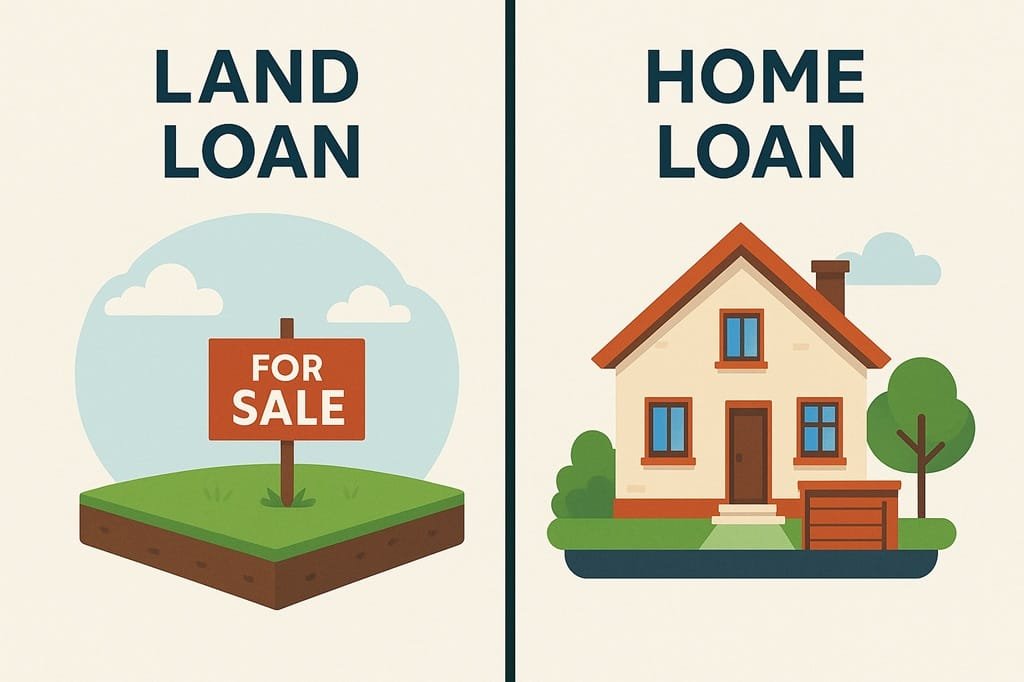
Here’s where the Land Loan Vs Home Loan debate begins. While both may sound similar, they serve different purposes and come with distinct sets of rules. A land loan helps you buy a plot to construct your own home in the future, while a home loan helps you buy a ready-made house, flat, or property under construction.

But that’s just the tip of the iceberg. The real difference lies in eligibility criteria, interest rates, tax benefits, and how lenders view your intent.

Let’s dive deeper and decode the Land Loan Vs Home Loan puzzle—without the jargon.

land loan home loan

What is a Land Loan?

A land loan, also called a plot loan, is a financial product that helps you purchase a piece of land. The land could be:

  • A residential plot within municipal limits
  • A plot meant for constructing a house later
  • A plot purchased from a government body or approved private developer

However, you can’t buy agricultural land or land in rural areas using a land loan. Banks usually finance plots located within city limits or in approved areas only.

Key Features of a Land Loan:

  • Purpose: Buying a residential plot
  • Property Type: Only non-agricultural, approved land
  • Loan-to-Value (LTV): Up to 70–80% of the plot cost
  • Tenure: Usually up to 15 years
  • Construction Clause: Some lenders expect you to start construction within a certain time (say, 2 years)

In short, a land loan is perfect if you’re planning to build your dream home from the ground up.

What is a Home Loan?

A home loan is a loan taken to buy a ready-to-move-in house, an under-construction property, or even to renovate an existing home.

Key Features of a Home Loan:

  • Purpose: Buying or constructing a house
  • Property Type: Ready, under-construction, or even resale homes
  • Loan-to-Value (LTV): Up to 90% of property value
  • Tenure: Up to 30 years
  • Tax Benefits: Yes, under Sections 80C and 24(b) of the Income Tax Act

Home loans are the go-to choice for anyone who wants to own a roof over their head right away.

Land Loan Vs Home Loan – What’s the Difference?

Let’s put both loans side by side and see how they really differ.

Parameter Land Loan Home Loan
Purpose Purchase of land or plot Purchase or construction of a house
Property Type Residential plot within municipal limits Ready/under-construction homes
Loan-to-Value Ratio (LTV) Up to 70–80% Up to 85–90%
Tenure Up to 15 years Up to 30 years
Interest Rate Slightly higher Generally lower
Tax Benefits Limited or none Full tax benefits on principal & interest
Construction Requirement Often mandatory within a time limit Not applicable
Eligibility Salaried or self-employed with proper documentation Salaried or self-employed
Risk Perception (by banks) Higher risk Lower risk
Property Approval Must be within municipal area & legally approved Must have occupancy & builder approvals

Why Are Interest Rates Different?

You might’ve noticed that land loans have slightly higher interest rates compared to home loans. But why?

It’s because banks view land as a non-productive asset. Until construction begins, the land doesn’t generate income or add tangible living value. On the other hand, a house provides immediate shelter and stability.

In simple terms, from a lender’s perspective:

  • Land = Higher risk, lower resale value
  • Home = Lower risk, stable value

So, if you take a land loan, expect to pay an interest rate that’s about 0.5%–1% higher than a typical home loan.

Tax Benefits – A Major Differentiator

When it comes to tax deductions, home loans take the trophy.

Home Loan Tax Benefits:

  1. Section 80C – Deduction up to ₹1.5 lakh on principal repayment
  2. Section 24(b) – Deduction up to ₹2 lakh on interest repayment for a self-occupied home
  3. Additional benefits for first-time buyers under Section 80EE or 80EEA

However, for land loans, tax benefits are limited:

  • You can’t claim deductions on interest or principal repayment for just buying land.
  • If you construct a house on that plot later using the same loan, you may claim benefits once the construction is complete.

So, in the Land Loan Vs Home Loan tax battle, the home loan wins hands down!

Loan-to-Value Ratio (LTV) – How Much Will the Bank Finance?

LTV simply means how much of the property’s value the bank is willing to finance.

  • Home Loan: Up to 85–90% of the property value
  • Land Loan: Around 70–80% of the plot value

For instance, if your plot costs ₹50 lakh, the bank may finance only up to ₹40 lakh, and you’ll have to pay the rest upfront.

That’s another subtle yet critical difference in the Land Loan Vs Home Loan comparison.

Repayment Tenure – Short vs Long Game

Time plays a major role in how comfortable your EMI feels.

  • Home Loan: Tenure up to 30 years → smaller EMIs, easier repayment
  • Land Loan: Tenure up to 15 years → higher EMIs, quicker closure

So, if you’re looking for flexibility and lower monthly stress, a home loan might be more manageable.

Eligibility & Documentation

Both loans require you to show steady income and a clean credit history. But the documentation may vary slightly.

Common Documents for Both:

  • PAN card, Aadhaar card, and address proof
  • Income proof (salary slips, ITRs, bank statements)
  • Property documents (sale deed, approved plans, NOC, etc.)

Additional for Land Loan:

  • Proof that the land is within municipal limits
  • Land use permission (non-agricultural certificate)
  • Encumbrance certificate

Since land carries higher risk, lenders scrutinize the paperwork more thoroughly.

Pros and Cons – Land Loan Vs Home Loan

Let’s weigh both sides of the coin.

✅ Advantages of a Land Loan:

  • Freedom to design and build your dream home your way
  • Potential appreciation in land value
  • Option to construct later as per convenience

❌ Disadvantages of a Land Loan:

  • Higher interest rates
  • Shorter tenure and limited tax benefits
  • Not available for agricultural or rural land

✅ Advantages of a Home Loan:

  • Easier approvals and longer repayment period
  • Full tax benefits on interest and principal
  • Lower interest rates

❌ Disadvantages of a Home Loan:

  • Less flexibility (you’re buying an already designed space)
  • Higher property cost due to construction and amenities

Which One Should You Choose?

This depends on your goal, financial situation, and timeline.

Choose a Land Loan if:

  • You want to build a custom home later
  • You have patience and planning flexibility
  • You’re comfortable with shorter tenure and higher EMI

Choose a Home Loan if:

  • You want immediate possession of a ready house
  • You seek tax savings and long-term repayment ease
  • You prefer a stable, predictable investment

Simply put, if you’re a planner and dreamer, go for a land loan.
If you’re a doer who wants to move in now, pick a home loan.

How Do Banks View Each Loan Type?

Lenders love clarity. When you apply for a home loan, they see a tangible property with ready resale potential. It’s a safer bet for them.

But when it comes to land loans, banks are a bit cautious because:

  • Land has no immediate use
  • Resale is trickier if you default
  • Value can fluctuate depending on location and future development

That’s why, during Land Loan Vs Home Loan evaluation, banks set stricter conditions for land loans—like higher down payment and faster construction timelines.

Construction Clause – The Hidden Twist

Here’s something many people miss: Some banks approve land loans only if you commit to start construction within a fixed period—say 2 or 3 years.

If you fail to do so, they might:

  • Convert your loan into a personal loan (with higher interest), or
  • Stop disbursing further loan installments

So, if your goal is just to invest in land for future resale, a land loan might not be ideal. Instead, consider other financing routes or invest from your own funds.

Future Value & Investment Perspective

From an investment lens, both have their unique charm.

Land:

  • Appreciates faster in developing areas
  • No depreciation
  • Offers flexibility for future construction

Home:

  • Provides immediate utility and rent potential
  • Slower appreciation due to structure aging
  • Easier resale and liquidity

If your aim is long-term appreciation, land could be your goldmine.
If your aim is steady returns and stability, home wins.

FAQs  

  1. Can I convert a land loan into a home loan?

Yes, once you begin construction, some banks allow you to convert your land loan into a home construction loan.

  1. Can I buy agricultural land with a land loan?

No, land loans are strictly for residential plots within municipal or approved limits.

  1. Which has better tax benefits – land loan or home loan?

Home loans. Land loans offer no tax benefits unless you construct a home on that land.

  1. What’s the minimum down payment for a land loan?

Usually, around 20–30% of the plot’s value.

  1. Can NRIs apply for land loans?

Some banks allow NRIs to buy land, but it depends on local regulations and lender policies.

Expert Tips Before You Decide

Here are a few pointers to make your Land Loan Vs Home Loan journey smoother:

  • Check property legality: Ensure clear titles, approvals, and zoning.
  • Compare interest rates: Even 0.5% can make a big difference in total repayment.
  • Read the fine print: Especially for construction clauses and penalties.
  • Plan your EMIs smartly: Use online calculators to assess affordability.
  • Think long-term: Choose based on future goals, not just immediate needs.

Conclusion

In the grand debate of Land Loan Vs Home Loan – What is the Difference? there’s no universal winner. It all boils down to your purpose and plans.

If you dream of designing your own home, enjoy flexibility, and can handle slightly higher EMIs, a land loan is your ticket.

But if you crave stability, ready possession, and tax savings, a home loan fits the bill perfectly.

Both paths lead to the same destination—property ownership—just through different routes.

So before you sign those papers, pause and ask yourself:
Do I want to build my dream… or buy it ready-made?

That one question will tell you everything you need to know.