

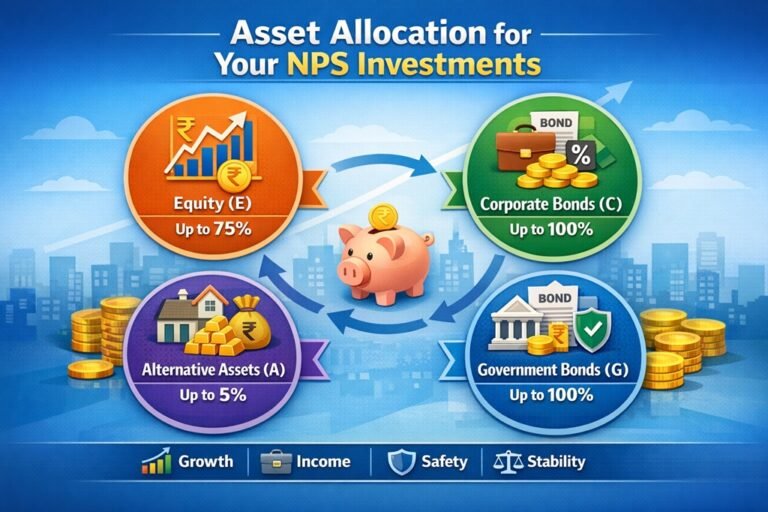
The National Pension System (NPS) is one of the most flexible retirement savings tools available to Indian citizens. It lets you invest in a mix of equities, corporate bonds, government securities, and alternative assets — all under one roof, with significant tax benefits on top. But there is a decision you have to make early on that will shape your retirement savings more than almost anything else: how do you split your money across these asset classes?
This is called asset allocation, and getting it right can make a huge difference. Put too little in equities when you are young, and you miss out on the power of compounding. Put too much in equities right before retirement, and one bad market year could hurt your corpus badly. The good news is that NPS gives you real control — but only if you understand what you are working with.
This guide walks you through everything you need to know about NPS asset allocation. We cover what each asset class is, how the two main investment modes work, what allocation makes sense at different life stages, and how to avoid common mistakes. By the end, you will be in a position to make a confident, informed decision.
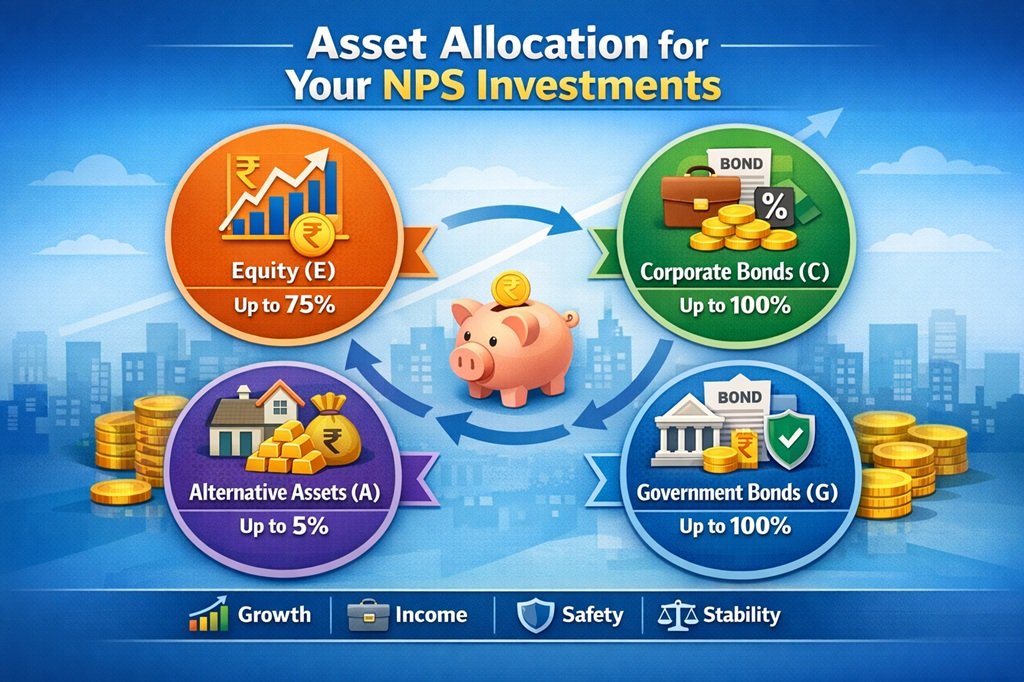
Understanding the NPS Asset Classes
NPS allows you to invest across four distinct asset classes. Each one has a different risk level, return potential, and role in your portfolio. Let us look at each one in simple terms.
Equity (Asset Class E)
The equity portion of NPS invests your money in stocks — specifically, shares of large, established companies listed on the BSE or NSE. Fund managers under NPS tend to focus on large-cap stocks, which are companies with a market capitalisation of Rs 5,000 crore or more, or shares that are traded in the derivatives segment. A small portion, up to 5% of the equity portfolio, can also be parked in equity mutual funds, provided those funds follow the same investing guidelines.
Equity is the highest-risk, highest-reward option in NPS. Over long periods — ten, fifteen, or twenty years — equity historically delivers the best returns among all asset classes. However, in the short term, it can be volatile. In a bad year, equity funds can fall by 20-30%. This is why equity suits younger investors who have time to ride out the ups and downs.
The maximum you can put into equity under the active choice model is 75% of your total NPS contribution. This cap drops as you get older if you are in the auto-choice mode. Recent updates from PFRDA have also introduced the ability to invest in gold and silver ETFs under Scheme E, adding another layer of diversification.
Corporate Debt (Asset Class C)
Corporate debt means lending your money to private companies in exchange for a fixed rate of interest. These companies issue bonds — essentially IOUs — and your NPS fund manager buys them on your behalf. Companies that issue such bonds in NPS include large infrastructure firms, public sector units (PSUs), financial institutions, and banks.
At least 90% of the corporate bond portfolio must be in bonds rated AA or above. This is a credit quality filter that protects you from very risky corporate debt. Up to 10% can be in bonds rated between A and AA. The fund can also hold bank term deposits (from banks with a capital adequacy of at least 9% and net NPA below 4%) and AT1 bonds from banks, up to a 2% limit.
Corporate debt typically yields between 7% and 9% annually — better than government bonds, though not as exciting as equities. But the key advantage is stability. It does not swing wildly with the stock market. For investors in their 35-50 age range who want growth but do not want all their money riding on markets, corporate debt is a sensible middle ground.
Government Securities (Asset Class G)
Government securities, or G-Secs, are bonds issued by the central and state governments of India. When you invest here, you are essentially lending money to the government. In return, the government pays you a fixed rate of interest over a set period, which can range from 5 to 40 years.
G-Secs carry virtually no default risk. The Indian government has never defaulted on its domestic debt obligations, and these bonds are backed by the full faith and credit of the nation. As of early 2025, yields on the 10-year G-Sec were around 6.75% to 6.9% — lower than corporate bonds, but remarkably stable.
Even during market crashes, G-Secs hold their value well. During the COVID-19 pandemic in 2020, when equity funds lost around 25% of their value, government security funds actually gained around 5%. This makes them excellent for capital preservation, especially for investors approaching retirement.
Alternative Investment Funds (Asset Class A)
This is the newest and most niche category in NPS. Asset Class A invests in unconventional assets like Real Estate Investment Trusts (REITs), Infrastructure Investment Trusts (InvITs), Mortgage-Backed Securities (MBS), and Basel III Tier 1 bonds.
Important update: According to PFRDA’s circular dated December 13, 2025, Scheme A is being phased out. The investment avenues that were under Scheme A will be absorbed into Scheme E or Scheme C going forward. Until this transition is complete, the maximum allocation to Scheme A remains at 5% for Tier-I accounts.
| Asset Class | Where It Invests | Risk Level | Expected Returns |
| Equity (E) | Large-cap stocks, index funds | High | 10–13% (long-term) |
| Corporate Debt (C) | Corporate bonds, PSU bonds | Medium | 7–9% |
| Govt Securities (G) | Central & state govt bonds | Low | 6.5–8% |
| Alternatives (A) | REITs, InvITs, MBS (being phased out) | Medium-High | Varies |
The Two Investment Modes: Active Choice vs Auto Choice
Once you know what the asset classes are, the next big decision is how you want your allocation to be managed. NPS offers two modes: Active Choice and Auto Choice.
Active Choice: You Are in Control
In Active Choice, you decide exactly what percentage of your NPS contribution goes into each asset class. You can put up to 75% in equity, and up to 100% in corporate debt or government securities (subject to the overall mix adding up to 100%). You can also put up to 5% in alternative assets under Tier-I accounts.
Active Choice also lets you pick your own Pension Fund Manager (PFM). You can even split your investments across different fund managers — one for equity, another for corporate debt, and a third for government securities. This is useful because a PFM that excels in managing equity may not be the best at managing corporate bonds.
This option is best suited for people who have a good understanding of financial markets and want to tailor their NPS portfolio to their specific goals. If you are comfortable reviewing your portfolio once or twice a year and adjusting the allocation as you age, Active Choice gives you that flexibility.
Key rule: You can change your asset allocation up to four times per financial year. You can change your Pension Fund Manager once per year. Switching between asset classes has no tax implications — unlike switching between mutual funds, which can trigger capital gains tax.
Auto Choice: The System Manages It for You
Auto Choice, also called the Lifecycle Fund, automatically adjusts your asset allocation based on your age. The idea is simple: when you are young, you can afford to take more risk, so a larger portion goes into equity. As you get older, the equity portion reduces and more money moves into safer assets like corporate bonds and government securities.
There are three sub-options within Auto Choice, each designed for a different risk appetite:
Aggressive Lifecycle Fund (LC-75)
Under this option, 75% of your corpus goes into equity until the age of 35. After that, the equity allocation drops by 4% every year, with the money moving into government securities and corporate debt. By the time you approach retirement, your portfolio is primarily in safer, fixed-income assets. This option is for people who want to maximise equity exposure early in their career.
Moderate Lifecycle Fund (LC-50)
This fund caps equity at 50% until age 35. After that, it reduces by 2% annually. The design balances growth with stability — you get decent equity exposure when young, but the transition to safer assets starts earlier and proceeds more gradually. This is the middle path — suitable for investors who want reasonable growth without taking on full market risk.
Conservative Lifecycle Fund (LC-25)
Only 25% of your money goes into equity at any point, and even this reduces by 1% every year after age 35. The bulk of the portfolio is always in corporate bonds and government securities. This option is for investors with a very low risk appetite who prioritise capital preservation over growth.
| Lifecycle Fund | Max Equity | Equity Cut After Age 35 | Best For |
| Aggressive (LC-75) | 75% | -4% per year | Risk-tolerant, long horizon |
| Moderate (LC-50) | 50% | -2% per year | Balanced risk profile |
| Conservative (LC-25) | 25% | -1% per year | Low risk tolerance |
Auto Choice: Advantages and Limitations
Auto Choice sounds convenient, and for many investors it is. You do not have to think about rebalancing. The system does it for you. But there are some important drawbacks you should know about before defaulting to this option.
- The auto reduction of equity starts at age 35, which is quite early. Most financial planners suggest maintaining a significant equity allocation until at least age 50-55 to fully benefit from compounding.
- The formulaic reduction does not account for market conditions. If the equity market is booming when your allocation is being cut, you end up selling at a potentially suboptimal time.
- For someone who starts NPS at age 30, the compounding benefits of equity are most powerful in the period between age 35 and 50 — exactly when the auto choice is trimming equity.
For these reasons, financially aware investors often prefer Active Choice so they can manually reduce equity allocation at a time that suits their specific situation rather than following a rigid age-based formula.
How to Choose Your Asset Allocation at Every Life Stage
There is no one-size-fits-all answer to NPS asset allocation. Your age, risk tolerance, income, other investments, and retirement timeline all matter. That said, here are practical guidelines for the three main career phases.
Early Career: Ages 25 to 35
This is the time to be aggressive with equity. You have the longest investment horizon, which means you can afford to ride out market downturns. Even if markets fall sharply in any given year, you have decades for your portfolio to recover and grow.
- Suggested equity allocation: 65% to 75%
- Suggested corporate debt allocation: 20% to 25%
- Suggested government securities: 5% to 10%
If NPS is your primary retirement vehicle and you have limited exposure to equities elsewhere, going up to the full 75% in equity is a sound strategy. If you already invest heavily in equity mutual funds or stocks outside NPS, you can bring the equity allocation down to 50% within NPS and use it as a debt-heavy complement to your overall portfolio.
The key at this stage is to avoid being overly conservative. Many young investors, especially those new to investing, tend to be afraid of equity and default to government securities. That is a missed opportunity. The long-term power of equity compounding is greatest when you have 25-30 years until retirement.
Mid-Career: Ages 36 to 50
As you move through your career, your priorities shift. You probably have a larger corpus now — which means there is more to protect. You may also have other financial responsibilities: children’s education, home loan EMIs, aging parents. This is a good time to start gradually reducing equity and building up your debt allocation.
- Suggested equity allocation: 40% to 60%
- Suggested corporate debt allocation: 25% to 35%
- Suggested government securities: 15% to 25%
The shift should be gradual — not sudden. Bringing equity down by 3-5% every two or three years is reasonable. This ensures you continue to benefit from equity growth while steadily reducing the risk of a market downturn wrecking your retirement savings.
This is also the stage where reviewing your Pension Fund Manager’s performance becomes more important. Check 3-year and 5-year returns across NPS schemes and compare PFMs. If your current manager is consistently underperforming peers, consider switching — you are allowed to do so once a year.
Pre-Retirement: Ages 51 to 60
In the decade before retirement, capital preservation takes priority over growth. A major market crash in the years just before you retire could significantly reduce your corpus and your eventual annuity income. The goal now is to lock in the gains you have built over the years.
- Suggested equity allocation: 15% to 30%
- Suggested corporate debt allocation: 30% to 40%
- Suggested government securities: 30% to 50%
Some investors go down to 10-15% equity by age 57-58, concentrating heavily on government securities as their retirement date approaches. Others maintain 25-30% equity even close to retirement, especially if they plan to continue the NPS account post-60 or have other income sources that reduce their dependence on the NPS corpus.
It is worth noting that after age 60, you can defer your NPS withdrawal up to age 75. If you plan to do this, keeping a slightly higher equity allocation closer to retirement might still make sense, as your investment horizon effectively extends beyond 60.
Choosing the Right Pension Fund Manager
Your Pension Fund Manager (PFM) is the entity that actually invests your money according to the asset class rules. Currently, there are several PFRDA-approved PFMs including SBI Pension Funds, HDFC Pension, ICICI Prudential Pension, Kotak Pension, Aditya Birla Sun Life Pension, and others.
It is a common misconception that all PFMs deliver identical results. In practice, their returns across asset classes can vary meaningfully — sometimes by 1-2% or more over a 5-year period. A 1% difference in annual returns might sound small, but over 20-25 years, it can translate into a difference of lakhs in your final corpus.
Here is what to look for when evaluating a PFM:
- Consistent long-term performance across 3-year and 5-year windows — not just a single good year
- Strong performance specifically in the asset classes you are using most (e.g., if you have 70% in equity, focus on who does equity best)
- Published track records from the NPS Trust website, which lists all PFM returns by scheme and time period
- Stability of the fund management team — frequent changes in fund managers can disrupt investment strategy
Remember, you can split your allocation across up to three different PFMs for different asset classes. So you could have one PFM managing your equity portion, another for corporate bonds, and a third for government securities. This allows you to pick the best-in-class manager for each category.
Tax Benefits
Asset allocation decisions should also factor in the tax advantages that NPS offers — because these are genuinely significant.
- Section 80C: Contributions up to Rs 1.5 lakh per year qualify for deduction under Section 80C.
- Section 80CCD(1B): An additional deduction of up to Rs 50,000 per year is available exclusively for NPS contributions, over and above the 80C limit. This is unique to NPS — no other investment offers this extra deduction.
- Section 80CCD(2): If your employer contributes to your NPS (up to 10% of basic salary + DA for private sector, 14% for central government employees), that contribution is also deductible, with no cap.
At withdrawal time, 60% of the accumulated corpus can be withdrawn as a lump sum, and this amount is fully tax-exempt. The remaining 40% must be used to purchase an annuity, and the annuity income you receive will be taxed as per your income tax slab at that time.
This tax structure makes NPS particularly powerful for people in higher tax brackets who want to reduce their current tax liability while building a substantial retirement fund.
Common Mistakes to Avoid
Even well-intentioned NPS investors make avoidable errors. Here are the most common ones and how to steer clear of them.
Mistake 1: Being Too Conservative Too Early
Many investors, especially those new to market-linked investing, put most of their NPS money into government securities right from the start. While this feels safe, it costs them dearly in the long run. At 7% annual return (which is what G-Secs offer) vs 12% from equity over 25 years, the difference in corpus can be enormous. If you are under 40, lean into equity.
Mistake 2: Never Reviewing Your Allocation
NPS allows you to change your allocation up to four times a year. Many investors set their allocation once during account opening and never look at it again for years. Life changes — income grows, risk appetite shifts, market conditions evolve. Review your allocation at least once a year and adjust if necessary.
Mistake 3: Switching Fund Managers Too Frequently
You can switch your PFM once a year. Some investors switch every year, chasing whoever had the best returns last year. This is a mistake. Short-term performance is often driven by luck or market conditions rather than skill. Focus on 3 to 5-year track records and switch only if there is a consistent and meaningful performance gap.
Mistake 4: Panic Selling During Market Crashes
When markets fall — and they will fall — some NPS investors rush to shift their equity allocation to government securities to avoid further losses. This is almost always counterproductive. You lock in losses at the bottom and miss the recovery. NPS is a long-term product. Short-term volatility is part of the journey. Stay the course.
Mistake 5: Ignoring the Contribution Amount
Asset allocation is important, but it does not matter much if you are contributing very little. The absolute size of your corpus at retirement depends on both the return rate and the amount you invest. Maximise your annual NPS contribution, especially to take full advantage of the additional Rs 50,000 deduction under Section 80CCD(1B).
Suggested Allocation Scenarios
To make this practical, here are three illustrative allocation scenarios based on different investor profiles.
Scenario 1: Rizan, Age 28, Private Sector Employee
Rizan has just started his career and has 32 years until retirement. He has no other major equity exposure outside NPS. He has a moderate-to-high risk appetite and wants to build a large retirement corpus.
- Equity (E): 75%
- Corporate Debt (C): 20%
- Government Securities (G): 5%
He uses Active Choice with the Aggressive profile and reviews his allocation every year. He plans to start reducing equity at age 45.
Scenario 2: Priya, Age 42, Mid-Career Professional
Priya already has a substantial equity mutual fund portfolio outside NPS. She wants NPS to serve as a more conservative, debt-heavy pillar of her retirement plan. She has a moderate risk appetite.
- Equity (E): 40%
- Corporate Debt (C): 35%
- Government Securities (G): 25%
She uses Active Choice and reviews once a year. She will bring equity down to 20-25% by age 55.
Scenario 3: Ramesh, Age 55, Nearing Retirement
Ramesh retires at 60 and wants to protect the corpus he has built over 25 years. He cannot afford a large market drawdown at this point.
- Equity (E): 20%
- Corporate Debt (C): 35%
- Government Securities (G): 45%
He will bring equity down further to around 10% by age 58. His focus is on preserving capital and ensuring predictable annuity income.
Reviewing and Rebalancing Your Portfolio
Asset allocation is not a one-time decision. As you age, your financial situation, risk capacity, and market conditions all change. Here is a simple rebalancing framework:
- Annual review: Once a year, check your current allocation vs your target. If equity has drifted up significantly due to market gains, trim it back.
- Life event review: Any major life change — job change, marriage, children, inheritance — is a good trigger for a fresh look at your NPS allocation.
- PFM performance review: Every year, compare your PFM’s performance against peers across all asset classes. If there is a persistent gap, consider switching.
- Rate environment check: When interest rates are high (10-year G-Sec yields above 7%), it can be a good time to increase allocation to government securities and lock in better returns. When rates are falling, equity tends to do well, making it a potentially better time to hold equity.
The important thing is not to over-tinker. NPS is a long-term product. Frequent changes based on short-term market movements will do more harm than good. Set your direction, stay disciplined, and let compounding do the heavy lifting.
Conclusion
Picking the right asset allocation for your NPS is not about finding the perfect formula. It is about making a sensible, age-appropriate decision, sticking to it with discipline, and adjusting gradually as you move through life.
The core principles are simple. When young, favour equity — it is the most powerful wealth-building tool in the NPS toolkit. As you age, shift gradually towards corporate debt and government securities to protect what you have built. Review your allocation and fund manager performance regularly, but do not let short-term noise drive big changes.
NPS, when used well, can be one of the most tax-efficient and robust retirement tools available in India. The asset allocation choices you make today will compound quietly over the coming decades — and by retirement, they will have made a very big difference indeed.