

Choosing health insurance after retirement requires careful attention to the conditions that determine how much an insurer pays during a medical emergency.
Health insurance for senior citizens might cover their hospitalization and other treatments but waiting periods, co-payments, and sub-limits will determine the actual payment. Knowledge of these terms will enable senior citizens and their family members to choose the policy.
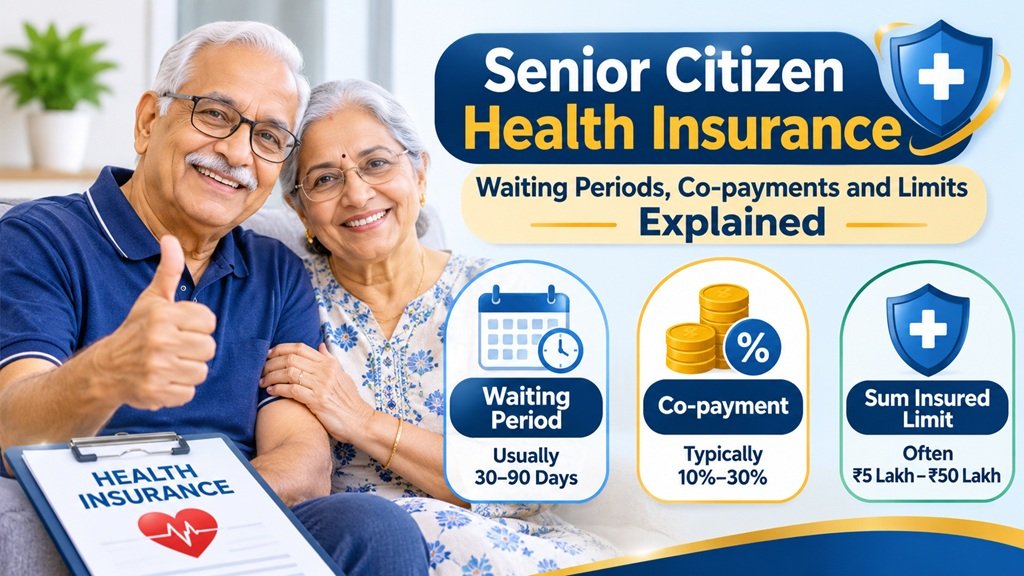
Why Do Policy Conditions Matter for Seniors?
Medical needs may increase with age, making health insurance for senior citizens essential for managing hospitalisation costs, existing illnesses, and age-related conditions. In 2026, these policies may offer higher entry age limits, often up to 80 years or with no upper age limit, along with shorter waiting periods for pre-existing diseases (PED). Nevertheless, it should be noted that the sum insured alone cannot define how much financial support will be provided through the insurance policy.
The following three elements need special focus:
- Waiting Periods – It defines when will the cover start for some specific disease or pre-existing illness.
- Co-payments – This includes payment of a defined percentage of costs of claims.
- Sub-Limits – These limit the payments for some particular treatment or expenses, like room rent.
Disclaimer: Coverage, exclusions, and payment obligations vary by insurer and policy. Review the policy wording before purchasing.
What Waiting Periods Apply to Senior Citizen Health Insurance?
For health insurance for senior citizens, a waiting period is the time during which specified medical expenses are not eligible for coverage. Purchasing a policy does not mean every illness or pre-existing condition will be covered immediately.
The main waiting periods to check are:
| Type | Meaning | What to Check |
| Initial Waiting Period | 30 Days of waiting period for new illnesses new policy | Whether accident-related claims are exempt |
| Pre-existing Disease Waiting Period | Applies to conditions that existed before policy inception, subject to policy definitions | The waiting period for diabetes, hypertension or heart disease |
| Specified Disease Waiting Period | Applies to listed illnesses or procedures | Whether treatments such as cataract surgery have separate waiting periods |
Pre-existing disease waiting periods commonly range from two to four years, while some plans offer shorter periods. The applicable duration depends on the policy and its terms.
When comparing health insurance for senior citizens, check whether existing medical conditions are covered after the waiting period and whether any exclusions or additional conditions apply. Disclose medical history accurately during the application process to avoid claim complications.
Disclaimer: The periods listed above are indicative, not universal. Actual waiting periods, definitions, and exceptions are governed by the insurer’s policy wording.
How Does a Co-payment Affect Your Claim?
Under health insurance for senior citizens, a co-payment, or co-pay, is the percentage of an admissible claim that the policyholder must pay out of pocket. Insurers may include this condition in senior-focused policies, with the percentage and applicability varying across plans.
For example, consider a hospital bill of ₹2,00,000, assuming the entire amount is admissible under the policy.
| Co-payment Rate | Your Share | Insurer’s Share |
| 10% | ₹20,000 | ₹1,80,000 |
| 20% | ₹40,000 | ₹1,60,000 |
| 30% | ₹60,000 | ₹1,40,000 |
A higher co-payment generally reduces the premium but increases the amount payable from personal savings when a claim arises. A plan with a lower co-pay may cost more upfront but reduce the financial burden during hospitalisation.
When assessing health insurance for senior citizens, compare mandatory co-payments with any available options to reduce or waive them. Also check whether the clause applies to all claims, particular treatments,s or hospitalisations outside a specified network.
Disclaimer: The illustration assumes the entire bill is admissible and excludes deductibles, sub-limits and other deductions. Actual claim payments depend on policy conditions.
What Sub-limits Should You Check Before Buying a Policy?
In health insurance for senior citizens, sub-limits restrict the insurer’s payment for particular expenses, even when the total bill falls within the sum insured. These restrictions may affect the final claim amount and increase out-of-pocket expenses.
| Type of Limit | How it Works | Why it Matters |
| Room Rent Cap | Restricts the amount payable for hospital accommodation | Choosing a room above the permitted limit may increase your expenses |
| Treatment-specific Cap | Sets a maximum payable amount for certain procedures | Expensive surgeries may leave a shortfall |
| Disease-specific Limit | Restricts coverage for specified illnesses or treatments | Some conditions may require greater personal contributions |
| Overall Sum Insured | Sets the maximum coverage available under the policy, subject to its terms | Large or repeated claims may exhaust the available amount |
For example, even if your policy allows for a maximum of ₹5,000 per day as room rent but you have chosen a room costing ₹8,000, then there might be more costs apart from this. This is because some policies make proportionate deductions in other hospital expenses too.
Before purchasing health insurance for senior citizens, look for plans with no room-rent restrictions or adequate limits for the treatments you may need. Read the policy schedule to understand how each restriction affects the claim.
Disclaimer: Room-rent deductions and treatment limits vary by policy. The example is illustrative and does not represent a standard insurer rule.
How Can You Compare These Conditions Effectively?
Comparing policies requires looking beyond premiums and advertised coverage amounts. Use the following checklist to assess the terms that influence actual claim payments.
| Comparison Point | What to Examine |
| Waiting Periods | Initial, pre-existing disease and specified illness waiting periods |
| Co-payment | Percentage payable by the insured and circumstances in which it applies |
| Sub-limits | Room rent, surgery and disease-specific restrictions |
| Sum Insured | Whether the amount is sufficient for expected healthcare expenses |
| Hospital Network | Availability of suitable network hospitals near your residence |
| Restoration Benefit | Conditions under which exhausted coverage may be reinstated |
| Renewability | Renewal conditions and long-term premium affordability |
| Exclusions | Treatments, expenses and situations that the policy does not cover |
Take into account any pre-existing health condition, preference of hospitals, and the chances of requiring specialist care. Also, consider whether the policy includes daycare treatment, pre- and post-hospitalization costs, and treatments at home.
A cheaper insurance policy might require higher co-payments or restrictive limits. Analyzing these factors along with the premium will give you a better idea of the coverage you get.
Disclaimer: Benefits such as restoration, daycare, and domiciliary services depend on the policy terms, limitations, and exclusions.
Reading the policy terms carefully before purchasing helps clarify your out-of-pocket expenses and reduces the risk of unexpected costs when filing a claim. Compare health insurance for senior citizens options through Jio Insurance Broking, paying particular attention to waiting periods, co-payments, sub-limits, and exclusions.
Disclaimer
- The information provided in this blog is for general informational purposes only and should not be considered insurance, financial, or medical advice.
- Coverage, waiting periods, co-payments, sub-limits, exclusions, and claim settlement conditions vary by insurer and policy.
- Review the policy wording and schedule carefully before purchasing health insurance for senior citizens.
- All examples and illustrations are for demonstration purposes only. Real payments will be based on the policy terms and conditions.

