

Open any investor discussion forum in the week prior to an IPO, and this is what you will find. There will be one post about the GMP, another will say “listing gain confirmed,” and the application form will go out. Ask this investor about what the business does and how it generates revenue, and the discussion will be silent.
The investors monitor the upcoming IPOs as an “IPO” is a unique opportunity to invest in a business at the time of its listing. It is a good enough reason for monitoring. It is not a good enough reason to apply for the IPO without even looking at the information. This guide covers the points which are to be considered apart from the obvious listing gain, and how the grey market premium fits into it.
Please note that the lot sizes, retail limit, and other rules may change, so you should verify everything given below.
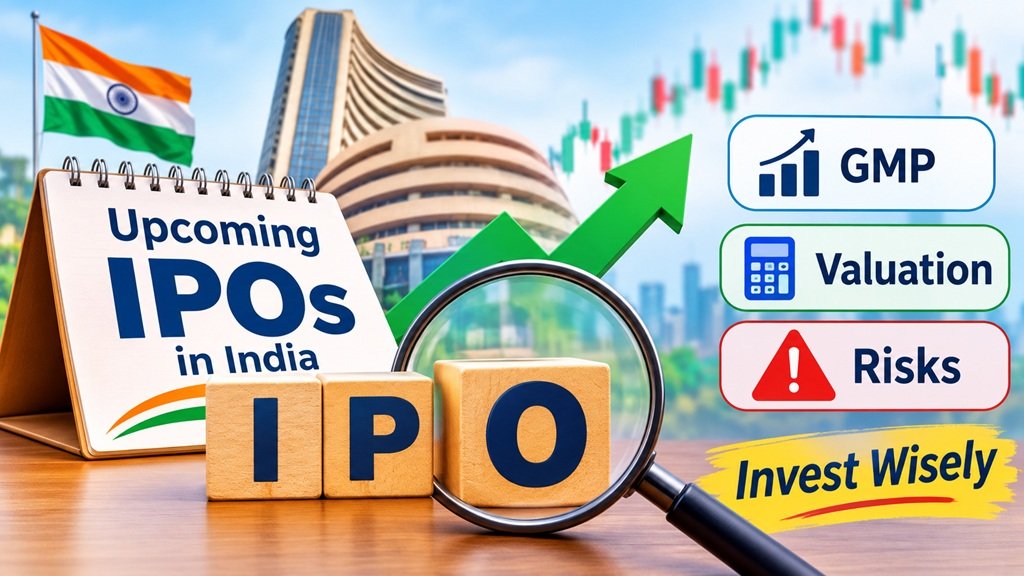
How do you track upcoming IPOs in India?
Every listing has the common elements of the date on which it opens and closes, the price band, the lot size and the issue size. Price band and lot size give an idea of the amount of money that would be required, while the issue size gives an idea of the demand for the security.
The trap lies in confusing confirmed information with rumored ones. Companies put out their draft prospectus months in advance, and websites make up the information by giving ‘expected’ dates and ‘expected’ prices. None of this information is at all binding. The price band comes out once the red herring prospectus is issued, usually a few business days before the issue opens.
A maintained upcoming IPO list helps because you can see what’s open, what’s about to open and what’s still unconfirmed in one place. Before bidding, though, make sure that your information corresponds to the RHP and the Exchange Notice. These are documents that company is responsible for according to regulations, which are published on SEBI, NSE and BSE websites.
What is IPO grey market premium (GMP)?
GMP (Grey Market Premium) is an unofficial estimate of the difference between the issue price of a share during an IPO and its value at the moment of trading on the grey market before being listed on the stock exchange. For example, if the issue price of an IPO is ₹100, and the GMP stands at ₹30, this means that the expected listing price will most likely be ₹130. This amount represents the ‘Expected Listing Price’ published on tracking websites.
There are two important facts you need to consider. First, the grey market is not regulated. There is no Exchange involved, no clearing house, and no official registration process; only the network of dealers exists. Secondly, the number changes. This may happen every day, and even every hour depending on general sentiment of the market, company news, fate of similar IPOs, and level of subscriptions. A premium that looks strong on Monday can be half as much by listing day, and it can turn negative.
So GMP is a sentiment reading. It tells you how some traders feel right now. It doesn’t tell you whether the business is good or the price is fair.
How should you read GMP next to the fundamentals?
It needs to be regarded as a “second opinion”, and not the first one. Firstly, you need to analyze the company’s revenue, profits, debt, and valuation. Secondly, consider GMP and see whether it looks reasonable. There is a difference between a strong premium for a company with growing profits and a reasonable price and a strong premium for a loss making company which is valued at a high multiple.
Subscription data provides additional information, and is more reliable since the exchanges publish it, categorized by QIBs, NIIs, and retail. High QIB interest shows that large funds have studied the company and liked it. Subscription from retail category many times oversubscribed, while the institutions show hesitation requires further consideration. Industry environment is important as well. An industry which is hot today might lose its momentum very quickly.
A high GMP alone is never a good enough reason to apply. It can fall before listing, it can be influenced by a small number of traders, and plenty of IPOs with strong premiums have listed flat or dropped below issue price. If the only argument for an IPO is “the GMP is high,” you don’t have an argument yet. For a running view of the premium, the latest IPO GMP updates on Malik Times are one place to follow it. Just remember what the number is and isn’t.
How do you evaluate an IPO’s valuation?
Use the numbers provided by the company itself first. Look through the income statement and the profit margins of the company for the last three years. Do not assess the company according to its latest performance. It is possible that sales growth goes together with falling profit margins. Also look at the cash flows generated by the business. The company may report profits in its accounting records, yet have a minimal amount of cash. After that analyze the debt of the company. A highly leveraged company leaves less margin for an off year.
After that compare the price with the prices of listed companies. Compare the price-to-earnings ratio of the company at the upper end of the price range with the same ratio of two-three listed companies that operate in the same field. Compare lenders according to price-to-book ratio and capital intensive companies according to EV/EBITDA. If the listed companies trade around 25 times earnings and the IPO requires 45 times, the company must grow much faster than its listed competitors.
Check the mix of fresh issue and offer for sale (OFS). In a fresh issue, the firm issues new equity and holds onto the cash. In an OFS, the existing equity holders sell their shares and the company makes no money. The presence of an OFS means early investors or promoters are cashing out. This isn’t necessarily negative; money has to come out at some point, but understand the rationale for the sale. Then look at the “objects of the issue.” Funding new capacity involves a future growth gamble. Debt repayment is balance sheet restructuring, and “general corporate purposes” is meaningless.
Which risks should you consider when applying?
Overvaluation is the primary one. The companies themselves decide to go public during strong markets, so you will end up paying the full price when it’s at its peak. Even well-managed firms can list in weak markets, but there’s nothing you can do about it.
The performance on listing is uncertain for the same reasons. Some initial public offerings have seen their share prices fall below their issue price a few months after listing.
“Company-level risks”: promoter track record, pledged shares, high leverage, over-reliance on a few customers or on a single regulation, and litigation follow. These appear in the risk factors paragraph and never make it into the social media summary.
The one that everyone seems to forget is liquidity. You can’t use the funds that you have invested in the IPO till the allotment process is done, and you will have to hold the shares through a downturn. You must not invest funds needed for rent payments, EMIs, school fees, or any emergency into an IPO. And also diversify your investments; don’t concentrate your entire investment into a couple of IPOs.
A short research checklist
- First of all, you should confirm dates, price band and lot size from the exchange notice or the RHP, not a forwarded message.
- Read the risk factors, objects of the issue and restated financial statements in the DRHP or RHP.
- Compare valuation with listed peers and with the company’s own history.
- Check the fresh issue versus OFS split, and the debt position.
- Look at subscription data as it comes in, by category.
- Treat GMP as extra information, not a promise.
- Ask yourself how you’d feel if the stock fell “20 percent” after listing, and whether you’d need to sell.
Frequently asked questions
What is IPO GMP?
It’s the unofficial premium at which an IPO’s shares trade in the grey market before listing, compared with the issue price. It’s a sentiment indicator, not an official or guaranteed figure.
Does a high GMP mean the stock will list at a profit?
Not reliably. The premium can fall sharply before listing day, and many IPOs with strong GMP have listed flat or below issue price.
What is the difference between DRHP and RHP?
The “DRHP” is the draft filed with SEBI for review and public comment. The “RHP” is the near-final version issued before the issue opens, and it includes the price band.
Where can I verify official IPO details?
The RHP on SEBI, NSE, BSE and lead manager websites, plus exchange notices for live subscription figures.
Final thoughts
An IPO launch is designed to get your attention, and GMP is part of the noise. Don’t rush into it. Read the filing, see what similar companies are priced at and think about how much money you could lose. The “grey market premium” is only one part of the picture. If the story sounds better than the numbers, skip it. There’s usually another issue a week or two away.

, company valuation, financials and risks before investing.)