

Choosing an appropriate stock out of several thousand firms that trade their shares on Indian stock exchanges could be quite difficult for small investors. Screening of the individual firms and analysis of their financial results, their valuation, the price movement, and selection of the stocks that satisfy particular investment criteria requires some time and effort.
In order to make the process easier, the National Stock Exchange of India (NSE) has created the innovative Market Lens – the stock screener that will allow investors to screen stocks based on NSE data. This screener is currently available in beta version and could be found on marketlens.nseindia.com.
The logic behind a stock screener is very straightforward: instead of browsing through thousands of stocks manually, investors can set criteria for stocks they are interested in and filter through the universe, thus reducing it to a much shorter list of companies. The criteria may be related to earnings, valuation, dividends, industry, and price-related factors. In any case, Market Lens is made to help investors do that.
Considering the Indian market, where there is already an array of stock-screening websites available, such as Screener.in or Chartink, it seems reasonable that now there is an official screening platform by NSE to complement the existing options for stock research. Given the fact that Market Lens utilizes NSE market data, it may be quite helpful for investors during their preliminary analysis and stock selection.
In this article, we will consider NSE Market Lens in detail: what it is, its key features, how stock screening works on the platform, what an investor can use the tool for, and how it is different from other popular platforms such as Screener.in or Chartink.
It is crucial to keep in mind that a stock screener is essentially a research and filtering tool. It is not automatically implied that a stock identified by the tool is a viable candidate for investment. Investors need to review a number of factors including business model, balance sheets, management, competition, valuation, debt, corporate governance, and others before investing.
What Is NSE Market Lens?
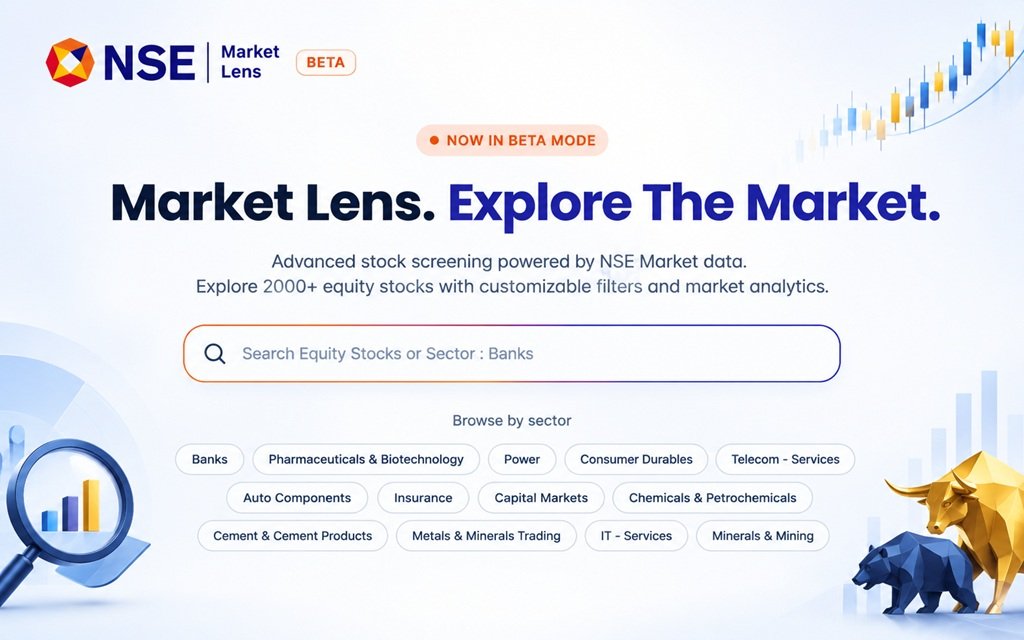
Market Lens is NSE’s own stock screening engine. It is a web-based application that allows users to look up, filter, and analyze 2000+ listed stocks by utilizing information available on the exchange directly. In contrast to external screening applications which take data from different sources, Market Lens uses information provided by NSE directly, thus making it an “official” stock screener for fundamental and market analysis.
A screening engine created by the exchange itself is a revolutionary move in Indian retail investing environment. Traditionally, NSE provided only the infrastructure and data, matched orders, published market information, and allowed building research applications based on its capabilities.
Key Features of NSE Market Lens
- Sector-Based Screening
With Market Lens, you can search by industry – Pharma, Auto, Banks, IT, and many more with just one click, which helps to conduct quick research comparisons within that industry, not in the entire market. The industries include banking, pharmaceutical and biotechnology, electricity generation, consumer durables, telecommunication services, automotive components, insurance, capital markets, chemicals and petrochemicals, cement, metal and mineral trading, information technology services, and mining.
- Ready-Made (Preset) Screens
If the investor does not wish to create the filter himself, the site offers a number of pre-configured screens that are designed according to various investment concepts. Some of the popular screens are Growth at a Discount, Income + Safety, Momentum + Breakout, Quality & Safety, and Value Growth. The Low Price + High EPS screen looks for companies with low price and high EPS, while other preset filters use metrics such as high promoter share plus EPS growth, dividend cover, and PE ratio.
- Custom, Saveable Screeners
Apart from the preset filters, there is a scope of creating one’s own filter combination and storing it so that it can be used again in the future. This is especially helpful in case of investors who have a particular way of investing like value investing or momentum trading.
- Broad Market Coverage
This tool enables the investors to screen more than 2,000 stocks in India, including a vast majority of the market beyond Nifty 50 or Nifty 500.
How to Use NSE Market Lens
Using NSE Market Lens is quite simple, even if you have never used a stock screener before. It helps the investor narrow down the large number of stocks into a more selected bunch through the use of sectors, themes and financial or market criteria.
- Go to NSE Market Lens
First, go to marketlens.nseindia.com. This website has been designed specifically as a stock screening and market analysis tool, where you can find information about listed companies and identify stocks using various criteria.
The portal combines information related to stocks as well as the screening capabilities in one place.
- Find a Stock or Explore Sectors
Either start your search by finding out about a particular company, or by exploring sectors.
For instance, the categories may include IT Services, Banks, Financial Services, Pharmaceuticals, Automobiles, FMCG, Energy, Metals, Chemicals.
If you do not have any company in mind yet, just look for one by searching for its name and opening its relevant market information. On the other hand, if you do not know which stock you are looking for, you may browse sectors to find out what companies exist in your industry of interest.
- Explore Popular Screens
Another feature offered by Market Lens are Popular Screens which can be useful for users who need to find stocks fitting common market conditions or themes.
For instance, a screen based on Momentum + Breakout will help you to find out stocks satisfying the pre-defined Momentum and Price-Breakout conditions.
Instead of selecting all required parameters individually, investors can choose one of the popular screens and then analyze the resulting stocks.
But, presence of a stock in the list of popular screens does not automatically mean it is a good candidate for investment. It is just a starting point for analysis.
- Create a Custom Screen
One of the most important functions is the possibility to customize the screening of stocks according to your own conditions.
Taking into account the available variables, you can make a combination of different filters like
- Market Cap (in Cr) > 500 AND Price to Earning (P/E) < 15 AND Earning Per Share (EPS) > 15
- Dividend Yield(%) > 3 AND Price to Earning (P/E) < 20 AND Market Cap (in Cr) > 200
One of the most important functions is the possibility to customize the screening of stocks according to your own conditions.
Customized screening is going to be quite time-efficient since you won’t need to go through thousands of companies by hand.
- Study the Screen Output
After applying your criteria, Market Lens will show you companies that correspond to the set criteria. This is when you should move on from screening to fundamental analysis and researching companies.
Do not just stick to the output of the screen. Dive into the details of every company and analyze the data related to their performance and fundamentals.
It is also crucial to understand why a certain stock ended up on the screen. A company might fulfill a certain criterion and yet still pose some hidden risks.
Market Lens vs Screener.in vs Chartink
Market Lens joins other successful platforms that include Screener.in (fundamental analysis) and Chartink (technical/momentum screening). The uniqueness of Market Lens lies in the direct exchange access of the data as opposed to the use of external aggregators. Nonetheless, being in beta now, this application is expected to improve the list of features – new features, technical screening tools and even improvements to the existing presets according to users’ needs. It will become evident whether Market Lens will manage to compete with other platforms such as Screener.in in terms of depth and ability to customize queries and technical analysis capabilities of Chartink.
Important Investor Notice
One should note that the result of the screening means that the company meets certain requirements, but it does not mean that the stock is suitable for investment. For instance, the low stock price does not necessarily mean that it is underpriced. A screener is an entry into research but not a substitute of due diligence.
NSE Market Scope can help make the initial process of stock picking more methodical. Rather than analyzing the whole market, the investors may choose to select companies using sectors, favorites and custom screens.

