

Choosing a government job is usually a long-term decision. Salary matters, but so do working hours, career growth, job security and the kind of work you will do every day. RBI Grade B scores well on these factors, which is why it remains a popular career choice.
The Reserve Bank of India is India’s central bank. Its responsibilities include monetary policy, regulation and supervision of the financial system, payment systems and foreign exchange management. A Grade B officer can work in departments connected with these functions, depending on the posting.
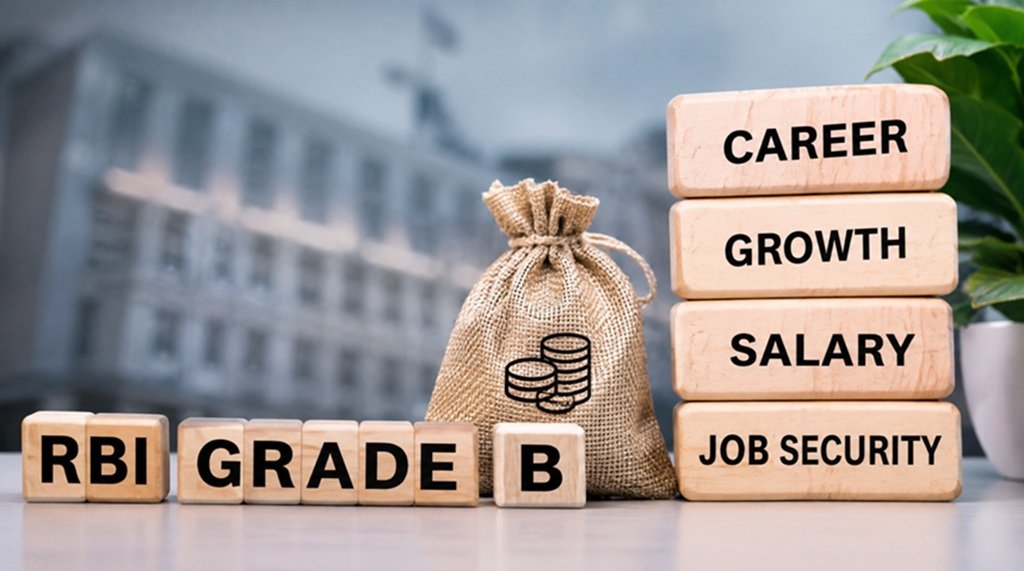
RBI Grade B Notification & Recruitment
The RBI Grade B notification was released on April 29, 2026. RBI announced 60 vacancies across the General, DEPR and DSIM cadres. The General cadre had 40 vacancies.
For the General cadre, Phase I was held on June 13, 2026. Phase II followed for shortlisted candidates, with an interview as the final stage. The official Phase I result shows an aggregate cutoff of 108.75 out of 200 for the General category. These numbers show how competitive the exam is.
RBI Grade B Salary
As per RBI recruitment information, a Grade B officer starts with a basic pay of ₹78,450 per month. The pay scale can rise to ₹1,41,600. Officers also receive allowances such as Dearness Allowance, House Rent Allowance, Local Compensatory Allowance, Special Allowance and Grade Allowance.
RBI currently lists initial monthly gross emoluments at about ₹1.49 lakh without HRA. Officers who do not receive Bank accommodation can get HRA at 15% of pay.
The actual take-home salary is lower because of deductions and taxes. RBI also lists accommodation subject to availability, medical facilities, Leave Fare Allowance and concessional loans for eligible purposes.
What does an RBI Grade B Officer Do?
There is no single daily routine for every Grade B officer. The department and posting matter.
RBI handles monetary policy, banking regulation and supervision, payment systems, foreign exchange and government banking. Officers can work on analysis, reports, regulatory matters, supervision and policy-related assignments.
This is different from a commercial bank role, where customer service, branch operations and business targets can take up much of the day. RBI work is more closely connected with the financial system and public policy.
RBI Grade B Work-Life Balance
Work life balance depends on the posting. RBI has different departments and offices, so the workload is not the same everywhere. Some roles can have a structured schedule, while deadlines, inspections, reports or other time-sensitive work can increase the pressure.
The work environment is generally more structured than many private-sector financial jobs. Still, candidates should not assume that every day will be a fixed 9 to 5 routine. The actual experience depends on the role and department.
Another point to consider is the type of person who fits the role. RBI Grade B is better suited to someone who can spend time reading financial news, understanding economic issues and working with reports and data. The job rewards patience and subject knowledge. It may feel slow to a person who wants constant change and quick decisions.
Job Security in RBI Grade B
Job security is one of the main attractions of RBI Grade B.
The Reserve Bank was established under the Reserve Bank of India Act, 1934. It began operations in 1935 and was nationalised in 1949. RBI is wholly owned by the Government of India.
Employees still work under service rules and performance requirements. But the employment structure is much more stable than in many private companies, where restructuring or business changes can affect jobs quickly.
Career Growth in RBI
RBI Grade B is designed as a long-term officer career. Employees can move to higher grades and take on greater responsibilities as they progress.
The role can also provide exposure to banking regulation, supervision, monetary policy, financial markets and other areas of the financial system. For candidates interested in economics, finance or public policy, that exposure can be an important part of the career.
An aspirant should also think beyond the first few years. The question is not only whether the starting salary looks good. It is whether the work, pace and responsibilities fit the kind of career you want to build.
Is RBI Grade B Better than a Bank PO?
A bank PO and an RBI Grade B officer do different kinds of work.
A bank PO usually works in commercial banking and may handle customers, branch operations, business development and targets. RBI Grade B is more closely linked with regulation, supervision, policy and analysis.
A candidate who prefers financial policy and analytical work may prefer RBI. Someone who enjoys commercial banking and direct business responsibilities may prefer a bank.
Conclusion
RBI Grade B is a strong career choice for candidates who want good compensation, stable employment and work related to banking and finance.
The 2026 recruitment offers a starting basic pay of ₹78,450 and gross monthly emoluments of about ₹1.49 lakh without HRA. RBI also provides several employee benefits.
The main drawback is competition. With only 40 General cadre vacancies in 2026, selection requires serious preparation.
The job also has a structured nature. That suits candidates who value stability and institutional work. For such candidates, RBI Grade B can offer a strong long-term career without making salary the only reason to choose it.
For an aspirant, the practical question is simple: can you see yourself doing this kind of work for several years? If the answer is yes, the salary, benefits and stability make the career even more attractive.

