

Most traders spend a lot of time picking the right stock or asset. They study companies, read charts, and look for promising opportunities. But many of them forget something just as important — when to get in and when to get out. Poor timing can turn a good idea into a losing trade. Even the best stock pick in the world won’t help if you enter too late or exit too early.
This guide is written for traders who want to improve their timing. Whether you are just starting out or have been trading for a while, understanding entry and exit points is one of the most important skills you can build. We will keep things simple and practical, so you can apply what you learn right away.
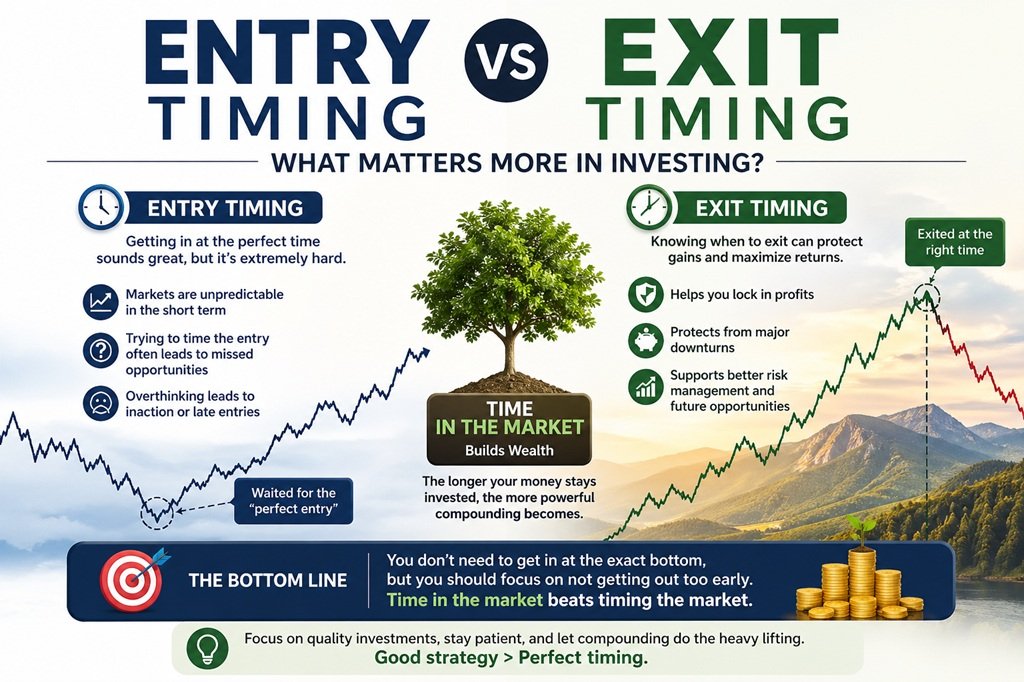
What Is an Entry Point?
An entry point is simply the price at which you decide to open a trade. It is the moment you buy (or sell short) an asset. Sounds simple, but getting this right takes practice.
A good entry point is not random. It comes after you have looked at the chart, studied the trend, and noticed a signal that suggests the price is about to move in your favour. Entering too early means you might sit in a losing position for a long time before it turns around. Entering too late means you might have already missed most of the move.
Here are some common ways traders find entry points:
- Breakouts: The price breaks above a resistance level with strong volume. Traders enter as soon as the breakout is confirmed, expecting the price to keep rising.
- Pullbacks to support: Instead of chasing a price that has already moved up, some traders wait for it to dip back to a support level before entering. This gives them a better price and a tighter stop loss.
- Moving average crossovers: When a short-term moving average crosses above a longer-term one, it can signal the start of an uptrend. Many traders use this as a buy signal.
- Candlestick patterns: Patterns like the bullish engulfing, hammer, or morning star tell traders that buyers are stepping in. These patterns are most reliable when they appear near support zones.
What Is an Exit Point?
An exit point is where you close your trade. This could be at a profit target you set in advance, or it could be a stop loss level that limits how much you are willing to lose.
Knowing when to exit is arguably more important than knowing when to enter. Many traders hold on to losing trades too long, hoping the price will come back. Others exit winning trades too quickly out of fear. Both habits eat into your overall returns.
There are two main types of exits:
- Take profit exit: This is the price level where you book your gains. You set it before you enter the trade, based on a realistic target like a resistance level or a Fibonacci extension.
- Stop loss exit: This is a safety net. If the trade goes against you, the stop loss automatically closes the position at a predetermined price, preventing the loss from getting bigger.
Stop Loss Orders Explained
A stop loss order is one of the most important tools in a trader’s kit. It is an instruction to your broker to close the trade automatically if the price falls (or rises, in a short trade) to a level you cannot afford.
Placing a stop loss correctly is a skill in itself. If it is too tight, you might get stopped out by normal market fluctuations before the trade has a chance to work. If it is too loose, you risk losing more than you planned.
Here are a few common approaches to stop loss placement:
- Below support levels: For long trades, place the stop just below a known support zone. If the price breaks that support, the trade idea is probably wrong.
- Fixed percentage: Some traders keep it simple and set the stop 1% to 2% below the entry price. This works well when you are trading consistently sized positions.
- ATR-based stop: The Average True Range (ATR) tells you how much an asset typically moves in a day. Setting your stop 1.5x or 2x ATR away from entry accounts for natural volatility without putting it too close.
- Trailing stop: This type of stop moves with the price as it goes in your favour. If the price climbs ₹10, the trailing stop climbs too. It locks in profits while still giving the trade room to run.
Take Profit Levels and Why They Matter
Setting a take profit level before you enter a trade removes the guesswork later on. When the price is moving in your favour, emotions can take over. Greed might make you hold on too long. Fear might make you exit before reaching your target.
Having a pre-set take profit order means the trade closes automatically when your target is hit. You don’t have to sit and watch the screen. You don’t have to make a last-minute decision under pressure.
Some useful ways to set your take profit target:
- Resistance levels: Look for previous price zones where the stock has struggled to go higher. These are natural points to take profits.
- Fibonacci extensions: The 1.272 and 1.618 Fibonacci levels are popular targets when a price breaks out of a range. They give you a mathematically based projection of where the next resistance might be.
- Risk-reward ratio target: If you are risking ₹50, aim to make at least ₹100 to ₹150. Your take profit should reflect this ratio.
The Risk-Reward Ratio: The Foundation of Good Timing
The risk-reward ratio is at the heart of good trading. It compares how much you stand to lose on a trade with how much you expect to gain.
For example, if your stop loss is ₹100 below your entry and your take profit is ₹200 above it, your risk-reward ratio is 1:2. This means for every rupee you risk, you expect to earn two.
Why does this matter so much? Because even if you are right only 50% of the time, a 1:2 ratio means you are still profitable over many trades. You win ₹200 on the good trades and lose ₹100 on the bad ones.
Most experienced traders aim for a minimum ratio of 1:2. Some go for 1:3 or higher. The key is not to take trades where the potential reward does not justify the risk you are taking.
Before entering any trade, ask yourself: where is my stop loss, where is my target, and does this ratio make sense? If the math doesn’t work, it’s usually best to skip the trade.
Technical Indicators That Help With Timing
Technical indicators are tools built into most trading platforms. They process price and volume data and display signals on your chart. While no indicator is perfect, combining a few of them can improve the quality of your entries and exits.
RSI (Relative Strength Index)
RSI measures how fast and how much a price has moved recently. It gives a reading between 0 and 100. A reading below 30 suggests the asset may be oversold, which can be a buying opportunity. A reading above 70 suggests the asset might be overbought, which can signal it is time to exit or avoid new long trades.
One practical use: if a stock is trending upward and the RSI dips to 40–50 and then bounces back up, that can be a great entry point during a healthy pullback.
MACD (Moving Average Convergence Divergence)
MACD tracks the relationship between two moving averages (usually the 12-day and 26-day). When the MACD line crosses above the signal line, it is a bullish signal — often used as an entry trigger. When it crosses below, it can signal that it’s time to exit or go short.
MACD also includes a histogram that shows the strength of momentum. When the histogram bars are growing, momentum is building. When they start shrinking, the move may be running out of energy.
Moving Averages
Simple moving averages (SMA) smooth out price action over a given period, like 50 days or 200 days. When the 50-day SMA crosses above the 200-day SMA, it is called a golden cross — a strong bullish signal. The opposite (50-day crossing below 200-day) is known as a death cross.
Traders also use moving averages as dynamic support and resistance. A price that bounces off the 50-day SMA in an uptrend can be a good entry opportunity.
Bollinger Bands
Bollinger Bands consist of a middle moving average and two outer bands that expand and contract based on volatility. When the price touches the lower band, it may be oversold and ready to bounce. When it touches the upper band, it may be overbought. Traders use these bands to time their entries and exits, especially in range-bound markets.
Support and Resistance: The Map of the Market
Support and resistance are perhaps the most useful concepts in technical analysis. They are price levels where the market has historically paused, reversed, or reacted.
Support is a price floor. It is where buyers tend to step in and stop the price from falling further. Resistance is a price ceiling — where sellers tend to push back and prevent the price from rising.
Here is how to use them for timing:
- Buy near support when the broader trend is up. Wait for a candlestick reversal pattern to confirm that buyers are active before entering.
- Exit or reduce your position as the price approaches resistance. This is where the journey often stalls or reverses.
- When resistance is broken convincingly (a breakout), it often becomes new support. You can use this flipped level as a re-entry or a stop loss location.
- Use multiple timeframes for confirmation. A support level that appears on both the daily and weekly chart carries more weight than one seen only on a 15-minute chart.
Combining Technical and Fundamental Analysis
Technical indicators and chart patterns are powerful tools, but they do not exist in a vacuum. Big price moves are often triggered by real-world events — earnings reports, interest rate decisions, global news, policy changes, or economic data releases.
If a chart shows a perfect buy setup but a company is about to report poor earnings, the trade could still go badly. Conversely, a stock with strong fundamentals — growing revenue, healthy margins, and a competitive advantage — is more likely to sustain a breakout than one that is struggling.
Blending both approaches helps in several ways:
- Fundamental analysis helps you pick the right assets. Technical analysis helps you time your entry.
- Avoid entering trades just before major news events unless you are experienced with the volatility they bring.
- Keep a simple economic calendar. Know when key data points like inflation numbers, RBI policy meetings, or quarterly results are due. These events can override any technical setup.
The Role of Volume in Confirming Entries and Exits
Volume is one of the most underrated tools in trading. It tells you how many shares or contracts were traded in a given period. Volume confirms whether a move is genuine or just a false signal.
A breakout with high volume is far more reliable than one with low volume. When price breaks resistance but volume is thin, it often reverses quickly. Traders call this a fake-out.
Here are some volume signals to watch:
- Rising price + rising volume: This is healthy. It confirms the uptrend is being supported by real buying interest.
- Rising price + falling volume: This is a warning sign. The move may be losing steam. Consider tightening your stop loss.
- High volume near support: Strong buying volume at a support level suggests big players are defending that zone. It can be a great entry point.
- Volume spike on exit day: If the price drops sharply on very high volume, it can signal panic selling or capitulation — sometimes a contrarian entry point, but always worth noting.
Multiple Timeframe Analysis for Better Timing
One of the best habits you can build is checking more than one timeframe before you trade. Looking at a single chart gives you a narrow view. Looking at multiple timeframes gives you context.
A common approach is the top-down method:
- Start with the weekly or daily chart to understand the bigger trend. Is the stock generally moving up, down, or sideways?
- Move to the 4-hour or 1-hour chart to look for a setup that aligns with the bigger trend.
- Use the 15-minute chart for your actual entry. Wait for a candlestick signal or indicator confirmation on this shorter timeframe before pulling the trigger.
For swing traders, the daily chart sets the direction and the 4-hour chart provides the entry. The key idea is this: never take a short-term entry that contradicts the long-term trend. Trading with the trend dramatically improves your probability of success.
How Emotions Affect Your Timing
Even if you have the best strategy in the world, emotions can ruin your trades. Fear and greed are the two biggest enemies of good timing.
Fear of missing out (FOMO) pushes traders to enter when the price has already moved far. They buy at the top and then get stuck when the price pulls back. The solution is to have predefined entry criteria. If the setup is gone, the trade is gone. Another one will come.
Fear of losing causes premature exits. A price dips slightly and you panic and close the trade before it can recover. Having a clearly placed stop loss solves this. If the price hasn’t hit your stop, the trade is still valid.
Greed makes you hold winning trades too long. You watch a 15% gain become a 5% gain because you kept hoping for more. Setting a take profit order and respecting it prevents this.
A practical trick: before you enter a trade, write down your entry price, stop loss, and take profit level. Commit to those numbers. If you want to change them mid-trade, wait at least 10 minutes and ask yourself honestly whether the chart has changed — or just your mood.
Building Your Own Entry and Exit Rules
Every trader eventually develops their own style. Some love breakouts. Others prefer pullback entries. Some focus on just one or two indicators. What matters is that your rules are clear, consistent, and tested.
Here is a simple framework to start with:
- Trend confirmation: Is the stock above or below its 50-day moving average? Only take longs in uptrends and shorts in downtrends.
- Entry signal: Look for a specific trigger. This could be a candlestick pattern, an RSI bounce from 40, or a MACD crossover.
- Volume check: Is today’s volume above average? If not, the signal might not be worth acting on.
- Stop loss placement: Set it below the nearest support or at 1.5x ATR below entry.
- Take profit target: Aim for at least 2x your stop loss distance. Set the order immediately after entry.
- Review: After each trade, note what worked, what didn’t, and whether you followed your rules. This is how you improve.
Common Timing Mistakes and How to Avoid Them
- Chasing the price: If a stock has already moved 10% in a day, jumping in now means you are buying at the top of a move. Wait for a pullback or find the next setup.
- Moving your stop loss wider after entry: This is a very common habit. You set a stop, the trade goes against you, and instead of accepting the loss, you move the stop further away. Don’t do it. Stick to your original plan.
- Exiting early because of small dips: All prices move in waves. A healthy uptrend will have small pullbacks. If the price hasn’t reached your stop, let it breathe.
- Ignoring news events: Technical analysis can be overridden by news. Always check whether there are major events scheduled near your trade window.
- Trading without a plan: Walking into a trade without pre-set stop loss and take profit levels is guesswork, not trading. Always have a plan before you enter.
Final Thoughts
Timing is what separates traders who consistently make money from those who don’t. It is not about catching every top and bottom. That’s not realistic. It is about having a structured approach — a clear entry signal, a stop loss that protects your capital, a take profit that reflects a fair reward, and the discipline to follow your rules.
The traders who last in the market are not necessarily the smartest. They are the ones who have built good habits. They do not over-trade. They do not let emotions drive their decisions. They treat each trade as one of many in a long series, and they focus on being consistent rather than being perfect.
Start simple. Pick one or two indicators. Define your rules. Practice with smaller positions. Review your trades. Over time, your timing will improve. The goal is not to win every trade. The goal is to have your winning trades earn more than your losing trades cost.
Good timing doesn’t come from luck. It comes from preparation, patience, and practice.

