

NPS is a popular retirement planning scheme. The NPS calculator is a tool that helps you in deciding your retirement planning corpus. Retirement Planning is one of the most important things when it comes to financial planning, yet many people ignore it. Knowing your retirement corpus is important in finding regular monthly income for the rest of your life after retirement. If you are investing money in NPS for your retirement, this post is for you. In this post, we will learn about NPS Calculator.
The National Pension System, or NPS, is now a go-to option for building your retirement savings. Launched by the Government of India, it’s a simple, low-cost way to set aside money for life after work. Over time, more and more Indians are choosing NPS to secure their future.
If you really want to get the most out of this scheme, the NPS calculator is a must-have. It gives you a clear look at how much you could actually save for retirement. When you put in contributions regularly throughout your career and let compounding do its thing, your savings can really grow. That’s how you end up with enough for a comfortable, stress-free retirement. Tools like the NPS Calculator make it much easier to figure out how much to invest, what kind of retirement fund you’ll end up with, and the pension you can expect down the road.
National Pension System (NPS)
The National Pension Scheme is a pension scheme that has been introduced by the government as a voluntary savings scheme that aims at providing a secure source of funds for individuals after their retirement.
NPS is made mandatory for employees of Central Government who started working on or after 01/01/2004. As for the voluntary NPS, it is open to any citizen of India, whether living in India or abroad, who falls between the ages of 18 and 70 years.
NPS Features
Flexibility – With NPS, one is free to make their own contributions depending on their ability and their financial goals. One can make contributions at intervals of one month, three months, or a year. There is the freedom of investing in equities, corporate bonds, and government securities.
Tax Benefits – Investment in NPS is eligible for deductions under Sections 80C and 80CCD(1B) of the Income Tax Act, which makes it a good choice for people seeking to save taxes. Deductions of up to Rs 1.5 lakh and Rs 50,000 are available under these two sections.
Asset Class Selection – NPS offers asset class selection. One can select percentage of investment in equity, corporate bonds and government securities. This selection can be auto age based or active (self-managed) based.
Market-linked Growth – The investments made by the National Pension Scheme enjoy market linked returns which enable them to grow at a higher rate than any other conventional fixed income investment scheme.
Annuity Purchase and Withdrawal – At the time of NPS maturity, you can withdraw up to 60 percent of your savings as a lump sum amount, while the rest will be used to buy annuity for a consistent flow of money post-retirement. There are also options available in NPS to withdraw partial savings for educational, medical, or housing purposes.
All of the above attributes render NPS a perfect option for saving enough money for your old age needs.
How NPS Helps Build a Retirement Corpus
Constructing a retirement corpus requires consistent saving habits, appropriate asset allocation, and harnessing the power of compounding. How does NPS make this possible?
- Systematic Saving: Systematic savings make up the first requirement for constructing a retirement corpus. With NPS, one can save as less as Rs 500 every month.
- Compounding Effect: Compounding effect is at play here because in NPS, one earns from returns which are further invested.
- Asset Allocation: Based on risk profile, one may choose to invest in stocks, bonds, or govt securities, maximizing the potential gain from his/her corpus.
- Long-term Investing Period: As one may continue to stay invested until the age of 60 years or beyond in NPS, there is enough time available to build a retirement corpus.
The power of compounding holds the key to constructing a retirement corpus through NPS. By investing early and saving consistently, one can build up his/her corpus effectively.
For instance, Mr Ramesh is 30 years old and has a retirement age of 60 years, which allows an investment horizon of 30 years. Let us assume the expected rate of return is 8% p.a.
Calculation: Using an NPS Calculator, Ramesh’s total contributions over 30 years will be:Rs 5,000 × 12 months × 30 years = Rs 18,00,000
At an expected annual return of 8%, the power of compounding will grow his corpus to approximately Rs 74.4 lakh by the age of 60.
Upon retirement, Ramesh opts to use 40% of his corpus for an annuity plan (a mandatory NPS rule). This leaves him with:
- Lump Sum Withdrawal: Rs 44.6 lakh (60% of the corpus)
- Annuity Corpus: Rs 29.8 lakh (40% of the corpus)
Assuming an annuity rate of 6%, Ramesh will receive a monthly pension of Rs 14,900 in addition to his lump sum withdrawal.
Why This Works:
- Regular monthly contributions ensure consistent growth
- Returns are reinvested, exponentially increasing the corpus over time
- Contributions and withdrawals are tax-efficient, maximising savings
Starting early, using the advantages offered by NPS, Ramesh has been able to create a large corpus and secure his financial future. This clearly shows that NPS is indeed a dependable tool for meeting one’s retirement needs.
By utilizing the advantages, an individual can create a large corpus that will serve him well after retirement.
What Is the NPS Calculator?
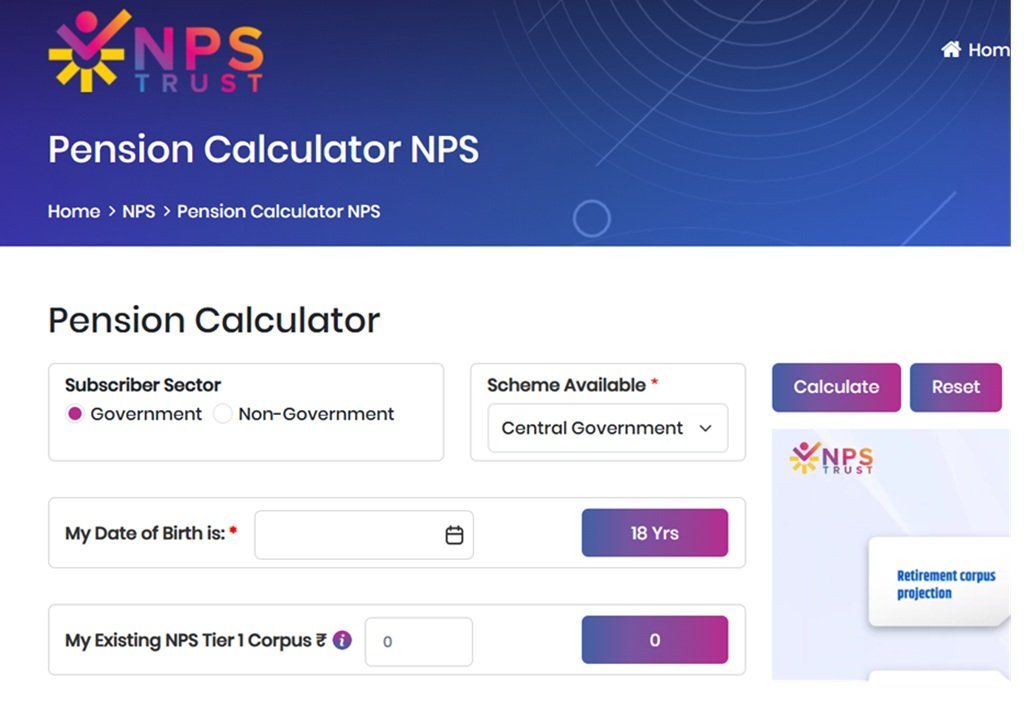
NPS Calculator is an online tool used to determine your maturity corpus and the value of your pension. The NPS calculator is provided by the NPS Trust and makes it easier for you to calculate the complicated calculations involved in retirement planning. Using the NPS calculator will enable you to:
- See how well your money grows towards retirement
- Calculate your monthly pension depending on the annuity choice you make
- Plan your contribution for a specific maturity corpus amount
The calculator factors in key variables such as your age, contribution amount, investment duration, and expected returns to provide accurate estimates, making it a critical component of retirement planning.
How to Use the NPS Calculator
It is easy to use the NPS calculator. Here is a step-by-step process that you can follow to calculate your retirement corpus:
Step 1: Open NPS Calculator
Navigate to www.npstrust.org.in, which is the official site for NPS Trust, and click on NPS calculator.
Step 2: Provide Personal Information
Supply personal information such as:
- Current Age: This helps in determining the tenure for making investments before your retirement
- Retirement Age: By default, the retirement age is 60, although this can be extended up to 75 years
Step 3: Provide Contribution Information
Supply expected annual/monthly contributions. Make sure that your contributions are according to your financial ability.
Step 4: Set Investment Return Rate
Set the expected annual return rate from your investments. NPS provides return rates based on equity, bonds, and government securities.
Step 5: Choose Annuity
Choose the annuity purchase percentage. The minimum required percentage of the corpus that should be used to purchase an annuity is 40%.
Step 6: Set Annuitization Return Rate
The rate of return from the annuity should also be determined.
Step 7: Click Calculate
After setting all the above factors, click on ‘Calculate’. The results provided include:
- Estimate Corpus: The savings accumulated at the time of maturity
- Monthly Pension Amount: Based on the percentage used for annuity purchase and the set return rate.
Example Scenarios
To illustrate how the NPS calculator works, let’s consider three example scenarios:
Scenario 1: Moderate Contributions and Returns
- Current Age: 30
- Retirement Age: 60
- Monthly Contribution: INR 5,000
- Expected Return: 9% annually
- Annuity Allocation: 40%
- Annuity Return Rate: 6%
Results:
- Corpus at Retirement: INR 1.15 crore
- Monthly Pension: INR 23,000
Scenario 2: Higher Contributions and Returns
- Current Age: 35
- Retirement Age: 60
- Monthly Contribution: Rs 10,000
- Expected Return: 10% annually
- Annuity Allocation: 50%
- Annuity Return Rate: 7%
Results:
- Corpus at Retirement: INR 2.3 crore
- Monthly Pension: INR 48,000
Scenario 3: Lower Contributions with Longer Horizon
- Current Age: 25
- Retirement Age: 60
- Monthly Contribution: Rs 3,000
- Expected Return: 8% annually
- Annuity Allocation: 40%
- Annuity Return Rate: 5%
Results:
- Corpus at Retirement: INR 80 lakh
- Monthly Pension: INR 16,500
Key Benefits of Using the NPS Calculator
- This tool offers clarity in helping you meet those retirement expectations.
- Trying various combinations, such as changing contribution amounts or rate of return, will give you the ability to see different possibilities.
- Visualising possible scenarios before you finalise decisions on how to allocate your assets or the amount you will be contributing provides better information and allows you to make these decisions based on facts rather than emotions.
- Since the calculator is available online, you may access it at any time to rethink and modify your existing plan.
Conclusion
Using the NPS calculator can easily help you work out your potential retirement corpus and “pension equivalent” (i.e., what the amount per month will be if you withdraw funds over time) by making it simpler to understand the key features of the NPS system and effectively utilising the tools available within the calculator. After doing so, you will create a solid financial plan for retirement based on your custom goals.

