

Flexi Cap Mutual Funds are open-ended equity mutual fund schemes that invest dynamically across large-cap, mid-cap, and small-cap stocks without fixed allocation limits. The fund manager has complete flexibility to shift investments between market capitalizations depending on market conditions, valuation opportunities, and economic outlook.
If you’re scratching your head over where to park your hard-earned money in the coming year, you’re not alone! With India’s economy buzzing along, hitting new highs despite global hiccups, Flexi Cap Funds are stealing the spotlight. These aren’t your run-of-the-mill investments; they’re like that versatile all-rounder in cricket who can bat, bowl, and field without breaking a sweat. Flexi Cap Funds let fund managers roam free across large, mid, and small-cap stocks, chasing the best opportunities no matter the market size. And guess what? As we gear up for 2026, with India’s GDP projected to surge and sectors like tech, renewables, and consumer goods firing on all cylinders, these funds could be your ticket to solid returns.
But hold on—why 2026 specifically? Well, post-pandemic recovery is still unfolding, inflation’s cooling down a bit, and government pushes for infrastructure and digital India are set to boost corporate earnings. Flexi Cap Funds, with their flexibility, can pivot quickly to ride these waves. In this article, we’ll break it all down: what makes them tick, the top picks to consider, pros and cons, and even some FAQs to clear up those nagging doubts. By the end, you’ll feel confident about dipping your toes—or diving headfirst—into these dynamic options. Let’s get started, shall we?
Understanding Flexi Cap Funds
First things first, what exactly are Flexi Cap Funds? Picture this: traditional mutual funds often box themselves in, like large-cap ones sticking only to big blue-chip companies, or small-cap funds gambling on underdogs. Flexi Cap Funds, though? They’re the rebels! Introduced by SEBI a few years back, these funds must invest at least 65% in equities but can shuffle between large, mid, and small caps based on where the manager spots the gold. No rigid rules tying their hands—it’s all about adapting to market moods.
Why does this matter for you? In a volatile world, where one day large caps are kings and the next mid-caps are exploding, Flexi Cap Funds give you that edge. They’re not locked into one style, so if small caps tank, the fund can shift gears to safer large caps without missing a beat. And in India, with our diverse economy—from giants like Reliance to nimble startups—these funds thrive on that variety. Heck, they’ve been outperforming many categories lately, averaging around 15-20% annual returns over the past five years, depending on the fund. But remember, past performance isn’t a crystal ball; it’s just a hint of what’s possible.
Key Features That Set Flexi Cap Funds Apart
Diving deeper, here are some standout traits that make Flexi Cap Funds a go-to for many:
- Flexibility Galore: Managers can allocate anywhere from 0% to 100% in any cap size, as long as it’s equities-heavy. This means they’re not sitting ducks when markets flip.
- Diversification Built-In: By spreading across caps, you’re less exposed to one segment’s downturn. Think of it as not putting all your eggs in one basket—smart, right?
- Long-Term Focus: These are ideal for folks with a 5-7 year horizon, letting compounding work its magic. Short-term? Maybe not, unless you’re okay with some bumps.
- Tax Perks: As equity funds, gains over a lakh in a year get taxed at 12.5% long-term capital gains—better than many alternatives.
Of course, they’re not without risks, but we’ll get to that later. For now, know that Flexi Cap Funds are like that reliable friend who’s always got your back in uncertain times.
Why Flexi Cap Funds Shine in India’s 2026 Landscape
Alright, let’s talk about the big picture. India’s economy is on a roll, isn’t it? By 2026, experts predict we’ll be the third-largest globally, with growth around 7-8%. But it’s not all smooth sailing—global tensions, like trade wars or oil spikes, could throw curveballs. That’s where Flexi Cap Funds come in handy; their agility lets them dodge pitfalls and grab opportunities.
For instance, with the push for ‘Make in India’ and green energy, mid and small caps in manufacturing and renewables might boom. Yet, if inflation rears its head, large caps offer stability. Flexi Cap Funds can balance this act effortlessly. Plus, with interest rates possibly easing, equities look more appealing than fixed deposits. And hey, if you’re a millennial or Gen Z investor, these funds align with your risk appetite—growth-oriented but not reckless.
Transitional phrase alert: That said, not all Flexi Cap Funds are created equal. Some have stellar track records, while others are still finding their footing. So, let’s spotlight the cream of the crop for 2026.
Top 5 Flexi Cap Funds 20% Returns in 3 Years
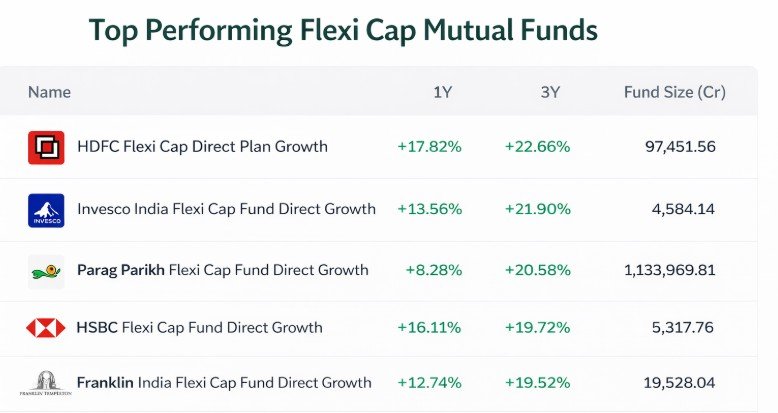
Based on recent performance trends, AUM growth, and manager expertise, here are some top Flexi Cap Funds worth eyeing for 2026. These funds have given 20% returns in last 3 years.
Remember, these are suggestions—do your homework or chat with a financial advisor!
Parag Parikh Flexi Cap Fund
The Parag Parikh Flexi Cap Fund is managed by the sharp minds at PPFAS, this one’s been a consistent performer, blending Indian and international stocks for that extra diversification kick. As of late 2024 data, it’s boasting around 20-25% annualized returns over three years, with an AUM soaring past ₹80,000 crores. Why for 2026? Its value-oriented approach—picking undervalued gems—should pay off as markets mature. Expense ratio? A low 0.6-0.7%, keeping more money in your pocket. This fund gives you benefit of both local and global market.
What sets it apart? The fund dips into global giants like Alphabet or Amazon, hedging against rupee dips. But watch out for currency risks. If you’re starting small, SIPs from ₹1,000 make it accessible. Exclamation time: This could be your set-it-and-forget-it option!
Parag Parikh Flexi Cap Fund has generated 20.58% returns for the investor in last 3 years.
HDFC Flexi Cap Fund
Next up, the HDFC Flexi Cap Fund— a beast in the space, with AUM over ₹60,000 crores and a history dating back decades. Under Roshi Jain’s watchful eye, it’s leaned towards large caps lately but flexes into mids when opportunities knock. Recent returns? Impressive 20-23% over five years, even through COVID slumps.
For 2026, with banking and IT sectors rebounding, this fund’s sector bets could shine. It’s got a balanced portfolio, heavy on financials and consumer goods, which are evergreen in India. Expense ratio hovers at 0.8%, and it’s got a 4-star Morningstar rating. Dangling modifier here: Thriving in bull markets, investors love its stability. If you’re risk-averse but want growth, this one’s a solid bet.
HDFC Flexi Cap Fund has generated 22.66% returns for the investors in last 3 years.
Invesco India Flexi Cap Fund Direct Growth
The Invesco India Flexi Cap Fund Direct Growth is a dynamic equity scheme from Invesco Mutual Fund, launched on February 14, 2022, giving it about four years in the market so far.
Performance-wise, it has delivered solid since-inception returns of about 18% annualized, which beats many peers and the benchmark in a choppy period.
Over the last three years, the fund has posted impressive annualized returns of roughly 21.9% to 22.4%, showing strong compounding power.
In the past one year, trailing returns hover around 11.5% to 13.6%, a bit muted amid recent market corrections but still respectable for the category.
HSBC Flexi Cap Fund Direct Growth
The HSBC Flexi Cap Fund Direct Growth is a well-established equity scheme from HSBC Mutual Fund, offering true flexibility across large-, mid-, and small-cap stocks to adapt to India’s dynamic market conditions.
Performance has been quite strong on a trailing basis: the fund has delivered around 19.94% to 19.96% annualized returns over the past three years, comfortably beating the flexi-cap category average.
Over five years, it clocks in solid 15.62% to 16.02% annualized returns, showing consistent compounding even through volatile periods.
In the last one year, trailing returns hover around 12.88%, a respectable showing amid broader market corrections and slightly below some aggressive peers.
Franklin India Flexi Cap Fund
Rounding out our top five is the Franklin India Flexi Cap Fund, blending Templeton’s global expertise with Indian insights. AUM over ₹18,000 crores, returns around 25-28% over five years—steady Eddie stuff.
For 2026, its multi-sector approach (tech, pharma, autos) aligns with India’s export boom. Expense ratio 0.8%, and it’s resilient in corrections. Informal language: Yeah, it’s not the flashiest, but it gets the job done without drama.
Franklin India Flexi Cap Fund generated 19.52% returns for the investors in last 3 years.
Pros and Cons of Investing in Flexi Cap Funds
Like anything worthwhile, Flexi Cap Funds have ups and downs. Let’s weigh them out.
The Upsides
- Adaptability: They adjust to market shifts, potentially beating rigid funds.
- Diversification: Spread risk across caps, smoothing out volatility.
- Growth Potential: In India’s expanding economy, they capture broad opportunities.
- Professional Management: Experts handle the heavy lifting—no need for you to micromanage.
Exclamation: Talk about a win-win!
The Downsides
- Higher Volatility: Flexibility means more ups and downs than pure large-cap funds.
- Manager Dependency: If the fund manager slips, performance can wobble.
- Overlap Risks: Some might mimic multi-cap funds, diluting uniqueness.
- Tax and Exit Loads: Early exits can sting with fees.
All in all, pros outweigh cons for long-haul investors.
How to Choose and Invest in Flexi Cap Funds for 2026
Overwhelmed? Here’s a step-by-step guide:
- Assess Your Goals: Short-term savings? Go conservative. Retirement? Amp up aggression.
- Check Past Performance: Look at 3-5 year returns, but don’t chase hot streaks.
- Expense Ratios Matter: Lower is better—aim under 1%.
- Fund Size and Manager Track Record: Bigger AUM means liquidity; experienced managers add trust.
- Start with SIPs: Invest ₹5,000 monthly to average costs.
- Platforms to Use: Apps like Groww, ET Money, or direct AMCs make it easy.
And always, diversify—don’t dump everything into one fund.
FAQs
What makes Flexi Cap Funds different from multi-cap funds?
Flexi Cap Funds have no mandatory allocation across caps, while multi-caps require at least 25% in each. More freedom here!
Are Flexi Cap Funds suitable for beginners?
Absolutely! They’re diversified, but start small and learn as you go. Question mark: Ready to jump in?
How much should I invest in Flexi Cap Funds for 2026?
Depends on your portfolio—10-20% for balanced exposure. Consult an advisor.
What risks come with these funds?
Market volatility, interest rate changes, and economic slowdowns. But hey, no reward without risk!
Can I switch between Flexi Cap Funds easily?
Yes, but watch for exit loads and taxes on gains.
Is 2026 a good year for Flexi Cap Funds?
With India’s growth story, yes! But monitor global cues.
Conclusion
Wrapping it up, Flexi Cap Funds are more than just a trend—they’re a smart way to tap into India’s vibrant market without getting bogged down by restrictions. From the powerhouse Parag Parikh to the data-driven Quant, the top Flexi Cap Funds to invest in India 2026 offer diverse paths to wealth. Sure, there’ll be bumps, but with patience and regular investments, you could see your money grow exponentially. Don’t just sit on the sidelines; research, invest wisely, and watch your future brighten. After all, as the saying goes, fortune favors the bold. What’s stopping you? Get investing today!
Disclaimer: The Views Expressed Above Should Not Be Considered Professional Investment Advice, Advertisement, Or Otherwise. The Article Is Only For General Educational Purposes. The Readers Are Requested To Consider All The Risk Factors, Including Their Financial Condition, Suitability To Risk-Return Profile, And The Like, And Take Professional Investment Advice Before Investing.

