

Picture this: You’re scrolling through the news one morning, sipping your chai, and bam – another headline about gold prices hitting a new high. It’s been quite the ride lately, hasn’t it? As of mid-December 2025, 24-karat gold is hovering around Rs 1,34,000 to Rs 1,35,000 per 10 grams in major Indian cities. That’s a far cry from just a few years ago when it was under Rs 50,000. With weddings around the corner and festivals lighting up the calendar, everyone’s asking the same burning question: Can gold prices cross Rs 2,00,000 per 10gm in 2026?
It’s a bold thought, right? Gold has always been more than just a shiny metal in India – it’s family heirlooms, wedding dreams, and a safety net during tough times. But crossing that Rs 2 lakh mark? That would be historic. In this article, we’ll break it down step by step, looking at where we’ve been, what’s happening now, and what experts are saying about the future. We’ll keep it real, no hype, just straightforward insights to help you make sense of it all.
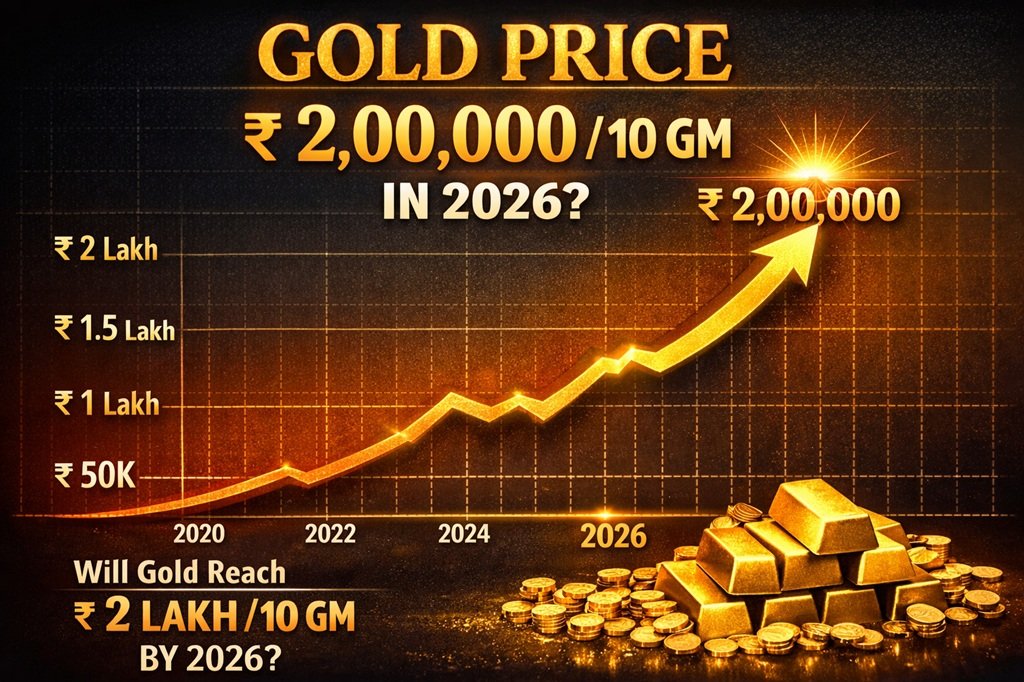
Historical Gold Price Trends in India
Gold prices don’t just jump overnight; they’ve been climbing steadily, with some dramatic leaps along the way. Let’s take a quick stroll down memory lane to see how we got here.
Back in 2020, amid the chaos of the pandemic, the average gold price in India shot up to around Rs 48,651 per 10 grams. Uncertainty was everywhere, and people flocked to gold as a safe haven. Fast forward to 2021-2022, things cooled a bit as economies reopened, but then geopolitical tensions – think Russia-Ukraine – kicked in, pushing prices higher again.
By 2023 and 2024, inflation worries and a fluctuating rupee kept the momentum going. And 2025? Wow, what a year! Gold price has smashed records repeatedly, driven by global uncertainties, central bank buying sprees, and investor frenzy. We’ve seen it surge past Rs 1,30,000, with peaks touching close to Rs 1,35,000 per 10 grams. That’s over a 60% jump in some global measures this year alone.
Gold Price History – 75 Years
| Year | Price (24 carat per 10 grams) |
| 1947 | ₹88.62 |
| 1948 | ₹95.87 |
| 1949 | ₹94.17 |
| 1950 | ₹99.18 |
| 1951 | ₹98.05 |
| 1952 | ₹76.81 |
| 1953 | ₹73.06 |
| 1954 | ₹77.75 |
| 1955 | ₹79.18 |
| 1956 | ₹90.81 |
| 1957 | ₹90.62 |
| 1958 | ₹95.38 |
| 1959 | ₹102.56 |
| 1960 | ₹111.87 |
| 1961 | ₹119.35 |
| 1962 | ₹119.75 |
| 1963 | ₹93 |
| 1964 | ₹63.25 |
| 1965 | ₹71.75 |
| 1966 | ₹83.75 |
| 1967 | ₹102.50 |
| 1968 | ₹162.00 |
| 1969 | ₹176.00 |
| 1970 | ₹184.00 |
| 1971 | ₹193.00 |
| 1972 | ₹202.00 |
| 1973 | ₹278.50 |
| 1974 | ₹506.00 |
| 1975 | ₹540.00 |
| 1976 | ₹432.00 |
| 1977 | ₹486.00 |
| 1978 | ₹685.00 |
| 1979 | ₹937.00 |
| 1980 | ₹1,330.00 |
| 1981 | ₹1670.00 |
| 1982 | ₹1,645.00 |
| 1983 | ₹1,800.00 |
| 1984 | ₹1,970.00 |
| 1985 | ₹2,130.00 |
| 1986 | ₹2,140.00 |
| 1987 | ₹2,570.00 |
| 1988 | ₹3,130.00 |
| 1989 | ₹3,140.00 |
| 1990 | ₹3,200.00 |
| 1991 | ₹3,466.00 |
| 1992 | ₹4,334.00 |
| 1993 | ₹4,140.00 |
| 1994 | ₹4,598.00 |
| 1995 | ₹4,680.00 |
| 1996 | ₹5,160.00 |
| 1997 | ₹4,725.00 |
| 1998 | ₹4,045.00 |
| 1999 | ₹4,234.00 |
| 2000 | ₹4,400.00 |
| 2001 | ₹4,300.00 |
| 2002 | ₹4,990.00 |
| 2003 | ₹5,600.00 |
| 2004 | ₹5,850.00 |
| 2005 | ₹7,000.00 |
| 2007 | ₹10,800.00 |
| 2008 | ₹12,500.00 |
| 2009 | ₹14,500.00 |
| 2010 | ₹18,500.00 |
| 2011 | ₹26,400.00 |
| 2012 | ₹31,050.00 |
| 2013 | ₹29,600.00 |
| 2014 | ₹28,006.50 |
| 2015 | ₹26,343.50 |
| 2016 | ₹28,623.50 |
| 2017 | ₹29,667.50 |
| 2018 | ₹31,438.00 |
| 2019 | ₹35,220.00 |
| 2020 | ₹48,651.00 |
| 2021 | ₹48,720.00 |
| 2022 | ₹52,670.00 |
| 2023 | ₹65,330.00 |
| 2024 | ₹80,450.00 |
| 2025 | ₹130,000.00 |
Looking at this trend, it’s clear gold price has been on an upward trajectory, fueled by a mix of global and local factors. But does this mean we’re headed straight to Rs 2 lakh in 2026? Not so fast – let’s dig deeper.
Current Gold Price Scenario: Where We Stand in Late 2025
Right now, as December 2025 winds down, gold is trading strong. In cities like Mumbai, Delhi, and Chennai, you’re looking at Rs 1,34,000 to Rs 1,35,000 for 10 grams of 24-karat gold. For 22-karat, it’s a bit lower, around Rs 1,23,000. That’s after some volatility – dips when stock markets rally, spikes when tensions flare up.
Why so high already? Simple: Demand is through the roof. Indian weddings and festivals boost jewelry buying, while investors worldwide are piling in via ETFs and bars. Plus, central banks – especially in emerging markets – can’t get enough, stocking up reserves like never before.
But here’s the thing – gold price isn’t just about India. It’s tied to the global spot price, currently around $4,300 per ounce. Convert that with the rupee at around 85-89 to the dollar, add import duties and taxes, and you get our local rates. Any weakness in the rupee or surge in dollar gold pushes our prices up further.
Key Factors Influencing Gold Prices in 2026
So, what could drive – or hold back – gold price next year? A lot boils down to these big players:
Geopolitical Tensions and Safe-Haven Demand
Wars, trade disputes, elections – you name it, they make people nervous. And when nerves fray, gold shines. Ongoing issues in various hotspots, plus potential trade tariffs, could keep safe-haven buying strong. Exclamation point: If things heat up, gold price could get a massive boost!
Interest Rates and Monetary Policy
Lower interest rates make gold more attractive since it doesn’t pay interest like bonds. If central banks keep cutting rates to spur growth, that’s bullish for gold. On the flip side, if inflation cools and rates stay high, it might cap gains.
Inflation and Currency Movements
Gold’s classic role? Hedging inflation. If prices rise faster than expected, gold price follows. Also, a weaker rupee means higher import costs, directly bumping up local gold rates.
Central Bank and Investor Demand
Central banks bought tons in 2025 – expect more in 2026. ETFs are seeing inflows too. This structural demand is a game-changer, absorbing supply and propping up prices.
Supply Side: Mining and Recycling
New mines take years to develop, so supply grows slowly. Higher prices might encourage more recycling, but overall, demand often outpaces supply.
In short, most arrows point up for gold price, but surprises happen. Economic booms could pull money to stocks, denting gold’s appeal.
Expert Forecasts: Can Gold Price Hit Rs 2,00,000 in 2026?
Experts are mostly bullish, but Rs 2 lakh? That’s stretching it.
Global forecasts for 2026:
- Many banks like Goldman Sachs, Morgan Stanley, and UBS see gold around $4,200 to $4,800 per ounce.
- Optimistic ones push $5,000+ in extreme scenarios.
Translating to India (assuming rupee around 90/USD and local premiums):
- Base case: Rs 1,40,000 to Rs 1,60,000 per 10gm.
- Bullish: Up to Rs 1,80,000 or so.
Some Indian analysts predict Rs 1,45,000 to Rs 1,50,000. A few wild cards mention higher if rupee weakens sharply or crises hit.
But Rs 2,00,000? That would need gold over $6,000/oz globally – possible in a major meltdown, but not the consensus. Most say steady gains, not a doubling from current levels.
To put it in perspective:
| Scenario | Global Gold ($/oz) | Approx. India Price (Rs/10gm) |
| Conservative | 4,200-4,500 | 1,40,000-1,55,000 |
| Moderate Bullish | 4,500-5,000 | 1,55,000-1,75,000 |
| Extreme Bullish | 5,000+ | 1,75,000-2,00,000+ |
Realistically, crossing Rs 2 lakh in 2026 seems unlikely without massive shocks. More probable: Solid growth to Rs 1,60,000-1,80,000 range.
Pros and Cons of Investing in Gold Ahead of 2026
Thinking of buying? Here’s a balanced view:
Pros:
- Hedge against uncertainty – perfect for volatile times.
- Cultural demand in India stays strong.
- Potential for good returns if forecasts hold.
Cons:
- No income like dividends or interest.
- Storage and making charges for physical gold.
- Volatility – prices can drop suddenly.
Alternatives like Sovereign Gold Bonds or ETFs might suit better for some.
Frequently Asked Questions
What is the current gold price in India as of December 2025?
Around Rs 1,34,000-1,35,000 per 10 grams for 24-karat.
Why have gold prices risen so much in 2025?
Geopolitical risks, central bank purchases, lower rates, and investor demand.
Is it possible for gold to reach Rs 2,00,000 per 10gm in 2026?
Possible in extreme scenarios, but most experts say no – expect Rs 1,50,000-1,80,000 more likely.
Should I buy gold now or wait for 2026?
Depends on your goals. For long-term, dips are buying opportunities; don’t try timing perfectly.
How does the rupee affect gold prices?
Weaker rupee = higher local gold price, since we import most of it.
Are digital gold or SGBs better than physical?
Often yes – no storage hassle, potential tax benefits.
What if global economy improves – will gold fall?
Possibly, as risk appetite rises, but structural demand might limit drops.
Conclusion
Wrapping it up, the idea of gold prices crossing Rs 2,00,000 per 10gm in 2026 is exciting – and not entirely impossible if the world throws curveballs our way. But based on current trends and expert views, it’s more of a stretch than a sure bet. We’re likely looking at continued strength, perhaps reaching Rs 1,60,000-1,80,000, driven by ongoing uncertainties and demand.
Gold’s allure in India isn’t fading anytime soon. Whether for jewelry, investment, or peace of mind, it’s got that timeless appeal. If you’re planning to buy, do your homework, diversify, and remember: Gold price fluctuations are part of the game. Here’s to a prosperous 2026 – may your investments glitter, whatever the price!

