

Imagine you started a small business with four friends. Each of you owns 20% of the company. Now, one of your friends wants to exit, and instead of letting an outsider buy his share, the business itself buys back that 20% stake. Now the remaining four people each own a larger piece of the same pie.
That, in simple terms, is what a share buyback is.
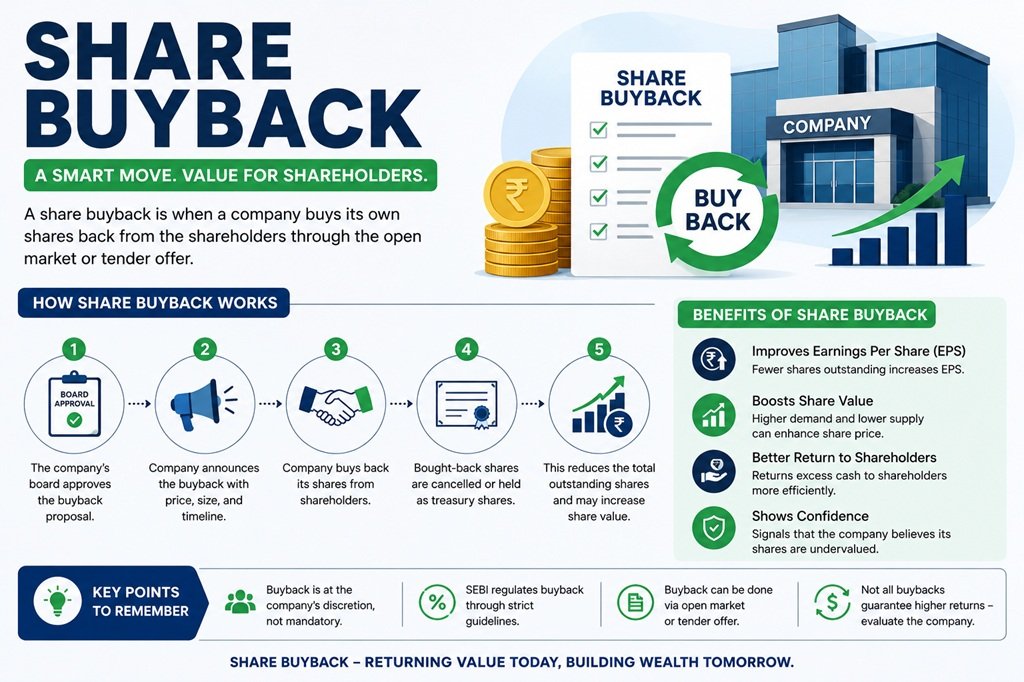
A share buyback (also called a stock repurchase) is when a publicly listed company uses its own money to purchase its own shares from the open market or directly from shareholders at a fixed price. Once the company buys these shares back, they are either cancelled or held in the company’s treasury. Either way, the total number of shares floating in the market goes down.
This might sound counterintuitive at first — why would a company spend money to buy its own stock? But there are actually many smart reasons behind this move, and we’ll go through all of them in detail.
Why Do Companies Announce Stock Buybacks?
When a big company like Infosys, TCS, or Wipro announces a share buyback, it makes front-page news. But why do companies do this in the first place?
Here are the most common and genuine reasons:
The Company Thinks Its Shares Are Undervalued
This is probably the most common reason. Sometimes, despite the company performing well in terms of profits, sales, and growth, the stock price doesn’t reflect that strength. The market may be pessimistic or distracted.
In such cases, the management may say, “We know our company better than the market does, and we believe our shares are worth more than what they’re trading at. So let’s buy them back.”
By buying its own undervalued shares, the company is essentially making an investment in itself — one it believes will pay off over time.
Surplus Cash With No Better Use
Profitable companies sometimes accumulate large amounts of cash on their balance sheets. If there aren’t good investment opportunities available — no new factories to build, no companies to acquire, no big R&D projects — the cash just sits idle.
Rather than letting that cash lose value to inflation, companies return it to shareholders through buybacks. It’s a smart and tax-efficient way to use excess cash.
For Improving Earnings Per Share (EPS)
EPS is calculated by dividing the company’s total profit by the number of outstanding shares. If the profit stays the same but the number of shares reduces due to a buyback, the EPS automatically goes up.
A higher EPS makes the stock look more attractive to investors, which can push the stock price higher. This benefits everyone who continues to hold shares in the company.
Example:
- Company profit: ₹100 crore
- Shares before buyback: 10 crore → EPS = ₹10
- Shares after buyback: 8 crore → EPS = ₹12.50
With the same profit, EPS improved by 25% just because of fewer shares.
To Reward Long-Term Shareholders
A buyback is one way companies reward their loyal shareholders. If you hold shares in a company that buys back stock, your ownership percentage in the company goes up automatically (even if you don’t buy any new shares). Over time, this can significantly increase the value of your investment.
To Counter ESOP Dilution
Many companies offer Employee Stock Option Plans (ESOPs), where employees receive shares as part of their compensation. Over time, this keeps adding new shares to the market, which dilutes the ownership of existing shareholders.
A buyback helps absorb this dilution. The company uses the buyback to cancel newly issued ESOP shares, keeping the total share count stable.
To Signal Confidence in the Future
When a company announces a buyback, it’s essentially saying, “We are confident enough in our future to invest in ourselves.” This signal is very powerful for investor psychology. It builds trust and often leads to a rise in the stock price, even before a single share is bought back.
Tax Efficiency
In some situations, a buyback can be more tax-efficient than paying dividends. While dividends are taxed as income in the hands of shareholders, capital gains from buyback participation may be taxed differently depending on the holding period. This makes buybacks an attractive option for companies looking to return money in a tax-smart way.
How Does the Stock Buyback Process Work?
Let’s walk through the entire process in simple steps so you know exactly what happens from start to finish.
Step 1: Board of Directors Approves the Buyback
Everything starts with the company’s board of directors. They meet, evaluate the company’s financial position, and decide whether a buyback makes sense. They fix the buyback price, the number of shares to be repurchased, and the method to be used (open market or tender offer).
For smaller buybacks (up to 10% of the paid-up capital), a board resolution is sufficient. For larger ones (above 10% and up to 25%), a special resolution passed by shareholders is required.
Step 2: Public Announcement
Once approved, the company makes a formal public announcement. This announcement includes:
- The buyback price (usually at a premium to the current market price)
- The number of shares the company wishes to buy back
- The opening and closing dates of the offer
- Eligibility criteria for shareholders
- The method of buyback (open market or tender offer)
This announcement is published on stock exchanges (NSE/BSE) and in newspapers, making it available to all shareholders.
Step 3: Record Date Is Set
The company sets a record date. Only those shareholders who hold shares in the company as of this date are eligible to participate in the buyback. If you buy shares after the record date, you won’t be eligible.
Step 4: Shareholders Decide Whether to Participate
Here’s the important part — participation is completely voluntary. You can choose to:
- Tender your shares and receive the buyback price (which is usually higher than the current market price).
- Hold your shares and stay invested. Since fewer shares will be outstanding after the buyback, your ownership percentage will go up.
Neither choice is wrong. It depends on your financial goals and your view of the company’s future.
Step 5: Shares Are Tendered Through the Depository
If you decide to participate, you submit your shares through your broker before the deadline. The shares are blocked in your demat account and sent to the company’s depository account.
Step 6: Company Accepts and Pays
The company reviews all the shares tendered. If oversubscribed (more shares offered than required), it accepts shares on a pro-rata basis — meaning you may not get all your shares accepted. The company then transfers the buyback price directly to your bank account.
Step 7: Shares Are Cancelled or Held in Treasury
The repurchased shares are typically cancelled, which permanently reduces the total share count. In some cases, they may be held as treasury shares and reissued later.
Step 8: Buyback Completion Report
Finally, the company publishes a completion report on the stock exchange, disclosing how many shares were bought back, the total amount spent, and the revised share count. This brings full transparency to the entire process.
Types of Share Buyback Methods
Not all buybacks work the same way. In India, there are two main methods companies use:
Tender Offer (Fixed Price)
In this method, the company announces a specific price at which it will buy shares and a specific window of time (usually 2–3 weeks). Shareholders who want to participate must tender their shares during this window.
The buyback price in a tender offer is almost always above the current market price — sometimes by 10% to 30% — making it attractive for shareholders. This is the most common method used in India.
Example: If a stock is trading at ₹500, the company may offer to buy it back at ₹600. You can choose to tender and earn ₹100 extra per share.
Open Market Buyback
In this method, the company buys shares directly from the stock exchange over a longer period, just like a regular investor would. There’s no fixed price — the company buys at prevailing market prices.
This method is more flexible for the company but offers less certainty to shareholders compared to the tender offer route. It’s more commonly used in the US; in India, tender offers are more prevalent.
How Is the Buyback Price Determined?
One of the most important questions shareholders ask is: “How does the company decide what price to offer?”
There isn’t one fixed formula, but companies consider several methods:
Discounted Cash Flow (DCF)
The company calculates the present value of all expected future cash flows. If this value is significantly higher than the current stock price, it signals undervaluation and supports a buyback at a premium.
Book Value Method
The company divides its total net assets (assets minus liabilities) by the number of outstanding shares. This gives the book value per share. The buyback price is often set at or above this value.
Market Price Method
The company looks at recent market prices — not just the current price, but trading history over the past few weeks. A buyback price is then set with a premium over this average.
Comparable Company Analysis
The company compares its valuation multiples (like Price-to-Earnings or Price-to-Book ratio) with similar companies in the industry. If its own shares look cheap relative to peers, it justifies a buyback.
In most cases, the final buyback price takes all these factors into account along with the company’s available cash and strategic intent.
SEBI Regulations for Share Buybacks in India
In India, share buybacks are strictly governed by SEBI (Securities and Exchange Board of India) under the SEBI (Buy-Back of Securities) Regulations, 2018, and the Companies Act, 2013. These rules protect both companies and shareholders from misuse.
Here are the key rules every investor should know:
- Maximum limit: A company cannot buy back more than 25% of its total paid-up equity capital and free reserves in a single financial year.
- Debt-to-equity ratio: After the buyback, the company’s debt-to-equity ratio should not exceed 2:1. This ensures the company doesn’t overspend and remains financially healthy.
- Fully paid-up shares only: Only fully paid-up shares are eligible for buyback. Partly paid shares don’t qualify.
- Cooling-off period: A company cannot announce another buyback within one year of completing the previous one.
- No fresh share issuance: The company cannot issue new shares of the same class for at least 6 months after a buyback. This prevents the company from buying shares with one hand and selling new ones with the other.
- Escrow account: The company must deposit at least 25% of the total buyback amount in an escrow account before the process begins. This ensures the money is actually available.
- Mandatory cancellation: Bought-back shares must be cancelled within 7 days of completion and cannot be reissued.
- Full disclosure: Every detail of the buyback — price, quantity, timeline, eligibility — must be disclosed publicly to ensure complete transparency.
These regulations ensure that buybacks are done in a fair, transparent, and financially responsible manner.
What Are the Benefits of a Share Buyback?
For the Company
- Uses idle cash productively
- Improves key financial ratios like EPS and Return on Equity (ROE)
- Signals strength and management confidence to the market
- Offsets dilution from ESOPs
- Optimizes the company’s capital structure
For Shareholders Who Participate
- Receive a price that is usually higher than the current market price
- Get liquidity — especially useful if the stock has low trading volume on the exchange
For Shareholders Who Don’t Participate
- Their ownership percentage in the company increases automatically
- EPS goes up, which can push the stock price higher over time
- Long-term value creation as the company’s per-share metrics improve
Impact of Buyback on Stock Price
When a company announces a buyback, the stock price usually reacts positively. Here’s why:
Immediate Reaction: The announcement itself boosts investor sentiment. It signals that management believes the stock is undervalued. Retail investors often rush to buy, pushing the price up toward the buyback price.
Supply-Demand Effect: With fewer shares in circulation after the buyback, the same demand from investors is now chasing fewer shares. Basic economics tells us that reduced supply with steady demand leads to higher prices.
Better EPS: As fewer shares remain, EPS improves. Better EPS usually attracts more investors, further supporting the stock price.
Improved ROE: With fewer shares and the same level of profits, Return on Equity also improves. This makes the stock more attractive in analyst reports and institutional portfolios.
However, a buyback doesn’t guarantee a stock price rise. If a company is doing a buyback to disguise poor business performance or to artificially boost management’s stock-linked bonuses (ESOPs), it could be a red flag. Investors should always look at the underlying business health before reading too much into a buyback announcement.
Share Buyback vs Dividend
Both buybacks and dividends are ways companies return money to shareholders, but they work very differently. Let’s break it down:
| Factor | Share Buyback | Dividend |
| What is it? | Company buys back its own shares | Company pays cash to shareholders |
| Who gets the money? | Only those who tender their shares | All eligible shareholders |
| Is it voluntary? | Yes — you choose to participate or not | No — you automatically receive it |
| Impact on share count | Reduces outstanding shares | No change in share count |
| Impact on EPS | Increases EPS | No direct impact on EPS |
| Flexibility for investors | You decide when to sell | Money comes to you regardless |
| Tax treatment | May attract capital gains tax | Taxed as income at your slab rate |
| Market signal | Management believes stock is undervalued | Company has stable profits to distribute |
| Best suited for | Growth-oriented investors who prefer capital appreciation | Income-seeking investors who need regular cash |
Which is better? There’s no one-size-fits-all answer. It depends on the company’s situation and your personal goals.
If you need regular income from your investments, dividends are great. But if you are a long-term investor looking for capital appreciation and tax efficiency, buybacks can be more beneficial. Many companies — especially in the Indian IT sector — use a combination of both to keep different types of investors happy.
Real-World Example
Let’s say ABC Technologies Ltd. has the following financials:
- Total outstanding shares: 10 crore
- Annual profit: ₹200 crore
- Current EPS: ₹20 per share
- Current stock price: ₹350
The company feels its stock is undervalued (it’s trading at just 17.5x earnings, while peers are at 22x). It has ₹400 crore in cash on its balance sheet.
The board approves a buyback of 1 crore shares at ₹450 per share (a 28% premium to the market price).
After the buyback:
- Outstanding shares: 9 crore (down from 10 crore)
- Total money spent: ₹450 crore
- Annual profit (unchanged): ₹200 crore
- New EPS: ₹200 crore ÷ 9 crore = ₹22.22
The EPS has improved by over 11%, even though the company didn’t earn a single extra rupee more. Investors who stayed invested now own a slightly larger stake in the company, and with higher EPS, the stock is likely to attract more buyers.
Conclusion
A share buyback is one of the most powerful tools a company has to create value for its shareholders. When done for the right reasons — undervalued stock, excess cash, or desire to improve per-share metrics — it’s a signal of a healthy, confident management team.
As an investor, understanding buybacks helps you make smarter decisions. Should you tender? Should you hold? Is the buyback a genuine sign of strength or a financial manoeuvre to boost short-term numbers? The answer lies in understanding the company’s fundamentals, the premium being offered, and your own investment goals.
The Indian stock market has seen numerous high-profile buybacks from companies like TCS, Infosys, HCL Technologies, and Wipro over the years. Each time, well-informed investors who understood the mechanics were better positioned to make the right call.
So the next time your company announces a buyback, don’t just react — understand it, analyse it, and then decide what’s best for your portfolio.
Frequently Asked Questions
- Is a share buyback good or bad for investors?
Generally, it’s considered positive. It increases EPS, signals management confidence, and rewards shareholders. But whether it’s good for you depends on the premium offered and your investment goals.
- Do stocks always go up after a buyback announcement?
Often yes, but not always. Stocks usually rise when the buyback signals undervaluation and management confidence. But if the buyback is seen as covering up poor performance, the reaction can be muted or even negative.
- Can I refuse to participate in a buyback?
Yes, absolutely. Participation is 100% voluntary. You can choose to hold your shares and benefit from higher EPS and ownership percentage after the buyback.
- What happens to shares after they’re bought back?
In India, bought-back shares are typically cancelled permanently within 7 days of the buyback completion. This reduces the total share count and improves per-share metrics.
- Is the buyback price always higher than the market price?
In a tender offer (the most common method in India), yes — the buyback price is set at a premium. In an open market buyback, the company buys at prevailing market prices.
- How do I participate in a buyback through my demat account?
Log in to your broker’s platform (like Rupeezy), go to the buyback section, enter the number of shares you wish to tender, and submit before the deadline. Your shares will be blocked in your demat account until the process is complete.
- Can a company do unlimited buybacks?
No. SEBI restricts buybacks to a maximum of 25% of paid-up equity capital in a financial year. There’s also a mandatory one-year cooling-off period between two consecutive buybacks.
- What is the tax on buyback proceeds?
In India, buyback proceeds are subject to capital gains tax. Short-term capital gains (if shares held less than 12 months) are taxed at 20%, while long-term capital gains (held more than 12 months) above ₹1.25 lakh are taxed at 12.5% (as per current tax laws — always verify with a tax advisor).

