

Every year, as July 31 approaches, millions of Indians rush to file their Income Tax Returns (ITR). Some file it because they have to — their income crosses the basic exemption limit and they are legally required to do so. Others file it simply out of habit. But here’s the truth that most people don’t fully appreciate: filing your ITR is one of the smartest financial habits you can build, and its benefits go far beyond just paying your taxes on time.
In India, the Income Tax Return is an annual document you submit to the Income Tax Department. It tells the government how much you earned during the year, what deductions you are claiming, and how much tax you have already paid. It’s like your annual financial report card — except this one can open doors for you in ways you might not have imagined.
A large number of people — especially salaried employees, students, freelancers, and homemakers who earn occasional income — believe that if their tax liability is zero, there’s no point filing an ITR. This is a common myth. Even if your income is below the taxable threshold of ₹12 lakh (as per the new tax regime in FY 2025-26), or even if you have no taxable income at all, filing an ITR can be extremely beneficial. Let’s break down exactly why.
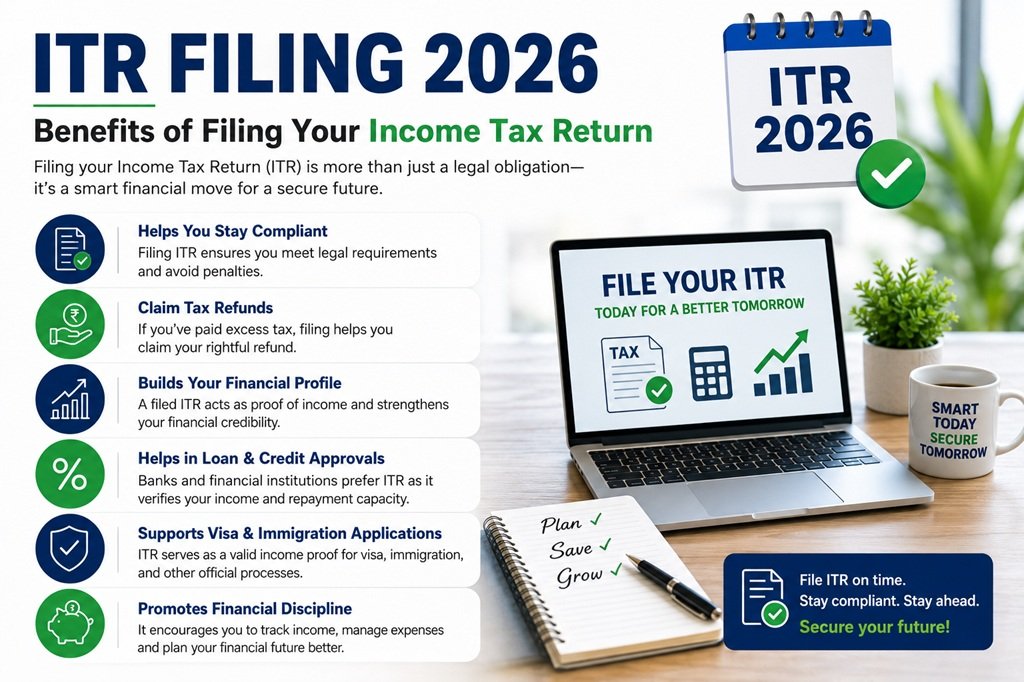
Benefit 1: Get Back Money That’s Already Yours — TDS Refunds
What Is TDS and Why Is It Deducted?
TDS stands for Tax Deducted at Source. It is a system the government uses to collect tax ‘at the source’ of income — meaning your employer, bank, or the company paying you deducts a certain percentage of tax before giving you your money. The amount deducted is based on estimated earnings, not your actual annual income or final tax liability.
This means that in many cases, more tax is deducted than what you actually owe. The excess money sits with the government until you claim it back. And the only official way to claim that refund is by filing your ITR.
Who Is Affected?
- Salaried employees whose total income — after all deductions — falls below the taxable limit, but whose employer deducted TDS from salary.
- Fixed Deposit (FD) holders: Banks deduct TDS at 10% on FD interest if it exceeds ₹40,000 in a year (₹50,000 for senior citizens). Even if your total income is below the exemption limit, TDS is still deducted automatically.
- Freelancers and consultants: Companies that hire freelancers typically deduct TDS at 10% on payments above a certain threshold. If your annual earnings are modest, you may end up being owed a refund.
- Individuals with dividend income or rental income where TDS has been deducted.
Benefit 2: Get Loans Faster and on Better Terms
Why Banks Ask for Your ITR
Whether you want a home loan, a car loan, an education loan, or even a personal loan, one of the first things banks and Non-Banking Financial Companies (NBFCs) will ask for is your Income Tax Return for the past two to three years. This is because your ITR is considered one of the most reliable and official proofs of your income.
Unlike a salary slip (which shows only one month’s earnings) or a bank statement (which can reflect irregular or one-time deposits), your ITR shows the complete picture: total income, sources of income, deductions claimed, and taxes paid. It tells the bank that you are a financially stable, organised, and trustworthy borrower.
What If You Don’t File?
If you haven’t been filing your ITR regularly, getting a loan approved becomes significantly harder. You may face one or more of the following problems:
- Your loan application may be rejected outright if you cannot provide ITR documents.
- You may be considered a high-risk borrower and offered a loan at a much higher interest rate.
- You may be asked for additional collateral or guarantees that others don’t need.
- The loan processing time could be longer as banks try to verify your income through alternate means.
The Benefit Goes Beyond Approval
A consistent ITR history doesn’t just get you the loan — it can also get you better terms. Banks often offer lower interest rates and higher loan amounts to applicants with strong, documented income histories. Over the life of a 20-year home loan, even a 0.25% difference in the interest rate can save you lakhs of rupees.
Applicable Loan Types
- Home loans / housing finance
- Car or two-wheeler loans
- Education loans for studying in India or abroad
- Business loans and working capital financing
- Personal loans for medical emergencies or other needs
- Loan against property
Benefit 3: Smooth Visa Processing for International Travel
The Hidden Role of ITR in Getting a Visa
If you plan to travel abroad for a holiday, for higher studies, for business, or to explore work opportunities in another country, there’s a good chance that the embassy or consulate will ask for your ITR documents. This is especially true for countries like the United States, the United Kingdom, Canada, Australia, and most of the European Union (Schengen zone) countries.
Embassies use your ITR to assess whether you have strong financial ties to India — meaning you’re likely to return after your trip — and whether you can financially support yourself during your stay abroad. Your ITR shows them a verified, government-documented record of your income and tax compliance.
What Embassies Typically Ask For
- ITR acknowledgment copies for the last two to three financial years.
- Form 26AS, which is a consolidated tax statement showing all TDS deducted and taxes paid.
- AIS (Annual Information Statement) — a newer document showing all your financial transactions.
How Consistent Filing Helps
When visa officers see that you have filed your ITR consistently over multiple years, it builds a picture of financial responsibility. It signals that you have a stable income, that you follow rules and regulations, and that you have genuine ties to India. This reduces the perceived ‘visa risk’ and can result in:
- Faster visa processing times.
- Higher chances of approval, especially for countries that are stringent about financial checks.
- Approval for longer-duration or multiple-entry visas.
- Fewer requests for additional documents or interviews.
Especially Important for Self-Employed Individuals
If you are a freelancer, a business owner, or a professional who doesn’t get a salary slip or Form 16, then your ITR becomes even more critical. It is often your primary proof of income for visa applications. Without it, your application becomes much harder to process and may be rejected.
Benefit 4: Carry Forward Your Losses and Save Tax in the Future
What Does ‘Carrying Forward Losses’ Mean?
This is a benefit that many taxpayers are simply unaware of, but it can save you a significant amount of money over the years. Under the Indian Income Tax Act, if you make a loss in a financial year — whether from business, stocks, mutual funds, or property — you are allowed to ‘carry forward’ that loss and set it off against gains you make in future years. This reduces your taxable income in those future years and lowers your tax bill.
However, there is a crucial condition: you can only carry forward losses if you file your ITR before the due date (July 31 for most individuals). If you miss the deadline, you permanently lose this benefit.
Types of Losses You Can Carry Forward
- Capital losses from selling shares, mutual funds, or property — these can be carried forward for up to 8 years.
- Business losses (non-speculative) — can be set off against any business income in the next 8 years.
- Speculative business losses (like intraday stock trading) — can be set off only against speculative gains for up to 4 years.
- Loss from house property (if interest paid on home loan exceeds rental income) — can be carried forward for 8 years.
Benefit 5: Your ITR Is a Powerful Multi-Purpose Legal Document
More Than Just a Tax Form
Once filed, your ITR acknowledgment (called ITR-V) is a government-recognised, legally valid document. Because it is registered with the Income Tax Department of India, it carries significant weight as an official record. You’d be surprised at how many situations in everyday life where this document comes in handy.
As Proof of Income
Your ITR is the most comprehensive and authentic proof of income available to you. Unlike salary slips or bank statements, the ITR reflects your total income from all sources — salary, freelance work, interest, rental income, capital gains, and more. This makes it especially useful for:
- Self-employed individuals and freelancers applying for loans or credit cards, since they don’t have an employer to verify income.
- Professionals like doctors, lawyers, and chartered accountants who have variable income.
- Business owners who need to demonstrate personal income separate from business turnover.
- Applying for government tenders or contracts, where income proof is required.
- Proof of income for insurance companies when purchasing high-value term or life insurance policies.
As Proof of Address
Your ITR contains your current residential address, and since it is a government document, it qualifies as a valid proof of address in many situations. You can use it for:
- Opening a new bank account.
- Applying for a new SIM card.
- Renting a property or taking on a lease.
- Applying for a Passport or Voter ID update.
- Government schemes and registrations that require address proof.
As a Financial History Document
In India’s increasingly digital financial ecosystem, your financial history and compliance record matter more than ever. A clean, consistent ITR history sends a powerful signal to banks, investors, lenders, and even prospective business partners that you are financially disciplined and transparent. This is especially valuable when:
- Raising funds from investors for a startup — investors often check ITR to verify your background.
- Entering into high-value contracts or partnerships.
- Applying for government grants or subsidies.
- Purchasing high-value real estate — property registrars and lenders both look at income documentation.
How to File Your ITR in 2026 — A Quick Overview
Step 1: Gather Your Documents
Before you sit down to file, make sure you have the following:
- PAN card and Aadhaar number (must be linked).
- Form 16 (provided by your employer — confirms salary and TDS deducted).
- Bank account details and account statements.
- Form 26AS / AIS (Annual Information Statement) — available on the IT portal.
- Details of any investments, capital gains, property, or freelance income.
- Interest certificates from banks for FDs, savings account interest.
Step 2: Choose the Right ITR Form
There are different ITR forms for different types of taxpayers. For most salaried individuals with a single employer and simple income, ITR-1 (also called Sahaj) is sufficient. For those with capital gains, multiple income sources, or business income, other forms like ITR-2, ITR-3, or ITR-4 may be applicable. The portal helps you identify the right form.
Step 3: File on the Portal
Visit incometax.gov.in and log in with your PAN. The portal has a user-friendly guided filing system. For most salaried taxpayers, a pre-filled form is available that already includes data from your employer and bank — you just need to verify and submit.
Step 4: Verify Your Return
After submitting, you must verify your return within 30 days. The easiest way is through Aadhaar OTP or net banking. Until you verify, the return is considered invalid.
Conclusion
Think about it this way: filing your ITR takes a couple of hours at most, and it’s free if you do it yourself on the government portal. In return, you get the ability to claim TDS refunds, qualify for better loans, support your visa applications, protect your investments through loss carry-forward, and carry a powerful legal document that proves your financial identity.
The benefits are real, tangible, and long-lasting. Whether you’re a salaried employee, a freelancer, a student with part-time income, or a retiree with FD interest — filing your ITR is always worth it. It is not a burden. It is one of the simplest and most impactful financial actions you can take every year.
So this year, don’t wait for the last-minute rush. File your ITR for FY 2025-26 early, do it right, and let it work for you — in ways that go well beyond just paying taxes.

